FUNCTIONS
UNIT 4 - HOMEWORK 8
      Homework Help
POINT-SLOPE FORMULA
POINT-SLOPE FORMULA
• Alternatemethod to find the equation of a line with the slope and
 one point.
POINT-SLOPE FORMULA
• Alternatemethod to find the equation of a line with the slope and
 one point.

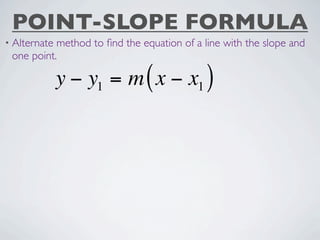
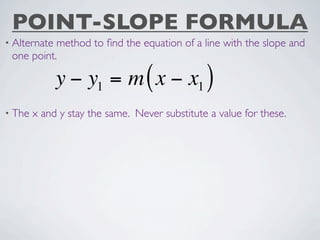
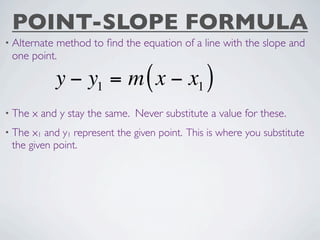
              y − y1 = m ( x − x1 )
POINT-SLOPE FORMULA
• Alternatemethod to find the equation of a line with the slope and
 one point.

              y − y1 = m ( x − x1 )
• The   x and y stay the same. Never substitute a value for these.
POINT-SLOPE FORMULA
• Alternatemethod to find the equation of a line with the slope and
 one point.

              y − y1 = m ( x − x1 )
• The   x and y stay the same. Never substitute a value for these.
• The x1 and y1 represent the given point. This is where you substitute
 the given point.
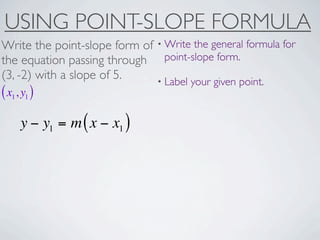
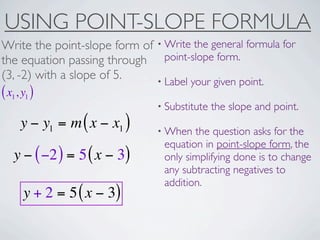
USING POINT-SLOPE FORMULA
Write the point-slope form of
the equation passing through
(3, -2) with a slope of 5.
USING POINT-SLOPE FORMULA
Write the point-slope form of • Write the general formula for
the equation passing through point-slope form.
(3, -2) with a slope of 5.
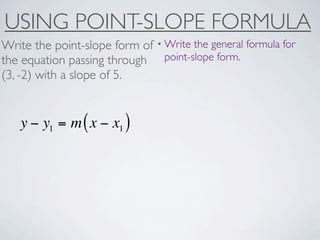
USING POINT-SLOPE FORMULA
Write the point-slope form of • Write the general formula for
the equation passing through point-slope form.
(3, -2) with a slope of 5.


   y − y1 = m ( x − x1 )
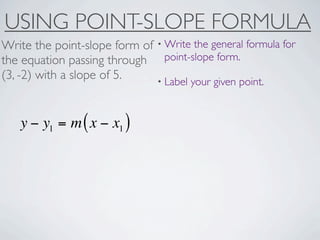
USING POINT-SLOPE FORMULA
Write the point-slope form of • Write the general formula for
the equation passing through point-slope form.
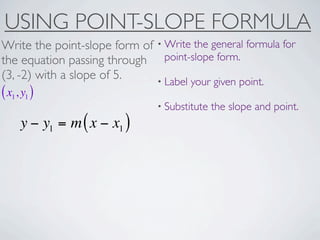
(3, -2) with a slope of 5.    • Label your given point.


   y − y1 = m ( x − x1 )
USING POINT-SLOPE FORMULA
Write the point-slope form of • Write the general formula for
the equation passing through point-slope form.
(3, -2) with a slope of 5.    • Label your given point.
( x1, y1 )
     y − y1 = m ( x − x1 )
USING POINT-SLOPE FORMULA
Write the point-slope form of • Write the general formula for
the equation passing through point-slope form.
(3, -2) with a slope of 5.    • Label your given point.
( x1, y1 )
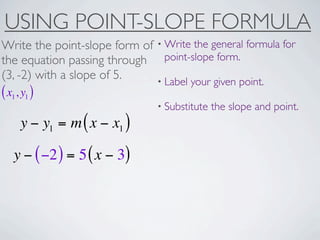
                                • Substitute   the slope and point.
     y − y1 = m ( x − x1 )
USING POINT-SLOPE FORMULA
Write the point-slope form of • Write the general formula for
the equation passing through point-slope form.
(3, -2) with a slope of 5.    • Label your given point.
( x1, y1 )
                                • Substitute   the slope and point.
     y − y1 = m ( x − x1 )

   y − ( −2 ) = 5 ( x − 3)
USING POINT-SLOPE FORMULA
Write the point-slope form of • Write the general formula for
the equation passing through point-slope form.
(3, -2) with a slope of 5.    • Label your given point.
( x1, y1 )
                                • Substitute   the slope and point.
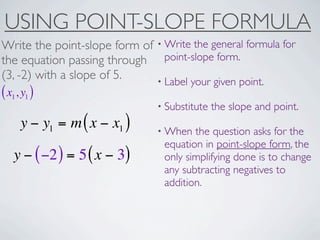
     y − y1 = m ( x − x1 )      • When  the question asks for the
                                 equation in point-slope form, the
   y − ( −2 ) = 5 ( x − 3)       only simplifying done is to change
                                 any subtracting negatives to
                                 addition.
USING POINT-SLOPE FORMULA
Write the point-slope form of • Write the general formula for
the equation passing through point-slope form.
(3, -2) with a slope of 5.    • Label your given point.
( x1, y1 )
                                • Substitute   the slope and point.
     y − y1 = m ( x − x1 )      • When  the question asks for the
                                 equation in point-slope form, the
   y − ( −2 ) = 5 ( x − 3)       only simplifying done is to change
                                 any subtracting negatives to
                                 addition.
      y + 2 = 5 ( x − 3)
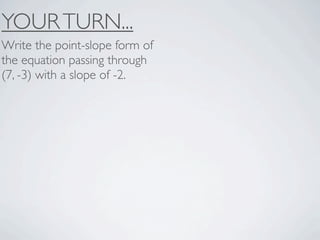
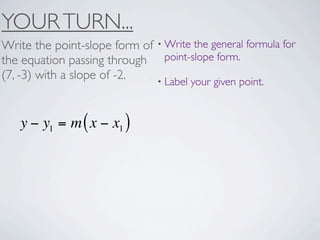
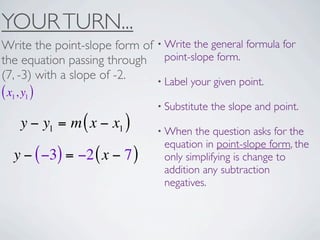
YOUR TURN...
Write the point-slope form of
the equation passing through
(7, -3) with a slope of -2.
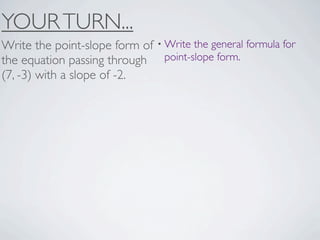
YOUR TURN...
Write the point-slope form of • Write the general formula for
the equation passing through point-slope form.
(7, -3) with a slope of -2.
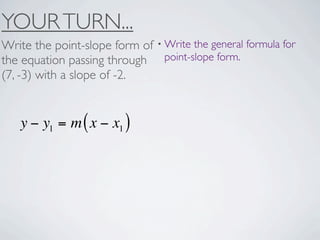
YOUR TURN...
Write the point-slope form of • Write the general formula for
the equation passing through point-slope form.
(7, -3) with a slope of -2.


   y − y1 = m ( x − x1 )
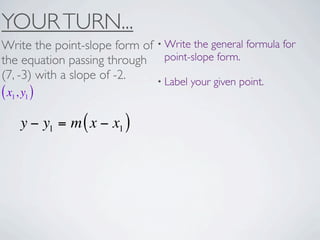
YOUR TURN...
Write the point-slope form of • Write the general formula for
the equation passing through point-slope form.
(7, -3) with a slope of -2.   • Label your given point.


   y − y1 = m ( x − x1 )
YOUR TURN...
Write the point-slope form of • Write the general formula for
the equation passing through point-slope form.
(7, -3) with a slope of -2.   • Label your given point.
( x1, y1 )
     y − y1 = m ( x − x1 )
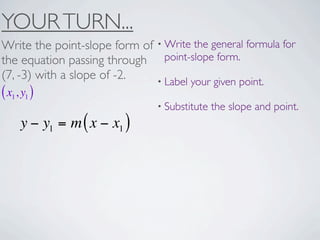
YOUR TURN...
Write the point-slope form of • Write the general formula for
the equation passing through point-slope form.
(7, -3) with a slope of -2.   • Label your given point.
( x1, y1 )
                                • Substitute   the slope and point.
     y − y1 = m ( x − x1 )
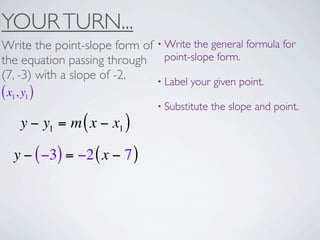
YOUR TURN...
Write the point-slope form of • Write the general formula for
the equation passing through point-slope form.
(7, -3) with a slope of -2.   • Label your given point.
( x1, y1 )
                                • Substitute   the slope and point.
     y − y1 = m ( x − x1 )

   y − ( −3) = −2 ( x − 7 )
YOUR TURN...
Write the point-slope form of • Write the general formula for
the equation passing through point-slope form.
(7, -3) with a slope of -2.   • Label your given point.
( x1, y1 )
                                • Substitute   the slope and point.
     y − y1 = m ( x − x1 )      • When  the question asks for the
                                 equation in point-slope form, the
   y − ( −3) = −2 ( x − 7 )      only simplifying is change to
                                 addition any subtraction
                                 negatives.
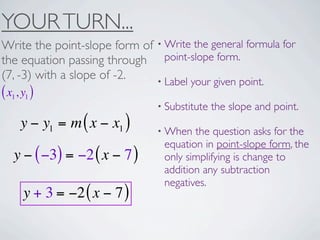
YOUR TURN...
Write the point-slope form of • Write the general formula for
the equation passing through point-slope form.
(7, -3) with a slope of -2.   • Label your given point.
( x1, y1 )
                                • Substitute   the slope and point.
     y − y1 = m ( x − x1 )      • When  the question asks for the
                                 equation in point-slope form, the
   y − ( −3) = −2 ( x − 7 )      only simplifying is change to
                                 addition any subtraction
                                 negatives.
      y + 3 = −2 ( x − 7 )
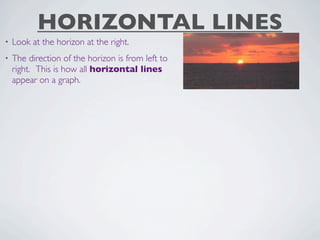
HORIZONTAL LINES
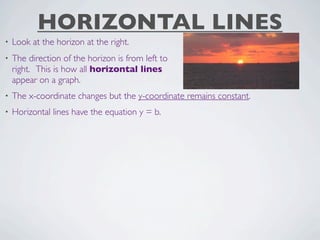
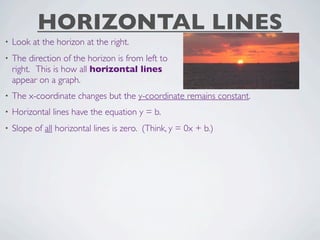
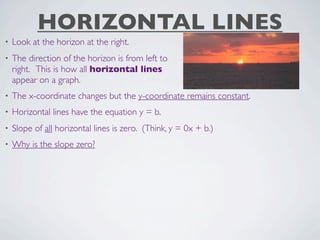
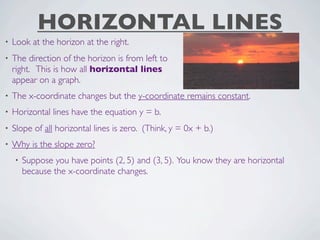
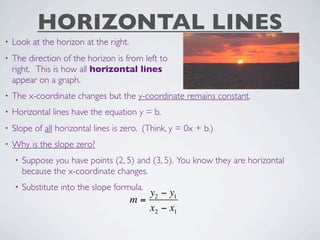
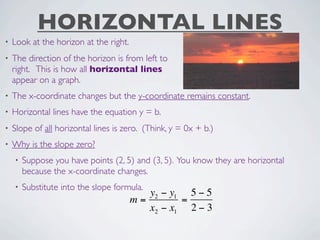
•   Look at the horizon at the right.
HORIZONTAL LINES
•   Look at the horizon at the right.
•   The direction of the horizon is from left to
    right. This is how all horizontal lines
    appear on a graph.
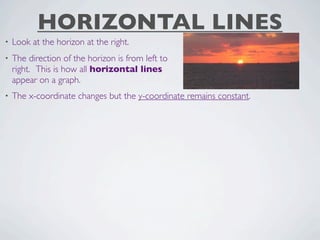
HORIZONTAL LINES
•   Look at the horizon at the right.
•   The direction of the horizon is from left to
    right. This is how all horizontal lines
    appear on a graph.
•   The x-coordinate changes but the y-coordinate remains constant.
HORIZONTAL LINES
•   Look at the horizon at the right.
•   The direction of the horizon is from left to
    right. This is how all horizontal lines
    appear on a graph.
•   The x-coordinate changes but the y-coordinate remains constant.
•   Horizontal lines have the equation y = b.
HORIZONTAL LINES
•   Look at the horizon at the right.
•   The direction of the horizon is from left to
    right. This is how all horizontal lines
    appear on a graph.
•   The x-coordinate changes but the y-coordinate remains constant.
•   Horizontal lines have the equation y = b.
•   Slope of all horizontal lines is zero. (Think, y = 0x + b.)
HORIZONTAL LINES
•   Look at the horizon at the right.
•   The direction of the horizon is from left to
    right. This is how all horizontal lines
    appear on a graph.
•   The x-coordinate changes but the y-coordinate remains constant.
•   Horizontal lines have the equation y = b.
•   Slope of all horizontal lines is zero. (Think, y = 0x + b.)
•   Why is the slope zero?
HORIZONTAL LINES
•   Look at the horizon at the right.
•   The direction of the horizon is from left to
    right. This is how all horizontal lines
    appear on a graph.
•   The x-coordinate changes but the y-coordinate remains constant.
•   Horizontal lines have the equation y = b.
•   Slope of all horizontal lines is zero. (Think, y = 0x + b.)
•   Why is the slope zero?
    •   Suppose you have points (2, 5) and (3, 5). You know they are horizontal
        because the x-coordinate changes.
HORIZONTAL LINES
•   Look at the horizon at the right.
•   The direction of the horizon is from left to
    right. This is how all horizontal lines
    appear on a graph.
•   The x-coordinate changes but the y-coordinate remains constant.
•   Horizontal lines have the equation y = b.
•   Slope of all horizontal lines is zero. (Think, y = 0x + b.)
•   Why is the slope zero?
    •   Suppose you have points (2, 5) and (3, 5). You know they are horizontal
        because the x-coordinate changes.
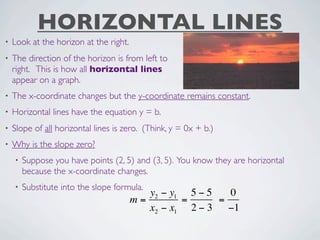
    •   Substitute into the slope formula.
                                           y2 − y1
                                        m=
                                           x2 − x1
HORIZONTAL LINES
•   Look at the horizon at the right.
•   The direction of the horizon is from left to
    right. This is how all horizontal lines
    appear on a graph.
•   The x-coordinate changes but the y-coordinate remains constant.
•   Horizontal lines have the equation y = b.
•   Slope of all horizontal lines is zero. (Think, y = 0x + b.)
•   Why is the slope zero?
    •   Suppose you have points (2, 5) and (3, 5). You know they are horizontal
        because the x-coordinate changes.
    •   Substitute into the slope formula.
                                           y2 − y1 5 − 5
                                        m=        =
                                           x2 − x1 2 − 3
HORIZONTAL LINES
•   Look at the horizon at the right.
•   The direction of the horizon is from left to
    right. This is how all horizontal lines
    appear on a graph.
•   The x-coordinate changes but the y-coordinate remains constant.
•   Horizontal lines have the equation y = b.
•   Slope of all horizontal lines is zero. (Think, y = 0x + b.)
•   Why is the slope zero?
    •   Suppose you have points (2, 5) and (3, 5). You know they are horizontal
        because the x-coordinate changes.
    •   Substitute into the slope formula.
                                           y2 − y1 5 − 5   0
                                        m=        =      =
                                           x2 − x1 2 − 3   −1
HORIZONTAL LINES
•   Look at the horizon at the right.
•   The direction of the horizon is from left to
    right. This is how all horizontal lines
    appear on a graph.
•   The x-coordinate changes but the y-coordinate remains constant.
•   Horizontal lines have the equation y = b.
•   Slope of all horizontal lines is zero. (Think, y = 0x + b.)
•   Why is the slope zero?
    •   Suppose you have points (2, 5) and (3, 5). You know they are horizontal
        because the x-coordinate changes.
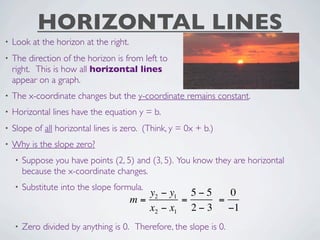
    •   Substitute into the slope formula.
                                           y2 − y1 5 − 5   0
                                        m=        =      =
                                           x2 − x1 2 − 3   −1
    •   Zero divided by anything is 0. Therefore, the slope is 0.
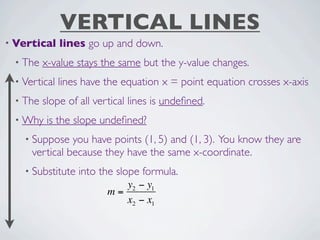
VERTICAL LINES
• Vertical   lines go up and down.
VERTICAL LINES
• Vertical   lines go up and down.
 • The   x-value stays the same but the y-value changes.
VERTICAL LINES
• Vertical    lines go up and down.
 • The   x-value stays the same but the y-value changes.
 • Vertical   lines have the equation x = point equation crosses x-axis
VERTICAL LINES
• Vertical    lines go up and down.
 • The   x-value stays the same but the y-value changes.
 • Vertical   lines have the equation x = point equation crosses x-axis
 • The   slope of all vertical lines is undefined.
VERTICAL LINES
• Vertical    lines go up and down.
 • The   x-value stays the same but the y-value changes.
 • Vertical   lines have the equation x = point equation crosses x-axis
 • The   slope of all vertical lines is undefined.
 • Why    is the slope undefined?
VERTICAL LINES
• Vertical    lines go up and down.
 • The   x-value stays the same but the y-value changes.
 • Vertical   lines have the equation x = point equation crosses x-axis
 • The   slope of all vertical lines is undefined.
 • Why    is the slope undefined?
   • Suppose   you have points (1, 5) and (1, 3). You know they are
     vertical because they have the same x-coordinate.
VERTICAL LINES
• Vertical    lines go up and down.
 • The   x-value stays the same but the y-value changes.
 • Vertical   lines have the equation x = point equation crosses x-axis
 • The   slope of all vertical lines is undefined.
 • Why    is the slope undefined?
   • Suppose   you have points (1, 5) and (1, 3). You know they are
     vertical because they have the same x-coordinate.
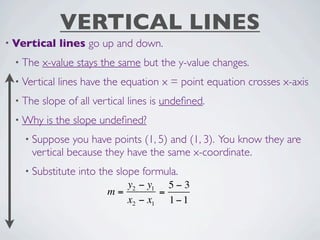
   • Substitute   into the slope formula.
                            y2 − y1
                         m=
                            x2 − x1
VERTICAL LINES
• Vertical    lines go up and down.
 • The   x-value stays the same but the y-value changes.
 • Vertical   lines have the equation x = point equation crosses x-axis
 • The   slope of all vertical lines is undefined.
 • Why    is the slope undefined?
   • Suppose   you have points (1, 5) and (1, 3). You know they are
     vertical because they have the same x-coordinate.
   • Substitute   into the slope formula.
                            y2 − y1 5 − 3
                         m=        =
                            x2 − x1 1 − 1
VERTICAL LINES
• Vertical    lines go up and down.
 • The   x-value stays the same but the y-value changes.
 • Vertical   lines have the equation x = point equation crosses x-axis
 • The   slope of all vertical lines is undefined.
 • Why    is the slope undefined?
   • Suppose   you have points (1, 5) and (1, 3). You know they are
     vertical because they have the same x-coordinate.
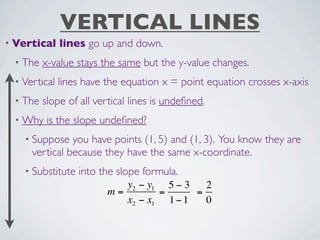
   • Substitute   into the slope formula.
                            y2 − y1 5 − 3   2
                         m=        =      =
                            x2 − x1 1 − 1   0
VERTICAL LINES
• Vertical    lines go up and down.
 • The   x-value stays the same but the y-value changes.
 • Vertical   lines have the equation x = point equation crosses x-axis
 • The   slope of all vertical lines is undefined.
 • Why    is the slope undefined?
   • Suppose   you have points (1, 5) and (1, 3). You know they are
     vertical because they have the same x-coordinate.
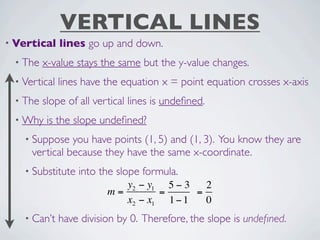
   • Substitute   into the slope formula.
                            y2 − y1 5 − 3   2
                         m=        =      =
                            x2 − x1 1 − 1   0
   • Can’t    have division by 0. Therefore, the slope is undefined.
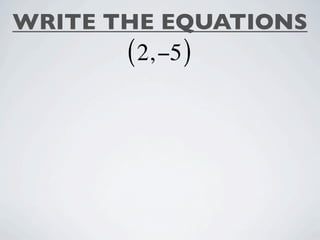
WRITE THE EQUATIONS
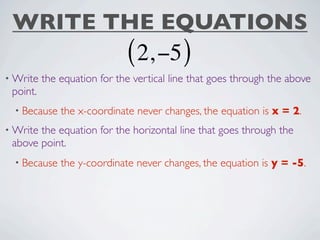
       ( 2, −5 )
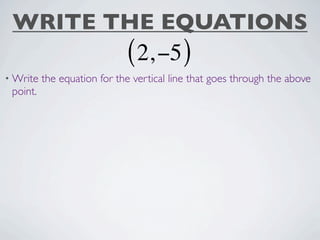
WRITE THE EQUATIONS
                             ( 2, −5 )
• Write   the equation for the vertical line that goes through the above
 point.
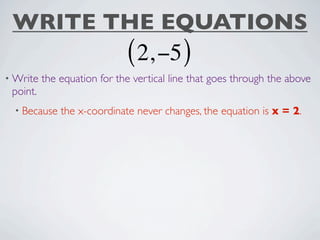
WRITE THE EQUATIONS
                             ( 2, −5 )
• Write   the equation for the vertical line that goes through the above
 point.
  • Because   the x-coordinate never changes, the equation is x = 2.
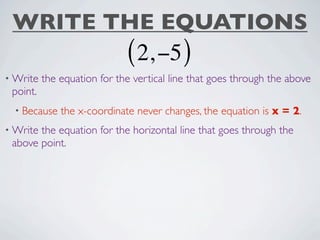
WRITE THE EQUATIONS
                             ( 2, −5 )
• Write   the equation for the vertical line that goes through the above
 point.
  • Because   the x-coordinate never changes, the equation is x = 2.
• Writethe equation for the horizontal line that goes through the
 above point.
WRITE THE EQUATIONS
                             ( 2, −5 )
• Write   the equation for the vertical line that goes through the above
 point.
  • Because   the x-coordinate never changes, the equation is x = 2.
• Writethe equation for the horizontal line that goes through the
 above point.
  • Because   the y-coordinate never changes, the equation is y = -5.
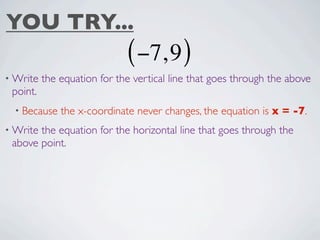
YOU TRY...
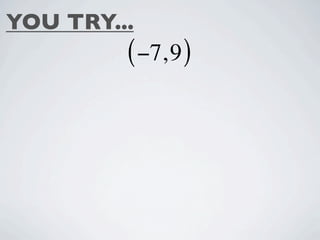
         ( −7, 9 )
YOU TRY...
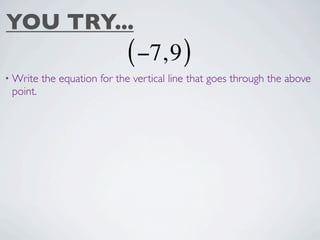
                             ( −7, 9 )
• Write   the equation for the vertical line that goes through the above
 point.
YOU TRY...
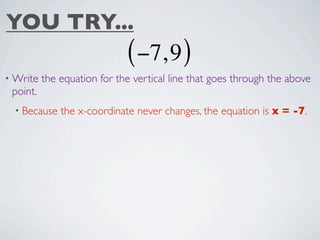
                             ( −7, 9 )
• Write   the equation for the vertical line that goes through the above
 point.
  • Because   the x-coordinate never changes, the equation is x = -7.
YOU TRY...
                             ( −7, 9 )
• Write   the equation for the vertical line that goes through the above
 point.
  • Because   the x-coordinate never changes, the equation is x = -7.
• Writethe equation for the horizontal line that goes through the
 above point.
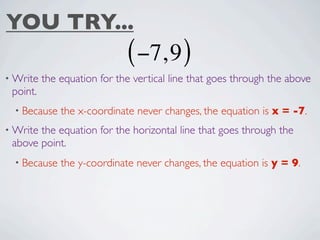
YOU TRY...
                             ( −7, 9 )
• Write   the equation for the vertical line that goes through the above
 point.
  • Because   the x-coordinate never changes, the equation is x = -7.
• Writethe equation for the horizontal line that goes through the
 above point.
  • Because   the y-coordinate never changes, the equation is y = 9.
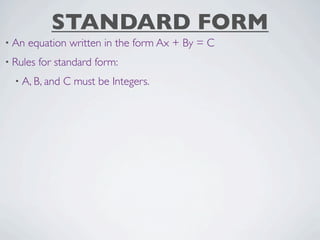
STANDARD FORM
STANDARD FORM
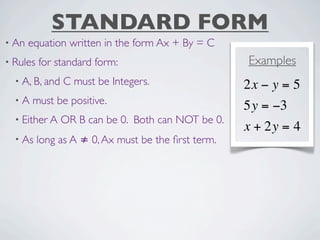
• An   equation written in the form Ax + By = C
STANDARD FORM
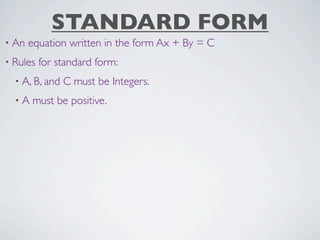
• An   equation written in the form Ax + By = C
• Rules   for standard form:
STANDARD FORM
• An   equation written in the form Ax + By = C
• Rules   for standard form:
  • A, B, and   C must be Integers.
STANDARD FORM
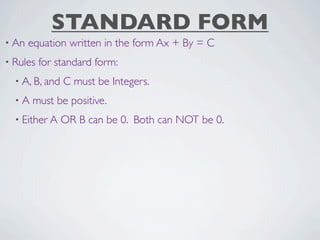
• An   equation written in the form Ax + By = C
• Rules   for standard form:
  • A, B, and   C must be Integers.
  •A   must be positive.
STANDARD FORM
• An   equation written in the form Ax + By = C
• Rules   for standard form:
  • A, B, and   C must be Integers.
  •A   must be positive.
  • Either A    OR B can be 0. Both can NOT be 0.
STANDARD FORM
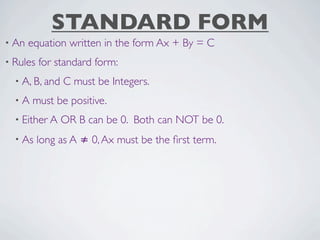
• An   equation written in the form Ax + By = C
• Rules   for standard form:
  • A, B, and   C must be Integers.
  •A   must be positive.
  • Either A    OR B can be 0. Both can NOT be 0.
  • As    long as A ≠ 0, Ax must be the first term.
STANDARD FORM
• An   equation written in the form Ax + By = C
• Rules   for standard form:                         Examples
  • A, B, and   C must be Integers.                  2x − y = 5
  •A   must be positive.
                                                     5y = −3
  • Either A    OR B can be 0. Both can NOT be 0.
                                                     x + 2y = 4
  • As    long as A ≠ 0, Ax must be the first term.
STANDARD FORM
• An   equation written in the form Ax + By = C
• Rules   for standard form:                         Examples
  • A, B, and   C must be Integers.                  2x − y = 5
  •A   must be positive.
                                                     5y = −3
  • Either A    OR B can be 0. Both can NOT be 0.
                                                     x + 2y = 4
  • As    long as A ≠ 0, Ax must be the first term.

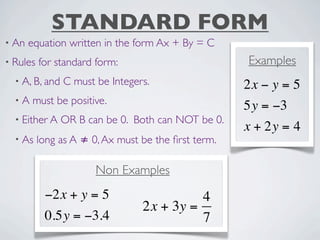
                       Non Examples
           −2x + y = 5                     4
                                 2x + 3y =
           0.5y = −3.4                     7
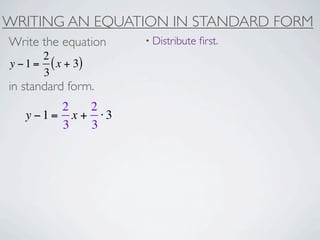
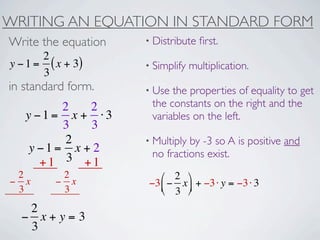
WRITING AN EQUATION IN STANDARD FORM
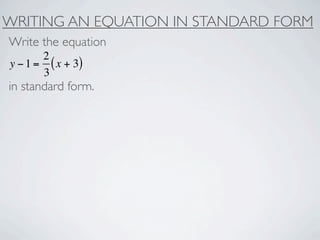
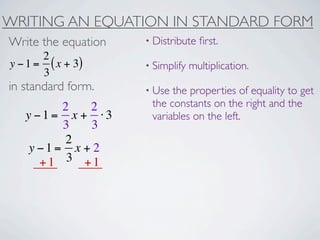
Write the equation
       2
y − 1 = ( x + 3)
       3
in standard form.
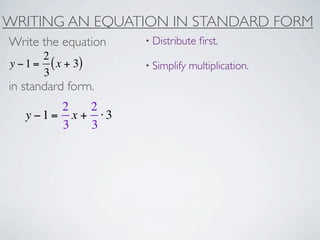
WRITING AN EQUATION IN STANDARD FORM
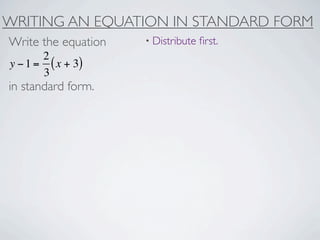
Write the equation   • Distribute   first.
       2
y − 1 = ( x + 3)
       3
in standard form.
WRITING AN EQUATION IN STANDARD FORM
Write the equation   • Distribute   first.
       2
y − 1 = ( x + 3)
       3
in standard form.
        2   2
   y −1= x + ⋅3
        3   3
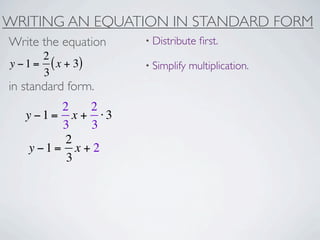
WRITING AN EQUATION IN STANDARD FORM
Write the equation   • Distribute   first.
       2
y − 1 = ( x + 3)     • Simplify   multiplication.
       3
in standard form.
        2   2
   y −1= x + ⋅3
        3   3
WRITING AN EQUATION IN STANDARD FORM
Write the equation   • Distribute   first.
       2
y − 1 = ( x + 3)     • Simplify   multiplication.
       3
in standard form.
         2   2
   y −1= x + ⋅3
         3   3
          2
    y −1= x + 2
          3
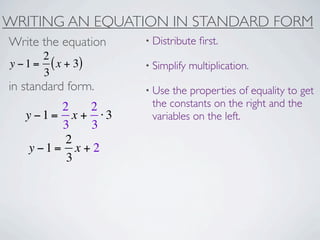
WRITING AN EQUATION IN STANDARD FORM
Write the equation   • Distribute   first.
       2
y − 1 = ( x + 3)     • Simplify   multiplication.
       3
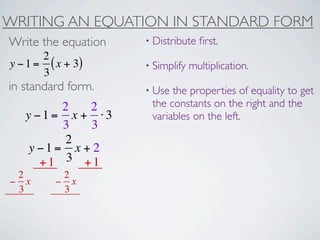
in standard form.    • Use the properties of equality to get
         2   2        the constants on the right and the
   y −1= x + ⋅3       variables on the left.
         3   3
          2
    y −1= x + 2
          3
WRITING AN EQUATION IN STANDARD FORM
Write the equation   • Distribute   first.
       2
y − 1 = ( x + 3)     • Simplify   multiplication.
       3
in standard form.    • Use the properties of equality to get
         2   2        the constants on the right and the
   y −1= x + ⋅3       variables on the left.
         3   3
          2
    y −1= x + 2
      +1 3 +1
WRITING AN EQUATION IN STANDARD FORM
Write the equation   • Distribute   first.
       2
y − 1 = ( x + 3)     • Simplify   multiplication.
       3
in standard form.    • Use the properties of equality to get
         2   2        the constants on the right and the
   y −1= x + ⋅3       variables on the left.
         3   3
          2
    y −1= x + 2
      +1 3 +1
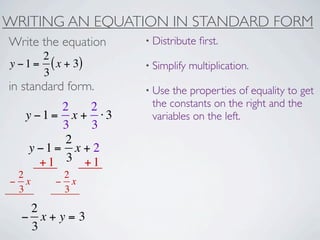
 2         2
− x       − x
 3         3
WRITING AN EQUATION IN STANDARD FORM
Write the equation   • Distribute   first.
       2
y − 1 = ( x + 3)     • Simplify   multiplication.
       3
in standard form.    • Use the properties of equality to get
         2   2        the constants on the right and the
   y −1= x + ⋅3       variables on the left.
         3   3
          2
    y −1= x + 2
      +1 3 +1
 2         2
− x       − x
 3         3
   2
  − x+y=3
   3
WRITING AN EQUATION IN STANDARD FORM
Write the equation   • Distribute   first.
       2
y − 1 = ( x + 3)     • Simplify   multiplication.
       3
in standard form.    • Use the properties of equality to get
         2   2        the constants on the right and the
   y −1= x + ⋅3       variables on the left.
         3   3
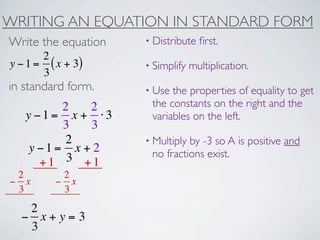
          2          • Multiplyby -3 so A is positive and
    y −1= x + 2       no fractions exist.
      +1 3 +1
 2         2
− x       − x
 3         3
   2
  − x+y=3
   3
WRITING AN EQUATION IN STANDARD FORM
Write the equation   • Distribute   first.
       2
y − 1 = ( x + 3)     • Simplify   multiplication.
       3
in standard form.    • Use the properties of equality to get
         2   2        the constants on the right and the
   y −1= x + ⋅3       variables on the left.
         3   3
          2          • Multiplyby -3 so A is positive and
    y −1= x + 2       no fractions exist.
      +1 3 +1
 2         2            ⎛ 2 ⎞
− x       − x        −3 ⎜ − x ⎟ + −3 ⋅ y = −3 ⋅ 3
 3         3            ⎝ 3 ⎠
   2
  − x+y=3
   3
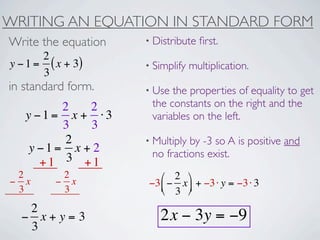
WRITING AN EQUATION IN STANDARD FORM
Write the equation   • Distribute   first.
       2
y − 1 = ( x + 3)     • Simplify   multiplication.
       3
in standard form.    • Use the properties of equality to get
         2   2        the constants on the right and the
   y −1= x + ⋅3       variables on the left.
         3   3
          2          • Multiplyby -3 so A is positive and
    y −1= x + 2       no fractions exist.
      +1 3 +1
 2         2            ⎛ 2 ⎞
− x       − x        −3 ⎜ − x ⎟ + −3 ⋅ y = −3 ⋅ 3
 3         3            ⎝ 3 ⎠
   2
  − x+y=3               2x − 3y = −9
   3
PARALLEL
• Parallel  lines are 2 lines that never
 touch. The distance between them remains
 constant forever.
PARALLEL
• Parallel   lines are 2 lines that never
  touch. The distance between them remains
  constant forever.
• Symbol used to represent: ∕∕
PARALLEL
• Parallel    lines are 2 lines that never
  touch. The distance between them remains
  constant forever.
• Symbol used to represent: ∕∕
• Real life examples...
PARALLEL
• Parallel    lines are 2 lines that never
  touch. The distance between them remains
  constant forever.
• Symbol used to represent: ∕∕
• Real life examples...
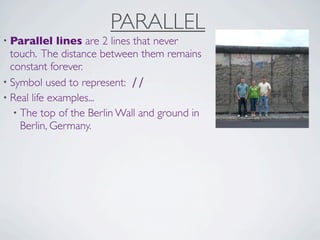
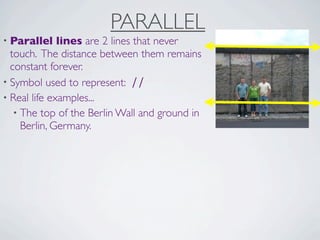
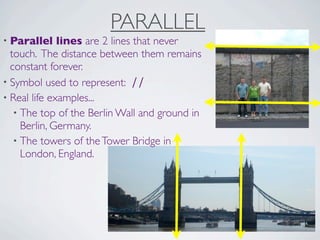
   • The top of the Berlin Wall and ground in
     Berlin, Germany.
PARALLEL
• Parallel    lines are 2 lines that never
  touch. The distance between them remains
  constant forever.
• Symbol used to represent: ∕∕
• Real life examples...
   • The top of the Berlin Wall and ground in
     Berlin, Germany.
PARALLEL
• Parallel    lines are 2 lines that never
  touch. The distance between them remains
  constant forever.
• Symbol used to represent: ∕∕
• Real life examples...
   • The top of the Berlin Wall and ground in
     Berlin, Germany.
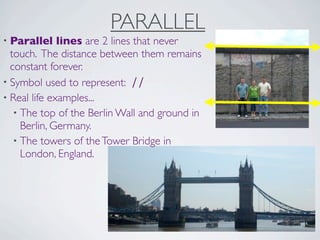
   • The towers of the Tower Bridge in
     London, England.
PARALLEL
• Parallel    lines are 2 lines that never
  touch. The distance between them remains
  constant forever.
• Symbol used to represent: ∕∕
• Real life examples...
   • The top of the Berlin Wall and ground in
     Berlin, Germany.
   • The towers of the Tower Bridge in
     London, England.
PERPENDICULAR
• Perpendicular      lines are 2 lines
 that intersect at a 90 degree angle.
PERPENDICULAR
• Perpendicular       lines are 2 lines
  that intersect at a 90 degree angle.
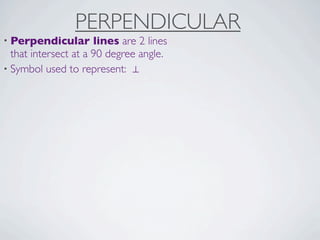
• Symbol used to represent: ⊥
PERPENDICULAR
• Perpendicular       lines are 2 lines
  that intersect at a 90 degree angle.
• Symbol used to represent: ⊥
• Real life examples...
PERPENDICULAR
• Perpendicular       lines are 2 lines
  that intersect at a 90 degree angle.
• Symbol used to represent: ⊥
• Real life examples...
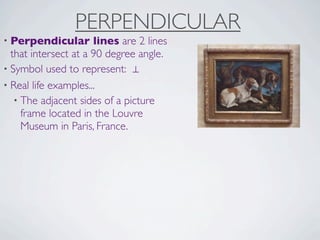
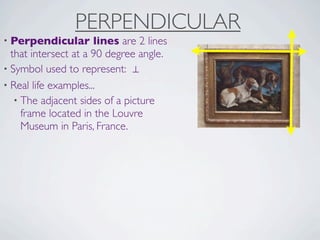
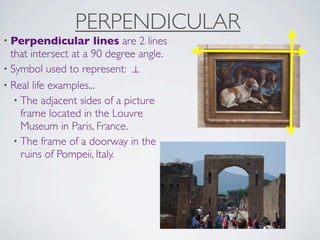
   • The adjacent sides of a picture
     frame located in the Louvre
     Museum in Paris, France.
PERPENDICULAR
• Perpendicular       lines are 2 lines
  that intersect at a 90 degree angle.
• Symbol used to represent: ⊥
• Real life examples...
   • The adjacent sides of a picture
     frame located in the Louvre
     Museum in Paris, France.
PERPENDICULAR
• Perpendicular       lines are 2 lines
  that intersect at a 90 degree angle.
• Symbol used to represent: ⊥
• Real life examples...
   • The adjacent sides of a picture
     frame located in the Louvre
     Museum in Paris, France.
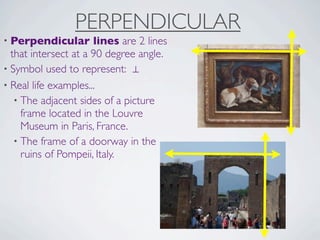
   • The frame of a doorway in the
     ruins of Pompeii, Italy.
PERPENDICULAR
• Perpendicular       lines are 2 lines
  that intersect at a 90 degree angle.
• Symbol used to represent: ⊥
• Real life examples...
   • The adjacent sides of a picture
     frame located in the Louvre
     Museum in Paris, France.
   • The frame of a doorway in the
     ruins of Pompeii, Italy.
EXPLORATION ON GRAPHING CALCULATOR
• Parallel lines and Perpendicular lines can be VERY
 deceiving on a graphing calculator.
EXPLORATION ON GRAPHING CALCULATOR
• Parallel lines and Perpendicular lines can be VERY
 deceiving on a graphing calculator.
• Enter
     these 2 equations in y= and graph on a standard window
 (Zoom - 6:ZStandard)
  •   y1 = .1x - 3
  •   y2 = .11x + 3
EXPLORATION ON GRAPHING CALCULATOR
• Parallel lines and Perpendicular lines can be VERY
 deceiving on a graphing calculator.
• Enter
     these 2 equations in y= and graph on a standard window
 (Zoom - 6:ZStandard)
  •   y1 = .1x - 3
  •   y2 = .11x + 3
• Are   these parallel, perpendicular or neither based on the screen?
EXPLORATION ON GRAPHING CALCULATOR
• Parallel lines and Perpendicular lines can be VERY
 deceiving on a graphing calculator.
• Enter
     these 2 equations in y= and graph on a standard window
 (Zoom - 6:ZStandard)
  •   y1 = .1x - 3
  •   y2 = .11x + 3
• Are   these parallel, perpendicular or neither based on the screen?
• Do    the same with these equations.
  •   y1 = 1.9x - 3
  •   y2 = -1.2x - 3
EXPLORATION ON GRAPHING CALCULATOR
• Parallel lines and Perpendicular lines can be VERY
 deceiving on a graphing calculator.
• Enter
     these 2 equations in y= and graph on a standard window
 (Zoom - 6:ZStandard)
  •   y1 = .1x - 3
  •   y2 = .11x + 3
• Are   these parallel, perpendicular or neither based on the screen?
• Do    the same with these equations.
  •   y1 = 1.9x - 3
  •   y2 = -1.2x - 3
• Keep    your answers because you will need them shortly!
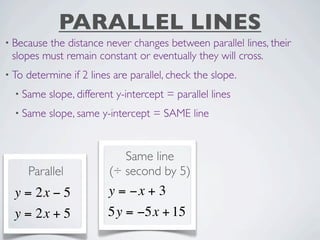
PARALLEL LINES
• Becausethe distance never changes between parallel lines, their
 slopes must remain constant or eventually they will cross.
PARALLEL LINES
• Becausethe distance never changes between parallel lines, their
 slopes must remain constant or eventually they will cross.
• To   determine if 2 lines are parallel, check the slope.
PARALLEL LINES
• Becausethe distance never changes between parallel lines, their
 slopes must remain constant or eventually they will cross.
• To   determine if 2 lines are parallel, check the slope.
  • Same    slope, different y-intercept = parallel lines
PARALLEL LINES
• Becausethe distance never changes between parallel lines, their
 slopes must remain constant or eventually they will cross.
• To   determine if 2 lines are parallel, check the slope.
  • Same    slope, different y-intercept = parallel lines


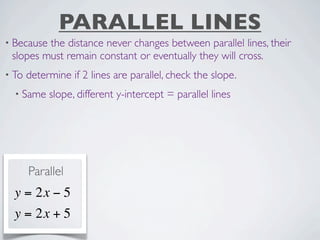
       Parallel
  y = 2x − 5
  y = 2x + 5
PARALLEL LINES
• Becausethe distance never changes between parallel lines, their
 slopes must remain constant or eventually they will cross.
• To   determine if 2 lines are parallel, check the slope.
  • Same    slope, different y-intercept = parallel lines
  • Same    slope, same y-intercept = SAME line


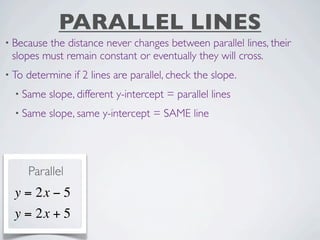
       Parallel
  y = 2x − 5
  y = 2x + 5
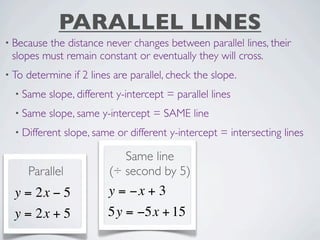
PARALLEL LINES
• Becausethe distance never changes between parallel lines, their
 slopes must remain constant or eventually they will cross.
• To   determine if 2 lines are parallel, check the slope.
  • Same    slope, different y-intercept = parallel lines
  • Same    slope, same y-intercept = SAME line


                              Same line
       Parallel            (÷ second by 5)
  y = 2x − 5              y = −x + 3
  y = 2x + 5              5y = −5x + 15
PARALLEL LINES
• Becausethe distance never changes between parallel lines, their
 slopes must remain constant or eventually they will cross.
• To   determine if 2 lines are parallel, check the slope.
  • Same    slope, different y-intercept = parallel lines
  • Same    slope, same y-intercept = SAME line
  • Different     slope, same or different y-intercept = intersecting lines

                               Same line
       Parallel             (÷ second by 5)
  y = 2x − 5                y = −x + 3
  y = 2x + 5                5y = −5x + 15
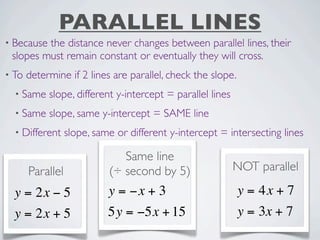
PARALLEL LINES
• Becausethe distance never changes between parallel lines, their
 slopes must remain constant or eventually they will cross.
• To   determine if 2 lines are parallel, check the slope.
  • Same    slope, different y-intercept = parallel lines
  • Same    slope, same y-intercept = SAME line
  • Different     slope, same or different y-intercept = intersecting lines

                               Same line
       Parallel             (÷ second by 5)                 NOT parallel

  y = 2x − 5                y = −x + 3                       y = 4x + 7
  y = 2x + 5                5y = −5x + 15                    y = 3x + 7
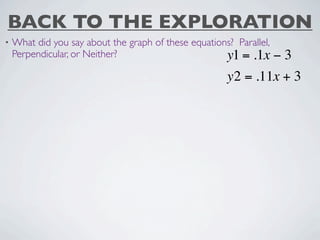
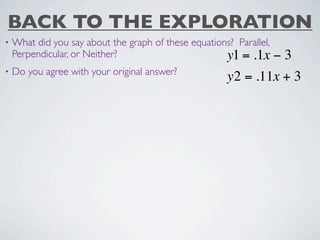
BACK TO THE EXPLORATION
•   What did you say about the graph of these equations? Parallel,
    Perpendicular, or Neither?                        y1 = .1x −3
                                                       y2 = .11x + 3
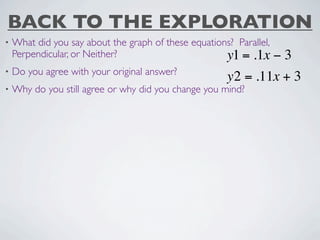
BACK TO THE EXPLORATION
•   What did you say about the graph of these equations? Parallel,
    Perpendicular, or Neither?                        y1 = .1x −3
•   Do you agree with your original answer?
                                                       y2 = .11x + 3
BACK TO THE EXPLORATION
•   What did you say about the graph of these equations? Parallel,
    Perpendicular, or Neither?                        y1 = .1x −3
•   Do you agree with your original answer?
                                                       y2 = .11x + 3
•   Why do you still agree or why did you change you mind?
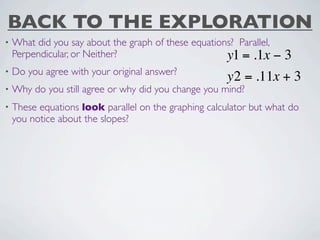
BACK TO THE EXPLORATION
•   What did you say about the graph of these equations? Parallel,
    Perpendicular, or Neither?                        y1 = .1x −3
•   Do you agree with your original answer?
                                                       y2 = .11x + 3
•   Why do you still agree or why did you change you mind?
•   These equations look parallel on the graphing calculator but what do
    you notice about the slopes?
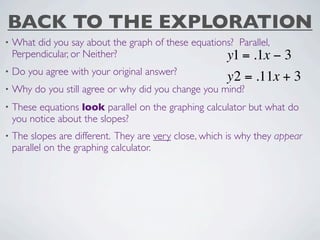
BACK TO THE EXPLORATION
•   What did you say about the graph of these equations? Parallel,
    Perpendicular, or Neither?                        y1 = .1x  −3
•   Do you agree with your original answer?
                                                        y2 = .11x + 3
•   Why do you still agree or why did you change you mind?
•   These equations look parallel on the graphing calculator but what do
    you notice about the slopes?
•   The slopes are different. They are very close, which is why they appear
    parallel on the graphing calculator.
BACK TO THE EXPLORATION
•   What did you say about the graph of these equations? Parallel,
    Perpendicular, or Neither?                        y1 = .1x  −3
•   Do you agree with your original answer?
                                                        y2 = .11x + 3
•   Why do you still agree or why did you change you mind?
•   These equations look parallel on the graphing calculator but what do
    you notice about the slopes?
•   The slopes are different. They are very close, which is why they appear
    parallel on the graphing calculator.
•   Change your window settings to Xmin=-1100, Xmax=5, Ymin=-100,
    Ymax=5 and graph the 2 equations again.
BACK TO THE EXPLORATION
•   What did you say about the graph of these equations? Parallel,
    Perpendicular, or Neither?                        y1 = .1x  −3
•   Do you agree with your original answer?
                                                        y2 = .11x + 3
•   Why do you still agree or why did you change you mind?
•   These equations look parallel on the graphing calculator but what do
    you notice about the slopes?
•   The slopes are different. They are very close, which is why they appear
    parallel on the graphing calculator.
•   Change your window settings to Xmin=-1100, Xmax=5, Ymin=-100,
    Ymax=5 and graph the 2 equations again.
•   Can you see the lines intersect now?
BACK TO THE EXPLORATION
•   What did you say about the graph of these equations? Parallel,
    Perpendicular, or Neither?                        y1 = .1x     −3
•   Do you agree with your original answer?
                                                           y2 = .11x + 3
•   Why do you still agree or why did you change you mind?
•   These equations look parallel on the graphing calculator but what do
    you notice about the slopes?
•   The slopes are different. They are very close, which is why they appear
    parallel on the graphing calculator.
•   Change your window settings to Xmin=-1100, Xmax=5, Ymin=-100,
    Ymax=5 and graph the 2 equations again.
•   Can you see the lines intersect now?
•   The Window setting is crucial to “seeing” if the equations are parallel. It is
    easier to determine parallel lines by comparing the slopes.
PERPENDICULAR LINES
• Stand up nice and tall. What do you notice about your body in
 relation to the floor? Are you parallel or perpendicular with the floor?
PERPENDICULAR LINES
• Stand up nice and tall. What do you notice about your body in
 relation to the floor? Are you parallel or perpendicular with the floor?
• Foryou to be parallel, you must lay your body on the floor. (This
 change is called a “rotation” in math.) Standing you meet the floor at
 a 90 degree angle so the “rotation” would be 90 degrees for you to
 be parallel to the floor.
PERPENDICULAR LINES
• Stand up nice and tall. What do you notice about your body in
 relation to the floor? Are you parallel or perpendicular with the floor?
• Foryou to be parallel, you must lay your body on the floor. (This
 change is called a “rotation” in math.) Standing you meet the floor at
 a 90 degree angle so the “rotation” would be 90 degrees for you to
 be parallel to the floor.
• Draw a coordinate plane on your paper. Place 2 pencils on the graph
 so they cross with a 90 degree angle. Don’t place them vertical and
 horizontal on the coordinate plane because these are a special case
 but do move them around maintaining the 90 degree angle.
PERPENDICULAR LINES
• Stand up nice and tall. What do you notice about your body in
 relation to the floor? Are you parallel or perpendicular with the floor?
• Foryou to be parallel, you must lay your body on the floor. (This
 change is called a “rotation” in math.) Standing you meet the floor at
 a 90 degree angle so the “rotation” would be 90 degrees for you to
 be parallel to the floor.
• Draw a coordinate plane on your paper. Place 2 pencils on the graph
 so they cross with a 90 degree angle. Don’t place them vertical and
 horizontal on the coordinate plane because these are a special case
 but do move them around maintaining the 90 degree angle.
• What did you notice about the slopes of the pencils? Both positive?
 Both negative? One of each? ...
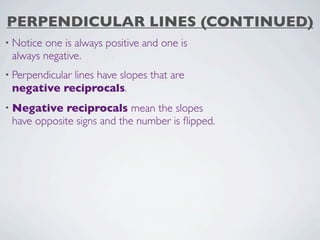
PERPENDICULAR LINES (CONTINUED)
• Noticeone is always positive and one is
 always negative.
PERPENDICULAR LINES (CONTINUED)
• Noticeone is always positive and one is
 always negative.
• Perpendicular
            lines have slopes that are
 negative reciprocals.
PERPENDICULAR LINES (CONTINUED)
• Noticeone is always positive and one is
 always negative.
• Perpendicular
            lines have slopes that are
 negative reciprocals.
• Negative   reciprocals mean the slopes
 have opposite signs and the number is flipped.
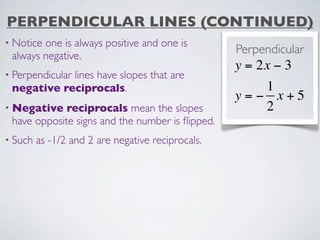
PERPENDICULAR LINES (CONTINUED)
• Noticeone is always positive and one is
 always negative.
                                                   Perpendicular
                                                   y = 2x − 3
• Perpendicular
            lines have slopes that are
 negative reciprocals.                                1
                                                   y=− x+5
• Negative   reciprocals mean the slopes              2
 have opposite signs and the number is flipped.
• Such   as -1/2 and 2 are negative reciprocals.
PERPENDICULAR LINES (CONTINUED)
• Noticeone is always positive and one is
 always negative.
                                                   Perpendicular
                                                   y = 2x − 3
• Perpendicular
            lines have slopes that are
 negative reciprocals.                                1
                                                   y=− x+5
• Negative   reciprocals mean the slopes              2
 have opposite signs and the number is flipped.
• Such   as -1/2 and 2 are negative reciprocals.
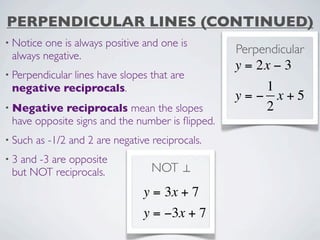
•3 and -3 are opposite
 but NOT reciprocals.               NOT ⊥
                                  y = 3x + 7
                                  y = −3x + 7
PERPENDICULAR LINES (CONTINUED)
• Noticeone is always positive and one is
 always negative.
                                                   Perpendicular
                                                   y = 2x − 3
• Perpendicular
            lines have slopes that are
 negative reciprocals.                                1
                                                   y=− x+5
• Negative   reciprocals mean the slopes              2
 have opposite signs and the number is flipped.
• Such   as -1/2 and 2 are negative reciprocals.
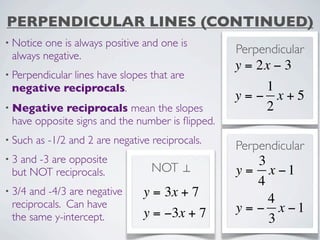
                                                   Perpendicular
•3 and -3 are opposite                                 3
 but NOT reciprocals.               NOT ⊥          y = x −1
                                                       4
• 3/4and -4/3 are negative        y = 3x + 7
 reciprocals. Can have                                   4
                                  y = −3x + 7      y = − x −1
 the same y-intercept.                                   3
BACK TO THE EXPLORATION
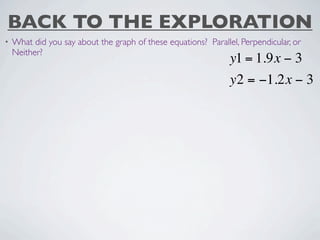
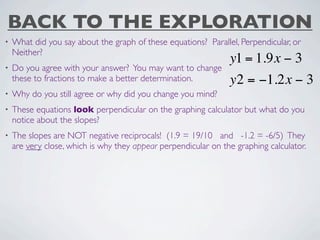
•   What did you say about the graph of these equations? Parallel, Perpendicular, or
    Neither?
                                                                y1 = 1.9x − 3
                                                                y2 = −1.2x − 3
BACK TO THE EXPLORATION
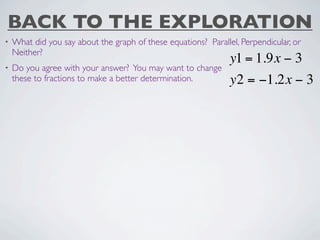
•   What did you say about the graph of these equations? Parallel, Perpendicular, or
    Neither?
                                                                y1 = 1.9x − 3
•   Do you agree with your answer? You may want to change
    these to fractions to make a better determination.          y2 = −1.2x − 3
BACK TO THE EXPLORATION
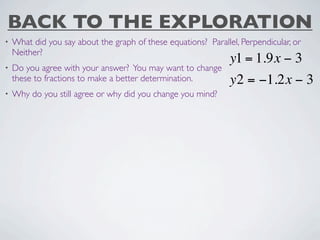
•   What did you say about the graph of these equations? Parallel, Perpendicular, or
    Neither?
                                                                y1 = 1.9x − 3
•   Do you agree with your answer? You may want to change
    these to fractions to make a better determination.          y2 = −1.2x − 3
•   Why do you still agree or why did you change you mind?
BACK TO THE EXPLORATION
•   What did you say about the graph of these equations? Parallel, Perpendicular, or
    Neither?
                                                                y1 = 1.9x − 3
•   Do you agree with your answer? You may want to change
    these to fractions to make a better determination.          y2 = −1.2x − 3
•   Why do you still agree or why did you change you mind?
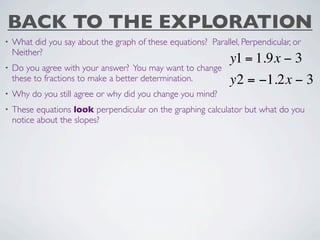
•   These equations look perpendicular on the graphing calculator but what do you
    notice about the slopes?
BACK TO THE EXPLORATION
•   What did you say about the graph of these equations? Parallel, Perpendicular, or
    Neither?
                                                                y1 = 1.9x − 3
•   Do you agree with your answer? You may want to change
    these to fractions to make a better determination.          y2 = −1.2x − 3
•   Why do you still agree or why did you change you mind?
•   These equations look perpendicular on the graphing calculator but what do you
    notice about the slopes?
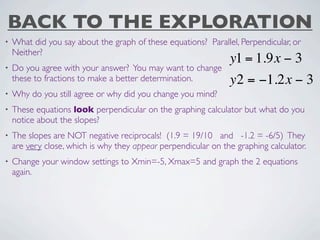
•   The slopes are NOT negative reciprocals! (1.9 = 19/10 and -1.2 = -6/5) They
    are very close, which is why they appear perpendicular on the graphing calculator.
BACK TO THE EXPLORATION
•   What did you say about the graph of these equations? Parallel, Perpendicular, or
    Neither?
                                                                y1 = 1.9x − 3
•   Do you agree with your answer? You may want to change
    these to fractions to make a better determination.          y2 = −1.2x − 3
•   Why do you still agree or why did you change you mind?
•   These equations look perpendicular on the graphing calculator but what do you
    notice about the slopes?
•   The slopes are NOT negative reciprocals! (1.9 = 19/10 and -1.2 = -6/5) They
    are very close, which is why they appear perpendicular on the graphing calculator.
•   Change your window settings to Xmin=-5, Xmax=5 and graph the 2 equations
    again.
BACK TO THE EXPLORATION
•   What did you say about the graph of these equations? Parallel, Perpendicular, or
    Neither?
                                                                y1 = 1.9x − 3
•   Do you agree with your answer? You may want to change
    these to fractions to make a better determination.          y2 = −1.2x − 3
•   Why do you still agree or why did you change you mind?
•   These equations look perpendicular on the graphing calculator but what do you
    notice about the slopes?
•   The slopes are NOT negative reciprocals! (1.9 = 19/10 and -1.2 = -6/5) They
    are very close, which is why they appear perpendicular on the graphing calculator.
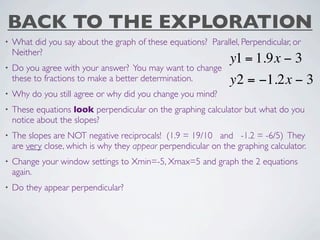
•   Change your window settings to Xmin=-5, Xmax=5 and graph the 2 equations
    again.
•   Do they appear perpendicular?
BACK TO THE EXPLORATION
•   What did you say about the graph of these equations? Parallel, Perpendicular, or
    Neither?
                                                                  y1 = 1.9x − 3
•   Do you agree with your answer? You may want to change
    these to fractions to make a better determination.            y2 = −1.2x − 3
•   Why do you still agree or why did you change you mind?
•   These equations look perpendicular on the graphing calculator but what do you
    notice about the slopes?
•   The slopes are NOT negative reciprocals! (1.9 = 19/10 and -1.2 = -6/5) They
    are very close, which is why they appear perpendicular on the graphing calculator.
•   Change your window settings to Xmin=-5, Xmax=5 and graph the 2 equations
    again.
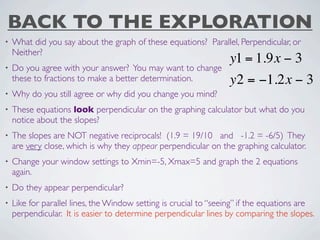
•   Do they appear perpendicular?
•   Like for parallel lines, the Window setting is crucial to “seeing” if the equations are
    perpendicular. It is easier to determine perpendicular lines by comparing the slopes.
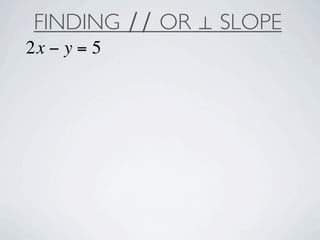
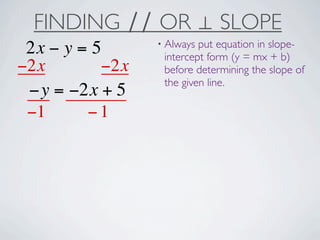
FINDING ∕∕ OR ⊥ SLOPE
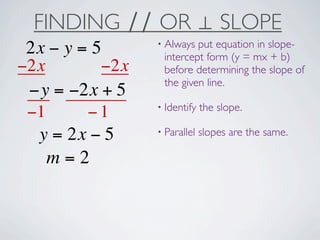
2x − y = 5
FINDING ∕∕ OR ⊥ SLOPE
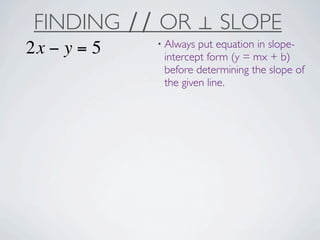
             • Always put equation in slope-
2x − y = 5    intercept form (y = mx + b)
              before determining the slope of
              the given line.
FINDING ∕∕ OR ⊥ SLOPE
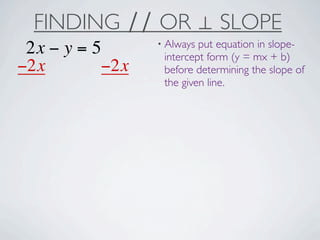
                 • Always put equation in slope-
 2x − y = 5       intercept form (y = mx + b)
−2x        −2x    before determining the slope of
                  the given line.
FINDING ∕∕ OR ⊥ SLOPE
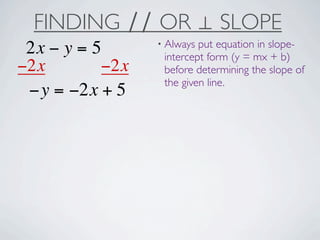
                 • Always put equation in slope-
 2x − y = 5       intercept form (y = mx + b)
−2x        −2x    before determining the slope of
                  the given line.
 −y = −2x + 5
FINDING ∕∕ OR ⊥ SLOPE
                 • Always put equation in slope-
 2x − y = 5       intercept form (y = mx + b)
−2x        −2x    before determining the slope of
                  the given line.
 −y = −2x + 5
 −1      −1
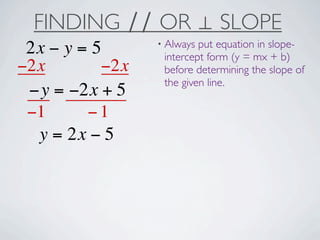
FINDING ∕∕ OR ⊥ SLOPE
                 • Always put equation in slope-
 2x − y = 5       intercept form (y = mx + b)
−2x        −2x    before determining the slope of
                  the given line.
 −y = −2x + 5
 −1      −1
  y = 2x − 5
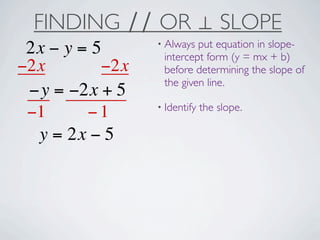
FINDING ∕∕ OR ⊥ SLOPE
                 • Always put equation in slope-
 2x − y = 5       intercept form (y = mx + b)
−2x        −2x    before determining the slope of
                  the given line.
 −y = −2x + 5
                 • Identify   the slope.
 −1      −1
  y = 2x − 5
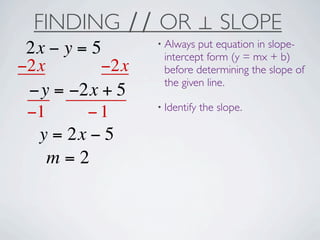
FINDING ∕∕ OR ⊥ SLOPE
                 • Always put equation in slope-
 2x − y = 5       intercept form (y = mx + b)
−2x        −2x    before determining the slope of
                  the given line.
 −y = −2x + 5
                 • Identify   the slope.
 −1      −1
  y = 2x − 5
    m=2
FINDING ∕∕ OR ⊥ SLOPE
                 • Always put equation in slope-
 2x − y = 5       intercept form (y = mx + b)
−2x        −2x    before determining the slope of
                  the given line.
 −y = −2x + 5
                 • Identify   the slope.
 −1      −1
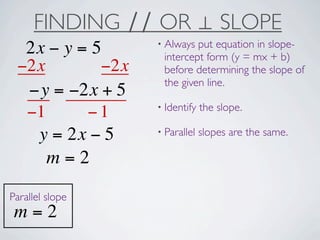
                 • Parallel   slopes are the same.
  y = 2x − 5
    m=2
FINDING ∕∕ OR ⊥ SLOPE
                  • Always put equation in slope-
  2x − y = 5       intercept form (y = mx + b)
 −2x        −2x    before determining the slope of
                   the given line.
  −y = −2x + 5
                  • Identify   the slope.
  −1      −1
                  • Parallel   slopes are the same.
   y = 2x − 5
     m=2
Parallel slope
 m=2
FINDING ∕∕ OR ⊥ SLOPE
                  • Always put equation in slope-
  2x − y = 5       intercept form (y = mx + b)
 −2x        −2x    before determining the slope of
                   the given line.
  −y = −2x + 5
                  • Identify   the slope.
  −1      −1
                  • Parallel   slopes are the same.
   y = 2x − 5
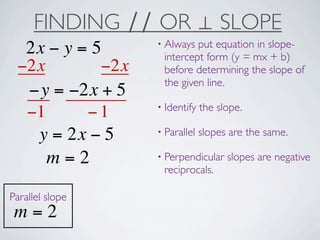
     m=2          • Perpendicular    slopes are negative
                   reciprocals.

Parallel slope
 m=2
FINDING ∕∕ OR ⊥ SLOPE
                                • Always  put equation in slope-
  2x − y = 5                      intercept form (y = mx + b)
 −2x        −2x                   before determining the slope of
                                  the given line.
  −y = −2x + 5
                                • Identify   the slope.
  −1      −1
                                • Parallel   slopes are the same.
   y = 2x − 5
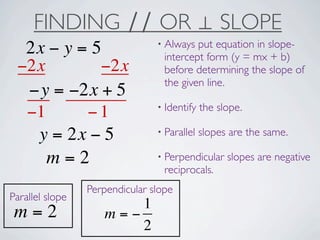
     m=2                        • Perpendicular    slopes are negative
                                  reciprocals.
                 Perpendicular slope
Parallel slope
                        1
 m=2                m=−
                        2
YOUR TURN TO FIND ∕∕ & ⊥ SLOPE...
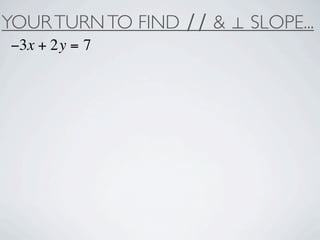
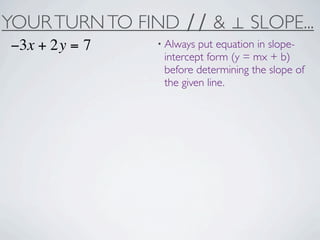
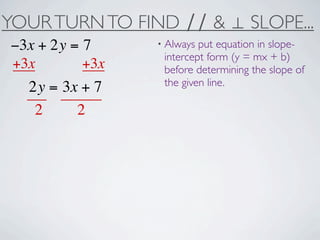
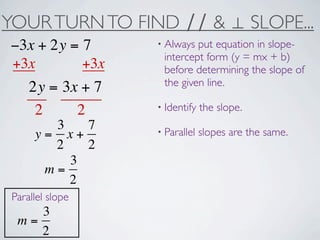
−3x + 2y = 7
YOUR TURN TO FIND ∕∕ & ⊥ SLOPE...
−3x + 2y = 7    • Always put equation in slope-
                 intercept form (y = mx + b)
                 before determining the slope of
                 the given line.
YOUR TURN TO FIND ∕∕ & ⊥ SLOPE...
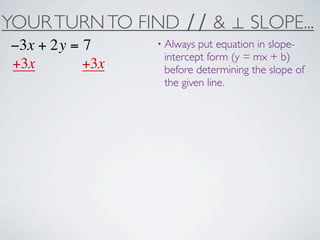
−3x + 2y = 7     • Always put equation in slope-
                  intercept form (y = mx + b)
+3x        +3x    before determining the slope of
                  the given line.
YOUR TURN TO FIND ∕∕ & ⊥ SLOPE...
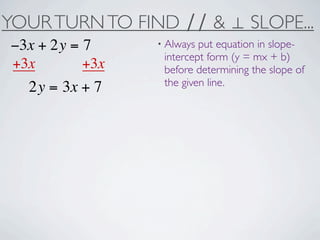
−3x + 2y = 7     • Always put equation in slope-
                  intercept form (y = mx + b)
+3x        +3x    before determining the slope of
                  the given line.
  2y = 3x + 7
YOUR TURN TO FIND ∕∕ & ⊥ SLOPE...
−3x + 2y = 7     • Always put equation in slope-
                  intercept form (y = mx + b)
+3x        +3x    before determining the slope of
                  the given line.
  2y = 3x + 7
   2     2
YOUR TURN TO FIND ∕∕ & ⊥ SLOPE...
−3x + 2y = 7     • Always put equation in slope-
                  intercept form (y = mx + b)
+3x        +3x    before determining the slope of
                  the given line.
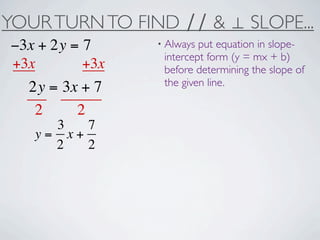
  2y = 3x + 7
   2     2
     3   7
   y= x+
     2   2
YOUR TURN TO FIND ∕∕ & ⊥ SLOPE...
−3x + 2y = 7     • Always put equation in slope-
                  intercept form (y = mx + b)
+3x        +3x    before determining the slope of
                  the given line.
  2y = 3x + 7
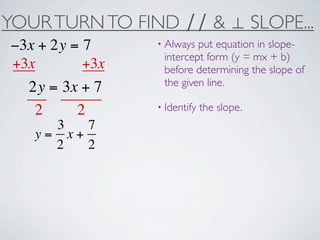
   2     2       • Identify   the slope.
     3   7
   y= x+
     2   2
YOUR TURN TO FIND ∕∕ & ⊥ SLOPE...
−3x + 2y = 7     • Always put equation in slope-
                  intercept form (y = mx + b)
+3x        +3x    before determining the slope of
                  the given line.
  2y = 3x + 7
   2     2       • Identify   the slope.
     3   7
   y= x+
     2   2
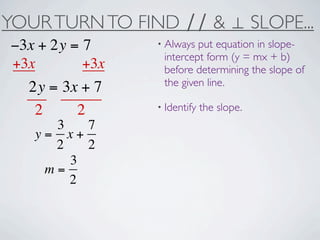
       3
    m=
       2
YOUR TURN TO FIND ∕∕ & ⊥ SLOPE...
−3x + 2y = 7       • Always put equation in slope-
                    intercept form (y = mx + b)
+3x        +3x      before determining the slope of
                    the given line.
     2y = 3x + 7
      2     2      • Identify   the slope.
        3   7      • Parallel   slopes are the same.
      y= x+
        2   2
          3
       m=
          2
 Parallel slope
     3
  m=
     2
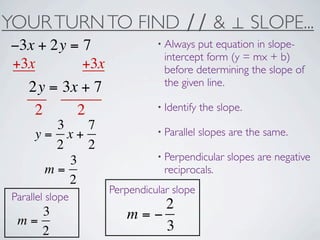
YOUR TURN TO FIND ∕∕ & ⊥ SLOPE...
−3x + 2y = 7                 • Always  put equation in slope-
                               intercept form (y = mx + b)
+3x        +3x                 before determining the slope of
                               the given line.
     2y = 3x + 7
      2     2                • Identify   the slope.
        3   7                • Parallel   slopes are the same.
      y= x+
        2   2
                             • Perpendicular    slopes are negative
          3
       m=                      reciprocals.
          2
                   Perpendicular slope
 Parallel slope
     3
                          2
  m=                  m=−
     2                    3
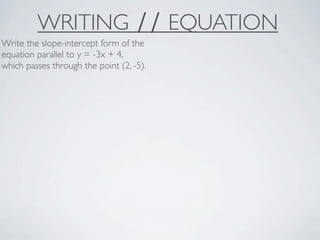
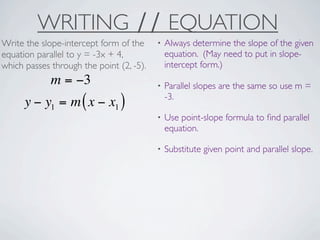
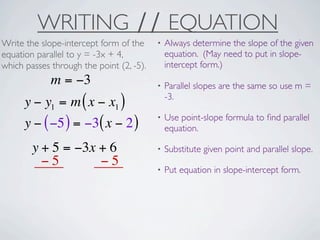
WRITING ∕∕ EQUATION
Write the slope-intercept form of the
equation parallel to y = -3x + 4,
which passes through the point (2, -5).
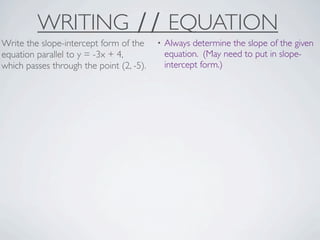
WRITING ∕∕ EQUATION
Write the slope-intercept form of the     •   Always determine the slope of the given
equation parallel to y = -3x + 4,             equation. (May need to put in slope-
which passes through the point (2, -5).       intercept form.)
WRITING ∕∕ EQUATION
Write the slope-intercept form of the     •   Always determine the slope of the given
equation parallel to y = -3x + 4,             equation. (May need to put in slope-
which passes through the point (2, -5).       intercept form.)
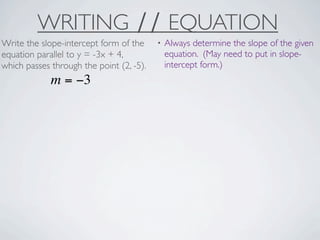
             m = −3
WRITING ∕∕ EQUATION
Write the slope-intercept form of the     •   Always determine the slope of the given
equation parallel to y = -3x + 4,             equation. (May need to put in slope-
which passes through the point (2, -5).       intercept form.)
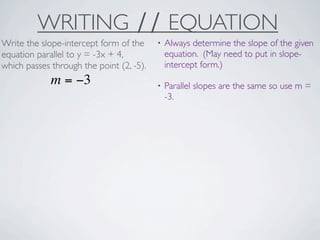
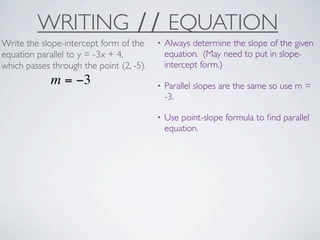
             m = −3                       •   Parallel slopes are the same so use m =
                                              -3.
WRITING ∕∕ EQUATION
Write the slope-intercept form of the     •   Always determine the slope of the given
equation parallel to y = -3x + 4,             equation. (May need to put in slope-
which passes through the point (2, -5).       intercept form.)
             m = −3                       •   Parallel slopes are the same so use m =
                                              -3.

                                          •   Use point-slope formula to find parallel
                                              equation.
WRITING ∕∕ EQUATION
Write the slope-intercept form of the     •   Always determine the slope of the given
equation parallel to y = -3x + 4,             equation. (May need to put in slope-
which passes through the point (2, -5).       intercept form.)
             m = −3                       •   Parallel slopes are the same so use m =
                                              -3.
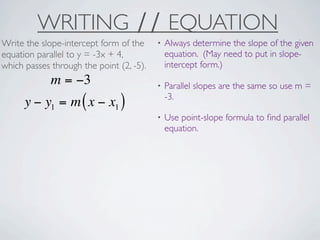
      y − y1 = m ( x − x1 )
                                          •   Use point-slope formula to find parallel
                                              equation.
WRITING ∕∕ EQUATION
Write the slope-intercept form of the     •   Always determine the slope of the given
equation parallel to y = -3x + 4,             equation. (May need to put in slope-
which passes through the point (2, -5).       intercept form.)
             m = −3                       •   Parallel slopes are the same so use m =
                                              -3.
      y − y1 = m ( x − x1 )
                                          •   Use point-slope formula to find parallel
                                              equation.

                                          •   Substitute given point and parallel slope.
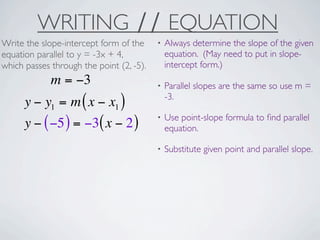
WRITING ∕∕ EQUATION
Write the slope-intercept form of the     •   Always determine the slope of the given
equation parallel to y = -3x + 4,             equation. (May need to put in slope-
which passes through the point (2, -5).       intercept form.)
             m = −3                       •   Parallel slopes are the same so use m =
                                              -3.
      y − y1 = m ( x − x1 )
                                          •   Use point-slope formula to find parallel
      y − ( −5 ) = −3( x − 2 )                equation.

                                          •   Substitute given point and parallel slope.
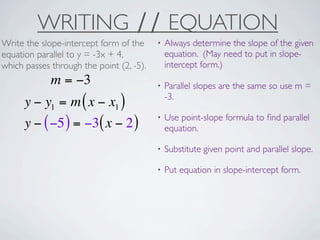
WRITING ∕∕ EQUATION
Write the slope-intercept form of the     •   Always determine the slope of the given
equation parallel to y = -3x + 4,             equation. (May need to put in slope-
which passes through the point (2, -5).       intercept form.)
             m = −3                       •   Parallel slopes are the same so use m =
                                              -3.
      y − y1 = m ( x − x1 )
                                          •   Use point-slope formula to find parallel
      y − ( −5 ) = −3( x − 2 )                equation.

                                          •   Substitute given point and parallel slope.

                                          •   Put equation in slope-intercept form.
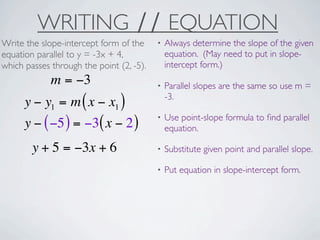
WRITING ∕∕ EQUATION
Write the slope-intercept form of the     •   Always determine the slope of the given
equation parallel to y = -3x + 4,             equation. (May need to put in slope-
which passes through the point (2, -5).       intercept form.)
             m = −3                       •   Parallel slopes are the same so use m =
                                              -3.
      y − y1 = m ( x − x1 )
                                          •   Use point-slope formula to find parallel
      y − ( −5 ) = −3( x − 2 )                equation.

        y + 5 = −3x + 6                   •   Substitute given point and parallel slope.

                                          •   Put equation in slope-intercept form.
WRITING ∕∕ EQUATION
Write the slope-intercept form of the     •   Always determine the slope of the given
equation parallel to y = -3x + 4,             equation. (May need to put in slope-
which passes through the point (2, -5).       intercept form.)
             m = −3                       •   Parallel slopes are the same so use m =
                                              -3.
      y − y1 = m ( x − x1 )
                                          •   Use point-slope formula to find parallel
      y − ( −5 ) = −3( x − 2 )                equation.

        y + 5 = −3x + 6                   •   Substitute given point and parallel slope.
          −5        −5
                                          •   Put equation in slope-intercept form.
WRITING ∕∕ EQUATION
Write the slope-intercept form of the     •   Always determine the slope of the given
equation parallel to y = -3x + 4,             equation. (May need to put in slope-
which passes through the point (2, -5).       intercept form.)
             m = −3                       •   Parallel slopes are the same so use m =
                                              -3.
      y − y1 = m ( x − x1 )
                                          •   Use point-slope formula to find parallel
      y − ( −5 ) = −3( x − 2 )                equation.

        y + 5 = −3x + 6                   •   Substitute given point and parallel slope.
          −5        −5
                                          •   Put equation in slope-intercept form.


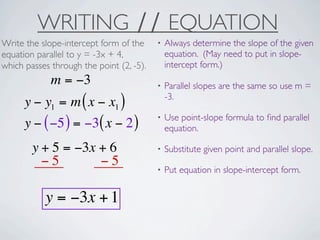
           y = −3x + 1
WRITING ∕∕ EQUATION
Write the slope-intercept form of the     •   Always determine the slope of the given
equation parallel to y = -3x + 4,             equation. (May need to put in slope-
which passes through the point (2, -5).       intercept form.)
             m = −3                       •   Parallel slopes are the same so use m =
                                              -3.
      y − y1 = m ( x − x1 )
                                          •   Use point-slope formula to find parallel
      y − ( −5 ) = −3( x − 2 )                equation.

        y + 5 = −3x + 6                   •   Substitute given point and parallel slope.
          −5        −5
                                          •   Put equation in slope-intercept form.

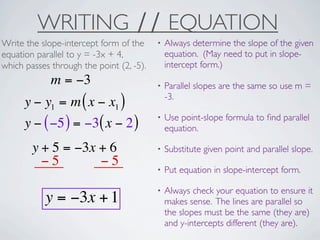
                                          •   Always check your equation to ensure it
           y = −3x + 1                        makes sense. The lines are parallel so
                                              the slopes must be the same (they are)
                                              and y-intercepts different (they are).
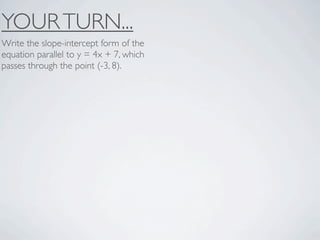
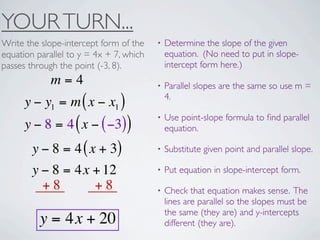
YOUR TURN...
Write the slope-intercept form of the
equation parallel to y = 4x + 7, which
passes through the point (-3, 8).
YOUR TURN...
Write the slope-intercept form of the    •   Determine the slope of the given
equation parallel to y = 4x + 7, which       equation. (No need to put in slope-
passes through the point (-3, 8).            intercept form here.)
YOUR TURN...
Write the slope-intercept form of the    •   Determine the slope of the given
equation parallel to y = 4x + 7, which       equation. (No need to put in slope-
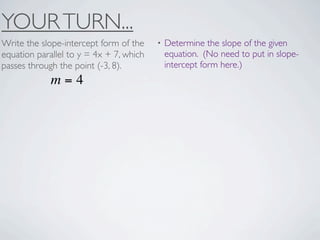
passes through the point (-3, 8).            intercept form here.)
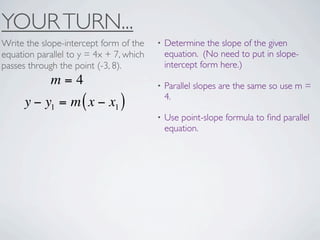
             m=4
YOUR TURN...
Write the slope-intercept form of the    •   Determine the slope of the given
equation parallel to y = 4x + 7, which       equation. (No need to put in slope-
passes through the point (-3, 8).            intercept form here.)
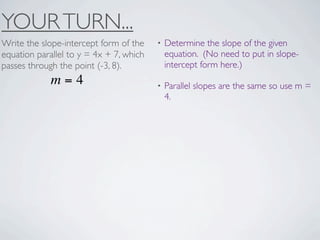
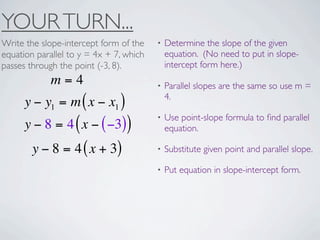
             m=4                         •   Parallel slopes are the same so use m =
                                             4.
YOUR TURN...
Write the slope-intercept form of the    •   Determine the slope of the given
equation parallel to y = 4x + 7, which       equation. (No need to put in slope-
passes through the point (-3, 8).            intercept form here.)
             m=4                         •   Parallel slopes are the same so use m =
                                             4.

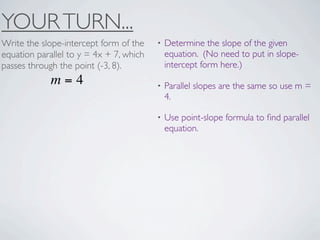
                                         •   Use point-slope formula to find parallel
                                             equation.
YOUR TURN...
Write the slope-intercept form of the    •   Determine the slope of the given
equation parallel to y = 4x + 7, which       equation. (No need to put in slope-
passes through the point (-3, 8).            intercept form here.)
             m=4                         •   Parallel slopes are the same so use m =
                                             4.
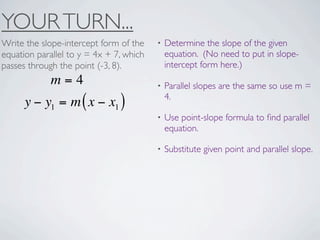
      y − y1 = m ( x − x1 )
                                         •   Use point-slope formula to find parallel
                                             equation.
YOUR TURN...
Write the slope-intercept form of the    •   Determine the slope of the given
equation parallel to y = 4x + 7, which       equation. (No need to put in slope-
passes through the point (-3, 8).            intercept form here.)
             m=4                         •   Parallel slopes are the same so use m =
                                             4.
      y − y1 = m ( x − x1 )
                                         •   Use point-slope formula to find parallel
                                             equation.

                                         •   Substitute given point and parallel slope.
YOUR TURN...
Write the slope-intercept form of the    •   Determine the slope of the given
equation parallel to y = 4x + 7, which       equation. (No need to put in slope-
passes through the point (-3, 8).            intercept form here.)
             m=4                         •   Parallel slopes are the same so use m =
                                             4.
      y − y1 = m ( x − x1 )
                                         •   Use point-slope formula to find parallel
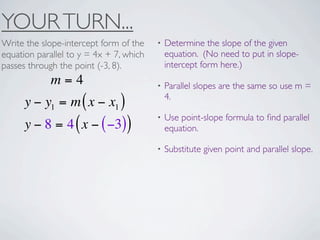
      y − 8 = 4 ( x − ( −3))                 equation.

                                         •   Substitute given point and parallel slope.
YOUR TURN...
Write the slope-intercept form of the    •   Determine the slope of the given
equation parallel to y = 4x + 7, which       equation. (No need to put in slope-
passes through the point (-3, 8).            intercept form here.)
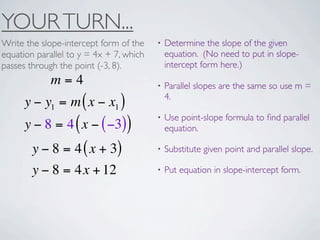
             m=4                         •   Parallel slopes are the same so use m =
                                             4.
      y − y1 = m ( x − x1 )
                                         •   Use point-slope formula to find parallel
      y − 8 = 4 ( x − ( −3))                 equation.

                                         •   Substitute given point and parallel slope.

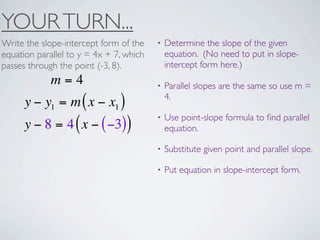
                                         •   Put equation in slope-intercept form.
YOUR TURN...
Write the slope-intercept form of the    •   Determine the slope of the given
equation parallel to y = 4x + 7, which       equation. (No need to put in slope-
passes through the point (-3, 8).            intercept form here.)
             m=4                         •   Parallel slopes are the same so use m =
                                             4.
      y − y1 = m ( x − x1 )
                                         •   Use point-slope formula to find parallel
      y − 8 = 4 ( x − ( −3))                 equation.

        y − 8 = 4 ( x + 3)               •   Substitute given point and parallel slope.

                                         •   Put equation in slope-intercept form.
YOUR TURN...
Write the slope-intercept form of the    •   Determine the slope of the given
equation parallel to y = 4x + 7, which       equation. (No need to put in slope-
passes through the point (-3, 8).            intercept form here.)
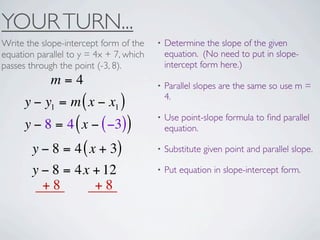
             m=4                         •   Parallel slopes are the same so use m =
                                             4.
      y − y1 = m ( x − x1 )
                                         •   Use point-slope formula to find parallel
      y − 8 = 4 ( x − ( −3))                 equation.

        y − 8 = 4 ( x + 3)               •   Substitute given point and parallel slope.

        y − 8 = 4x + 12                  •   Put equation in slope-intercept form.
YOUR TURN...
Write the slope-intercept form of the    •   Determine the slope of the given
equation parallel to y = 4x + 7, which       equation. (No need to put in slope-
passes through the point (-3, 8).            intercept form here.)
             m=4                         •   Parallel slopes are the same so use m =
                                             4.
      y − y1 = m ( x − x1 )
                                         •   Use point-slope formula to find parallel
      y − 8 = 4 ( x − ( −3))                 equation.

        y − 8 = 4 ( x + 3)               •   Substitute given point and parallel slope.

        y − 8 = 4x + 12                  •   Put equation in slope-intercept form.
          +8         +8
YOUR TURN...
Write the slope-intercept form of the    •   Determine the slope of the given
equation parallel to y = 4x + 7, which       equation. (No need to put in slope-
passes through the point (-3, 8).            intercept form here.)
             m=4                         •   Parallel slopes are the same so use m =
                                             4.
      y − y1 = m ( x − x1 )
                                         •   Use point-slope formula to find parallel
      y − 8 = 4 ( x − ( −3))                 equation.

        y − 8 = 4 ( x + 3)               •   Substitute given point and parallel slope.

        y − 8 = 4x + 12                  •   Put equation in slope-intercept form.
          +8         +8

          y = 4x + 20
YOUR TURN...
Write the slope-intercept form of the    •   Determine the slope of the given
equation parallel to y = 4x + 7, which       equation. (No need to put in slope-
passes through the point (-3, 8).            intercept form here.)
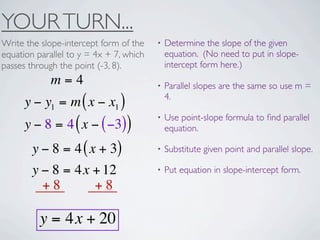
             m=4                         •   Parallel slopes are the same so use m =
                                             4.
      y − y1 = m ( x − x1 )
                                         •   Use point-slope formula to find parallel
      y − 8 = 4 ( x − ( −3))                 equation.

        y − 8 = 4 ( x + 3)               •   Substitute given point and parallel slope.

        y − 8 = 4x + 12                  •   Put equation in slope-intercept form.
          +8         +8                  •   Check that equation makes sense. The
                                             lines are parallel so the slopes must be
                                             the same (they are) and y-intercepts
          y = 4x + 20                        different (they are).
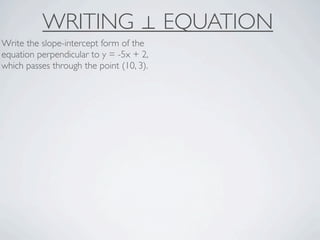
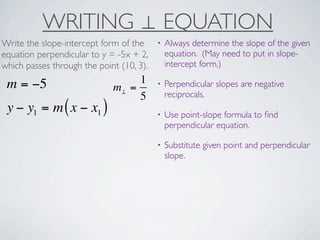
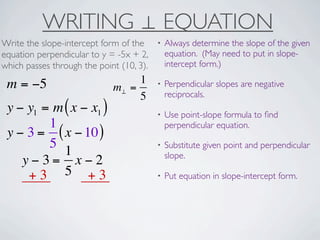
WRITING ⊥ EQUATION
Write the slope-intercept form of the
equation perpendicular to y = -5x + 2,
which passes through the point (10, 3).
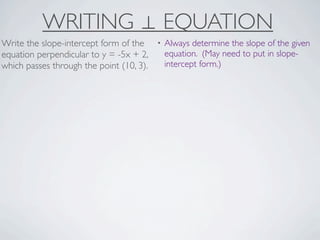
WRITING ⊥ EQUATION
Write the slope-intercept form of the     •   Always determine the slope of the given
equation perpendicular to y = -5x + 2,        equation. (May need to put in slope-
which passes through the point (10, 3).       intercept form.)
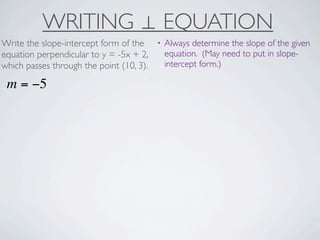
WRITING ⊥ EQUATION
Write the slope-intercept form of the     •   Always determine the slope of the given
equation perpendicular to y = -5x + 2,        equation. (May need to put in slope-
which passes through the point (10, 3).       intercept form.)

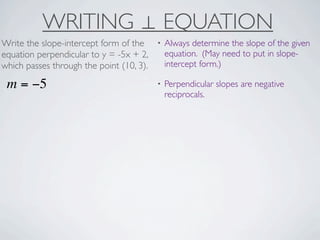
 m = −5
WRITING ⊥ EQUATION
Write the slope-intercept form of the     •   Always determine the slope of the given
equation perpendicular to y = -5x + 2,        equation. (May need to put in slope-
which passes through the point (10, 3).       intercept form.)

 m = −5                                   •   Perpendicular slopes are negative
                                              reciprocals.
WRITING ⊥ EQUATION
Write the slope-intercept form of the     •   Always determine the slope of the given
equation perpendicular to y = -5x + 2,        equation. (May need to put in slope-
which passes through the point (10, 3).       intercept form.)

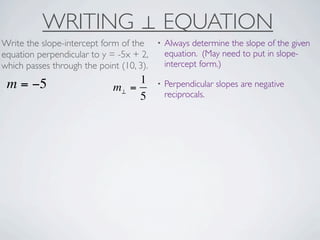
 m = −5                           1       •   Perpendicular slopes are negative
                             m⊥ =
                                  5           reciprocals.
WRITING ⊥ EQUATION
Write the slope-intercept form of the     •   Always determine the slope of the given
equation perpendicular to y = -5x + 2,        equation. (May need to put in slope-
which passes through the point (10, 3).       intercept form.)

 m = −5                           1       •   Perpendicular slopes are negative
                             m⊥ =
                                  5           reciprocals.

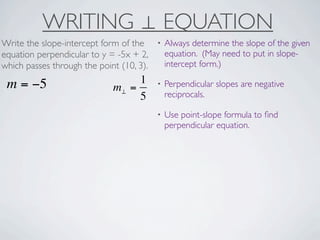
                                          •   Use point-slope formula to find
                                              perpendicular equation.
WRITING ⊥ EQUATION
Write the slope-intercept form of the     •   Always determine the slope of the given
equation perpendicular to y = -5x + 2,        equation. (May need to put in slope-
which passes through the point (10, 3).       intercept form.)

 m = −5                           1       •   Perpendicular slopes are negative
                             m⊥ =
                                  5           reciprocals.
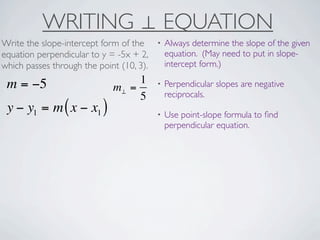
 y − y1 = m ( x − x1 )                    •   Use point-slope formula to find
                                              perpendicular equation.
WRITING ⊥ EQUATION
Write the slope-intercept form of the     •   Always determine the slope of the given
equation perpendicular to y = -5x + 2,        equation. (May need to put in slope-
which passes through the point (10, 3).       intercept form.)

 m = −5                           1       •   Perpendicular slopes are negative
                             m⊥ =
                                  5           reciprocals.
 y − y1 = m ( x − x1 )                    •   Use point-slope formula to find
                                              perpendicular equation.

                                          •   Substitute given point and perpendicular
                                              slope.
WRITING ⊥ EQUATION
Write the slope-intercept form of the     •   Always determine the slope of the given
equation perpendicular to y = -5x + 2,        equation. (May need to put in slope-
which passes through the point (10, 3).       intercept form.)

 m = −5                           1       •   Perpendicular slopes are negative
                             m⊥ =
                                  5           reciprocals.
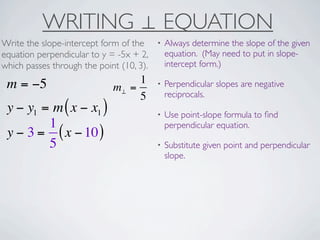
 y − y1 = m ( x − x1 )                    •   Use point-slope formula to find
         1                                    perpendicular equation.
 y − 3 = ( x − 10 )
         5                                •   Substitute given point and perpendicular
                                              slope.
WRITING ⊥ EQUATION
Write the slope-intercept form of the     •   Always determine the slope of the given
equation perpendicular to y = -5x + 2,        equation. (May need to put in slope-
which passes through the point (10, 3).       intercept form.)

 m = −5                           1       •   Perpendicular slopes are negative
                             m⊥ =
                                  5           reciprocals.
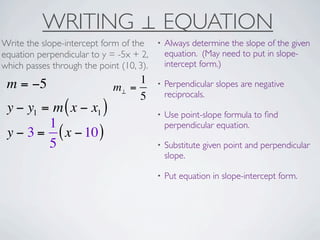
 y − y1 = m ( x − x1 )                    •   Use point-slope formula to find
         1                                    perpendicular equation.
 y − 3 = ( x − 10 )
         5                                •   Substitute given point and perpendicular
                                              slope.

                                          •   Put equation in slope-intercept form.
WRITING ⊥ EQUATION
Write the slope-intercept form of the     •   Always determine the slope of the given
equation perpendicular to y = -5x + 2,        equation. (May need to put in slope-
which passes through the point (10, 3).       intercept form.)

 m = −5                           1       •   Perpendicular slopes are negative
                             m⊥ =
                                  5           reciprocals.
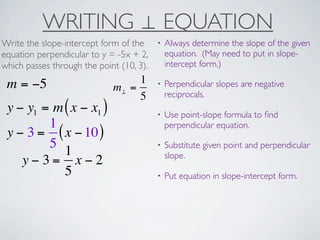
 y − y1 = m ( x − x1 )                    •   Use point-slope formula to find
         1                                    perpendicular equation.
 y − 3 = ( x − 10 )
         5                                •   Substitute given point and perpendicular
            1                                 slope.
    y−3= x−2
            5                             •   Put equation in slope-intercept form.
WRITING ⊥ EQUATION
Write the slope-intercept form of the     •   Always determine the slope of the given
equation perpendicular to y = -5x + 2,        equation. (May need to put in slope-
which passes through the point (10, 3).       intercept form.)

 m = −5                           1       •   Perpendicular slopes are negative
                             m⊥ =
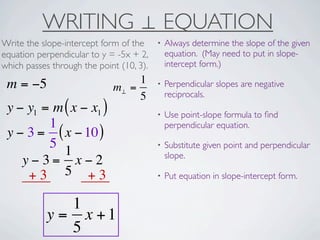
                                  5           reciprocals.
 y − y1 = m ( x − x1 )                    •   Use point-slope formula to find
         1                                    perpendicular equation.
 y − 3 = ( x − 10 )
         5                                •   Substitute given point and perpendicular
            1                                 slope.
    y−3= x−2
     +3 5 +3                              •   Put equation in slope-intercept form.
WRITING ⊥ EQUATION
Write the slope-intercept form of the     •   Always determine the slope of the given
equation perpendicular to y = -5x + 2,        equation. (May need to put in slope-
which passes through the point (10, 3).       intercept form.)

 m = −5                           1       •   Perpendicular slopes are negative
                             m⊥ =
                                  5           reciprocals.
 y − y1 = m ( x − x1 )                    •   Use point-slope formula to find
         1                                    perpendicular equation.
 y − 3 = ( x − 10 )
         5                                •   Substitute given point and perpendicular
            1                                 slope.
    y−3= x−2
     +3 5 +3                              •   Put equation in slope-intercept form.


               1
            y = x +1
               5
WRITING ⊥ EQUATION
Write the slope-intercept form of the     •   Always determine the slope of the given
equation perpendicular to y = -5x + 2,        equation. (May need to put in slope-
which passes through the point (10, 3).       intercept form.)

 m = −5                           1       •   Perpendicular slopes are negative
                             m⊥ =
                                  5           reciprocals.
 y − y1 = m ( x − x1 )                    •   Use point-slope formula to find
         1                                    perpendicular equation.
 y − 3 = ( x − 10 )
         5                                •   Substitute given point and perpendicular
            1                                 slope.
    y−3= x−2
     +3 5 +3                              •   Put equation in slope-intercept form.

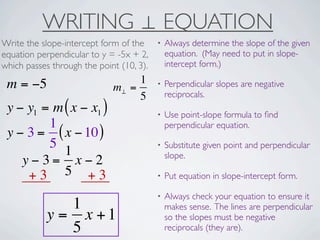
                                          •   Always check your equation to ensure it
               1                              makes sense. The lines are perpendicular
            y = x +1                          so the slopes must be negative
               5                              reciprocals (they are).
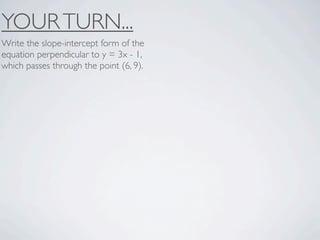
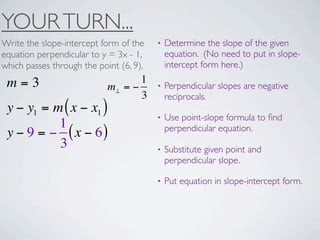
YOUR TURN...
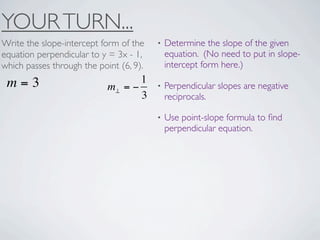
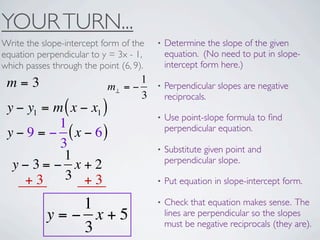
Write the slope-intercept form of the
equation perpendicular to y = 3x - 1,
which passes through the point (6, 9).
YOUR TURN...
Write the slope-intercept form of the    •   Determine the slope of the given
equation perpendicular to y = 3x - 1,        equation. (No need to put in slope-
which passes through the point (6, 9).       intercept form here.)
YOUR TURN...
Write the slope-intercept form of the    •   Determine the slope of the given
equation perpendicular to y = 3x - 1,        equation. (No need to put in slope-
which passes through the point (6, 9).       intercept form here.)

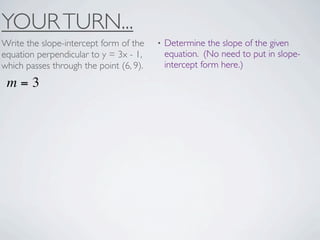
 m=3
YOUR TURN...
Write the slope-intercept form of the    •   Determine the slope of the given
equation perpendicular to y = 3x - 1,        equation. (No need to put in slope-
which passes through the point (6, 9).       intercept form here.)

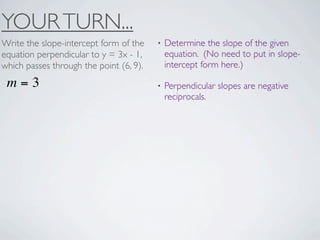
 m=3                                     •   Perpendicular slopes are negative
                                             reciprocals.
YOUR TURN...
Write the slope-intercept form of the    •   Determine the slope of the given
equation perpendicular to y = 3x - 1,        equation. (No need to put in slope-
which passes through the point (6, 9).       intercept form here.)

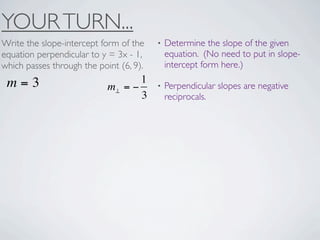
 m=3                               1
                            m⊥ = −       •   Perpendicular slopes are negative
                                   3         reciprocals.
YOUR TURN...
Write the slope-intercept form of the    •   Determine the slope of the given
equation perpendicular to y = 3x - 1,        equation. (No need to put in slope-
which passes through the point (6, 9).       intercept form here.)

 m=3                               1
                            m⊥ = −       •   Perpendicular slopes are negative
                                   3         reciprocals.

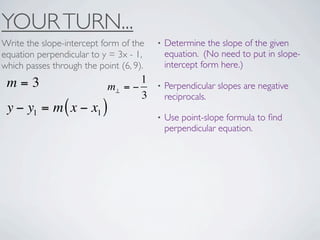
                                         •   Use point-slope formula to find
                                             perpendicular equation.
YOUR TURN...
Write the slope-intercept form of the    •   Determine the slope of the given
equation perpendicular to y = 3x - 1,        equation. (No need to put in slope-
which passes through the point (6, 9).       intercept form here.)

 m=3                               1
                            m⊥ = −       •   Perpendicular slopes are negative
                                   3         reciprocals.
 y − y1 = m ( x − x1 )
                                         •   Use point-slope formula to find
                                             perpendicular equation.
YOUR TURN...
Write the slope-intercept form of the    •   Determine the slope of the given
equation perpendicular to y = 3x - 1,        equation. (No need to put in slope-
which passes through the point (6, 9).       intercept form here.)

 m=3                               1
                            m⊥ = −       •   Perpendicular slopes are negative
                                   3         reciprocals.
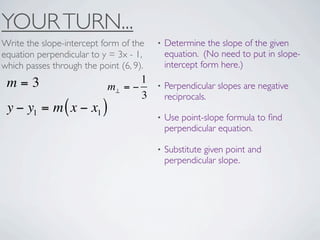
 y − y1 = m ( x − x1 )
                                         •   Use point-slope formula to find
                                             perpendicular equation.

                                         •   Substitute given point and
                                             perpendicular slope.
YOUR TURN...
Write the slope-intercept form of the    •   Determine the slope of the given
equation perpendicular to y = 3x - 1,        equation. (No need to put in slope-
which passes through the point (6, 9).       intercept form here.)

 m=3                               1
                            m⊥ = −       •   Perpendicular slopes are negative
                                   3         reciprocals.
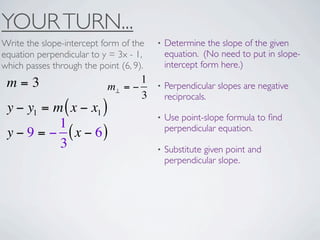
 y − y1 = m ( x − x1 )
                                         •   Use point-slope formula to find
           1                                 perpendicular equation.
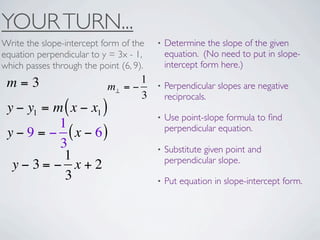
 y − 9 = − ( x − 6)
           3                             •   Substitute given point and
                                             perpendicular slope.
YOUR TURN...
Write the slope-intercept form of the    •   Determine the slope of the given
equation perpendicular to y = 3x - 1,        equation. (No need to put in slope-
which passes through the point (6, 9).       intercept form here.)

 m=3                               1
                            m⊥ = −       •   Perpendicular slopes are negative
                                   3         reciprocals.
 y − y1 = m ( x − x1 )
                                         •   Use point-slope formula to find
           1                                 perpendicular equation.
 y − 9 = − ( x − 6)
           3                             •   Substitute given point and
                                             perpendicular slope.

                                         •   Put equation in slope-intercept form.
YOUR TURN...
Write the slope-intercept form of the    •   Determine the slope of the given
equation perpendicular to y = 3x - 1,        equation. (No need to put in slope-
which passes through the point (6, 9).       intercept form here.)

 m=3                               1
                            m⊥ = −       •   Perpendicular slopes are negative
                                   3         reciprocals.
 y − y1 = m ( x − x1 )
                                         •   Use point-slope formula to find
           1                                 perpendicular equation.
 y − 9 = − ( x − 6)
           3                             •   Substitute given point and
            1                                perpendicular slope.
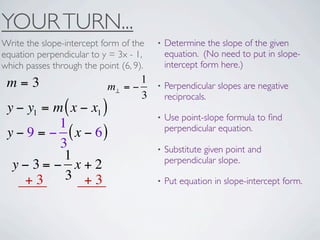
  y−3= − x+2
            3                            •   Put equation in slope-intercept form.
YOUR TURN...
Write the slope-intercept form of the    •   Determine the slope of the given
equation perpendicular to y = 3x - 1,        equation. (No need to put in slope-
which passes through the point (6, 9).       intercept form here.)

 m=3                               1
                            m⊥ = −       •   Perpendicular slopes are negative
                                   3         reciprocals.
 y − y1 = m ( x − x1 )
                                         •   Use point-slope formula to find
           1                                 perpendicular equation.
 y − 9 = − ( x − 6)
           3                             •   Substitute given point and
            1                                perpendicular slope.
  y−3= − x+2
    +3      3 +3                         •   Put equation in slope-intercept form.
YOUR TURN...
Write the slope-intercept form of the    •   Determine the slope of the given
equation perpendicular to y = 3x - 1,        equation. (No need to put in slope-
which passes through the point (6, 9).       intercept form here.)

 m=3                               1
                            m⊥ = −       •   Perpendicular slopes are negative
                                   3         reciprocals.
 y − y1 = m ( x − x1 )
                                         •   Use point-slope formula to find
           1                                 perpendicular equation.
 y − 9 = − ( x − 6)
           3                             •   Substitute given point and
            1                                perpendicular slope.
  y−3= − x+2
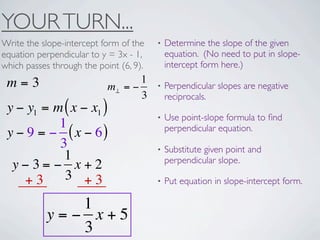
    +3      3 +3                         •   Put equation in slope-intercept form.

               1
            y=− x+5
               3
YOUR TURN...
Write the slope-intercept form of the    •   Determine the slope of the given
equation perpendicular to y = 3x - 1,        equation. (No need to put in slope-
which passes through the point (6, 9).       intercept form here.)

 m=3                               1
                            m⊥ = −       •   Perpendicular slopes are negative
                                   3         reciprocals.
 y − y1 = m ( x − x1 )
                                         •   Use point-slope formula to find
           1                                 perpendicular equation.
 y − 9 = − ( x − 6)
           3                             •   Substitute given point and
            1                                perpendicular slope.
  y−3= − x+2
    +3      3 +3                         •   Put equation in slope-intercept form.

               1                         •   Check that equation makes sense. The
            y=− x+5                          lines are perpendicular so the slopes
                                             must be negative reciprocals (they are).
               3

Unit 4 hw 8 - pointslope, parallel & perp

  • 1.
    FUNCTIONS UNIT 4 -HOMEWORK 8 Homework Help
  • 2.
  • 3.
    POINT-SLOPE FORMULA • Alternatemethodto find the equation of a line with the slope and one point.
  • 4.
    POINT-SLOPE FORMULA • Alternatemethodto find the equation of a line with the slope and one point. y − y1 = m ( x − x1 )
  • 5.
    POINT-SLOPE FORMULA • Alternatemethodto find the equation of a line with the slope and one point. y − y1 = m ( x − x1 ) • The x and y stay the same. Never substitute a value for these.
  • 6.
    POINT-SLOPE FORMULA • Alternatemethodto find the equation of a line with the slope and one point. y − y1 = m ( x − x1 ) • The x and y stay the same. Never substitute a value for these. • The x1 and y1 represent the given point. This is where you substitute the given point.
  • 7.
    USING POINT-SLOPE FORMULA Writethe point-slope form of the equation passing through (3, -2) with a slope of 5.
  • 8.
    USING POINT-SLOPE FORMULA Writethe point-slope form of • Write the general formula for the equation passing through point-slope form. (3, -2) with a slope of 5.
  • 9.
    USING POINT-SLOPE FORMULA Writethe point-slope form of • Write the general formula for the equation passing through point-slope form. (3, -2) with a slope of 5. y − y1 = m ( x − x1 )
  • 10.
    USING POINT-SLOPE FORMULA Writethe point-slope form of • Write the general formula for the equation passing through point-slope form. (3, -2) with a slope of 5. • Label your given point. y − y1 = m ( x − x1 )
  • 11.
    USING POINT-SLOPE FORMULA Writethe point-slope form of • Write the general formula for the equation passing through point-slope form. (3, -2) with a slope of 5. • Label your given point. ( x1, y1 ) y − y1 = m ( x − x1 )
  • 12.
    USING POINT-SLOPE FORMULA Writethe point-slope form of • Write the general formula for the equation passing through point-slope form. (3, -2) with a slope of 5. • Label your given point. ( x1, y1 ) • Substitute the slope and point. y − y1 = m ( x − x1 )
  • 13.
    USING POINT-SLOPE FORMULA Writethe point-slope form of • Write the general formula for the equation passing through point-slope form. (3, -2) with a slope of 5. • Label your given point. ( x1, y1 ) • Substitute the slope and point. y − y1 = m ( x − x1 ) y − ( −2 ) = 5 ( x − 3)
  • 14.
    USING POINT-SLOPE FORMULA Writethe point-slope form of • Write the general formula for the equation passing through point-slope form. (3, -2) with a slope of 5. • Label your given point. ( x1, y1 ) • Substitute the slope and point. y − y1 = m ( x − x1 ) • When the question asks for the equation in point-slope form, the y − ( −2 ) = 5 ( x − 3) only simplifying done is to change any subtracting negatives to addition.
  • 15.
    USING POINT-SLOPE FORMULA Writethe point-slope form of • Write the general formula for the equation passing through point-slope form. (3, -2) with a slope of 5. • Label your given point. ( x1, y1 ) • Substitute the slope and point. y − y1 = m ( x − x1 ) • When the question asks for the equation in point-slope form, the y − ( −2 ) = 5 ( x − 3) only simplifying done is to change any subtracting negatives to addition. y + 2 = 5 ( x − 3)
  • 16.
    YOUR TURN... Write thepoint-slope form of the equation passing through (7, -3) with a slope of -2.
  • 17.
    YOUR TURN... Write thepoint-slope form of • Write the general formula for the equation passing through point-slope form. (7, -3) with a slope of -2.
  • 18.
    YOUR TURN... Write thepoint-slope form of • Write the general formula for the equation passing through point-slope form. (7, -3) with a slope of -2. y − y1 = m ( x − x1 )
  • 19.
    YOUR TURN... Write thepoint-slope form of • Write the general formula for the equation passing through point-slope form. (7, -3) with a slope of -2. • Label your given point. y − y1 = m ( x − x1 )
  • 20.
    YOUR TURN... Write thepoint-slope form of • Write the general formula for the equation passing through point-slope form. (7, -3) with a slope of -2. • Label your given point. ( x1, y1 ) y − y1 = m ( x − x1 )
  • 21.
    YOUR TURN... Write thepoint-slope form of • Write the general formula for the equation passing through point-slope form. (7, -3) with a slope of -2. • Label your given point. ( x1, y1 ) • Substitute the slope and point. y − y1 = m ( x − x1 )
  • 22.
    YOUR TURN... Write thepoint-slope form of • Write the general formula for the equation passing through point-slope form. (7, -3) with a slope of -2. • Label your given point. ( x1, y1 ) • Substitute the slope and point. y − y1 = m ( x − x1 ) y − ( −3) = −2 ( x − 7 )
  • 23.
    YOUR TURN... Write thepoint-slope form of • Write the general formula for the equation passing through point-slope form. (7, -3) with a slope of -2. • Label your given point. ( x1, y1 ) • Substitute the slope and point. y − y1 = m ( x − x1 ) • When the question asks for the equation in point-slope form, the y − ( −3) = −2 ( x − 7 ) only simplifying is change to addition any subtraction negatives.
  • 24.
    YOUR TURN... Write thepoint-slope form of • Write the general formula for the equation passing through point-slope form. (7, -3) with a slope of -2. • Label your given point. ( x1, y1 ) • Substitute the slope and point. y − y1 = m ( x − x1 ) • When the question asks for the equation in point-slope form, the y − ( −3) = −2 ( x − 7 ) only simplifying is change to addition any subtraction negatives. y + 3 = −2 ( x − 7 )
  • 25.
    HORIZONTAL LINES • Look at the horizon at the right.
  • 26.
    HORIZONTAL LINES • Look at the horizon at the right. • The direction of the horizon is from left to right. This is how all horizontal lines appear on a graph.
  • 27.
    HORIZONTAL LINES • Look at the horizon at the right. • The direction of the horizon is from left to right. This is how all horizontal lines appear on a graph. • The x-coordinate changes but the y-coordinate remains constant.
  • 28.
    HORIZONTAL LINES • Look at the horizon at the right. • The direction of the horizon is from left to right. This is how all horizontal lines appear on a graph. • The x-coordinate changes but the y-coordinate remains constant. • Horizontal lines have the equation y = b.
  • 29.
    HORIZONTAL LINES • Look at the horizon at the right. • The direction of the horizon is from left to right. This is how all horizontal lines appear on a graph. • The x-coordinate changes but the y-coordinate remains constant. • Horizontal lines have the equation y = b. • Slope of all horizontal lines is zero. (Think, y = 0x + b.)
  • 30.
    HORIZONTAL LINES • Look at the horizon at the right. • The direction of the horizon is from left to right. This is how all horizontal lines appear on a graph. • The x-coordinate changes but the y-coordinate remains constant. • Horizontal lines have the equation y = b. • Slope of all horizontal lines is zero. (Think, y = 0x + b.) • Why is the slope zero?
  • 31.
    HORIZONTAL LINES • Look at the horizon at the right. • The direction of the horizon is from left to right. This is how all horizontal lines appear on a graph. • The x-coordinate changes but the y-coordinate remains constant. • Horizontal lines have the equation y = b. • Slope of all horizontal lines is zero. (Think, y = 0x + b.) • Why is the slope zero? • Suppose you have points (2, 5) and (3, 5). You know they are horizontal because the x-coordinate changes.
  • 32.
    HORIZONTAL LINES • Look at the horizon at the right. • The direction of the horizon is from left to right. This is how all horizontal lines appear on a graph. • The x-coordinate changes but the y-coordinate remains constant. • Horizontal lines have the equation y = b. • Slope of all horizontal lines is zero. (Think, y = 0x + b.) • Why is the slope zero? • Suppose you have points (2, 5) and (3, 5). You know they are horizontal because the x-coordinate changes. • Substitute into the slope formula. y2 − y1 m= x2 − x1
  • 33.
    HORIZONTAL LINES • Look at the horizon at the right. • The direction of the horizon is from left to right. This is how all horizontal lines appear on a graph. • The x-coordinate changes but the y-coordinate remains constant. • Horizontal lines have the equation y = b. • Slope of all horizontal lines is zero. (Think, y = 0x + b.) • Why is the slope zero? • Suppose you have points (2, 5) and (3, 5). You know they are horizontal because the x-coordinate changes. • Substitute into the slope formula. y2 − y1 5 − 5 m= = x2 − x1 2 − 3
  • 34.
    HORIZONTAL LINES • Look at the horizon at the right. • The direction of the horizon is from left to right. This is how all horizontal lines appear on a graph. • The x-coordinate changes but the y-coordinate remains constant. • Horizontal lines have the equation y = b. • Slope of all horizontal lines is zero. (Think, y = 0x + b.) • Why is the slope zero? • Suppose you have points (2, 5) and (3, 5). You know they are horizontal because the x-coordinate changes. • Substitute into the slope formula. y2 − y1 5 − 5 0 m= = = x2 − x1 2 − 3 −1
  • 35.
    HORIZONTAL LINES • Look at the horizon at the right. • The direction of the horizon is from left to right. This is how all horizontal lines appear on a graph. • The x-coordinate changes but the y-coordinate remains constant. • Horizontal lines have the equation y = b. • Slope of all horizontal lines is zero. (Think, y = 0x + b.) • Why is the slope zero? • Suppose you have points (2, 5) and (3, 5). You know they are horizontal because the x-coordinate changes. • Substitute into the slope formula. y2 − y1 5 − 5 0 m= = = x2 − x1 2 − 3 −1 • Zero divided by anything is 0. Therefore, the slope is 0.
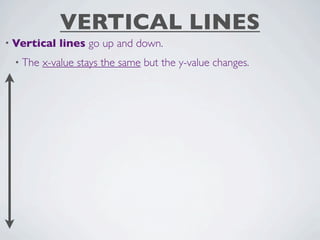
  • 36.
    VERTICAL LINES • Vertical lines go up and down.
  • 37.
    VERTICAL LINES • Vertical lines go up and down. • The x-value stays the same but the y-value changes.
  • 38.
    VERTICAL LINES • Vertical lines go up and down. • The x-value stays the same but the y-value changes. • Vertical lines have the equation x = point equation crosses x-axis
  • 39.
    VERTICAL LINES • Vertical lines go up and down. • The x-value stays the same but the y-value changes. • Vertical lines have the equation x = point equation crosses x-axis • The slope of all vertical lines is undefined.
  • 40.
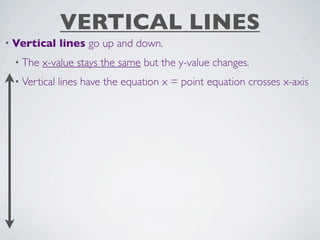
    VERTICAL LINES • Vertical lines go up and down. • The x-value stays the same but the y-value changes. • Vertical lines have the equation x = point equation crosses x-axis • The slope of all vertical lines is undefined. • Why is the slope undefined?
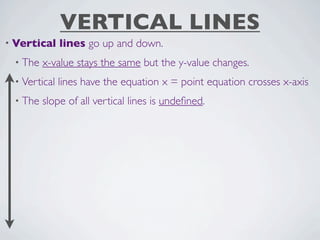
  • 41.
    VERTICAL LINES • Vertical lines go up and down. • The x-value stays the same but the y-value changes. • Vertical lines have the equation x = point equation crosses x-axis • The slope of all vertical lines is undefined. • Why is the slope undefined? • Suppose you have points (1, 5) and (1, 3). You know they are vertical because they have the same x-coordinate.
  • 42.
    VERTICAL LINES • Vertical lines go up and down. • The x-value stays the same but the y-value changes. • Vertical lines have the equation x = point equation crosses x-axis • The slope of all vertical lines is undefined. • Why is the slope undefined? • Suppose you have points (1, 5) and (1, 3). You know they are vertical because they have the same x-coordinate. • Substitute into the slope formula. y2 − y1 m= x2 − x1
  • 43.
    VERTICAL LINES • Vertical lines go up and down. • The x-value stays the same but the y-value changes. • Vertical lines have the equation x = point equation crosses x-axis • The slope of all vertical lines is undefined. • Why is the slope undefined? • Suppose you have points (1, 5) and (1, 3). You know they are vertical because they have the same x-coordinate. • Substitute into the slope formula. y2 − y1 5 − 3 m= = x2 − x1 1 − 1
  • 44.
    VERTICAL LINES • Vertical lines go up and down. • The x-value stays the same but the y-value changes. • Vertical lines have the equation x = point equation crosses x-axis • The slope of all vertical lines is undefined. • Why is the slope undefined? • Suppose you have points (1, 5) and (1, 3). You know they are vertical because they have the same x-coordinate. • Substitute into the slope formula. y2 − y1 5 − 3 2 m= = = x2 − x1 1 − 1 0
  • 45.
    VERTICAL LINES • Vertical lines go up and down. • The x-value stays the same but the y-value changes. • Vertical lines have the equation x = point equation crosses x-axis • The slope of all vertical lines is undefined. • Why is the slope undefined? • Suppose you have points (1, 5) and (1, 3). You know they are vertical because they have the same x-coordinate. • Substitute into the slope formula. y2 − y1 5 − 3 2 m= = = x2 − x1 1 − 1 0 • Can’t have division by 0. Therefore, the slope is undefined.
  • 46.
  • 47.
    WRITE THE EQUATIONS ( 2, −5 ) • Write the equation for the vertical line that goes through the above point.
  • 48.
    WRITE THE EQUATIONS ( 2, −5 ) • Write the equation for the vertical line that goes through the above point. • Because the x-coordinate never changes, the equation is x = 2.
  • 49.
    WRITE THE EQUATIONS ( 2, −5 ) • Write the equation for the vertical line that goes through the above point. • Because the x-coordinate never changes, the equation is x = 2. • Writethe equation for the horizontal line that goes through the above point.
  • 50.
    WRITE THE EQUATIONS ( 2, −5 ) • Write the equation for the vertical line that goes through the above point. • Because the x-coordinate never changes, the equation is x = 2. • Writethe equation for the horizontal line that goes through the above point. • Because the y-coordinate never changes, the equation is y = -5.
  • 51.
    YOU TRY... ( −7, 9 )
  • 52.
    YOU TRY... ( −7, 9 ) • Write the equation for the vertical line that goes through the above point.
  • 53.
    YOU TRY... ( −7, 9 ) • Write the equation for the vertical line that goes through the above point. • Because the x-coordinate never changes, the equation is x = -7.
  • 54.
    YOU TRY... ( −7, 9 ) • Write the equation for the vertical line that goes through the above point. • Because the x-coordinate never changes, the equation is x = -7. • Writethe equation for the horizontal line that goes through the above point.
  • 55.
    YOU TRY... ( −7, 9 ) • Write the equation for the vertical line that goes through the above point. • Because the x-coordinate never changes, the equation is x = -7. • Writethe equation for the horizontal line that goes through the above point. • Because the y-coordinate never changes, the equation is y = 9.
  • 56.
  • 57.
    STANDARD FORM • An equation written in the form Ax + By = C
  • 58.
    STANDARD FORM • An equation written in the form Ax + By = C • Rules for standard form:
  • 59.
    STANDARD FORM • An equation written in the form Ax + By = C • Rules for standard form: • A, B, and C must be Integers.
  • 60.
    STANDARD FORM • An equation written in the form Ax + By = C • Rules for standard form: • A, B, and C must be Integers. •A must be positive.
  • 61.
    STANDARD FORM • An equation written in the form Ax + By = C • Rules for standard form: • A, B, and C must be Integers. •A must be positive. • Either A OR B can be 0. Both can NOT be 0.
  • 62.
    STANDARD FORM • An equation written in the form Ax + By = C • Rules for standard form: • A, B, and C must be Integers. •A must be positive. • Either A OR B can be 0. Both can NOT be 0. • As long as A ≠ 0, Ax must be the first term.
  • 63.
    STANDARD FORM • An equation written in the form Ax + By = C • Rules for standard form: Examples • A, B, and C must be Integers. 2x − y = 5 •A must be positive. 5y = −3 • Either A OR B can be 0. Both can NOT be 0. x + 2y = 4 • As long as A ≠ 0, Ax must be the first term.
  • 64.
    STANDARD FORM • An equation written in the form Ax + By = C • Rules for standard form: Examples • A, B, and C must be Integers. 2x − y = 5 •A must be positive. 5y = −3 • Either A OR B can be 0. Both can NOT be 0. x + 2y = 4 • As long as A ≠ 0, Ax must be the first term. Non Examples −2x + y = 5 4 2x + 3y = 0.5y = −3.4 7
  • 65.
    WRITING AN EQUATIONIN STANDARD FORM Write the equation 2 y − 1 = ( x + 3) 3 in standard form.
  • 66.
    WRITING AN EQUATIONIN STANDARD FORM Write the equation • Distribute first. 2 y − 1 = ( x + 3) 3 in standard form.
  • 67.
    WRITING AN EQUATIONIN STANDARD FORM Write the equation • Distribute first. 2 y − 1 = ( x + 3) 3 in standard form. 2 2 y −1= x + ⋅3 3 3
  • 68.
    WRITING AN EQUATIONIN STANDARD FORM Write the equation • Distribute first. 2 y − 1 = ( x + 3) • Simplify multiplication. 3 in standard form. 2 2 y −1= x + ⋅3 3 3
  • 69.
    WRITING AN EQUATIONIN STANDARD FORM Write the equation • Distribute first. 2 y − 1 = ( x + 3) • Simplify multiplication. 3 in standard form. 2 2 y −1= x + ⋅3 3 3 2 y −1= x + 2 3
  • 70.
    WRITING AN EQUATIONIN STANDARD FORM Write the equation • Distribute first. 2 y − 1 = ( x + 3) • Simplify multiplication. 3 in standard form. • Use the properties of equality to get 2 2 the constants on the right and the y −1= x + ⋅3 variables on the left. 3 3 2 y −1= x + 2 3
  • 71.
    WRITING AN EQUATIONIN STANDARD FORM Write the equation • Distribute first. 2 y − 1 = ( x + 3) • Simplify multiplication. 3 in standard form. • Use the properties of equality to get 2 2 the constants on the right and the y −1= x + ⋅3 variables on the left. 3 3 2 y −1= x + 2 +1 3 +1
  • 72.
    WRITING AN EQUATIONIN STANDARD FORM Write the equation • Distribute first. 2 y − 1 = ( x + 3) • Simplify multiplication. 3 in standard form. • Use the properties of equality to get 2 2 the constants on the right and the y −1= x + ⋅3 variables on the left. 3 3 2 y −1= x + 2 +1 3 +1 2 2 − x − x 3 3
  • 73.
    WRITING AN EQUATIONIN STANDARD FORM Write the equation • Distribute first. 2 y − 1 = ( x + 3) • Simplify multiplication. 3 in standard form. • Use the properties of equality to get 2 2 the constants on the right and the y −1= x + ⋅3 variables on the left. 3 3 2 y −1= x + 2 +1 3 +1 2 2 − x − x 3 3 2 − x+y=3 3
  • 74.
    WRITING AN EQUATIONIN STANDARD FORM Write the equation • Distribute first. 2 y − 1 = ( x + 3) • Simplify multiplication. 3 in standard form. • Use the properties of equality to get 2 2 the constants on the right and the y −1= x + ⋅3 variables on the left. 3 3 2 • Multiplyby -3 so A is positive and y −1= x + 2 no fractions exist. +1 3 +1 2 2 − x − x 3 3 2 − x+y=3 3
  • 75.
    WRITING AN EQUATIONIN STANDARD FORM Write the equation • Distribute first. 2 y − 1 = ( x + 3) • Simplify multiplication. 3 in standard form. • Use the properties of equality to get 2 2 the constants on the right and the y −1= x + ⋅3 variables on the left. 3 3 2 • Multiplyby -3 so A is positive and y −1= x + 2 no fractions exist. +1 3 +1 2 2 ⎛ 2 ⎞ − x − x −3 ⎜ − x ⎟ + −3 ⋅ y = −3 ⋅ 3 3 3 ⎝ 3 ⎠ 2 − x+y=3 3
  • 76.
    WRITING AN EQUATIONIN STANDARD FORM Write the equation • Distribute first. 2 y − 1 = ( x + 3) • Simplify multiplication. 3 in standard form. • Use the properties of equality to get 2 2 the constants on the right and the y −1= x + ⋅3 variables on the left. 3 3 2 • Multiplyby -3 so A is positive and y −1= x + 2 no fractions exist. +1 3 +1 2 2 ⎛ 2 ⎞ − x − x −3 ⎜ − x ⎟ + −3 ⋅ y = −3 ⋅ 3 3 3 ⎝ 3 ⎠ 2 − x+y=3 2x − 3y = −9 3
  • 77.
    PARALLEL • Parallel lines are 2 lines that never touch. The distance between them remains constant forever.
  • 78.
    PARALLEL • Parallel lines are 2 lines that never touch. The distance between them remains constant forever. • Symbol used to represent: ∕∕
  • 79.
    PARALLEL • Parallel lines are 2 lines that never touch. The distance between them remains constant forever. • Symbol used to represent: ∕∕ • Real life examples...
  • 80.
    PARALLEL • Parallel lines are 2 lines that never touch. The distance between them remains constant forever. • Symbol used to represent: ∕∕ • Real life examples... • The top of the Berlin Wall and ground in Berlin, Germany.
  • 81.
    PARALLEL • Parallel lines are 2 lines that never touch. The distance between them remains constant forever. • Symbol used to represent: ∕∕ • Real life examples... • The top of the Berlin Wall and ground in Berlin, Germany.
  • 82.
    PARALLEL • Parallel lines are 2 lines that never touch. The distance between them remains constant forever. • Symbol used to represent: ∕∕ • Real life examples... • The top of the Berlin Wall and ground in Berlin, Germany. • The towers of the Tower Bridge in London, England.
  • 83.
    PARALLEL • Parallel lines are 2 lines that never touch. The distance between them remains constant forever. • Symbol used to represent: ∕∕ • Real life examples... • The top of the Berlin Wall and ground in Berlin, Germany. • The towers of the Tower Bridge in London, England.
  • 84.
    PERPENDICULAR • Perpendicular lines are 2 lines that intersect at a 90 degree angle.
  • 85.
    PERPENDICULAR • Perpendicular lines are 2 lines that intersect at a 90 degree angle. • Symbol used to represent: ⊥
  • 86.
    PERPENDICULAR • Perpendicular lines are 2 lines that intersect at a 90 degree angle. • Symbol used to represent: ⊥ • Real life examples...
  • 87.
    PERPENDICULAR • Perpendicular lines are 2 lines that intersect at a 90 degree angle. • Symbol used to represent: ⊥ • Real life examples... • The adjacent sides of a picture frame located in the Louvre Museum in Paris, France.
  • 88.
    PERPENDICULAR • Perpendicular lines are 2 lines that intersect at a 90 degree angle. • Symbol used to represent: ⊥ • Real life examples... • The adjacent sides of a picture frame located in the Louvre Museum in Paris, France.
  • 89.
    PERPENDICULAR • Perpendicular lines are 2 lines that intersect at a 90 degree angle. • Symbol used to represent: ⊥ • Real life examples... • The adjacent sides of a picture frame located in the Louvre Museum in Paris, France. • The frame of a doorway in the ruins of Pompeii, Italy.
  • 90.
    PERPENDICULAR • Perpendicular lines are 2 lines that intersect at a 90 degree angle. • Symbol used to represent: ⊥ • Real life examples... • The adjacent sides of a picture frame located in the Louvre Museum in Paris, France. • The frame of a doorway in the ruins of Pompeii, Italy.
  • 91.
  • 92.
    EXPLORATION ON GRAPHINGCALCULATOR • Parallel lines and Perpendicular lines can be VERY deceiving on a graphing calculator.
  • 93.
    EXPLORATION ON GRAPHINGCALCULATOR • Parallel lines and Perpendicular lines can be VERY deceiving on a graphing calculator. • Enter these 2 equations in y= and graph on a standard window (Zoom - 6:ZStandard) • y1 = .1x - 3 • y2 = .11x + 3
  • 94.
    EXPLORATION ON GRAPHINGCALCULATOR • Parallel lines and Perpendicular lines can be VERY deceiving on a graphing calculator. • Enter these 2 equations in y= and graph on a standard window (Zoom - 6:ZStandard) • y1 = .1x - 3 • y2 = .11x + 3 • Are these parallel, perpendicular or neither based on the screen?
  • 95.
    EXPLORATION ON GRAPHINGCALCULATOR • Parallel lines and Perpendicular lines can be VERY deceiving on a graphing calculator. • Enter these 2 equations in y= and graph on a standard window (Zoom - 6:ZStandard) • y1 = .1x - 3 • y2 = .11x + 3 • Are these parallel, perpendicular or neither based on the screen? • Do the same with these equations. • y1 = 1.9x - 3 • y2 = -1.2x - 3
  • 96.
    EXPLORATION ON GRAPHINGCALCULATOR • Parallel lines and Perpendicular lines can be VERY deceiving on a graphing calculator. • Enter these 2 equations in y= and graph on a standard window (Zoom - 6:ZStandard) • y1 = .1x - 3 • y2 = .11x + 3 • Are these parallel, perpendicular or neither based on the screen? • Do the same with these equations. • y1 = 1.9x - 3 • y2 = -1.2x - 3 • Keep your answers because you will need them shortly!
  • 97.
    PARALLEL LINES • Becausethedistance never changes between parallel lines, their slopes must remain constant or eventually they will cross.
  • 98.
    PARALLEL LINES • Becausethedistance never changes between parallel lines, their slopes must remain constant or eventually they will cross. • To determine if 2 lines are parallel, check the slope.
  • 99.
    PARALLEL LINES • Becausethedistance never changes between parallel lines, their slopes must remain constant or eventually they will cross. • To determine if 2 lines are parallel, check the slope. • Same slope, different y-intercept = parallel lines
  • 100.
    PARALLEL LINES • Becausethedistance never changes between parallel lines, their slopes must remain constant or eventually they will cross. • To determine if 2 lines are parallel, check the slope. • Same slope, different y-intercept = parallel lines Parallel y = 2x − 5 y = 2x + 5
  • 101.
    PARALLEL LINES • Becausethedistance never changes between parallel lines, their slopes must remain constant or eventually they will cross. • To determine if 2 lines are parallel, check the slope. • Same slope, different y-intercept = parallel lines • Same slope, same y-intercept = SAME line Parallel y = 2x − 5 y = 2x + 5
  • 102.
    PARALLEL LINES • Becausethedistance never changes between parallel lines, their slopes must remain constant or eventually they will cross. • To determine if 2 lines are parallel, check the slope. • Same slope, different y-intercept = parallel lines • Same slope, same y-intercept = SAME line Same line Parallel (÷ second by 5) y = 2x − 5 y = −x + 3 y = 2x + 5 5y = −5x + 15
  • 103.
    PARALLEL LINES • Becausethedistance never changes between parallel lines, their slopes must remain constant or eventually they will cross. • To determine if 2 lines are parallel, check the slope. • Same slope, different y-intercept = parallel lines • Same slope, same y-intercept = SAME line • Different slope, same or different y-intercept = intersecting lines Same line Parallel (÷ second by 5) y = 2x − 5 y = −x + 3 y = 2x + 5 5y = −5x + 15
  • 104.
    PARALLEL LINES • Becausethedistance never changes between parallel lines, their slopes must remain constant or eventually they will cross. • To determine if 2 lines are parallel, check the slope. • Same slope, different y-intercept = parallel lines • Same slope, same y-intercept = SAME line • Different slope, same or different y-intercept = intersecting lines Same line Parallel (÷ second by 5) NOT parallel y = 2x − 5 y = −x + 3 y = 4x + 7 y = 2x + 5 5y = −5x + 15 y = 3x + 7
  • 105.
    BACK TO THEEXPLORATION • What did you say about the graph of these equations? Parallel, Perpendicular, or Neither? y1 = .1x −3 y2 = .11x + 3
  • 106.
    BACK TO THEEXPLORATION • What did you say about the graph of these equations? Parallel, Perpendicular, or Neither? y1 = .1x −3 • Do you agree with your original answer? y2 = .11x + 3
  • 107.
    BACK TO THEEXPLORATION • What did you say about the graph of these equations? Parallel, Perpendicular, or Neither? y1 = .1x −3 • Do you agree with your original answer? y2 = .11x + 3 • Why do you still agree or why did you change you mind?
  • 108.
    BACK TO THEEXPLORATION • What did you say about the graph of these equations? Parallel, Perpendicular, or Neither? y1 = .1x −3 • Do you agree with your original answer? y2 = .11x + 3 • Why do you still agree or why did you change you mind? • These equations look parallel on the graphing calculator but what do you notice about the slopes?
  • 109.
    BACK TO THEEXPLORATION • What did you say about the graph of these equations? Parallel, Perpendicular, or Neither? y1 = .1x −3 • Do you agree with your original answer? y2 = .11x + 3 • Why do you still agree or why did you change you mind? • These equations look parallel on the graphing calculator but what do you notice about the slopes? • The slopes are different. They are very close, which is why they appear parallel on the graphing calculator.
  • 110.
    BACK TO THEEXPLORATION • What did you say about the graph of these equations? Parallel, Perpendicular, or Neither? y1 = .1x −3 • Do you agree with your original answer? y2 = .11x + 3 • Why do you still agree or why did you change you mind? • These equations look parallel on the graphing calculator but what do you notice about the slopes? • The slopes are different. They are very close, which is why they appear parallel on the graphing calculator. • Change your window settings to Xmin=-1100, Xmax=5, Ymin=-100, Ymax=5 and graph the 2 equations again.
  • 111.
    BACK TO THEEXPLORATION • What did you say about the graph of these equations? Parallel, Perpendicular, or Neither? y1 = .1x −3 • Do you agree with your original answer? y2 = .11x + 3 • Why do you still agree or why did you change you mind? • These equations look parallel on the graphing calculator but what do you notice about the slopes? • The slopes are different. They are very close, which is why they appear parallel on the graphing calculator. • Change your window settings to Xmin=-1100, Xmax=5, Ymin=-100, Ymax=5 and graph the 2 equations again. • Can you see the lines intersect now?
  • 112.
    BACK TO THEEXPLORATION • What did you say about the graph of these equations? Parallel, Perpendicular, or Neither? y1 = .1x −3 • Do you agree with your original answer? y2 = .11x + 3 • Why do you still agree or why did you change you mind? • These equations look parallel on the graphing calculator but what do you notice about the slopes? • The slopes are different. They are very close, which is why they appear parallel on the graphing calculator. • Change your window settings to Xmin=-1100, Xmax=5, Ymin=-100, Ymax=5 and graph the 2 equations again. • Can you see the lines intersect now? • The Window setting is crucial to “seeing” if the equations are parallel. It is easier to determine parallel lines by comparing the slopes.
  • 113.
    PERPENDICULAR LINES • Standup nice and tall. What do you notice about your body in relation to the floor? Are you parallel or perpendicular with the floor?
  • 114.
    PERPENDICULAR LINES • Standup nice and tall. What do you notice about your body in relation to the floor? Are you parallel or perpendicular with the floor? • Foryou to be parallel, you must lay your body on the floor. (This change is called a “rotation” in math.) Standing you meet the floor at a 90 degree angle so the “rotation” would be 90 degrees for you to be parallel to the floor.
  • 115.
    PERPENDICULAR LINES • Standup nice and tall. What do you notice about your body in relation to the floor? Are you parallel or perpendicular with the floor? • Foryou to be parallel, you must lay your body on the floor. (This change is called a “rotation” in math.) Standing you meet the floor at a 90 degree angle so the “rotation” would be 90 degrees for you to be parallel to the floor. • Draw a coordinate plane on your paper. Place 2 pencils on the graph so they cross with a 90 degree angle. Don’t place them vertical and horizontal on the coordinate plane because these are a special case but do move them around maintaining the 90 degree angle.
  • 116.
    PERPENDICULAR LINES • Standup nice and tall. What do you notice about your body in relation to the floor? Are you parallel or perpendicular with the floor? • Foryou to be parallel, you must lay your body on the floor. (This change is called a “rotation” in math.) Standing you meet the floor at a 90 degree angle so the “rotation” would be 90 degrees for you to be parallel to the floor. • Draw a coordinate plane on your paper. Place 2 pencils on the graph so they cross with a 90 degree angle. Don’t place them vertical and horizontal on the coordinate plane because these are a special case but do move them around maintaining the 90 degree angle. • What did you notice about the slopes of the pencils? Both positive? Both negative? One of each? ...
  • 117.
    PERPENDICULAR LINES (CONTINUED) •Noticeone is always positive and one is always negative.
  • 118.
    PERPENDICULAR LINES (CONTINUED) •Noticeone is always positive and one is always negative. • Perpendicular lines have slopes that are negative reciprocals.
  • 119.
    PERPENDICULAR LINES (CONTINUED) •Noticeone is always positive and one is always negative. • Perpendicular lines have slopes that are negative reciprocals. • Negative reciprocals mean the slopes have opposite signs and the number is flipped.
  • 120.
    PERPENDICULAR LINES (CONTINUED) •Noticeone is always positive and one is always negative. Perpendicular y = 2x − 3 • Perpendicular lines have slopes that are negative reciprocals. 1 y=− x+5 • Negative reciprocals mean the slopes 2 have opposite signs and the number is flipped. • Such as -1/2 and 2 are negative reciprocals.
  • 121.
    PERPENDICULAR LINES (CONTINUED) •Noticeone is always positive and one is always negative. Perpendicular y = 2x − 3 • Perpendicular lines have slopes that are negative reciprocals. 1 y=− x+5 • Negative reciprocals mean the slopes 2 have opposite signs and the number is flipped. • Such as -1/2 and 2 are negative reciprocals. •3 and -3 are opposite but NOT reciprocals. NOT ⊥ y = 3x + 7 y = −3x + 7
  • 122.
    PERPENDICULAR LINES (CONTINUED) •Noticeone is always positive and one is always negative. Perpendicular y = 2x − 3 • Perpendicular lines have slopes that are negative reciprocals. 1 y=− x+5 • Negative reciprocals mean the slopes 2 have opposite signs and the number is flipped. • Such as -1/2 and 2 are negative reciprocals. Perpendicular •3 and -3 are opposite 3 but NOT reciprocals. NOT ⊥ y = x −1 4 • 3/4and -4/3 are negative y = 3x + 7 reciprocals. Can have 4 y = −3x + 7 y = − x −1 the same y-intercept. 3
  • 123.
    BACK TO THEEXPLORATION • What did you say about the graph of these equations? Parallel, Perpendicular, or Neither? y1 = 1.9x − 3 y2 = −1.2x − 3
  • 124.
    BACK TO THEEXPLORATION • What did you say about the graph of these equations? Parallel, Perpendicular, or Neither? y1 = 1.9x − 3 • Do you agree with your answer? You may want to change these to fractions to make a better determination. y2 = −1.2x − 3
  • 125.
    BACK TO THEEXPLORATION • What did you say about the graph of these equations? Parallel, Perpendicular, or Neither? y1 = 1.9x − 3 • Do you agree with your answer? You may want to change these to fractions to make a better determination. y2 = −1.2x − 3 • Why do you still agree or why did you change you mind?
  • 126.
    BACK TO THEEXPLORATION • What did you say about the graph of these equations? Parallel, Perpendicular, or Neither? y1 = 1.9x − 3 • Do you agree with your answer? You may want to change these to fractions to make a better determination. y2 = −1.2x − 3 • Why do you still agree or why did you change you mind? • These equations look perpendicular on the graphing calculator but what do you notice about the slopes?
  • 127.
    BACK TO THEEXPLORATION • What did you say about the graph of these equations? Parallel, Perpendicular, or Neither? y1 = 1.9x − 3 • Do you agree with your answer? You may want to change these to fractions to make a better determination. y2 = −1.2x − 3 • Why do you still agree or why did you change you mind? • These equations look perpendicular on the graphing calculator but what do you notice about the slopes? • The slopes are NOT negative reciprocals! (1.9 = 19/10 and -1.2 = -6/5) They are very close, which is why they appear perpendicular on the graphing calculator.
  • 128.
    BACK TO THEEXPLORATION • What did you say about the graph of these equations? Parallel, Perpendicular, or Neither? y1 = 1.9x − 3 • Do you agree with your answer? You may want to change these to fractions to make a better determination. y2 = −1.2x − 3 • Why do you still agree or why did you change you mind? • These equations look perpendicular on the graphing calculator but what do you notice about the slopes? • The slopes are NOT negative reciprocals! (1.9 = 19/10 and -1.2 = -6/5) They are very close, which is why they appear perpendicular on the graphing calculator. • Change your window settings to Xmin=-5, Xmax=5 and graph the 2 equations again.
  • 129.
    BACK TO THEEXPLORATION • What did you say about the graph of these equations? Parallel, Perpendicular, or Neither? y1 = 1.9x − 3 • Do you agree with your answer? You may want to change these to fractions to make a better determination. y2 = −1.2x − 3 • Why do you still agree or why did you change you mind? • These equations look perpendicular on the graphing calculator but what do you notice about the slopes? • The slopes are NOT negative reciprocals! (1.9 = 19/10 and -1.2 = -6/5) They are very close, which is why they appear perpendicular on the graphing calculator. • Change your window settings to Xmin=-5, Xmax=5 and graph the 2 equations again. • Do they appear perpendicular?
  • 130.
    BACK TO THEEXPLORATION • What did you say about the graph of these equations? Parallel, Perpendicular, or Neither? y1 = 1.9x − 3 • Do you agree with your answer? You may want to change these to fractions to make a better determination. y2 = −1.2x − 3 • Why do you still agree or why did you change you mind? • These equations look perpendicular on the graphing calculator but what do you notice about the slopes? • The slopes are NOT negative reciprocals! (1.9 = 19/10 and -1.2 = -6/5) They are very close, which is why they appear perpendicular on the graphing calculator. • Change your window settings to Xmin=-5, Xmax=5 and graph the 2 equations again. • Do they appear perpendicular? • Like for parallel lines, the Window setting is crucial to “seeing” if the equations are perpendicular. It is easier to determine perpendicular lines by comparing the slopes.
  • 131.
    FINDING ∕∕ OR⊥ SLOPE 2x − y = 5
  • 132.
    FINDING ∕∕ OR⊥ SLOPE • Always put equation in slope- 2x − y = 5 intercept form (y = mx + b) before determining the slope of the given line.
  • 133.
    FINDING ∕∕ OR⊥ SLOPE • Always put equation in slope- 2x − y = 5 intercept form (y = mx + b) −2x −2x before determining the slope of the given line.
  • 134.
    FINDING ∕∕ OR⊥ SLOPE • Always put equation in slope- 2x − y = 5 intercept form (y = mx + b) −2x −2x before determining the slope of the given line. −y = −2x + 5
  • 135.
    FINDING ∕∕ OR⊥ SLOPE • Always put equation in slope- 2x − y = 5 intercept form (y = mx + b) −2x −2x before determining the slope of the given line. −y = −2x + 5 −1 −1
  • 136.
    FINDING ∕∕ OR⊥ SLOPE • Always put equation in slope- 2x − y = 5 intercept form (y = mx + b) −2x −2x before determining the slope of the given line. −y = −2x + 5 −1 −1 y = 2x − 5
  • 137.
    FINDING ∕∕ OR⊥ SLOPE • Always put equation in slope- 2x − y = 5 intercept form (y = mx + b) −2x −2x before determining the slope of the given line. −y = −2x + 5 • Identify the slope. −1 −1 y = 2x − 5
  • 138.
    FINDING ∕∕ OR⊥ SLOPE • Always put equation in slope- 2x − y = 5 intercept form (y = mx + b) −2x −2x before determining the slope of the given line. −y = −2x + 5 • Identify the slope. −1 −1 y = 2x − 5 m=2
  • 139.
    FINDING ∕∕ OR⊥ SLOPE • Always put equation in slope- 2x − y = 5 intercept form (y = mx + b) −2x −2x before determining the slope of the given line. −y = −2x + 5 • Identify the slope. −1 −1 • Parallel slopes are the same. y = 2x − 5 m=2
  • 140.
    FINDING ∕∕ OR⊥ SLOPE • Always put equation in slope- 2x − y = 5 intercept form (y = mx + b) −2x −2x before determining the slope of the given line. −y = −2x + 5 • Identify the slope. −1 −1 • Parallel slopes are the same. y = 2x − 5 m=2 Parallel slope m=2
  • 141.
    FINDING ∕∕ OR⊥ SLOPE • Always put equation in slope- 2x − y = 5 intercept form (y = mx + b) −2x −2x before determining the slope of the given line. −y = −2x + 5 • Identify the slope. −1 −1 • Parallel slopes are the same. y = 2x − 5 m=2 • Perpendicular slopes are negative reciprocals. Parallel slope m=2
  • 142.
    FINDING ∕∕ OR⊥ SLOPE • Always put equation in slope- 2x − y = 5 intercept form (y = mx + b) −2x −2x before determining the slope of the given line. −y = −2x + 5 • Identify the slope. −1 −1 • Parallel slopes are the same. y = 2x − 5 m=2 • Perpendicular slopes are negative reciprocals. Perpendicular slope Parallel slope 1 m=2 m=− 2
  • 143.
    YOUR TURN TOFIND ∕∕ & ⊥ SLOPE... −3x + 2y = 7
  • 144.
    YOUR TURN TOFIND ∕∕ & ⊥ SLOPE... −3x + 2y = 7 • Always put equation in slope- intercept form (y = mx + b) before determining the slope of the given line.
  • 145.
    YOUR TURN TOFIND ∕∕ & ⊥ SLOPE... −3x + 2y = 7 • Always put equation in slope- intercept form (y = mx + b) +3x +3x before determining the slope of the given line.
  • 146.
    YOUR TURN TOFIND ∕∕ & ⊥ SLOPE... −3x + 2y = 7 • Always put equation in slope- intercept form (y = mx + b) +3x +3x before determining the slope of the given line. 2y = 3x + 7
  • 147.
    YOUR TURN TOFIND ∕∕ & ⊥ SLOPE... −3x + 2y = 7 • Always put equation in slope- intercept form (y = mx + b) +3x +3x before determining the slope of the given line. 2y = 3x + 7 2 2
  • 148.
    YOUR TURN TOFIND ∕∕ & ⊥ SLOPE... −3x + 2y = 7 • Always put equation in slope- intercept form (y = mx + b) +3x +3x before determining the slope of the given line. 2y = 3x + 7 2 2 3 7 y= x+ 2 2
  • 149.
    YOUR TURN TOFIND ∕∕ & ⊥ SLOPE... −3x + 2y = 7 • Always put equation in slope- intercept form (y = mx + b) +3x +3x before determining the slope of the given line. 2y = 3x + 7 2 2 • Identify the slope. 3 7 y= x+ 2 2
  • 150.
    YOUR TURN TOFIND ∕∕ & ⊥ SLOPE... −3x + 2y = 7 • Always put equation in slope- intercept form (y = mx + b) +3x +3x before determining the slope of the given line. 2y = 3x + 7 2 2 • Identify the slope. 3 7 y= x+ 2 2 3 m= 2
  • 151.
    YOUR TURN TOFIND ∕∕ & ⊥ SLOPE... −3x + 2y = 7 • Always put equation in slope- intercept form (y = mx + b) +3x +3x before determining the slope of the given line. 2y = 3x + 7 2 2 • Identify the slope. 3 7 • Parallel slopes are the same. y= x+ 2 2 3 m= 2 Parallel slope 3 m= 2
  • 152.
    YOUR TURN TOFIND ∕∕ & ⊥ SLOPE... −3x + 2y = 7 • Always put equation in slope- intercept form (y = mx + b) +3x +3x before determining the slope of the given line. 2y = 3x + 7 2 2 • Identify the slope. 3 7 • Parallel slopes are the same. y= x+ 2 2 • Perpendicular slopes are negative 3 m= reciprocals. 2 Perpendicular slope Parallel slope 3 2 m= m=− 2 3
  • 153.
    WRITING ∕∕ EQUATION Writethe slope-intercept form of the equation parallel to y = -3x + 4, which passes through the point (2, -5).
  • 154.
    WRITING ∕∕ EQUATION Writethe slope-intercept form of the • Always determine the slope of the given equation parallel to y = -3x + 4, equation. (May need to put in slope- which passes through the point (2, -5). intercept form.)
  • 155.
    WRITING ∕∕ EQUATION Writethe slope-intercept form of the • Always determine the slope of the given equation parallel to y = -3x + 4, equation. (May need to put in slope- which passes through the point (2, -5). intercept form.) m = −3
  • 156.
    WRITING ∕∕ EQUATION Writethe slope-intercept form of the • Always determine the slope of the given equation parallel to y = -3x + 4, equation. (May need to put in slope- which passes through the point (2, -5). intercept form.) m = −3 • Parallel slopes are the same so use m = -3.
  • 157.
    WRITING ∕∕ EQUATION Writethe slope-intercept form of the • Always determine the slope of the given equation parallel to y = -3x + 4, equation. (May need to put in slope- which passes through the point (2, -5). intercept form.) m = −3 • Parallel slopes are the same so use m = -3. • Use point-slope formula to find parallel equation.
  • 158.
    WRITING ∕∕ EQUATION Writethe slope-intercept form of the • Always determine the slope of the given equation parallel to y = -3x + 4, equation. (May need to put in slope- which passes through the point (2, -5). intercept form.) m = −3 • Parallel slopes are the same so use m = -3. y − y1 = m ( x − x1 ) • Use point-slope formula to find parallel equation.
  • 159.
    WRITING ∕∕ EQUATION Writethe slope-intercept form of the • Always determine the slope of the given equation parallel to y = -3x + 4, equation. (May need to put in slope- which passes through the point (2, -5). intercept form.) m = −3 • Parallel slopes are the same so use m = -3. y − y1 = m ( x − x1 ) • Use point-slope formula to find parallel equation. • Substitute given point and parallel slope.
  • 160.
    WRITING ∕∕ EQUATION Writethe slope-intercept form of the • Always determine the slope of the given equation parallel to y = -3x + 4, equation. (May need to put in slope- which passes through the point (2, -5). intercept form.) m = −3 • Parallel slopes are the same so use m = -3. y − y1 = m ( x − x1 ) • Use point-slope formula to find parallel y − ( −5 ) = −3( x − 2 ) equation. • Substitute given point and parallel slope.
  • 161.
    WRITING ∕∕ EQUATION Writethe slope-intercept form of the • Always determine the slope of the given equation parallel to y = -3x + 4, equation. (May need to put in slope- which passes through the point (2, -5). intercept form.) m = −3 • Parallel slopes are the same so use m = -3. y − y1 = m ( x − x1 ) • Use point-slope formula to find parallel y − ( −5 ) = −3( x − 2 ) equation. • Substitute given point and parallel slope. • Put equation in slope-intercept form.
  • 162.
    WRITING ∕∕ EQUATION Writethe slope-intercept form of the • Always determine the slope of the given equation parallel to y = -3x + 4, equation. (May need to put in slope- which passes through the point (2, -5). intercept form.) m = −3 • Parallel slopes are the same so use m = -3. y − y1 = m ( x − x1 ) • Use point-slope formula to find parallel y − ( −5 ) = −3( x − 2 ) equation. y + 5 = −3x + 6 • Substitute given point and parallel slope. • Put equation in slope-intercept form.
  • 163.
    WRITING ∕∕ EQUATION Writethe slope-intercept form of the • Always determine the slope of the given equation parallel to y = -3x + 4, equation. (May need to put in slope- which passes through the point (2, -5). intercept form.) m = −3 • Parallel slopes are the same so use m = -3. y − y1 = m ( x − x1 ) • Use point-slope formula to find parallel y − ( −5 ) = −3( x − 2 ) equation. y + 5 = −3x + 6 • Substitute given point and parallel slope. −5 −5 • Put equation in slope-intercept form.
  • 164.
    WRITING ∕∕ EQUATION Writethe slope-intercept form of the • Always determine the slope of the given equation parallel to y = -3x + 4, equation. (May need to put in slope- which passes through the point (2, -5). intercept form.) m = −3 • Parallel slopes are the same so use m = -3. y − y1 = m ( x − x1 ) • Use point-slope formula to find parallel y − ( −5 ) = −3( x − 2 ) equation. y + 5 = −3x + 6 • Substitute given point and parallel slope. −5 −5 • Put equation in slope-intercept form. y = −3x + 1
  • 165.
    WRITING ∕∕ EQUATION Writethe slope-intercept form of the • Always determine the slope of the given equation parallel to y = -3x + 4, equation. (May need to put in slope- which passes through the point (2, -5). intercept form.) m = −3 • Parallel slopes are the same so use m = -3. y − y1 = m ( x − x1 ) • Use point-slope formula to find parallel y − ( −5 ) = −3( x − 2 ) equation. y + 5 = −3x + 6 • Substitute given point and parallel slope. −5 −5 • Put equation in slope-intercept form. • Always check your equation to ensure it y = −3x + 1 makes sense. The lines are parallel so the slopes must be the same (they are) and y-intercepts different (they are).
  • 166.
    YOUR TURN... Write theslope-intercept form of the equation parallel to y = 4x + 7, which passes through the point (-3, 8).
  • 167.
    YOUR TURN... Write theslope-intercept form of the • Determine the slope of the given equation parallel to y = 4x + 7, which equation. (No need to put in slope- passes through the point (-3, 8). intercept form here.)
  • 168.
    YOUR TURN... Write theslope-intercept form of the • Determine the slope of the given equation parallel to y = 4x + 7, which equation. (No need to put in slope- passes through the point (-3, 8). intercept form here.) m=4
  • 169.
    YOUR TURN... Write theslope-intercept form of the • Determine the slope of the given equation parallel to y = 4x + 7, which equation. (No need to put in slope- passes through the point (-3, 8). intercept form here.) m=4 • Parallel slopes are the same so use m = 4.
  • 170.
    YOUR TURN... Write theslope-intercept form of the • Determine the slope of the given equation parallel to y = 4x + 7, which equation. (No need to put in slope- passes through the point (-3, 8). intercept form here.) m=4 • Parallel slopes are the same so use m = 4. • Use point-slope formula to find parallel equation.
  • 171.
    YOUR TURN... Write theslope-intercept form of the • Determine the slope of the given equation parallel to y = 4x + 7, which equation. (No need to put in slope- passes through the point (-3, 8). intercept form here.) m=4 • Parallel slopes are the same so use m = 4. y − y1 = m ( x − x1 ) • Use point-slope formula to find parallel equation.
  • 172.
    YOUR TURN... Write theslope-intercept form of the • Determine the slope of the given equation parallel to y = 4x + 7, which equation. (No need to put in slope- passes through the point (-3, 8). intercept form here.) m=4 • Parallel slopes are the same so use m = 4. y − y1 = m ( x − x1 ) • Use point-slope formula to find parallel equation. • Substitute given point and parallel slope.
  • 173.
    YOUR TURN... Write theslope-intercept form of the • Determine the slope of the given equation parallel to y = 4x + 7, which equation. (No need to put in slope- passes through the point (-3, 8). intercept form here.) m=4 • Parallel slopes are the same so use m = 4. y − y1 = m ( x − x1 ) • Use point-slope formula to find parallel y − 8 = 4 ( x − ( −3)) equation. • Substitute given point and parallel slope.
  • 174.
    YOUR TURN... Write theslope-intercept form of the • Determine the slope of the given equation parallel to y = 4x + 7, which equation. (No need to put in slope- passes through the point (-3, 8). intercept form here.) m=4 • Parallel slopes are the same so use m = 4. y − y1 = m ( x − x1 ) • Use point-slope formula to find parallel y − 8 = 4 ( x − ( −3)) equation. • Substitute given point and parallel slope. • Put equation in slope-intercept form.
  • 175.
    YOUR TURN... Write theslope-intercept form of the • Determine the slope of the given equation parallel to y = 4x + 7, which equation. (No need to put in slope- passes through the point (-3, 8). intercept form here.) m=4 • Parallel slopes are the same so use m = 4. y − y1 = m ( x − x1 ) • Use point-slope formula to find parallel y − 8 = 4 ( x − ( −3)) equation. y − 8 = 4 ( x + 3) • Substitute given point and parallel slope. • Put equation in slope-intercept form.
  • 176.
    YOUR TURN... Write theslope-intercept form of the • Determine the slope of the given equation parallel to y = 4x + 7, which equation. (No need to put in slope- passes through the point (-3, 8). intercept form here.) m=4 • Parallel slopes are the same so use m = 4. y − y1 = m ( x − x1 ) • Use point-slope formula to find parallel y − 8 = 4 ( x − ( −3)) equation. y − 8 = 4 ( x + 3) • Substitute given point and parallel slope. y − 8 = 4x + 12 • Put equation in slope-intercept form.
  • 177.
    YOUR TURN... Write theslope-intercept form of the • Determine the slope of the given equation parallel to y = 4x + 7, which equation. (No need to put in slope- passes through the point (-3, 8). intercept form here.) m=4 • Parallel slopes are the same so use m = 4. y − y1 = m ( x − x1 ) • Use point-slope formula to find parallel y − 8 = 4 ( x − ( −3)) equation. y − 8 = 4 ( x + 3) • Substitute given point and parallel slope. y − 8 = 4x + 12 • Put equation in slope-intercept form. +8 +8
  • 178.
    YOUR TURN... Write theslope-intercept form of the • Determine the slope of the given equation parallel to y = 4x + 7, which equation. (No need to put in slope- passes through the point (-3, 8). intercept form here.) m=4 • Parallel slopes are the same so use m = 4. y − y1 = m ( x − x1 ) • Use point-slope formula to find parallel y − 8 = 4 ( x − ( −3)) equation. y − 8 = 4 ( x + 3) • Substitute given point and parallel slope. y − 8 = 4x + 12 • Put equation in slope-intercept form. +8 +8 y = 4x + 20
  • 179.
    YOUR TURN... Write theslope-intercept form of the • Determine the slope of the given equation parallel to y = 4x + 7, which equation. (No need to put in slope- passes through the point (-3, 8). intercept form here.) m=4 • Parallel slopes are the same so use m = 4. y − y1 = m ( x − x1 ) • Use point-slope formula to find parallel y − 8 = 4 ( x − ( −3)) equation. y − 8 = 4 ( x + 3) • Substitute given point and parallel slope. y − 8 = 4x + 12 • Put equation in slope-intercept form. +8 +8 • Check that equation makes sense. The lines are parallel so the slopes must be the same (they are) and y-intercepts y = 4x + 20 different (they are).
  • 180.
    WRITING ⊥ EQUATION Writethe slope-intercept form of the equation perpendicular to y = -5x + 2, which passes through the point (10, 3).
  • 181.
    WRITING ⊥ EQUATION Writethe slope-intercept form of the • Always determine the slope of the given equation perpendicular to y = -5x + 2, equation. (May need to put in slope- which passes through the point (10, 3). intercept form.)
  • 182.
    WRITING ⊥ EQUATION Writethe slope-intercept form of the • Always determine the slope of the given equation perpendicular to y = -5x + 2, equation. (May need to put in slope- which passes through the point (10, 3). intercept form.) m = −5
  • 183.
    WRITING ⊥ EQUATION Writethe slope-intercept form of the • Always determine the slope of the given equation perpendicular to y = -5x + 2, equation. (May need to put in slope- which passes through the point (10, 3). intercept form.) m = −5 • Perpendicular slopes are negative reciprocals.
  • 184.
    WRITING ⊥ EQUATION Writethe slope-intercept form of the • Always determine the slope of the given equation perpendicular to y = -5x + 2, equation. (May need to put in slope- which passes through the point (10, 3). intercept form.) m = −5 1 • Perpendicular slopes are negative m⊥ = 5 reciprocals.
  • 185.
    WRITING ⊥ EQUATION Writethe slope-intercept form of the • Always determine the slope of the given equation perpendicular to y = -5x + 2, equation. (May need to put in slope- which passes through the point (10, 3). intercept form.) m = −5 1 • Perpendicular slopes are negative m⊥ = 5 reciprocals. • Use point-slope formula to find perpendicular equation.
  • 186.
    WRITING ⊥ EQUATION Writethe slope-intercept form of the • Always determine the slope of the given equation perpendicular to y = -5x + 2, equation. (May need to put in slope- which passes through the point (10, 3). intercept form.) m = −5 1 • Perpendicular slopes are negative m⊥ = 5 reciprocals. y − y1 = m ( x − x1 ) • Use point-slope formula to find perpendicular equation.
  • 187.
    WRITING ⊥ EQUATION Writethe slope-intercept form of the • Always determine the slope of the given equation perpendicular to y = -5x + 2, equation. (May need to put in slope- which passes through the point (10, 3). intercept form.) m = −5 1 • Perpendicular slopes are negative m⊥ = 5 reciprocals. y − y1 = m ( x − x1 ) • Use point-slope formula to find perpendicular equation. • Substitute given point and perpendicular slope.
  • 188.
    WRITING ⊥ EQUATION Writethe slope-intercept form of the • Always determine the slope of the given equation perpendicular to y = -5x + 2, equation. (May need to put in slope- which passes through the point (10, 3). intercept form.) m = −5 1 • Perpendicular slopes are negative m⊥ = 5 reciprocals. y − y1 = m ( x − x1 ) • Use point-slope formula to find 1 perpendicular equation. y − 3 = ( x − 10 ) 5 • Substitute given point and perpendicular slope.
  • 189.
    WRITING ⊥ EQUATION Writethe slope-intercept form of the • Always determine the slope of the given equation perpendicular to y = -5x + 2, equation. (May need to put in slope- which passes through the point (10, 3). intercept form.) m = −5 1 • Perpendicular slopes are negative m⊥ = 5 reciprocals. y − y1 = m ( x − x1 ) • Use point-slope formula to find 1 perpendicular equation. y − 3 = ( x − 10 ) 5 • Substitute given point and perpendicular slope. • Put equation in slope-intercept form.
  • 190.
    WRITING ⊥ EQUATION Writethe slope-intercept form of the • Always determine the slope of the given equation perpendicular to y = -5x + 2, equation. (May need to put in slope- which passes through the point (10, 3). intercept form.) m = −5 1 • Perpendicular slopes are negative m⊥ = 5 reciprocals. y − y1 = m ( x − x1 ) • Use point-slope formula to find 1 perpendicular equation. y − 3 = ( x − 10 ) 5 • Substitute given point and perpendicular 1 slope. y−3= x−2 5 • Put equation in slope-intercept form.
  • 191.
    WRITING ⊥ EQUATION Writethe slope-intercept form of the • Always determine the slope of the given equation perpendicular to y = -5x + 2, equation. (May need to put in slope- which passes through the point (10, 3). intercept form.) m = −5 1 • Perpendicular slopes are negative m⊥ = 5 reciprocals. y − y1 = m ( x − x1 ) • Use point-slope formula to find 1 perpendicular equation. y − 3 = ( x − 10 ) 5 • Substitute given point and perpendicular 1 slope. y−3= x−2 +3 5 +3 • Put equation in slope-intercept form.
  • 192.
    WRITING ⊥ EQUATION Writethe slope-intercept form of the • Always determine the slope of the given equation perpendicular to y = -5x + 2, equation. (May need to put in slope- which passes through the point (10, 3). intercept form.) m = −5 1 • Perpendicular slopes are negative m⊥ = 5 reciprocals. y − y1 = m ( x − x1 ) • Use point-slope formula to find 1 perpendicular equation. y − 3 = ( x − 10 ) 5 • Substitute given point and perpendicular 1 slope. y−3= x−2 +3 5 +3 • Put equation in slope-intercept form. 1 y = x +1 5
  • 193.
    WRITING ⊥ EQUATION Writethe slope-intercept form of the • Always determine the slope of the given equation perpendicular to y = -5x + 2, equation. (May need to put in slope- which passes through the point (10, 3). intercept form.) m = −5 1 • Perpendicular slopes are negative m⊥ = 5 reciprocals. y − y1 = m ( x − x1 ) • Use point-slope formula to find 1 perpendicular equation. y − 3 = ( x − 10 ) 5 • Substitute given point and perpendicular 1 slope. y−3= x−2 +3 5 +3 • Put equation in slope-intercept form. • Always check your equation to ensure it 1 makes sense. The lines are perpendicular y = x +1 so the slopes must be negative 5 reciprocals (they are).
  • 194.
    YOUR TURN... Write theslope-intercept form of the equation perpendicular to y = 3x - 1, which passes through the point (6, 9).
  • 195.
    YOUR TURN... Write theslope-intercept form of the • Determine the slope of the given equation perpendicular to y = 3x - 1, equation. (No need to put in slope- which passes through the point (6, 9). intercept form here.)
  • 196.
    YOUR TURN... Write theslope-intercept form of the • Determine the slope of the given equation perpendicular to y = 3x - 1, equation. (No need to put in slope- which passes through the point (6, 9). intercept form here.) m=3
  • 197.
    YOUR TURN... Write theslope-intercept form of the • Determine the slope of the given equation perpendicular to y = 3x - 1, equation. (No need to put in slope- which passes through the point (6, 9). intercept form here.) m=3 • Perpendicular slopes are negative reciprocals.
  • 198.
    YOUR TURN... Write theslope-intercept form of the • Determine the slope of the given equation perpendicular to y = 3x - 1, equation. (No need to put in slope- which passes through the point (6, 9). intercept form here.) m=3 1 m⊥ = − • Perpendicular slopes are negative 3 reciprocals.
  • 199.
    YOUR TURN... Write theslope-intercept form of the • Determine the slope of the given equation perpendicular to y = 3x - 1, equation. (No need to put in slope- which passes through the point (6, 9). intercept form here.) m=3 1 m⊥ = − • Perpendicular slopes are negative 3 reciprocals. • Use point-slope formula to find perpendicular equation.
  • 200.
    YOUR TURN... Write theslope-intercept form of the • Determine the slope of the given equation perpendicular to y = 3x - 1, equation. (No need to put in slope- which passes through the point (6, 9). intercept form here.) m=3 1 m⊥ = − • Perpendicular slopes are negative 3 reciprocals. y − y1 = m ( x − x1 ) • Use point-slope formula to find perpendicular equation.
  • 201.
    YOUR TURN... Write theslope-intercept form of the • Determine the slope of the given equation perpendicular to y = 3x - 1, equation. (No need to put in slope- which passes through the point (6, 9). intercept form here.) m=3 1 m⊥ = − • Perpendicular slopes are negative 3 reciprocals. y − y1 = m ( x − x1 ) • Use point-slope formula to find perpendicular equation. • Substitute given point and perpendicular slope.
  • 202.
    YOUR TURN... Write theslope-intercept form of the • Determine the slope of the given equation perpendicular to y = 3x - 1, equation. (No need to put in slope- which passes through the point (6, 9). intercept form here.) m=3 1 m⊥ = − • Perpendicular slopes are negative 3 reciprocals. y − y1 = m ( x − x1 ) • Use point-slope formula to find 1 perpendicular equation. y − 9 = − ( x − 6) 3 • Substitute given point and perpendicular slope.
  • 203.
    YOUR TURN... Write theslope-intercept form of the • Determine the slope of the given equation perpendicular to y = 3x - 1, equation. (No need to put in slope- which passes through the point (6, 9). intercept form here.) m=3 1 m⊥ = − • Perpendicular slopes are negative 3 reciprocals. y − y1 = m ( x − x1 ) • Use point-slope formula to find 1 perpendicular equation. y − 9 = − ( x − 6) 3 • Substitute given point and perpendicular slope. • Put equation in slope-intercept form.
  • 204.
    YOUR TURN... Write theslope-intercept form of the • Determine the slope of the given equation perpendicular to y = 3x - 1, equation. (No need to put in slope- which passes through the point (6, 9). intercept form here.) m=3 1 m⊥ = − • Perpendicular slopes are negative 3 reciprocals. y − y1 = m ( x − x1 ) • Use point-slope formula to find 1 perpendicular equation. y − 9 = − ( x − 6) 3 • Substitute given point and 1 perpendicular slope. y−3= − x+2 3 • Put equation in slope-intercept form.
  • 205.
    YOUR TURN... Write theslope-intercept form of the • Determine the slope of the given equation perpendicular to y = 3x - 1, equation. (No need to put in slope- which passes through the point (6, 9). intercept form here.) m=3 1 m⊥ = − • Perpendicular slopes are negative 3 reciprocals. y − y1 = m ( x − x1 ) • Use point-slope formula to find 1 perpendicular equation. y − 9 = − ( x − 6) 3 • Substitute given point and 1 perpendicular slope. y−3= − x+2 +3 3 +3 • Put equation in slope-intercept form.
  • 206.
    YOUR TURN... Write theslope-intercept form of the • Determine the slope of the given equation perpendicular to y = 3x - 1, equation. (No need to put in slope- which passes through the point (6, 9). intercept form here.) m=3 1 m⊥ = − • Perpendicular slopes are negative 3 reciprocals. y − y1 = m ( x − x1 ) • Use point-slope formula to find 1 perpendicular equation. y − 9 = − ( x − 6) 3 • Substitute given point and 1 perpendicular slope. y−3= − x+2 +3 3 +3 • Put equation in slope-intercept form. 1 y=− x+5 3
  • 207.
    YOUR TURN... Write theslope-intercept form of the • Determine the slope of the given equation perpendicular to y = 3x - 1, equation. (No need to put in slope- which passes through the point (6, 9). intercept form here.) m=3 1 m⊥ = − • Perpendicular slopes are negative 3 reciprocals. y − y1 = m ( x − x1 ) • Use point-slope formula to find 1 perpendicular equation. y − 9 = − ( x − 6) 3 • Substitute given point and 1 perpendicular slope. y−3= − x+2 +3 3 +3 • Put equation in slope-intercept form. 1 • Check that equation makes sense. The y=− x+5 lines are perpendicular so the slopes must be negative reciprocals (they are). 3

Editor's Notes