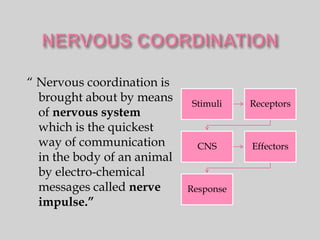
“ Nervous coordination is
  brought about by means     Stimuli    Receptors
  of nervous system
  which is the quickest
  way of communication         CNS      Effectors
  in the body of an animal
  by electro-chemical
  messages called nerve      Response
  impulse.”
Nervous system consists of two types of
   tissues:
 Neurons

 Neuroglia (glial cells)

Neuroglia are smaller cells which
1. Separate neurons from one another

2. Form myelin sheath

3. Involved in phagocytic functions
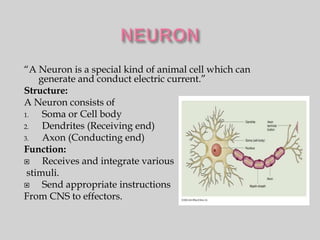
“A Neuron is a special kind of animal cell which can
    generate and conduct electric current.”
Structure:
A Neuron consists of
1.   Soma or Cell body
2.   Dendrites (Receiving end)
3.   Axon (Conducting end)
Function:
    Receives and integrate various
 stimuli.
    Send appropriate instructions
From CNS to effectors.
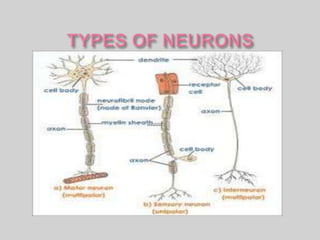
Functionally there are three types of neurons:
1. Sensory Neuron which carries sensory
   information from receptor to other neurons
   or directly to CNS.
2. Motor Neuron which takes commands of
   the control system to the effecter.
3. Inter Neuron found in central nervous
   system.
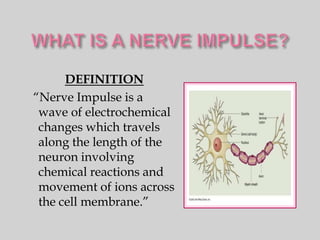
DEFINITION
“Nerve Impulse is a
 wave of electrochemical
 changes which travels
 along the length of the
 neuron involving
 chemical reactions and
 movement of ions across
 the cell membrane.”
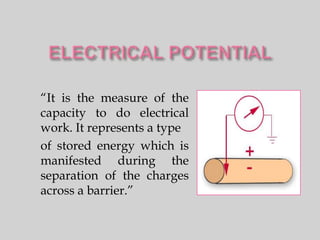
“It is the measure of the
capacity to do electrical
work. It represents a type
of stored energy which is
manifested during the
separation of the charges
across a barrier.”
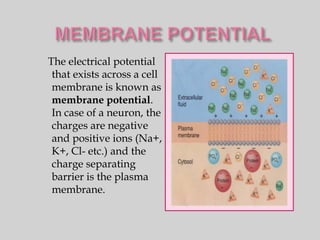
The electrical potential
 that exists across a cell
 membrane is known as
 membrane potential.
 In case of a neuron, the
 charges are negative
 and positive ions (Na+,
 K+, Cl- etc.) and the
 charge separating
 barrier is the plasma
 membrane.
   A typical neuron at rest is electrically more
    positive outside than inside the plasma
    membrane. The net difference in charge
    between the inner and outer surface of a
     non-conducting neuron is called the
    “Resting Membrane Potential or RMP.”
   No conduction of nerve impulse.
   Membrane potential is equal to -70 mV/-0.07V.
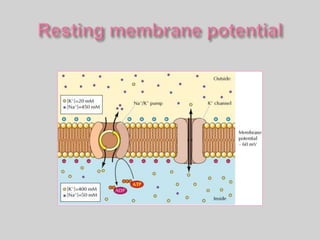
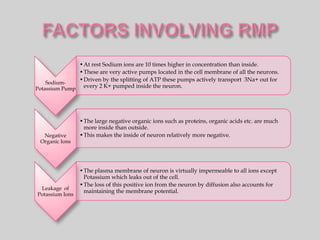
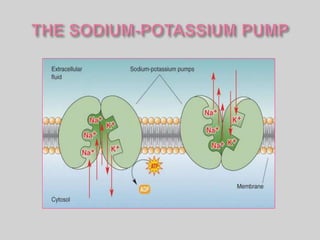
•At rest Sodium ions are 10 times higher in concentration than inside.
               •These are very active pumps located in the cell membrane of all the neurons.
               •Driven by the splitting of ATP these pumps actively transport 3Na+ out for
    Sodium-
Potassium Pump  every 2 K+ pumped inside the neuron.


                 •The large negative organic ions such as proteins, organic acids etc. are much
                  more inside than outside.
  Negative       •This makes the inside of neuron relatively more negative.
 Organic Ions


                 •The plasma membrane of neuron is virtually impermeable to all ions except
                  Potassium which leaks out of the cell.
                 •The loss of this positive ion from the neuron by diffusion also accounts for
 Leakage of
                  maintaining the membrane potential.
Potassium Ions
   A Nerve Impulse is initiated by an appropriate
    stimulus called “threshold stimulus.”
   Such a stimulus results in a remarkable localized
    change in resting membrane potential which is
    replaced by a new potential called “Active
    Membrane Potential (AMP) or Action Potential.”
   This change(depolarization)is for a brief instant(
    perhaps for a few milliseconds) due to the reversal
    of charges at the stimulated site of neurolemma.
   Conduction of nerve impulse.
   Membrane potential becomes +40mV/+0.04 V.
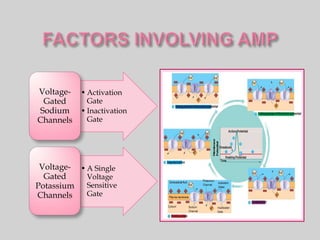
Voltage-   • Activation
 Gated       Gate
Sodium     • Inactivation
Channels     Gate


 Voltage- • A Single
  Gated     Voltage
Potassium   Sensitive
Channels    Gate
   The action potential or AMP is actually the
    Nerve Impulse.
   Once an action potential is triggered, the
    membrane potential goes through a
    stereotypical sequence of changes which
    involves the following steps:
    Depolarization
    Repolarization
    Hyper polarization
   The activation gate of Sodium channels
    opens rapidly causing an influx of Na+ ions.
   This influx of Na+ positively feedback to open
    all the Sodium channels at the stimulated site.
   Sodium permeability becomes 1000 times
    greater than at rest.
   The inner side of neurolemma becomes
    relatively more positive than the outer side.
   Membrane potential changes from -70mV to
    +40mV.
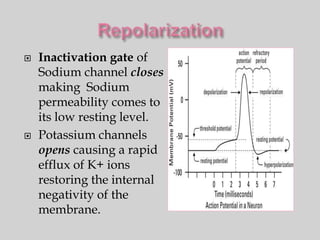
   Inactivation gate of
    Sodium channel closes
    making Sodium
    permeability comes to
    its low resting level.
   Potassium channels
    opens causing a rapid
    efflux of K+ ions
    restoring the internal
    negativity of the
    membrane.
   The continuous outflow of K+ ions makes the
    membrane potential more negative i.e.
    hyperpolarize it.
   During this phase, also called as undershoot,
    both the activation and inactivation gates of
    Sodium channel are closed.
   If a second depolarizing stimulus arrives
    during this phase, it will be unable to trigger an
    action potential.
   This period when a neuron is insensitive to
    depolarization is called “refractory period.”
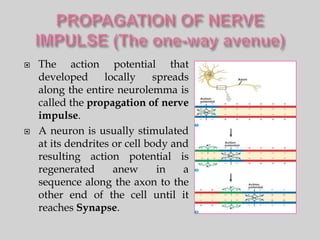
   The action potential that
    developed      locally    spreads
    along the entire neurolemma is
    called the propagation of nerve
    impulse.
   A neuron is usually stimulated
    at its dendrites or cell body and
    resulting action potential is
    regenerated      anew      in   a
    sequence along the axon to the
    other end of the cell until it
    reaches Synapse.
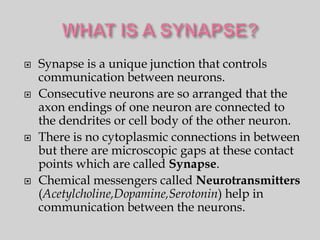
   Synapse is a unique junction that controls
    communication between neurons.
   Consecutive neurons are so arranged that the
    axon endings of one neuron are connected to
    the dendrites or cell body of the other neuron.
   There is no cytoplasmic connections in between
    but there are microscopic gaps at these contact
    points which are called Synapse.
   Chemical messengers called Neurotransmitters
    (Acetylcholine,Dopamine,Serotonin) help in
    communication between the neurons.
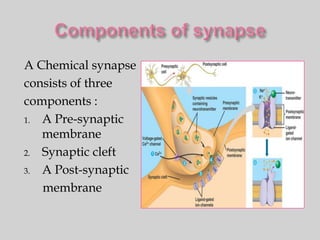
A Chemical synapse
consists of three
components :
1. A Pre-synaptic
   membrane
2. Synaptic cleft

3. A Post-synaptic

   membrane
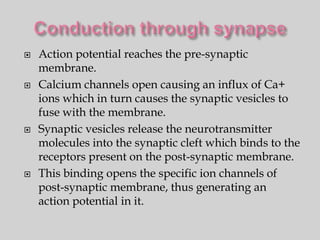
   Action potential reaches the pre-synaptic
    membrane.
   Calcium channels open causing an influx of Ca+
    ions which in turn causes the synaptic vesicles to
    fuse with the membrane.
   Synaptic vesicles release the neurotransmitter
    molecules into the synaptic cleft which binds to the
    receptors present on the post-synaptic membrane.
   This binding opens the specific ion channels of
    post-synaptic membrane, thus generating an
    action potential in it.
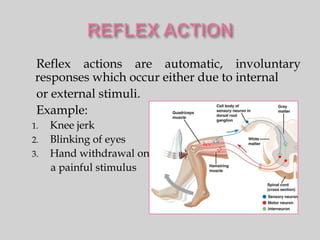
Reflex actions are automatic, involuntary
 responses which occur either due to internal
 or external stimuli.
 Example:
1.   Knee jerk
2.   Blinking of eyes
3.   Hand withdrawal on
     a painful stimulus

Nervous coordination

  • 1.
    “ Nervous coordinationis brought about by means Stimuli Receptors of nervous system which is the quickest way of communication CNS Effectors in the body of an animal by electro-chemical messages called nerve Response impulse.”
  • 2.
    Nervous system consistsof two types of tissues:  Neurons  Neuroglia (glial cells) Neuroglia are smaller cells which 1. Separate neurons from one another 2. Form myelin sheath 3. Involved in phagocytic functions
  • 3.
    “A Neuron isa special kind of animal cell which can generate and conduct electric current.” Structure: A Neuron consists of 1. Soma or Cell body 2. Dendrites (Receiving end) 3. Axon (Conducting end) Function:  Receives and integrate various stimuli.  Send appropriate instructions From CNS to effectors.
  • 4.
    Functionally there arethree types of neurons: 1. Sensory Neuron which carries sensory information from receptor to other neurons or directly to CNS. 2. Motor Neuron which takes commands of the control system to the effecter. 3. Inter Neuron found in central nervous system.
  • 6.
    DEFINITION “Nerve Impulse isa wave of electrochemical changes which travels along the length of the neuron involving chemical reactions and movement of ions across the cell membrane.”
  • 7.
    “It is themeasure of the capacity to do electrical work. It represents a type of stored energy which is manifested during the separation of the charges across a barrier.”
  • 8.
    The electrical potential that exists across a cell membrane is known as membrane potential. In case of a neuron, the charges are negative and positive ions (Na+, K+, Cl- etc.) and the charge separating barrier is the plasma membrane.
  • 9.
    A typical neuron at rest is electrically more positive outside than inside the plasma membrane. The net difference in charge between the inner and outer surface of a non-conducting neuron is called the “Resting Membrane Potential or RMP.”  No conduction of nerve impulse.  Membrane potential is equal to -70 mV/-0.07V.
  • 11.
    •At rest Sodiumions are 10 times higher in concentration than inside. •These are very active pumps located in the cell membrane of all the neurons. •Driven by the splitting of ATP these pumps actively transport 3Na+ out for Sodium- Potassium Pump every 2 K+ pumped inside the neuron. •The large negative organic ions such as proteins, organic acids etc. are much more inside than outside. Negative •This makes the inside of neuron relatively more negative. Organic Ions •The plasma membrane of neuron is virtually impermeable to all ions except Potassium which leaks out of the cell. •The loss of this positive ion from the neuron by diffusion also accounts for Leakage of maintaining the membrane potential. Potassium Ions
  • 13.
    A Nerve Impulse is initiated by an appropriate stimulus called “threshold stimulus.”  Such a stimulus results in a remarkable localized change in resting membrane potential which is replaced by a new potential called “Active Membrane Potential (AMP) or Action Potential.”  This change(depolarization)is for a brief instant( perhaps for a few milliseconds) due to the reversal of charges at the stimulated site of neurolemma.  Conduction of nerve impulse.  Membrane potential becomes +40mV/+0.04 V.
  • 14.
    Voltage- • Activation Gated Gate Sodium • Inactivation Channels Gate Voltage- • A Single Gated Voltage Potassium Sensitive Channels Gate
  • 15.
    The action potential or AMP is actually the Nerve Impulse.  Once an action potential is triggered, the membrane potential goes through a stereotypical sequence of changes which involves the following steps:  Depolarization  Repolarization  Hyper polarization
  • 16.
    The activation gate of Sodium channels opens rapidly causing an influx of Na+ ions.  This influx of Na+ positively feedback to open all the Sodium channels at the stimulated site.  Sodium permeability becomes 1000 times greater than at rest.  The inner side of neurolemma becomes relatively more positive than the outer side.  Membrane potential changes from -70mV to +40mV.
  • 17.
    Inactivation gate of Sodium channel closes making Sodium permeability comes to its low resting level.  Potassium channels opens causing a rapid efflux of K+ ions restoring the internal negativity of the membrane.
  • 18.
    The continuous outflow of K+ ions makes the membrane potential more negative i.e. hyperpolarize it.  During this phase, also called as undershoot, both the activation and inactivation gates of Sodium channel are closed.  If a second depolarizing stimulus arrives during this phase, it will be unable to trigger an action potential.  This period when a neuron is insensitive to depolarization is called “refractory period.”
  • 19.
    The action potential that developed locally spreads along the entire neurolemma is called the propagation of nerve impulse.  A neuron is usually stimulated at its dendrites or cell body and resulting action potential is regenerated anew in a sequence along the axon to the other end of the cell until it reaches Synapse.
  • 20.
    Synapse is a unique junction that controls communication between neurons.  Consecutive neurons are so arranged that the axon endings of one neuron are connected to the dendrites or cell body of the other neuron.  There is no cytoplasmic connections in between but there are microscopic gaps at these contact points which are called Synapse.  Chemical messengers called Neurotransmitters (Acetylcholine,Dopamine,Serotonin) help in communication between the neurons.
  • 21.
    A Chemical synapse consistsof three components : 1. A Pre-synaptic membrane 2. Synaptic cleft 3. A Post-synaptic membrane
  • 22.
    Action potential reaches the pre-synaptic membrane.  Calcium channels open causing an influx of Ca+ ions which in turn causes the synaptic vesicles to fuse with the membrane.  Synaptic vesicles release the neurotransmitter molecules into the synaptic cleft which binds to the receptors present on the post-synaptic membrane.  This binding opens the specific ion channels of post-synaptic membrane, thus generating an action potential in it.
  • 23.
    Reflex actions areautomatic, involuntary responses which occur either due to internal or external stimuli. Example: 1. Knee jerk 2. Blinking of eyes 3. Hand withdrawal on a painful stimulus