RECEPTORS 
Presented by 
VENKAT SANNAPU(11AB1R0057) 
Under the guidance of 
Mrs.B.DEEPTHI M.Pharm (PhD) 
VIGNAN PHARMACY COLLEGE 
(Affiliated to JNTU Kakinada Approved by PCI & AICTE, New Delhi) 
Vadlamudi , Guntur, Andhra Pradesh
CONTENTS 
 Introduction - receptor 
 Drug – receptor interactions 
 Ligand gated ion channel receptors 
 G – protein coupled receptors 
 Kinase liked receptors 
 Nuclear receptors 
 Comparison of receptor types 
 Conclusion 
 References 
RECEPTORS @ VPC 
2
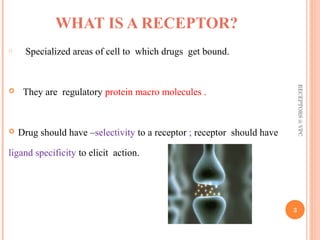
WHAT IS A RECEPTOR? 
o Specialized areas of cell to which drugs get bound. 
 They are regulatory protein macro molecules . 
 Drug should have –selectivity to a receptor ; receptor should have 
ligand specificity to elicit action. 
RECEPTORS @ VPC 
3
DRUG RECEPTOR INTERACTIONS 
 Effect of drug attributed to two factors 
1. Affinity : tendency of the drug to bind to receptor and form D-R 
complex . 
2. Efficacy or intrinsic activity : ability of the drug to trigger 
pharmacological responses after forming D-R complex . 
RECEPTORS @ VPC 
4
CONTD… 
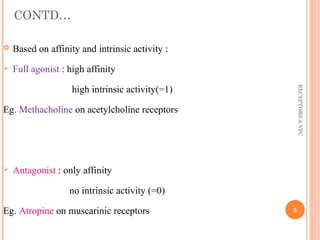
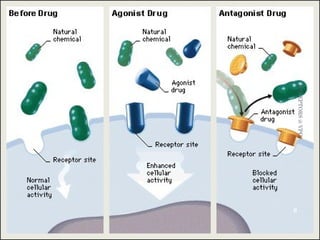
 Based on affinity and intrinsic activity : 
 Full agonist : high affinity 
high intrinsic activity(=1) 
Eg. Methacholine on acetylcholine receptors 
 Antagonist : only affinity 
no intrinsic activity (=0) 
Eg. Atropine on muscarinic receptors 
RECEPTORS @ VPC 
5
RECEPTORS @ VPC 
6
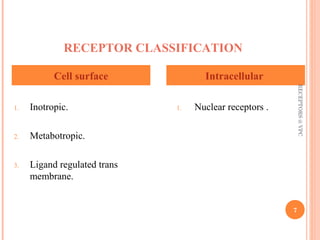
RECEPTOR CLASSIFICATION 
Cell surface Intracellular 
1. Inotropic. 
2. Metabotropic. 
3. Ligand regulated trans 
membrane. 
1. Nuclear receptors . 
RECEPTORS @ VPC 
7
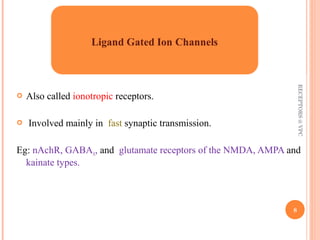
 Also called ionotropic receptors. 
 Involved mainly in fast synaptic transmission. 
RECEPTORS @ VPC 
Eg: nAchR, GABAA, and glutamate receptors of the NMDA, AMPA and 
kainate types. 
8
FEATURES – ION CHANNELS 
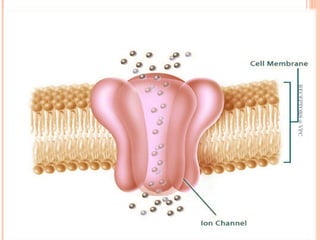
 Protein molecules form water filled 
pores that span the membrane. 
 Switch between open and closed states. 
RECEPTORS @ VPC 
 Rate and Direction of movement depends on electrochemical gradient of 
the ions 
9
MOLECULAR STRUCTURE 
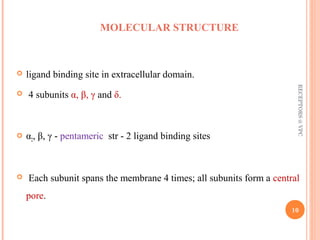
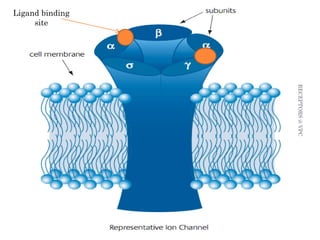
 ligand binding site in extracellular domain. 
 4 subunits α, β, γ and δ. 
 α2, β, γ - pentameric str - 2 ligand binding sites 
RECEPTORS @ VPC 
 Each subunit spans the membrane 4 times; all subunits form a central 
pore. 
10
Ligand binding 
site 
RECEPTORS @ VPC 
11
RECEPTORS @ VPC 
12
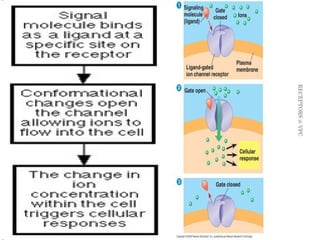
Mechanism of 
receptor action 
RECEPTORS @ VPC 
13
RECEPTORS @ VPC 
14
CONTD… 
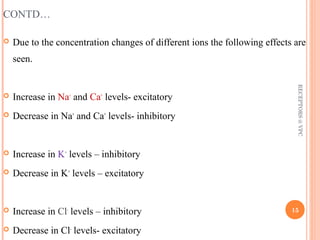
 Due to the concentration changes of different ions the following effects are 
seen. 
 Increase in Na+ and Ca+ levels- excitatory 
 Decrease in Na+ and Ca+ levels- inhibitory 
 Increase in K+ levels – inhibitory 
 Decrease in K+ levels – excitatory 
 Increase in Cl- levels – inhibitory 
 Decrease in Cl- levels- excitatory 
RECEPTORS @ VPC 
15
ION CHANNELS - IMPORTANCE 
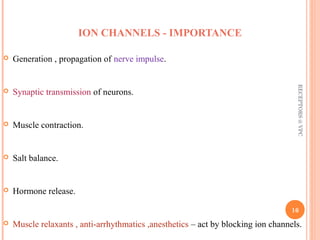
 Generation , propagation of nerve impulse. 
 Synaptic transmission of neurons. 
 Muscle contraction. 
 Salt balance. 
 Hormone release. 
RECEPTORS @ VPC 
16 
 Muscle relaxants , anti-arrhythmatics ,anesthetics – act by blocking ion channels.
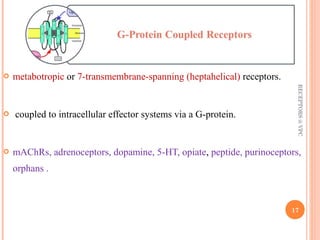
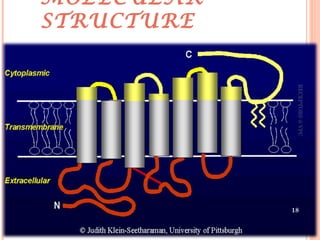
 metabotropic or 7-transmembrane-spanning (heptahelical) receptors. 
 coupled to intracellular effector systems via a G-protein. 
RECEPTORS @ VPC 
 mAChRs, adrenoceptors, dopamine, 5-HT, opiate, peptide, purinoceptors, 
orphans . 
17
MOLECULAR 
STRUCTURE 
RECEPTORS @ VPC 
18
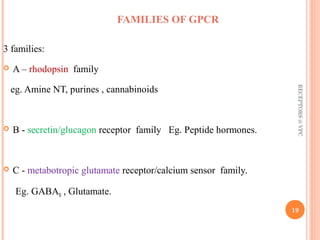
FAMILIES OF GPCR 
3 families: 
 A – rhodopsin family 
eg. Amine NT, purines , cannabinoids 
 B - secretin/glucagon receptor family Eg. Peptide hormones. 
 C - metabotropic glutamate receptor/calcium sensor family. 
Eg. GABAB , Glutamate. 
RECEPTORS @ VPC 
19
G-PROTEIN -ROLE 
 Membrane resident proteins – recognize activated GPCRs- pass message to 
effector system. 
 Occurs in interaction with guanine nucleotides ; freely moving in cytoplasm. 
 α, β and γ subunits – trimer in resting state. 
 3 subunits attached to GPCR through fatty acid chain – reaction called 
prenylation. 
RECEPTORS @ VPC 
20
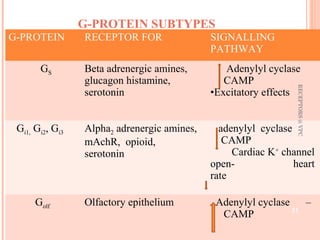
G-PROTEIN SUBTYPES 
G-PROTEIN RECEPTOR FOR SIGNALLING 
PATHWAY 
GS Beta adrenergic amines, 
glucagon histamine, 
serotonin 
Adenylyl cyclase 
CAMP 
•Excitatory effects 
Gi1, Gi2, Gi3 Alpha2 adrenergic amines, 
mAchR, opioid, 
serotonin 
adenylyl cyclase 
CAMP 
Cardiac K+ channel 
open- heart 
rate 
Golf Olfactory epithelium Adenylyl cyclase – 
CAMP 
RECEPTORS @ VPC 
21
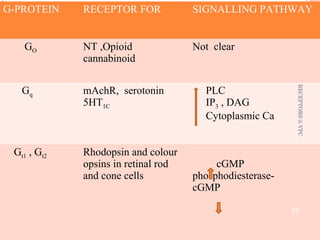
G-PROTEIN RECEPTOR FOR SIGNALLING PATHWAY 
GO NT ,Opioid 
cannabinoid 
Not clear 
Gq mAchR, serotonin 
5HT1C 
PLC 
IP3 , DAG 
Cytoplasmic Ca 
Gt1 , Gt2 Rhodopsin and colour 
opsins in retinal rod 
and cone cells 
cGMP 
phosphodiesterase-cGMP 
RECEPTORS @ VPC 
22
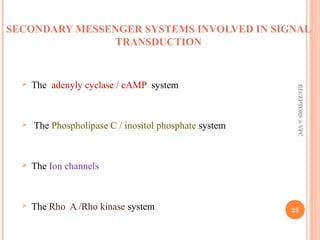
SECONDARY MESSENGER SYSTEMS INVOLVED IN SIGNAL 
TRANSDUCTION 
 The adenyly cyclase / cAMP system 
 The Phospholipase C / inositol phosphate system 
 The Ion channels 
 The Rho A /Rho kinase system 
RECEPTORS @ VPC 
23
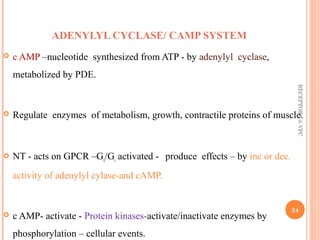
ADENYLYL CYCLASE/ CAMP SYSTEM 
 c AMP –nucleotide synthesized from ATP - by adenylyl cyclase, 
metabolized by PDE. 
 Regulate enzymes of metabolism, growth, contractile proteins of muscle. 

 NT - acts on GPCR –Gs/Gi activated - produce effects – by inc or dec. 
activity of adenylyl cylase-and cAMP. 
 c AMP- activate - Protein kinases-activate/inactivate enzymes by 
phosphorylation – cellular events. 
RECEPTORS @ VPC 
24
PHOSPHOLIPASE C-INOSITOL SYSTEM 
 Phospholipase C : Cleaves membrane phospholipids - phosphoinositides. 
 PLC beta – cleaves phosphatidylinositol(4,5)bis Phosphate PIP2 - into DAG 
and IP3. 
 DAG and IP3 - Secondary messenegers – elicit cellular responses. 
RECEPTORS @ VPC 
25
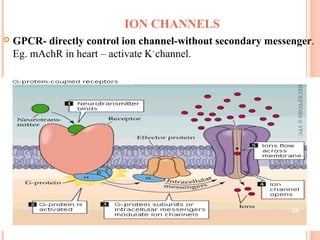
ION CHANNELS 
 GPCR- directly control ion channel-without secondary messenger. 
Eg. mAchR in heart – activate K+ channel. 
RECEPTORS @ VPC 
26
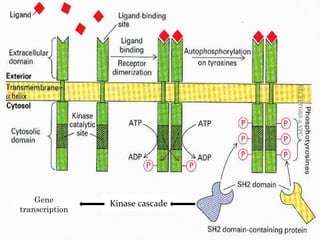
 Involved in growth, proliferation, differentiation or survival-called growth 
factors. 
 Mediate actions of protein mediators- GF, cytokines , harmones - insulin and 
leptin. 
 Slow – require the expression of new genes. 
 Single membrane spanning helix - extracellular ligand binding domain - 
intracellular domain. 
RECEPTORS @ VPC 
27
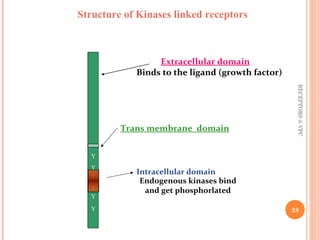
Structure of Kinases linked receptors 
Y 
Y 
Y 
Y 
Y 
Y 
Extracellular domain 
Binds to the ligand (growth factor) 
Trans membrane domain 
Intracellular domain 
Endogenous kinases bind 
and get phosphorlated 
RECEPTORS @ VPC 
28
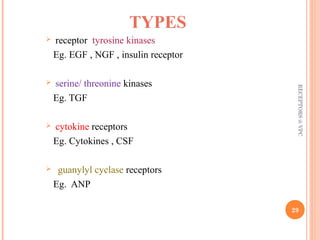
TYPES 
 receptor tyrosine kinases 
Eg. EGF , NGF , insulin receptor 
 serine/ threonine kinases 
Eg. TGF 
 cytokine receptors 
Eg. Cytokines , CSF 
 guanylyl cyclase receptors 
Eg. ANP 
RECEPTORS @ VPC 
29
Gene Kinase cascade 
transcription 
RECEPTORS @ VPC 
30
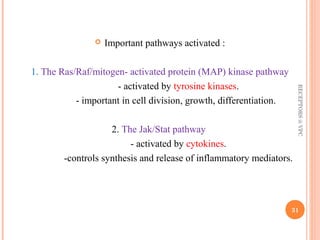
 Important pathways activated : 
1. The Ras/Raf/mitogen- activated protein (MAP) kinase pathway 
- activated by tyrosine kinases. 
- important in cell division, growth, differentiation. 
2. The Jak/Stat pathway 
- activated by cytokines. 
-controls synthesis and release of inflammatory mediators. 
RECEPTORS @ VPC 
31
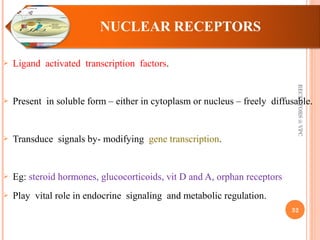
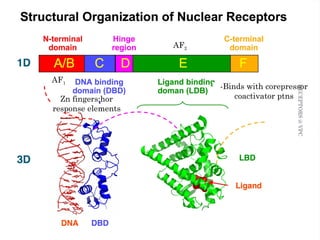
 Ligand activated transcription factors. 
 Present in soluble form – either in cytoplasm or nucleus – freely diffusable. 
 Transduce signals by- modifying gene transcription. 
 Eg: steroid hormones, glucocorticoids, vit D and A, orphan receptors 
 Play vital role in endocrine signaling and metabolic regulation. 
RECEPTORS @ VPC 
32
Zn fingers;hor 
response elements 
-Binds with corepressor 
coactivator ptns 
AF1 
AF2 
RECEPTORS @ VPC 
33
CONCLUSION 
 Extensive research done on Receptor pharmacology -lead to discovery of 
new drug targets for treatment of several diseases. 
 Still requires discovery of new receptor types and the mechanisms of many 
orphan receptors that can result in effective treatment of many diseases. 
 Requires development of receptor crystallization etc. 
 Much to be discovered about the nuclear receptors. 
RECEPTORS @ VPC 
34
ACKNOWLEDGEMENT 
 I would like to thank my guide, Mrs. B. Deepthi for her 
constant guidance and support . 
 I would also like to thank our principal, Mr. P. Srinivasa 
Babu and the seminar committee for giving me this 
opportunity. 
RECEPTORS @ VPC 
35
REFERENCES 
 Rang , Dale, Ritter ,Flower :Rang and Dale’s, 
pharmacology;6th edition, Churchill Livingstone;2008, 
9-52. 
 Bertram G. Katzung , Basic and clinical pharmacology; 
10th edition ; 2006 , 197-209 
 KD Tripati , essentials of medical pharmacology ; 6th 
edition; 2008, 40-52. 
 RICHARD’s LIPPINCOTT’s illustrated reviews of 
PHARMACOLOGY , 4th edition , Page no 25 – 34. 
RECEPTORS @ VPC 
36
RECEPTORS @ VPC 
37

Receptors

  • 1.
    RECEPTORS Presented by VENKAT SANNAPU(11AB1R0057) Under the guidance of Mrs.B.DEEPTHI M.Pharm (PhD) VIGNAN PHARMACY COLLEGE (Affiliated to JNTU Kakinada Approved by PCI & AICTE, New Delhi) Vadlamudi , Guntur, Andhra Pradesh
  • 2.
    CONTENTS  Introduction- receptor  Drug – receptor interactions  Ligand gated ion channel receptors  G – protein coupled receptors  Kinase liked receptors  Nuclear receptors  Comparison of receptor types  Conclusion  References RECEPTORS @ VPC 2
  • 3.
    WHAT IS ARECEPTOR? o Specialized areas of cell to which drugs get bound.  They are regulatory protein macro molecules .  Drug should have –selectivity to a receptor ; receptor should have ligand specificity to elicit action. RECEPTORS @ VPC 3
  • 4.
    DRUG RECEPTOR INTERACTIONS  Effect of drug attributed to two factors 1. Affinity : tendency of the drug to bind to receptor and form D-R complex . 2. Efficacy or intrinsic activity : ability of the drug to trigger pharmacological responses after forming D-R complex . RECEPTORS @ VPC 4
  • 5.
    CONTD…  Basedon affinity and intrinsic activity :  Full agonist : high affinity high intrinsic activity(=1) Eg. Methacholine on acetylcholine receptors  Antagonist : only affinity no intrinsic activity (=0) Eg. Atropine on muscarinic receptors RECEPTORS @ VPC 5
  • 6.
  • 7.
    RECEPTOR CLASSIFICATION Cellsurface Intracellular 1. Inotropic. 2. Metabotropic. 3. Ligand regulated trans membrane. 1. Nuclear receptors . RECEPTORS @ VPC 7
  • 8.
     Also calledionotropic receptors.  Involved mainly in fast synaptic transmission. RECEPTORS @ VPC Eg: nAchR, GABAA, and glutamate receptors of the NMDA, AMPA and kainate types. 8
  • 9.
    FEATURES – IONCHANNELS  Protein molecules form water filled pores that span the membrane.  Switch between open and closed states. RECEPTORS @ VPC  Rate and Direction of movement depends on electrochemical gradient of the ions 9
  • 10.
    MOLECULAR STRUCTURE ligand binding site in extracellular domain.  4 subunits α, β, γ and δ.  α2, β, γ - pentameric str - 2 ligand binding sites RECEPTORS @ VPC  Each subunit spans the membrane 4 times; all subunits form a central pore. 10
  • 11.
    Ligand binding site RECEPTORS @ VPC 11
  • 12.
  • 13.
    Mechanism of receptoraction RECEPTORS @ VPC 13
  • 14.
  • 15.
    CONTD…  Dueto the concentration changes of different ions the following effects are seen.  Increase in Na+ and Ca+ levels- excitatory  Decrease in Na+ and Ca+ levels- inhibitory  Increase in K+ levels – inhibitory  Decrease in K+ levels – excitatory  Increase in Cl- levels – inhibitory  Decrease in Cl- levels- excitatory RECEPTORS @ VPC 15
  • 16.
    ION CHANNELS -IMPORTANCE  Generation , propagation of nerve impulse.  Synaptic transmission of neurons.  Muscle contraction.  Salt balance.  Hormone release. RECEPTORS @ VPC 16  Muscle relaxants , anti-arrhythmatics ,anesthetics – act by blocking ion channels.
  • 17.
     metabotropic or7-transmembrane-spanning (heptahelical) receptors.  coupled to intracellular effector systems via a G-protein. RECEPTORS @ VPC  mAChRs, adrenoceptors, dopamine, 5-HT, opiate, peptide, purinoceptors, orphans . 17
  • 18.
  • 19.
    FAMILIES OF GPCR 3 families:  A – rhodopsin family eg. Amine NT, purines , cannabinoids  B - secretin/glucagon receptor family Eg. Peptide hormones.  C - metabotropic glutamate receptor/calcium sensor family. Eg. GABAB , Glutamate. RECEPTORS @ VPC 19
  • 20.
    G-PROTEIN -ROLE Membrane resident proteins – recognize activated GPCRs- pass message to effector system.  Occurs in interaction with guanine nucleotides ; freely moving in cytoplasm.  α, β and γ subunits – trimer in resting state.  3 subunits attached to GPCR through fatty acid chain – reaction called prenylation. RECEPTORS @ VPC 20
  • 21.
    G-PROTEIN SUBTYPES G-PROTEINRECEPTOR FOR SIGNALLING PATHWAY GS Beta adrenergic amines, glucagon histamine, serotonin Adenylyl cyclase CAMP •Excitatory effects Gi1, Gi2, Gi3 Alpha2 adrenergic amines, mAchR, opioid, serotonin adenylyl cyclase CAMP Cardiac K+ channel open- heart rate Golf Olfactory epithelium Adenylyl cyclase – CAMP RECEPTORS @ VPC 21
  • 22.
    G-PROTEIN RECEPTOR FORSIGNALLING PATHWAY GO NT ,Opioid cannabinoid Not clear Gq mAchR, serotonin 5HT1C PLC IP3 , DAG Cytoplasmic Ca Gt1 , Gt2 Rhodopsin and colour opsins in retinal rod and cone cells cGMP phosphodiesterase-cGMP RECEPTORS @ VPC 22
  • 23.
    SECONDARY MESSENGER SYSTEMSINVOLVED IN SIGNAL TRANSDUCTION  The adenyly cyclase / cAMP system  The Phospholipase C / inositol phosphate system  The Ion channels  The Rho A /Rho kinase system RECEPTORS @ VPC 23
  • 24.
    ADENYLYL CYCLASE/ CAMPSYSTEM  c AMP –nucleotide synthesized from ATP - by adenylyl cyclase, metabolized by PDE.  Regulate enzymes of metabolism, growth, contractile proteins of muscle.  NT - acts on GPCR –Gs/Gi activated - produce effects – by inc or dec. activity of adenylyl cylase-and cAMP.  c AMP- activate - Protein kinases-activate/inactivate enzymes by phosphorylation – cellular events. RECEPTORS @ VPC 24
  • 25.
    PHOSPHOLIPASE C-INOSITOL SYSTEM  Phospholipase C : Cleaves membrane phospholipids - phosphoinositides.  PLC beta – cleaves phosphatidylinositol(4,5)bis Phosphate PIP2 - into DAG and IP3.  DAG and IP3 - Secondary messenegers – elicit cellular responses. RECEPTORS @ VPC 25
  • 26.
    ION CHANNELS GPCR- directly control ion channel-without secondary messenger. Eg. mAchR in heart – activate K+ channel. RECEPTORS @ VPC 26
  • 27.
     Involved ingrowth, proliferation, differentiation or survival-called growth factors.  Mediate actions of protein mediators- GF, cytokines , harmones - insulin and leptin.  Slow – require the expression of new genes.  Single membrane spanning helix - extracellular ligand binding domain - intracellular domain. RECEPTORS @ VPC 27
  • 28.
    Structure of Kinaseslinked receptors Y Y Y Y Y Y Extracellular domain Binds to the ligand (growth factor) Trans membrane domain Intracellular domain Endogenous kinases bind and get phosphorlated RECEPTORS @ VPC 28
  • 29.
    TYPES  receptortyrosine kinases Eg. EGF , NGF , insulin receptor  serine/ threonine kinases Eg. TGF  cytokine receptors Eg. Cytokines , CSF  guanylyl cyclase receptors Eg. ANP RECEPTORS @ VPC 29
  • 30.
    Gene Kinase cascade transcription RECEPTORS @ VPC 30
  • 31.
     Important pathwaysactivated : 1. The Ras/Raf/mitogen- activated protein (MAP) kinase pathway - activated by tyrosine kinases. - important in cell division, growth, differentiation. 2. The Jak/Stat pathway - activated by cytokines. -controls synthesis and release of inflammatory mediators. RECEPTORS @ VPC 31
  • 32.
     Ligand activatedtranscription factors.  Present in soluble form – either in cytoplasm or nucleus – freely diffusable.  Transduce signals by- modifying gene transcription.  Eg: steroid hormones, glucocorticoids, vit D and A, orphan receptors  Play vital role in endocrine signaling and metabolic regulation. RECEPTORS @ VPC 32
  • 33.
    Zn fingers;hor responseelements -Binds with corepressor coactivator ptns AF1 AF2 RECEPTORS @ VPC 33
  • 34.
    CONCLUSION  Extensiveresearch done on Receptor pharmacology -lead to discovery of new drug targets for treatment of several diseases.  Still requires discovery of new receptor types and the mechanisms of many orphan receptors that can result in effective treatment of many diseases.  Requires development of receptor crystallization etc.  Much to be discovered about the nuclear receptors. RECEPTORS @ VPC 34
  • 35.
    ACKNOWLEDGEMENT  Iwould like to thank my guide, Mrs. B. Deepthi for her constant guidance and support .  I would also like to thank our principal, Mr. P. Srinivasa Babu and the seminar committee for giving me this opportunity. RECEPTORS @ VPC 35
  • 36.
    REFERENCES  Rang, Dale, Ritter ,Flower :Rang and Dale’s, pharmacology;6th edition, Churchill Livingstone;2008, 9-52.  Bertram G. Katzung , Basic and clinical pharmacology; 10th edition ; 2006 , 197-209  KD Tripati , essentials of medical pharmacology ; 6th edition; 2008, 40-52.  RICHARD’s LIPPINCOTT’s illustrated reviews of PHARMACOLOGY , 4th edition , Page no 25 – 34. RECEPTORS @ VPC 36
  • 37.

Editor's Notes