Chapter

CELL CYCLE
Why Is Cell Division Important
 What do you, an octopus, and an oak tree
 all have in common?
You are all made of many cells, trillions of
 them!
Many multi-celled organisms start off as just
 one single cell. And this single divides to
 become 2 cells which divide to become 4
 cells and then 8 and 16 and so forth.
Why Is Cell Division Important
Many celled organisms are able to grow
and develop because cell division
increases the total number of cells in an
organism.
Even after we stop growing cell division is
very important.
Everyday billions of red blood cells are
replaced by new ones through cell
division.
Why Is Cell Division Important
Cell division is not just important to multi-
celled organisms. It is also important to
single celled organisms, like bacteria and
algae.
All cells go through cell division in what is
called the cell cycle or the cell life cycle.
The cell cycle begins with the formation of
a cell of an organism.
This formation is followed by growth and
finally ends in the death of the cell.
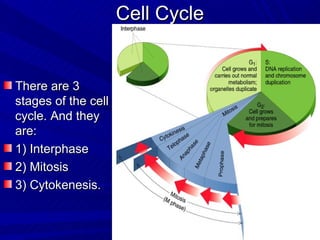
Cell Cycle


There are 3
stages of the cell
cycle. And they
are:
1) Interphase
2) Mitosis
3) Cytokenesis.
Cell Cycle
1) Interphase- during this first stage of the
   cell cycle, the cell grows and duplicates
   its organelles and chromosomes in order
   to prepare for mitosis.
2) Mitosis- Is stage 2 of the cell cycle. And
   mitosis is the way that all of our cell go
   through cell division.
3) The third stage of the cell cycle is called
   cytokenesis. Here the cytoplasm of the
   parent cell is evenly distributed into the
   two new daughter cells or offspring.
Interphase
Most of the life of any cell is spent in Interphase, in
which the cell grows and develops.

Also, during the later part of interphase the cell
duplicates all of its chromosomes, which hold all of our
genetic material and prepares to undergo a form of
cell division called mitosis.
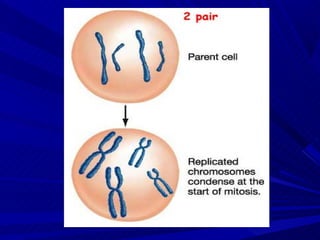
When chromosomes duplicate they form 2
chromatids.
You are able to grow and develop because of mitosis,
the process in which one cell splits its nuclei and its
DNA to produce two exact genetic copies of itself.

The cells want to duplicate or copy its chromosomes
before mitosis so that the two new cells that are going
to be made have an equal amount of chromosomes in
Cell Division or Mitosis
Cells go through mitosis in order to
assure that each new cell receives
exactly the same information as the
cell it came from.
Also, cells go through mitosis in order
to grow and replace dead or
damaged cells, like when you get a
cut, or break a bone.
5 Stages of Mitosis.
     Mitosis occurs in 5 stages, and they are
     called:
1)   Prophase
2)   Metaphase
3)   Anaphase
4)   Telophase
Mitosis
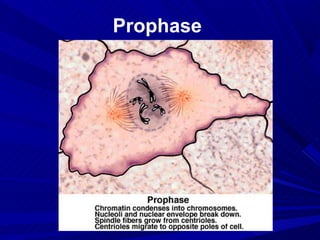
1) Prophase- Here, the chromatids
    become visible because the nucleus is
    breaking down and the spindle
    apparatus, which is used to separate
    the chromosomes is formed.
 - The spindle apparatus is a set of thread
    like fibers that are made by an organelle
    called a centriole.
And it is used to pull the duplicated
    chromatids apart so that each new cell
    can have an equal amount of
    chromosomes.
Prophase
Mitosis
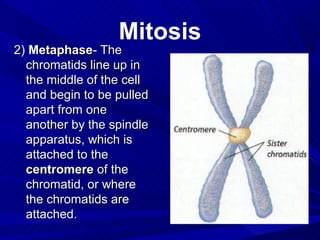
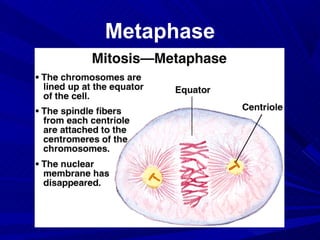
2) Metaphase- The
  chromatids line up in
  the middle of the cell
  and begin to be pulled
  apart from one
  another by the spindle
  apparatus, which is
  attached to the
  centromere of the
  chromatid, or where
  the chromatids are
  attached.
Metaphase
Mitosis
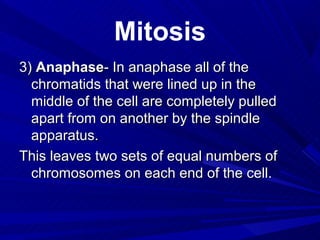
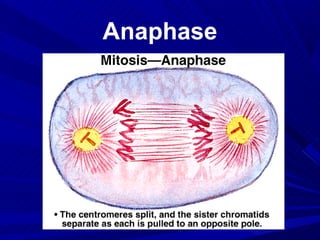
3) Anaphase- In anaphase all of the
  chromatids that were lined up in the
  middle of the cell are completely pulled
  apart from on another by the spindle
  apparatus.
This leaves two sets of equal numbers of
  chromosomes on each end of the cell.
Anaphase
Mitosis
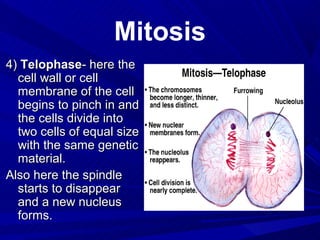
4) Telophase- here the
  cell wall or cell
  membrane of the cell
  begins to pinch in and
  the cells divide into
  two cells of equal size
  with the same genetic
  material.
Also here the spindle
  starts to disappear
  and a new nucleus
  forms.
Stage 3 of the Cell Cycle:
          Cytokenesis
In animal cells, the cell membrane pinches
and the cytoplasm of the parent cell is
divided into the two new cells.

In plant cells, after telophase a cell plate
is formed in order to allow the proper
formation of the cell wall.
The presence of the cell plate tells you
that the cell is in the stage of cytokenesis.
Results of Mitosis
You should remember 2 important facts
   about mitosis:
1) It is the division of the nucleus.
2) It produces 2 new nuclei that are
   identical to each other and also identical
   to the original parent cell.
Reproduction
The method in which an organism can produce
a new organism from one parent is called, what?
Asexual reproduction
In asexual reproduction, all the DNA in the new
organism comes from only one parent.
A potato uses asexual reproduction, so every
potato that comes from one parent potato will
have the same DNA as that parent.
There are 2 ways in which
    reproduction from one parent
               occurs.
1) By Splitting-bacteria and other single
  celled organisms divide in half,
  forming two new cells.
When the cell divides, each new cell gets
  an exact copy of the parents DNA.
Now the two new cells are exactly alike
  and the parent cell no longer exists.
There are 2 ways in which reproduction from
             one parent occurs.
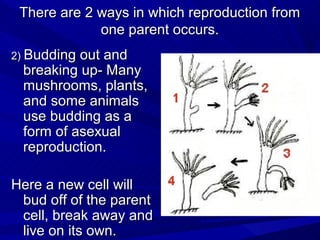
2) Buddingout and
 breaking up- Many
 mushrooms, plants,
 and some animals
 use budding as a
 form of asexual
 reproduction.

Here a new cell will
 bud off of the parent
 cell, break away and
 live on its own.
Budding & Regeneration
Ex: If you cut a piece of ivy, that piece that
you cut can be planted and grow to a new
plant.

In a process called regeneration some
organisms are able to replace body parts
that have been lost because of injury.
Sexual Reproduction
In sexual reproduction- a new organism is
produced from two parents.
During this process, DNA from both parents
combine to form a new individual with its own
DNA.

In Chapter 3 we spoke of how there are
different cells for different function in the human
body.
For sexual reproduction have cells called sex
cells.
Sex cells
   There are two types of sex cells:
1) Sperm- a male sex cells that form in male
   reproductive organs.
2) Ova or egg- a female sex cell which will
   form within the female reproductive organs.

Body cells or non sex cells in your body have
   46 chromosomes and are called diploid
   because each chromosome has a pair.
And when they divide the new cells gets all 46
   chromosomes that the original had, and we
   said that this process was called mitosis.
Sex Cells

Sex cells are a little different. They go
through a process called meiosis, which is
the formation of sex cells.
Sex cells only contain 23 chromosomes and
are called haploid.
These cells have half the amount that a
normal non-sex cell would have.
So when they divide only 23 chromosomes
are given to the new cell.
Sex Cells
So, each sperm and egg have 23 chromosomes
and when they join in a process called
fertilization, the result or offspring has a full set
of 46 chromosomes.
After these sex cells combine and fertilization
occurs the resulting cell that is formed is called a
zygote.
As soon as the zygote is formed, it then begins
to go through cell division.
Meiosis
Meiosis only occurs with respect to sex cells.
And meiosis produces more haploid sex cells.
Meiosis ensures that the offspring between 2
organisms will result in an offspring that has the
same amount of chromosomes, 46, as the
original parents had.
During Meiosis 2 divisions of the nucleus occurs.
These two divisions are called Meiosis I and
Meiosis II
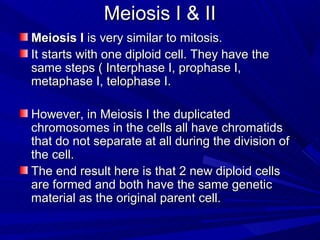
Meiosis I & II
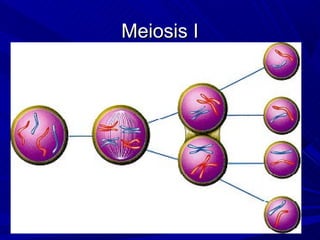
Meiosis I is very similar to mitosis.
It starts with one diploid cell. They have the
same steps ( Interphase I, prophase I,
metaphase I, telophase I.

However, in Meiosis I the duplicated
chromosomes in the cells all have chromatids
that do not separate at all during the division of
the cell.
The end result here is that 2 new diploid cells
are formed and both have the same genetic
material as the original parent cell.
Meiosis I
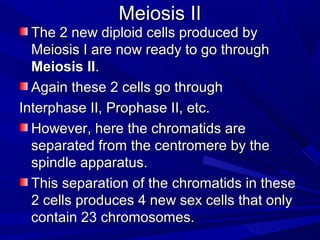
Meiosis II
  The 2 new diploid cells produced by
  Meiosis I are now ready to go through
  Meiosis II.
  Again these 2 cells go through
Interphase II, Prophase II, etc.
  However, here the chromatids are
  separated from the centromere by the
  spindle apparatus.
  This separation of the chromatids in these
  2 cells produces 4 new sex cells that only
  contain 23 chromosomes.
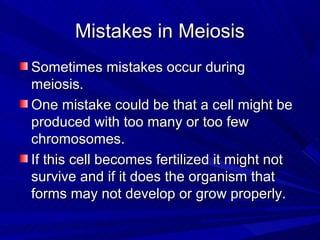
Mistakes in Meiosis
Sometimes mistakes occur during
meiosis.
One mistake could be that a cell might be
produced with too many or too few
chromosomes.
If this cell becomes fertilized it might not
survive and if it does the organism that
forms may not develop or grow properly.
DNA
DNA- Deoxyribonucleic acid contains all
the information that an organism needs to
grow and develop.
DNA, as we know, is contained inside all
cells in their nuclei. And when a cell
divides, DNA is copied and passed on to
the new cells, or daughter, cells that are
formed.
Cells do this to ensure that all new cells
receive the same coded information that
was in the original cell.
Discovery of DNA
In the 1800’s scientists knew that inside the
nucleus of all cells were large molecules called
nucleic acids, however they did not know what
they were used for.
In the 1950’s, scientists identified what the
nucleic acids were and named them Adenine,
Thymine, Guanine, and Cytosine. But they still
didn’t know how they were arranged or put
together.
In 1952, a scientist named Rosalind Franklin
discovered that DNA was composed of 2 chains
of molecules in a spiral shape or a twisted
ladder shape.
This twisted ladder or spiral staircase shape is
called a helix. And DNA, since it has 2 chains is
called a double helix.
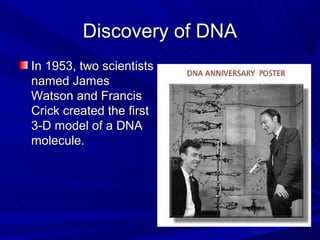
Discovery of DNA
In 1953, two scientists
named James
Watson and Francis
Crick created the first
3-D model of a DNA
molecule.
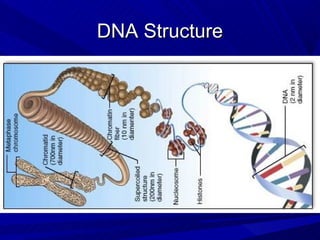
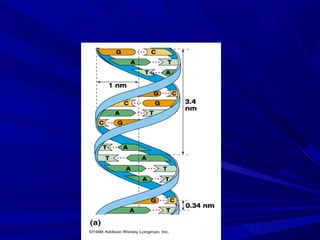
DNA Structure
DNA Model
Each side of the DNA ladder is made up of
a 5 carbon sugar molecule with a
phosphate molecule attached to it.
Because of this, we call the sides of the
ladder the sugar-phosphate backbone of
DNA.
The sugar here in the backbone is a
deoxyribose sugar. Meaning it has 2
oxygen molecules and a ribose sugar.
DNA Model
The rungs of this ladder that connect the
two sides are the nucleic acids Adenine,
guanine, cytosine, and thymine.
Another name for a nucleic acid is
nitrogenous base, because all 4 of them
contain nitrogen.
When these nitrogen bases interact they
are called base pairs.
DNA Model
These nucleic acids are very specific when it
comes to binding.
Adenine will only bind to Thymine
Guanine will only bind to Cytosine
A-T & G-C We now this because when
scientists measured the amounts of these
nucleic acids they found that in every cell the
amount of Adenine was always the same as the
amount of thymine.
 And the amount of Guanine was always equal
to the amount of cytosine
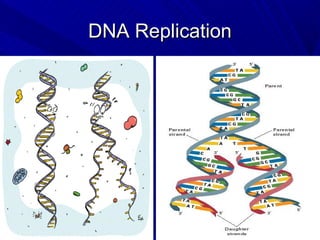
Copying DNA
We said that before mitosis, in interphase,
chromosomes inside the nucleus are
duplicated.
The Watson and Crick model shows that
when this happens each side of the DNA
unwind from each other.
Now the two separate sides each become
a template for a new piece of DNA to be
made from.
DNA Replication
Genes
The nucleic acids in our DNA are used to
make proteins.
Genes are the specific instructions for
making specific proteins.
And proteins are made of hundreds of
thousands of things called amino acids.
The genes tells what amino acids to make
and in what order to make them in.
Ribonucleic acid
RNA is made in the nucleus on a DNA pattern.
It is very similar to DNA, but instead of looking
like a ladder, it looks like half a ladder. And
instead of deoxyribose it has a ribose sugar.
There is also one other major chemical
difference. Instead of having thymine like DNA.
RNA has a nucleic acid called Uracil.
So in RNA A binds to U not to T.
G will always bind to C, even in RNA
Main types of RNA
mRNA- messenger RNA
rRNA- ribosomal RNA
tRNA- transverse RNA
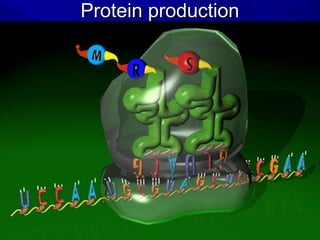
How Proteins are Made
     Proteins are made in a couple of steps:
1)   First, tRNA makes a copy of the DNA section that is
     needed for the production of a protein, in the form of
     mRNA. ( this occurs inside the nucleus)
2)   Next, the mRNA, which is an exact copy of the DNA,
     is shipped to a ribosome in the cytoplasm.
3)   The mRNA attaches to the ribosome, which is made
     of rRNA. The ribosome now reads the mRNA and
     begins to make the amino acids that the nucleic
     acids tell it to make.
4)   Lastly, tRNA takes the amino acids made by the
     ribosome and puts them together in the order in
     which the ribosome made them.
Protein production
Mutations
Mutations a source of trait variation.
A mutation is a permanent change in a gene or
a chromosome due to some error during cell
division.
Some mutations could be caused from outside
sources like UV light from the sun or smoking.
Some mutations occur because they are
present on the parent DNA and it is passed
down to the offspring. Or, the DNA is not
copied correctly during cell division.
Not all mutations are of the negative variety.
Some are good. Like a 4 leaf clover. Normally it
will have 3 leaves but due to a mutation it has
4. This is good because the extra leaf can trap
more sunlight for photosynthesis.
H.W
& Look though your notes and
see if you have any questions
      about the Chapter.
Test on Chapter 4 in one
         Week!!!!!

chapter 4

  • 1.
  • 2.
    Why Is CellDivision Important What do you, an octopus, and an oak tree all have in common? You are all made of many cells, trillions of them! Many multi-celled organisms start off as just one single cell. And this single divides to become 2 cells which divide to become 4 cells and then 8 and 16 and so forth.
  • 3.
    Why Is CellDivision Important Many celled organisms are able to grow and develop because cell division increases the total number of cells in an organism. Even after we stop growing cell division is very important. Everyday billions of red blood cells are replaced by new ones through cell division.
  • 4.
    Why Is CellDivision Important Cell division is not just important to multi- celled organisms. It is also important to single celled organisms, like bacteria and algae. All cells go through cell division in what is called the cell cycle or the cell life cycle. The cell cycle begins with the formation of a cell of an organism. This formation is followed by growth and finally ends in the death of the cell.
  • 5.
    Cell Cycle There are3 stages of the cell cycle. And they are: 1) Interphase 2) Mitosis 3) Cytokenesis.
  • 6.
    Cell Cycle 1) Interphase-during this first stage of the cell cycle, the cell grows and duplicates its organelles and chromosomes in order to prepare for mitosis. 2) Mitosis- Is stage 2 of the cell cycle. And mitosis is the way that all of our cell go through cell division. 3) The third stage of the cell cycle is called cytokenesis. Here the cytoplasm of the parent cell is evenly distributed into the two new daughter cells or offspring.
  • 7.
    Interphase Most of thelife of any cell is spent in Interphase, in which the cell grows and develops. Also, during the later part of interphase the cell duplicates all of its chromosomes, which hold all of our genetic material and prepares to undergo a form of cell division called mitosis. When chromosomes duplicate they form 2 chromatids. You are able to grow and develop because of mitosis, the process in which one cell splits its nuclei and its DNA to produce two exact genetic copies of itself. The cells want to duplicate or copy its chromosomes before mitosis so that the two new cells that are going to be made have an equal amount of chromosomes in
  • 9.
    Cell Division orMitosis Cells go through mitosis in order to assure that each new cell receives exactly the same information as the cell it came from. Also, cells go through mitosis in order to grow and replace dead or damaged cells, like when you get a cut, or break a bone.
  • 10.
    5 Stages ofMitosis. Mitosis occurs in 5 stages, and they are called: 1) Prophase 2) Metaphase 3) Anaphase 4) Telophase
  • 11.
    Mitosis 1) Prophase- Here,the chromatids become visible because the nucleus is breaking down and the spindle apparatus, which is used to separate the chromosomes is formed. - The spindle apparatus is a set of thread like fibers that are made by an organelle called a centriole. And it is used to pull the duplicated chromatids apart so that each new cell can have an equal amount of chromosomes.
  • 12.
  • 13.
    Mitosis 2) Metaphase- The chromatids line up in the middle of the cell and begin to be pulled apart from one another by the spindle apparatus, which is attached to the centromere of the chromatid, or where the chromatids are attached.
  • 14.
  • 15.
    Mitosis 3) Anaphase- Inanaphase all of the chromatids that were lined up in the middle of the cell are completely pulled apart from on another by the spindle apparatus. This leaves two sets of equal numbers of chromosomes on each end of the cell.
  • 16.
  • 17.
    Mitosis 4) Telophase- herethe cell wall or cell membrane of the cell begins to pinch in and the cells divide into two cells of equal size with the same genetic material. Also here the spindle starts to disappear and a new nucleus forms.
  • 18.
    Stage 3 ofthe Cell Cycle: Cytokenesis In animal cells, the cell membrane pinches and the cytoplasm of the parent cell is divided into the two new cells. In plant cells, after telophase a cell plate is formed in order to allow the proper formation of the cell wall. The presence of the cell plate tells you that the cell is in the stage of cytokenesis.
  • 19.
    Results of Mitosis Youshould remember 2 important facts about mitosis: 1) It is the division of the nucleus. 2) It produces 2 new nuclei that are identical to each other and also identical to the original parent cell.
  • 20.
    Reproduction The method inwhich an organism can produce a new organism from one parent is called, what? Asexual reproduction In asexual reproduction, all the DNA in the new organism comes from only one parent. A potato uses asexual reproduction, so every potato that comes from one parent potato will have the same DNA as that parent.
  • 21.
    There are 2ways in which reproduction from one parent occurs. 1) By Splitting-bacteria and other single celled organisms divide in half, forming two new cells. When the cell divides, each new cell gets an exact copy of the parents DNA. Now the two new cells are exactly alike and the parent cell no longer exists.
  • 22.
    There are 2ways in which reproduction from one parent occurs. 2) Buddingout and breaking up- Many mushrooms, plants, and some animals use budding as a form of asexual reproduction. Here a new cell will bud off of the parent cell, break away and live on its own.
  • 23.
    Budding & Regeneration Ex:If you cut a piece of ivy, that piece that you cut can be planted and grow to a new plant. In a process called regeneration some organisms are able to replace body parts that have been lost because of injury.
  • 24.
    Sexual Reproduction In sexualreproduction- a new organism is produced from two parents. During this process, DNA from both parents combine to form a new individual with its own DNA. In Chapter 3 we spoke of how there are different cells for different function in the human body. For sexual reproduction have cells called sex cells.
  • 25.
    Sex cells There are two types of sex cells: 1) Sperm- a male sex cells that form in male reproductive organs. 2) Ova or egg- a female sex cell which will form within the female reproductive organs. Body cells or non sex cells in your body have 46 chromosomes and are called diploid because each chromosome has a pair. And when they divide the new cells gets all 46 chromosomes that the original had, and we said that this process was called mitosis.
  • 26.
    Sex Cells Sex cellsare a little different. They go through a process called meiosis, which is the formation of sex cells. Sex cells only contain 23 chromosomes and are called haploid. These cells have half the amount that a normal non-sex cell would have. So when they divide only 23 chromosomes are given to the new cell.
  • 27.
    Sex Cells So, eachsperm and egg have 23 chromosomes and when they join in a process called fertilization, the result or offspring has a full set of 46 chromosomes. After these sex cells combine and fertilization occurs the resulting cell that is formed is called a zygote. As soon as the zygote is formed, it then begins to go through cell division.
  • 28.
    Meiosis Meiosis only occurswith respect to sex cells. And meiosis produces more haploid sex cells. Meiosis ensures that the offspring between 2 organisms will result in an offspring that has the same amount of chromosomes, 46, as the original parents had. During Meiosis 2 divisions of the nucleus occurs. These two divisions are called Meiosis I and Meiosis II
  • 29.
    Meiosis I &II Meiosis I is very similar to mitosis. It starts with one diploid cell. They have the same steps ( Interphase I, prophase I, metaphase I, telophase I. However, in Meiosis I the duplicated chromosomes in the cells all have chromatids that do not separate at all during the division of the cell. The end result here is that 2 new diploid cells are formed and both have the same genetic material as the original parent cell.
  • 30.
  • 31.
    Meiosis II The 2 new diploid cells produced by Meiosis I are now ready to go through Meiosis II. Again these 2 cells go through Interphase II, Prophase II, etc. However, here the chromatids are separated from the centromere by the spindle apparatus. This separation of the chromatids in these 2 cells produces 4 new sex cells that only contain 23 chromosomes.
  • 32.
    Mistakes in Meiosis Sometimesmistakes occur during meiosis. One mistake could be that a cell might be produced with too many or too few chromosomes. If this cell becomes fertilized it might not survive and if it does the organism that forms may not develop or grow properly.
  • 33.
    DNA DNA- Deoxyribonucleic acidcontains all the information that an organism needs to grow and develop. DNA, as we know, is contained inside all cells in their nuclei. And when a cell divides, DNA is copied and passed on to the new cells, or daughter, cells that are formed. Cells do this to ensure that all new cells receive the same coded information that was in the original cell.
  • 34.
    Discovery of DNA Inthe 1800’s scientists knew that inside the nucleus of all cells were large molecules called nucleic acids, however they did not know what they were used for. In the 1950’s, scientists identified what the nucleic acids were and named them Adenine, Thymine, Guanine, and Cytosine. But they still didn’t know how they were arranged or put together. In 1952, a scientist named Rosalind Franklin discovered that DNA was composed of 2 chains of molecules in a spiral shape or a twisted ladder shape. This twisted ladder or spiral staircase shape is called a helix. And DNA, since it has 2 chains is called a double helix.
  • 35.
    Discovery of DNA In1953, two scientists named James Watson and Francis Crick created the first 3-D model of a DNA molecule.
  • 36.
  • 37.
    DNA Model Each sideof the DNA ladder is made up of a 5 carbon sugar molecule with a phosphate molecule attached to it. Because of this, we call the sides of the ladder the sugar-phosphate backbone of DNA. The sugar here in the backbone is a deoxyribose sugar. Meaning it has 2 oxygen molecules and a ribose sugar.
  • 38.
    DNA Model The rungsof this ladder that connect the two sides are the nucleic acids Adenine, guanine, cytosine, and thymine. Another name for a nucleic acid is nitrogenous base, because all 4 of them contain nitrogen. When these nitrogen bases interact they are called base pairs.
  • 39.
    DNA Model These nucleicacids are very specific when it comes to binding. Adenine will only bind to Thymine Guanine will only bind to Cytosine A-T & G-C We now this because when scientists measured the amounts of these nucleic acids they found that in every cell the amount of Adenine was always the same as the amount of thymine. And the amount of Guanine was always equal to the amount of cytosine
  • 41.
    Copying DNA We saidthat before mitosis, in interphase, chromosomes inside the nucleus are duplicated. The Watson and Crick model shows that when this happens each side of the DNA unwind from each other. Now the two separate sides each become a template for a new piece of DNA to be made from.
  • 42.
  • 43.
    Genes The nucleic acidsin our DNA are used to make proteins. Genes are the specific instructions for making specific proteins. And proteins are made of hundreds of thousands of things called amino acids. The genes tells what amino acids to make and in what order to make them in.
  • 44.
    Ribonucleic acid RNA ismade in the nucleus on a DNA pattern. It is very similar to DNA, but instead of looking like a ladder, it looks like half a ladder. And instead of deoxyribose it has a ribose sugar. There is also one other major chemical difference. Instead of having thymine like DNA. RNA has a nucleic acid called Uracil. So in RNA A binds to U not to T. G will always bind to C, even in RNA
  • 45.
    Main types ofRNA mRNA- messenger RNA rRNA- ribosomal RNA tRNA- transverse RNA
  • 46.
    How Proteins areMade Proteins are made in a couple of steps: 1) First, tRNA makes a copy of the DNA section that is needed for the production of a protein, in the form of mRNA. ( this occurs inside the nucleus) 2) Next, the mRNA, which is an exact copy of the DNA, is shipped to a ribosome in the cytoplasm. 3) The mRNA attaches to the ribosome, which is made of rRNA. The ribosome now reads the mRNA and begins to make the amino acids that the nucleic acids tell it to make. 4) Lastly, tRNA takes the amino acids made by the ribosome and puts them together in the order in which the ribosome made them.
  • 47.
  • 48.
    Mutations Mutations a sourceof trait variation. A mutation is a permanent change in a gene or a chromosome due to some error during cell division. Some mutations could be caused from outside sources like UV light from the sun or smoking. Some mutations occur because they are present on the parent DNA and it is passed down to the offspring. Or, the DNA is not copied correctly during cell division. Not all mutations are of the negative variety. Some are good. Like a 4 leaf clover. Normally it will have 3 leaves but due to a mutation it has 4. This is good because the extra leaf can trap more sunlight for photosynthesis.
  • 49.
    H.W & Look thoughyour notes and see if you have any questions about the Chapter.
  • 50.
    Test on Chapter4 in one Week!!!!!