Transition Year


     Biology

Plant Classification


     H. Jones, St. Columba’s College
Introduction to Plants
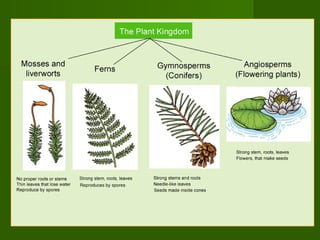
    Plants are classified into four main group:
1.   Mosses and Liverwort (Bryophyta)
2.   Ferns (Pteridophyta)
3.   Conifers (Gymnosperms)
4.   Flowering Plants (Angiosperms)
    All are distinctly different in appearance,
     structure and behaviour.
Mosses - Bryophyta
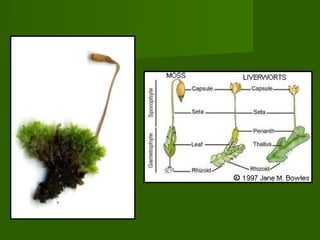
 Mosses are non-vascular plants -- they
  cannot transport fluids through their bodies.
 Instead, they must rely on surrounding
  moisture to do this job for them.
 Though small in stature, mosses are very
  important members of our ecosystem.
 They lay the foundations for other plant
  growth, prevent erosion, and contribute to
  the lush green appearance of many forested
  areas.
Mosses - 2
    The 24,000 bryophyte species, sometimes
     grouped into a single phylum are now
     grouped in three phyla:
1.   Mosses (Bryophyta),
2.   Liverworts (Hepatophyta) and
3.   Hornworts (Anthoceraphyta).
    They reproduce by spores, never have
     flowers, and can be found growing on the
     ground, on rocks, and on other plants.
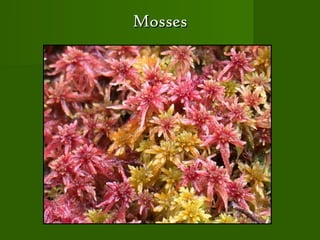
Mosses
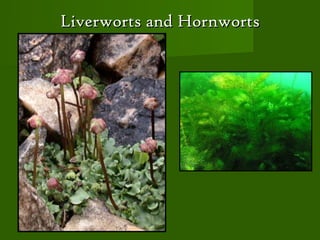
Liverworts and Hornworts
Life Cycle
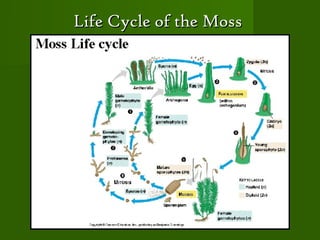
   Moss plants have two generations, the gametophyte
    and sporophyte .
   The first generation, the gametophyte, forms the green
    leafy structure we ordinarily associate with moss.
   It produces a sperm and an egg (the gametes) which
    unite, when conditions are right, to grow into the next
    generation: the sporophyte or spore-bearing structure.
   The moss sporophyte is typically a capsule growing on
    the end of a stalk called the seta.
   The sporophyte contains no chlorophyll of its own: it
    grows parasitically on its gametophyte mother.
   As the sporophyte dries out, the capsule release spores
    which will grow into a new generation of
    gametophytes, if they germinate.
Life Cycle of the Moss
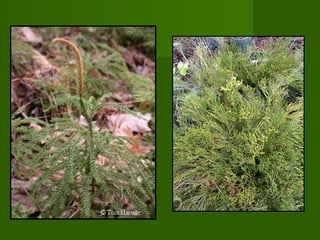
The Fern - Pteridophyta
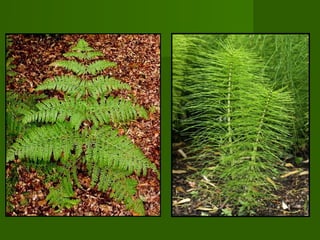
   Ferns have a vascular system to transport fluids
    through their bodies but like the mosses, they
    reproduce from spores rather than seeds.
   The main phylum, the Ferns (Pteridophyta)
    includes around 12,000 species.
   Three other phyla are included as fern allies: the
    Horsetails , Club Mosses and Whisk Ferns
   Ferns also have a gametophyte and sporophyte
    stage, but the gametophyte stage is much reduced.
Life Cycle of Fern
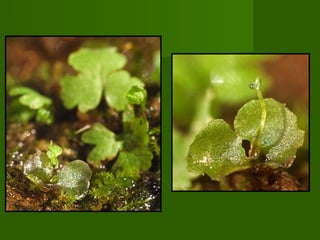
   The gametophyte generation of ferns are small,
    heart-shaped, plants called prothallia (singular:
    prothallium).
   They are less than an inch (1 - 2 cm) in diameter
    and look very much like thalloid liverworts or
    hornworts.
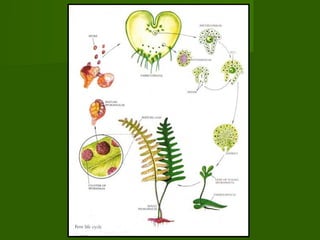
   Male and female sex organs are located on the
    underside of the prothallium and, when conditions
    are right, the sperm swims from the male
    antheridium to fertilize the egg in the archegonium.
   A new adult (sporophyte) fern plant will grow
    from the prothallium.
Conifers - Gymnosperms
   The gymnosperms add the next level of complexity to
    plant evolution: they reproduce from seeds instead of
    spores.
   The seeds, however, are "naked" (Greek: gummnos) --
    not covered by an ovary.
   Usually, the seed is produced inside a cone-like
    structure such as a pine cone hence the name "conifer."
   Some conifers, such as the Yew and Ginko, produce
    their seeds inside a berry-like structure.
   Conifers are fairly easy to identify: In addition to the
    aforementioned cones, these trees and shrubs typically
    have needle-like, scale-like or awl-like leaves.
   And they never have flowers.
Conifers - 2
   Approximately 600 species are counted as conifers
    including the pines, firs, spruces, cedars, junipers,
    and yew.
   Species within the conifer ranks give us pine nuts --
    pesto's magic ingredient -- as well as juniper berries
    for gin.
   Conifer allies include three small phyla containing
    fewer than 200 species all together:
   Ginko (Ginkophyta)
   Cycads (Cycadophyta) ;
   And herb-like cone-bearing plants (Gnetophyta)
    such as Ephedra.
Scientific Names and
              Classification
   Species are named using a system developed in 1750 in
    Sweden by Linnaeus.
   Each species is given two names.
   The first is the genus name.
   Each genus contains a number of related species.
   For example Buttercups belong to the genus Rannunculus.
   Different types of buttercup then have a different species
    name e.g. Creeping Buttercup is Rannunculus repens while
    the common buttercup is called Rannunculus flutans.
   The genus and species are always written in Italics but
    when hand - written they should be underlined.
   Also the genus should have a CAPITAL letter and the
    species should have a small letter.
Angiosperms: Families
 Seed bearing plants of the Order Angiosperm

 are further classified into plant families.
 Plants belonging to the same family share a

 common trait, usually based on flower
 structure.
 The most important and common families

 are detailed next:
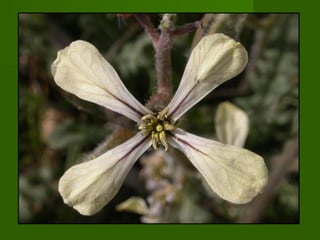
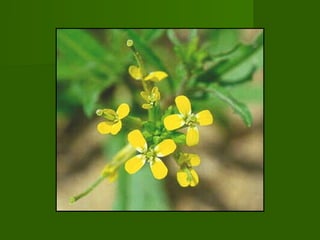
Cruciferae
   This family include wallflowers and many
    Brassica vegetables like Cabbage, Brussels
    sprouts, Cauliflower, Turnips, Mustard plants
    etc.
   They are classified by floral parts, arranged in
    fours. (4 sepals, petals & stamen).
   Their flowers are in the shape of a cross, hence
    the name Cruciferae.
Rosacae

 Also known as the Rose    Family.

 It includes apple, pear, peach, plum, cherry,

  apricot, almond, nectarine, prune, raspberry,

  blackberry, dewberry and the strawberry.

 They are characterised by five sepals and

  petals and numerous carpels and stamen.
Leguminosae
   Also called the pea family, they are characterised by
    five petals (One large, two small and two even
    smaller “wings”).
   A common feature in the family is the presence of
    root nodules containing bacteria of the genus
    Rhizobium.
   These bacteria convert atmospheric N, which
    cannot be used by the plants, into nitrate (NO3-), a
    form that can be used.
   This family is the second most economically
    important family after grasses and has over 18,000
    species.
Liliaceae
 This is a monocot family, whose members

  include onions, garlic, lilies, tulips, bluebells
  and hyacinths.
 This family is characterised be fused     petals
  and sepals.
 Their floral parts are in multiples of three –

  six sepals, six petals, six stamen and three
  carpels.
Gramineae
   This is the grass family, and includes all grass
    species as well as cereals such as wheat, oats, barley
    maize and rice.
   Grass species have flower structures based on the
    use of wind pollination.
   Therefore they do not contain bright, colourful
    petals to attract insects, as this is not required.
   Grass plants produce high levels of pollen to
    increase its chances of reproduction – this high
    level of pollen can cause hay fever.
   Grass flowers are said to be hermaphrodite – they
    contain both male and female parts.
   These are formed on an inflorescence.
Compositae
 This is the largest family of plants (NB) and
  includes daisies, dandelions, thistles, lettuce
  and sunflowers.
 The family is called Compositae because each
  flower is actually a composite of many
  “florets”.
 If you look at a daisy, you will find to
  different types of floret (the white “ray”
  floret and the yellow “disc” floret.
Umbelliferae
 Members of this family have a distinctive
  florescence (collection of flowers) shaped
  like an umbrella.
 Each of the flowers are small but contain five
  sepals, stamen and petals and two carpels.
 Members of this family include parsley, dill,
  celery, carrots and parsnips.
 Giant hogweeds and cow parsnip (parsley)
  are also weeds belonging to this family.
Other Families
Raunculaceae
   The buttercup family.
Solanaceae
   This family contains potatoes, tomatoes,
    tobacco and the “deadly nightshade”.
Polygonaceae
   Rhubarb family – rhubarb, dock and
    buckwheat.

Plant classification

  • 1.
    Transition Year Biology Plant Classification H. Jones, St. Columba’s College
  • 2.
    Introduction to Plants  Plants are classified into four main group: 1. Mosses and Liverwort (Bryophyta) 2. Ferns (Pteridophyta) 3. Conifers (Gymnosperms) 4. Flowering Plants (Angiosperms)  All are distinctly different in appearance, structure and behaviour.
  • 4.
    Mosses - Bryophyta Mosses are non-vascular plants -- they cannot transport fluids through their bodies.  Instead, they must rely on surrounding moisture to do this job for them.  Though small in stature, mosses are very important members of our ecosystem.  They lay the foundations for other plant growth, prevent erosion, and contribute to the lush green appearance of many forested areas.
  • 5.
    Mosses - 2  The 24,000 bryophyte species, sometimes grouped into a single phylum are now grouped in three phyla: 1. Mosses (Bryophyta), 2. Liverworts (Hepatophyta) and 3. Hornworts (Anthoceraphyta).  They reproduce by spores, never have flowers, and can be found growing on the ground, on rocks, and on other plants.
  • 6.
  • 7.
  • 8.
    Life Cycle  Moss plants have two generations, the gametophyte and sporophyte .  The first generation, the gametophyte, forms the green leafy structure we ordinarily associate with moss.  It produces a sperm and an egg (the gametes) which unite, when conditions are right, to grow into the next generation: the sporophyte or spore-bearing structure.  The moss sporophyte is typically a capsule growing on the end of a stalk called the seta.  The sporophyte contains no chlorophyll of its own: it grows parasitically on its gametophyte mother.  As the sporophyte dries out, the capsule release spores which will grow into a new generation of gametophytes, if they germinate.
  • 10.
    Life Cycle ofthe Moss
  • 11.
    The Fern -Pteridophyta  Ferns have a vascular system to transport fluids through their bodies but like the mosses, they reproduce from spores rather than seeds.  The main phylum, the Ferns (Pteridophyta) includes around 12,000 species.  Three other phyla are included as fern allies: the Horsetails , Club Mosses and Whisk Ferns  Ferns also have a gametophyte and sporophyte stage, but the gametophyte stage is much reduced.
  • 14.
    Life Cycle ofFern  The gametophyte generation of ferns are small, heart-shaped, plants called prothallia (singular: prothallium).  They are less than an inch (1 - 2 cm) in diameter and look very much like thalloid liverworts or hornworts.  Male and female sex organs are located on the underside of the prothallium and, when conditions are right, the sperm swims from the male antheridium to fertilize the egg in the archegonium.  A new adult (sporophyte) fern plant will grow from the prothallium.
  • 17.
    Conifers - Gymnosperms  The gymnosperms add the next level of complexity to plant evolution: they reproduce from seeds instead of spores.  The seeds, however, are "naked" (Greek: gummnos) -- not covered by an ovary.  Usually, the seed is produced inside a cone-like structure such as a pine cone hence the name "conifer."  Some conifers, such as the Yew and Ginko, produce their seeds inside a berry-like structure.  Conifers are fairly easy to identify: In addition to the aforementioned cones, these trees and shrubs typically have needle-like, scale-like or awl-like leaves.  And they never have flowers.
  • 18.
    Conifers - 2  Approximately 600 species are counted as conifers including the pines, firs, spruces, cedars, junipers, and yew.  Species within the conifer ranks give us pine nuts -- pesto's magic ingredient -- as well as juniper berries for gin.  Conifer allies include three small phyla containing fewer than 200 species all together:  Ginko (Ginkophyta)  Cycads (Cycadophyta) ;  And herb-like cone-bearing plants (Gnetophyta) such as Ephedra.
  • 19.
    Scientific Names and Classification  Species are named using a system developed in 1750 in Sweden by Linnaeus.  Each species is given two names.  The first is the genus name.  Each genus contains a number of related species.  For example Buttercups belong to the genus Rannunculus.  Different types of buttercup then have a different species name e.g. Creeping Buttercup is Rannunculus repens while the common buttercup is called Rannunculus flutans.  The genus and species are always written in Italics but when hand - written they should be underlined.  Also the genus should have a CAPITAL letter and the species should have a small letter.
  • 20.
    Angiosperms: Families  Seedbearing plants of the Order Angiosperm are further classified into plant families.  Plants belonging to the same family share a common trait, usually based on flower structure.  The most important and common families are detailed next:
  • 21.
    Cruciferae  This family include wallflowers and many Brassica vegetables like Cabbage, Brussels sprouts, Cauliflower, Turnips, Mustard plants etc.  They are classified by floral parts, arranged in fours. (4 sepals, petals & stamen).  Their flowers are in the shape of a cross, hence the name Cruciferae.
  • 24.
    Rosacae  Also knownas the Rose Family.  It includes apple, pear, peach, plum, cherry, apricot, almond, nectarine, prune, raspberry, blackberry, dewberry and the strawberry.  They are characterised by five sepals and petals and numerous carpels and stamen.
  • 26.
    Leguminosae  Also called the pea family, they are characterised by five petals (One large, two small and two even smaller “wings”).  A common feature in the family is the presence of root nodules containing bacteria of the genus Rhizobium.  These bacteria convert atmospheric N, which cannot be used by the plants, into nitrate (NO3-), a form that can be used.  This family is the second most economically important family after grasses and has over 18,000 species.
  • 27.
    Liliaceae  This isa monocot family, whose members include onions, garlic, lilies, tulips, bluebells and hyacinths.  This family is characterised be fused petals and sepals.  Their floral parts are in multiples of three – six sepals, six petals, six stamen and three carpels.
  • 28.
    Gramineae  This is the grass family, and includes all grass species as well as cereals such as wheat, oats, barley maize and rice.  Grass species have flower structures based on the use of wind pollination.  Therefore they do not contain bright, colourful petals to attract insects, as this is not required.  Grass plants produce high levels of pollen to increase its chances of reproduction – this high level of pollen can cause hay fever.  Grass flowers are said to be hermaphrodite – they contain both male and female parts.  These are formed on an inflorescence.
  • 29.
    Compositae  This isthe largest family of plants (NB) and includes daisies, dandelions, thistles, lettuce and sunflowers.  The family is called Compositae because each flower is actually a composite of many “florets”.  If you look at a daisy, you will find to different types of floret (the white “ray” floret and the yellow “disc” floret.
  • 30.
    Umbelliferae  Members ofthis family have a distinctive florescence (collection of flowers) shaped like an umbrella.  Each of the flowers are small but contain five sepals, stamen and petals and two carpels.  Members of this family include parsley, dill, celery, carrots and parsnips.  Giant hogweeds and cow parsnip (parsley) are also weeds belonging to this family.
  • 31.
    Other Families Raunculaceae  The buttercup family. Solanaceae  This family contains potatoes, tomatoes, tobacco and the “deadly nightshade”. Polygonaceae  Rhubarb family – rhubarb, dock and buckwheat.