Fundamental Types of Neurons
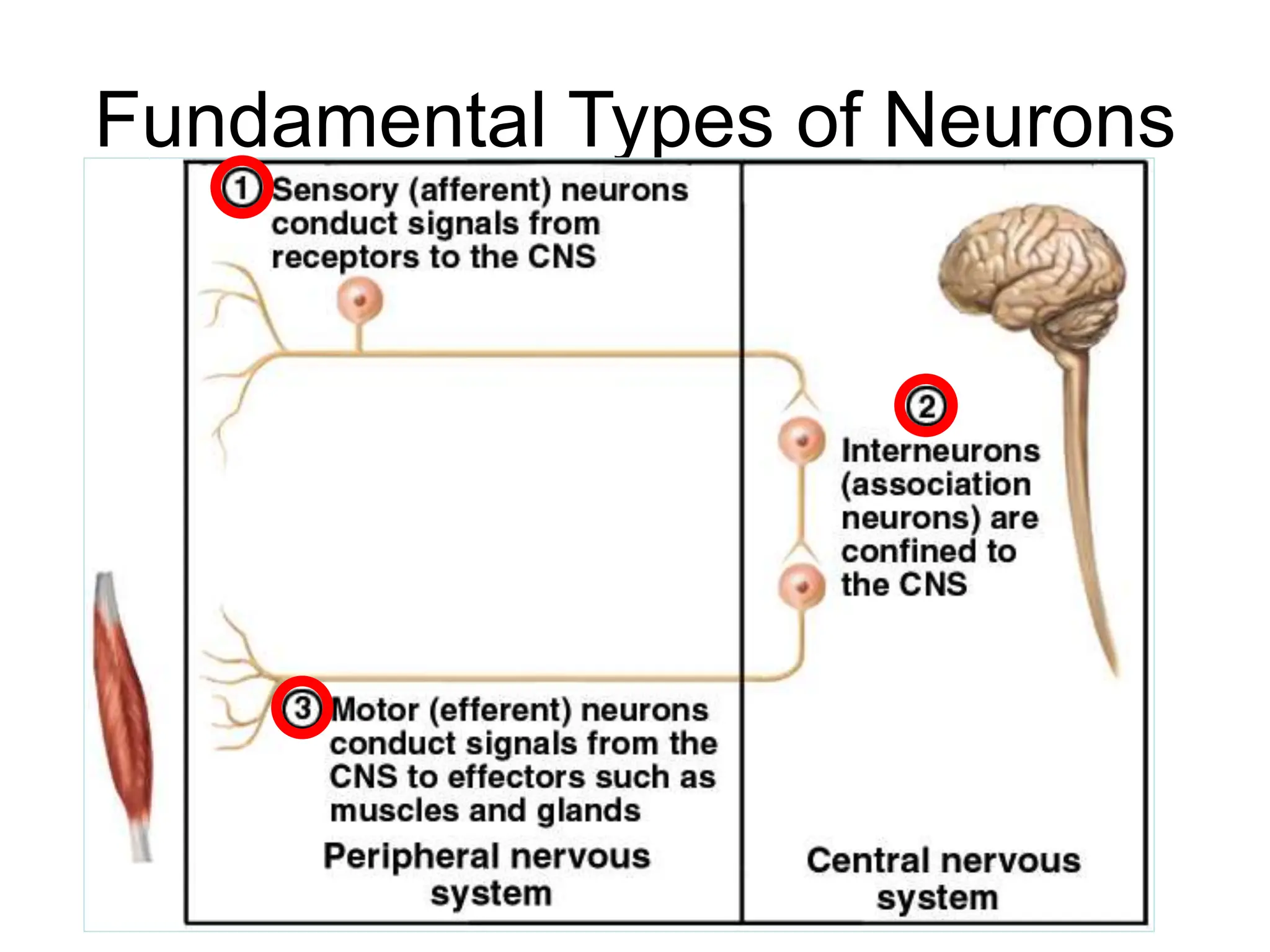
• Sensory (afferent) neurons
– receptors detect changes in body and external
environment
– this information is transmitted into brain or spinal cord
• Interneurons (association neurons)
– lie between sensory & motor pathways in CNS
– 90% of our neurons are interneurons
– process, store & retrieve information
• Motor (efferent) neuron
– send signals out to muscles & gland cells
– organs that carry out responses called effectors
Fundamental Types of Neurons
Fundamental Properties of
Neurons
• Excitability (irritability)
– ability to respond to changes in the body and
external environment called stimuli
• Conductivity
– produce traveling electrical signals
• Secretion
– when electrical signal reaches end of nerve
fiber, a chemical neurotransmitter is secreted
Structure of a Neuron
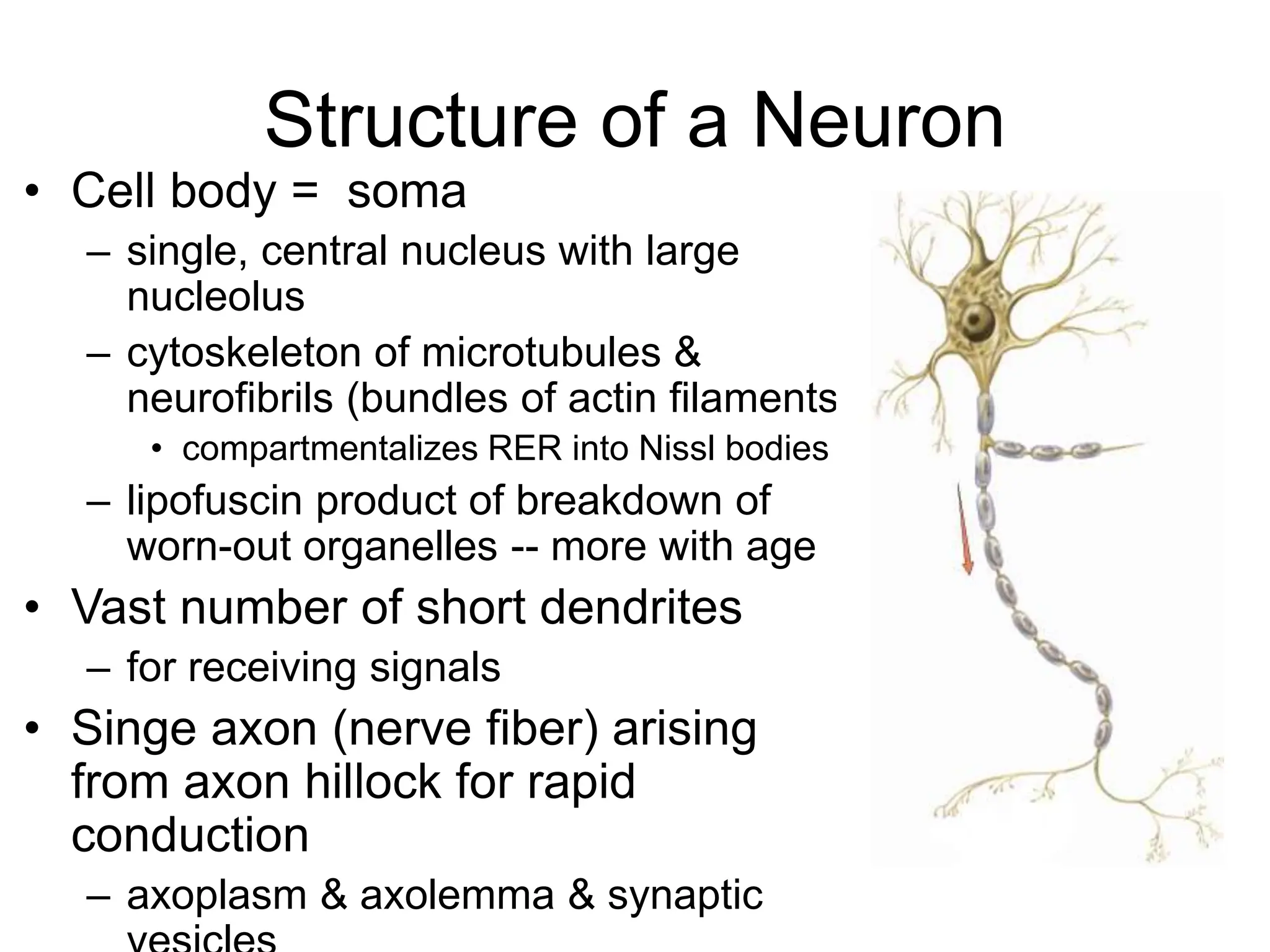
• Cell body = soma
– single, central nucleus with large
nucleolus
– cytoskeleton of microtubules &
neurofibrils (bundles of actin filaments)
• compartmentalizes RER into Nissl bodies
– lipofuscin product of breakdown of
worn-out organelles -- more with age
• Vast number of short dendrites
– for receiving signals
• Singe axon (nerve fiber) arising
from axon hillock for rapid
conduction
– axoplasm & axolemma & synaptic
Axonal Transport
• Many proteins made in soma must be
transported to axon & axon terminal
– repair axolemma, for gated ion channel
proteins, as enzymes or neurotransmitters
• Fast anterograde axonal transport
– either direction up to 400 mm/day for
organelles, enzymes, vesicles & small
molecules
• Fast retrograde for recycled materials
& pathogens
• Slow axonal transport or axoplasmic
flow
– moves cytoskeletal & new axoplasm at 10
mm/day during repair & regeneration in
damaged axons
Electrical Potentials
& Currents
• Neuron doctrine -- nerve pathway is
not a continuous “wire” but a series of
separate cells
• Neuronal communication is based on
mechanisms for producing electrical
potentials & currents
– electrical potential - difference in
concentration of charged particles
between different parts of the cell
– electrical current - flow of charged
particles from one point to another
within the cell
• Living cells are polarized
– resting membrane potential is -70
mV with a relatively negative
charge on the inside of nerve cell
membranes
Resting Membrane Potential
• Unequal electrolytes distribution
– diffusion of ions down their concentration gradients
– selective permeability of plasma membrane
– electrical attraction of cations and anions
• Explanation for -70 mV resting potential
– membrane very permeable to K+
• leaks out until electrical gradient created attracts it back in
– membrane much less permeable to Na+
– Na+/K+ pumps out 3 Na+ for every 2 K+ it brings in
• works continuously & requires great deal of ATP
• necessitates glucose & oxygen be supplied to nerve
tissue
Be clear on vocabulary
• Polarize = to increase the difference in ion
concentration. To move away from 0mV.
– Resting potential is polarized (-70mV).
– There’s a difference in Na+/K+ conc.
• Depolarize = To move toward no electrical
potential.
– Allowing Na+/K+ to go where they want.
– “Opening flood gates”
• Repolarize = To go back to original potential
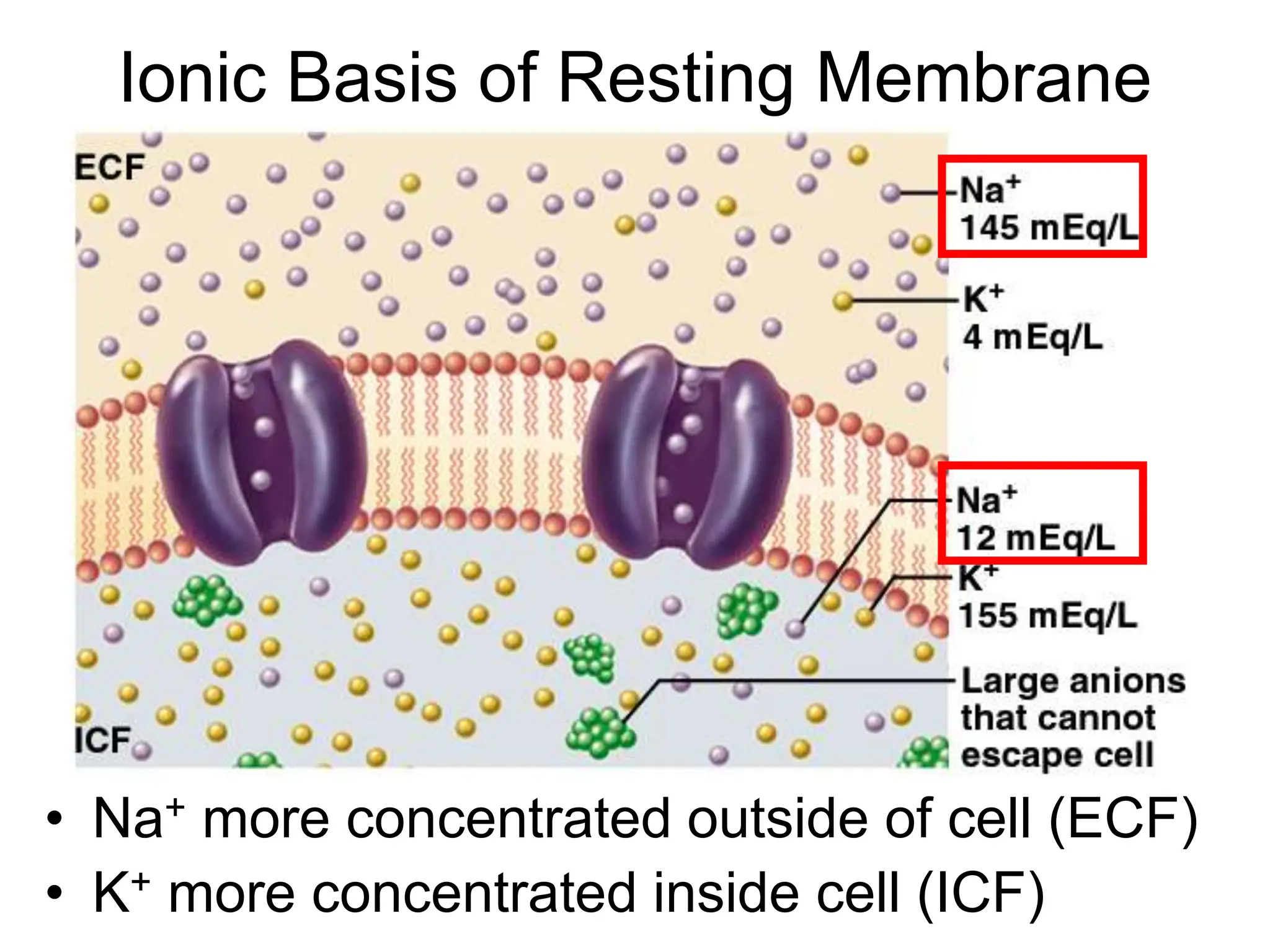
Ionic Basis of Resting Membrane
Potential
• Na+ more concentrated outside of cell (ECF)
• K+ more concentrated inside cell (ICF)
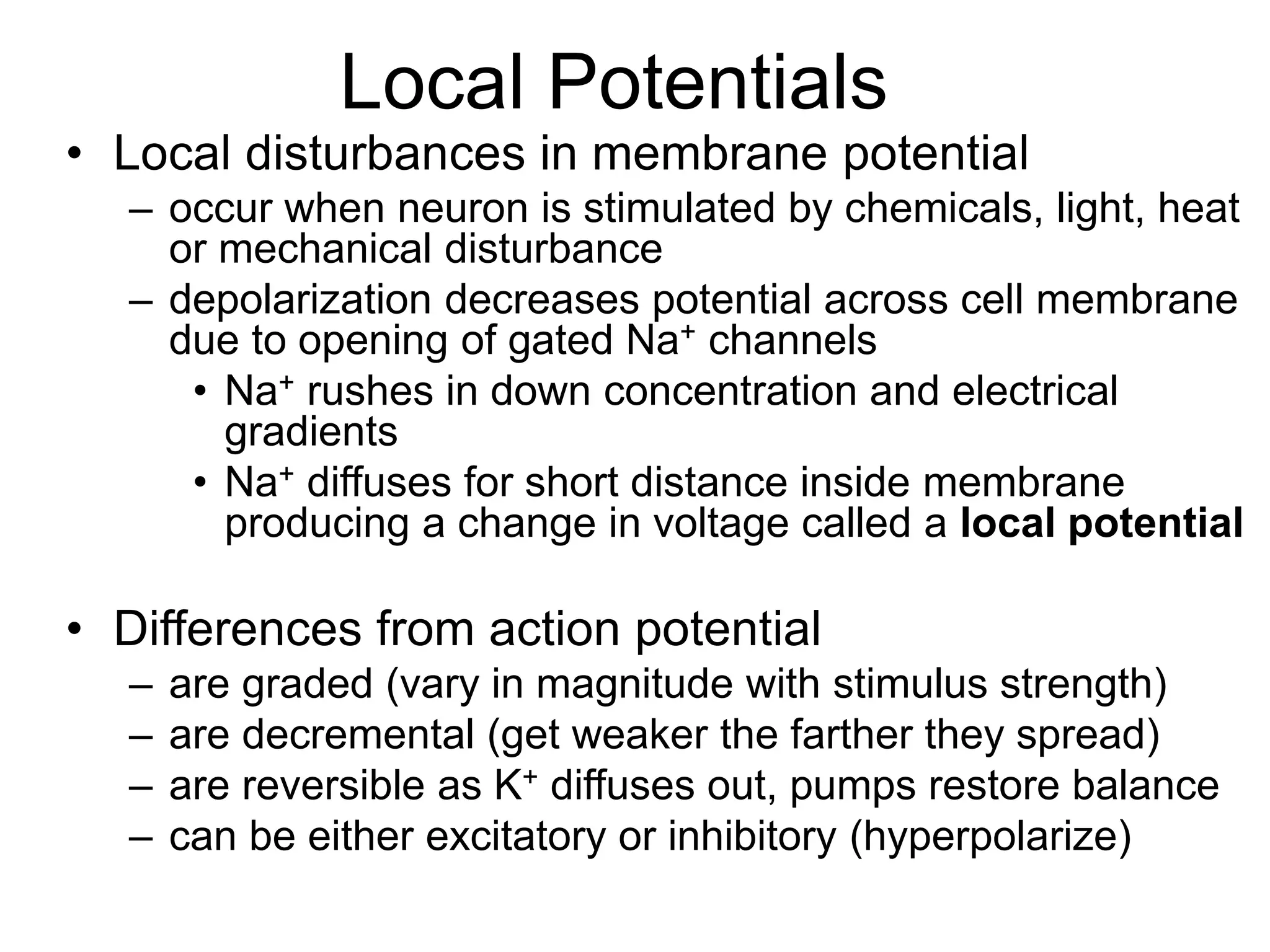
Local Potentials
• Local disturbances in membrane potential
– occur when neuron is stimulated by chemicals, light, heat
or mechanical disturbance
– depolarization decreases potential across cell membrane
due to opening of gated Na+ channels
• Na+ rushes in down concentration and electrical
gradients
• Na+ diffuses for short distance inside membrane
producing a change in voltage called a local potential
• Differences from action potential
– are graded (vary in magnitude with stimulus strength)
– are decremental (get weaker the farther they spread)
– are reversible as K+ diffuses out, pumps restore balance
– can be either excitatory or inhibitory (hyperpolarize)
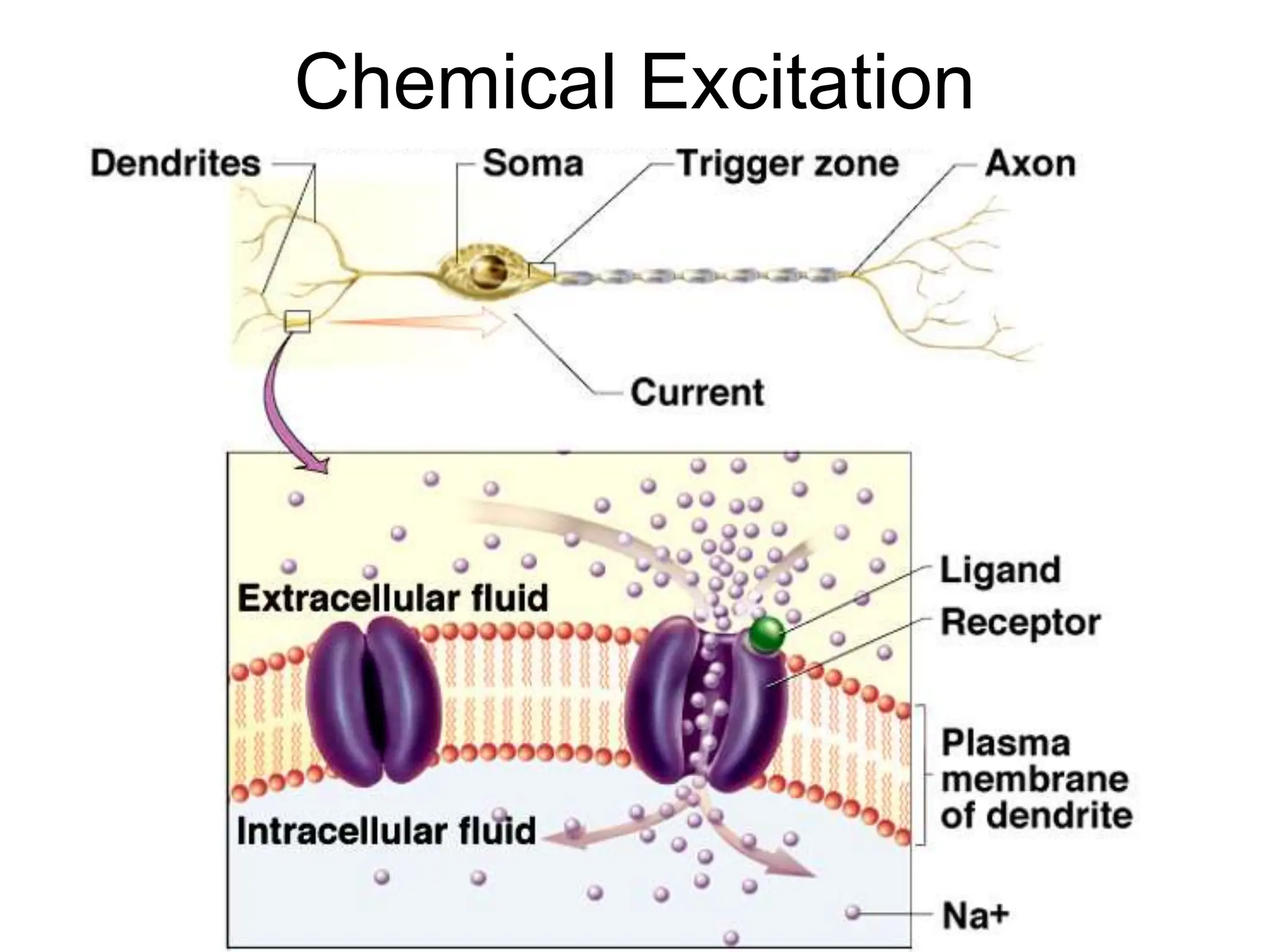
Chemical Excitation
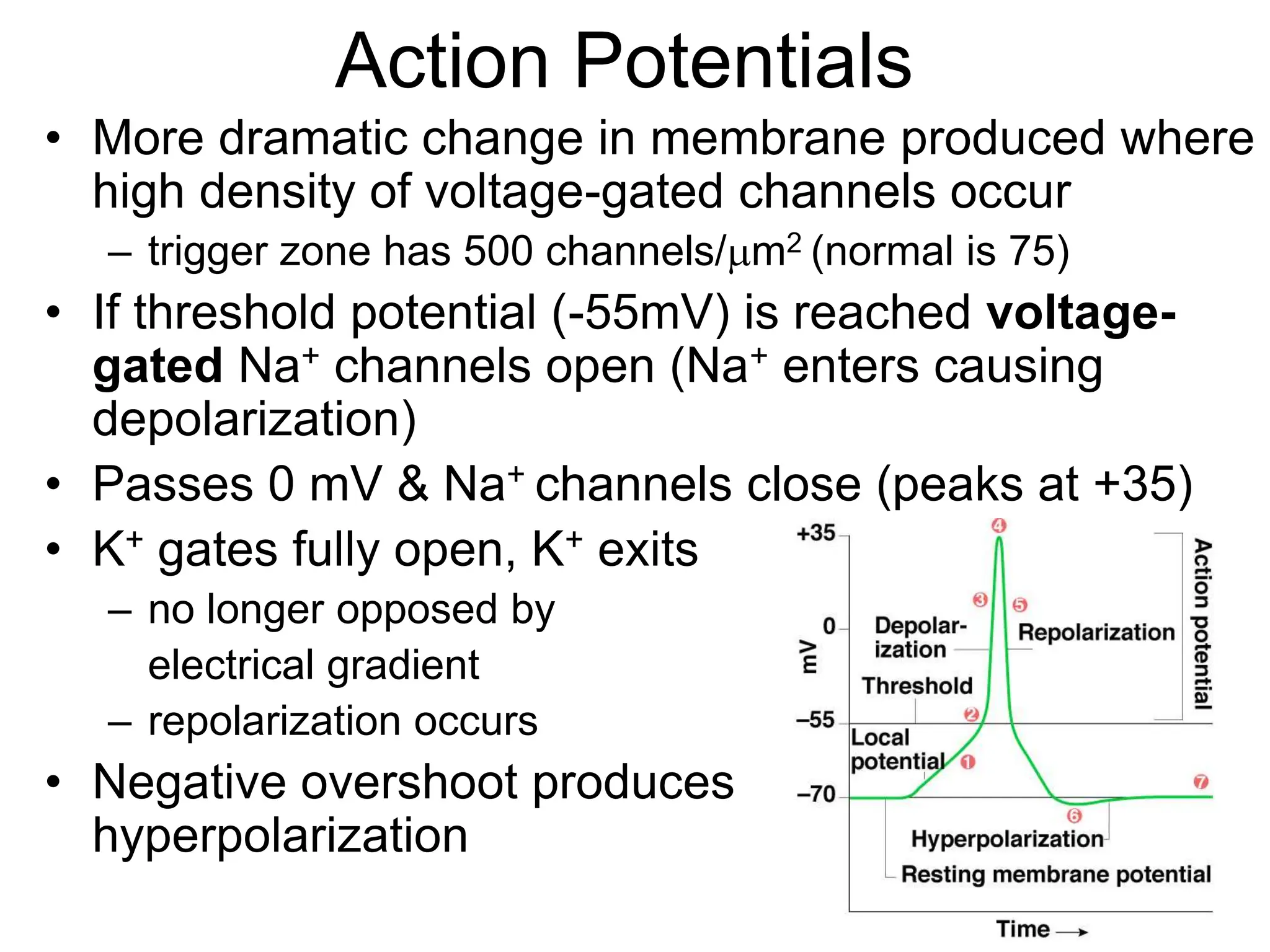
Action Potentials
• More dramatic change in membrane produced where
high density of voltage-gated channels occur
– trigger zone has 500 channels/m2 (normal is 75)
• If threshold potential (-55mV) is reached voltage-
gated Na+ channels open (Na+ enters causing
depolarization)
• Passes 0 mV & Na+ channels close (peaks at +35)
• K+ gates fully open, K+ exits
– no longer opposed by
electrical gradient
– repolarization occurs
• Negative overshoot produces
hyperpolarization
Action Potentials
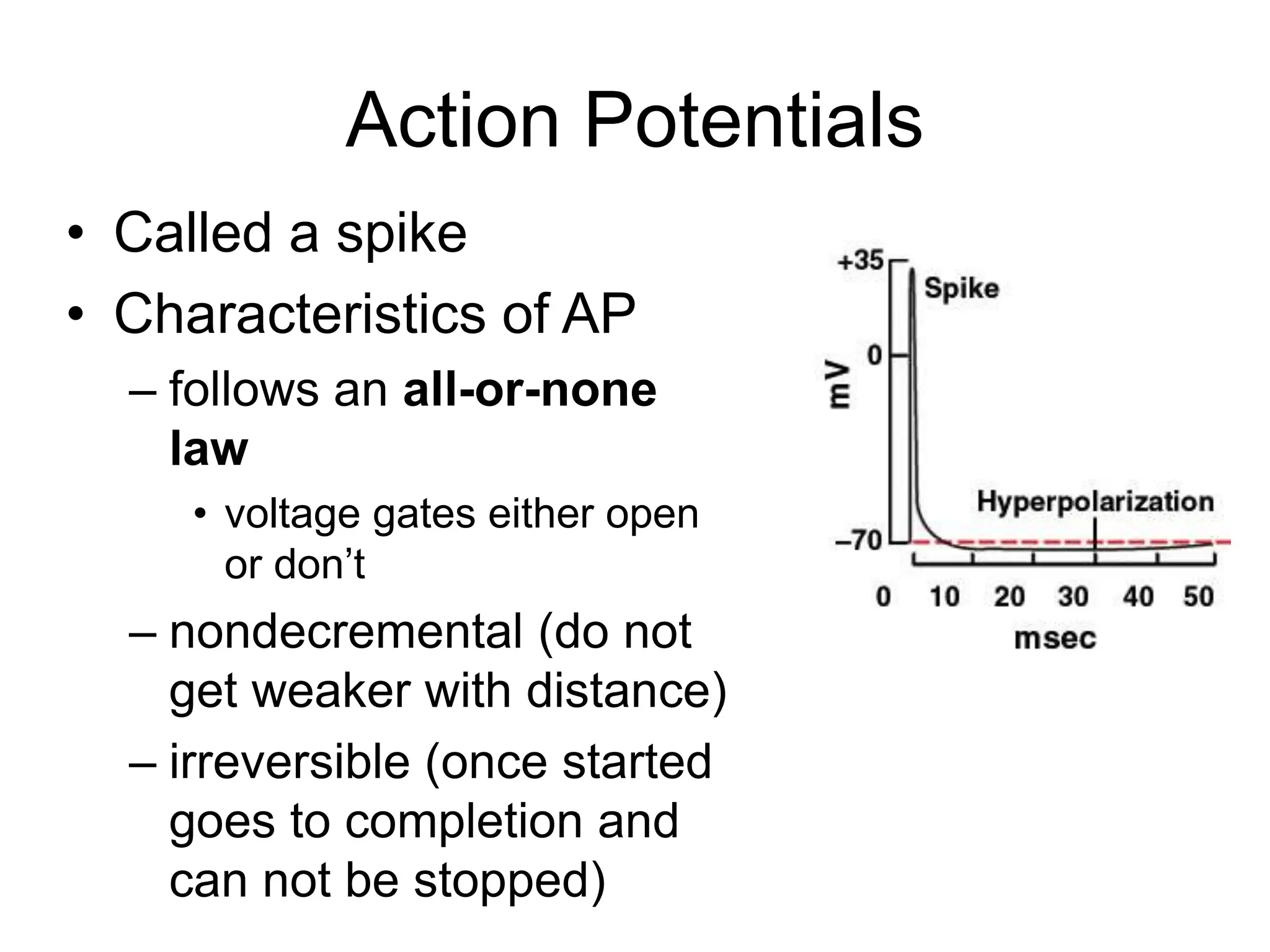
• Called a spike
• Characteristics of AP
– follows an all-or-none
law
• voltage gates either open
or don’t
– nondecremental (do not
get weaker with distance)
– irreversible (once started
goes to completion and
can not be stopped)
The Refractory Period
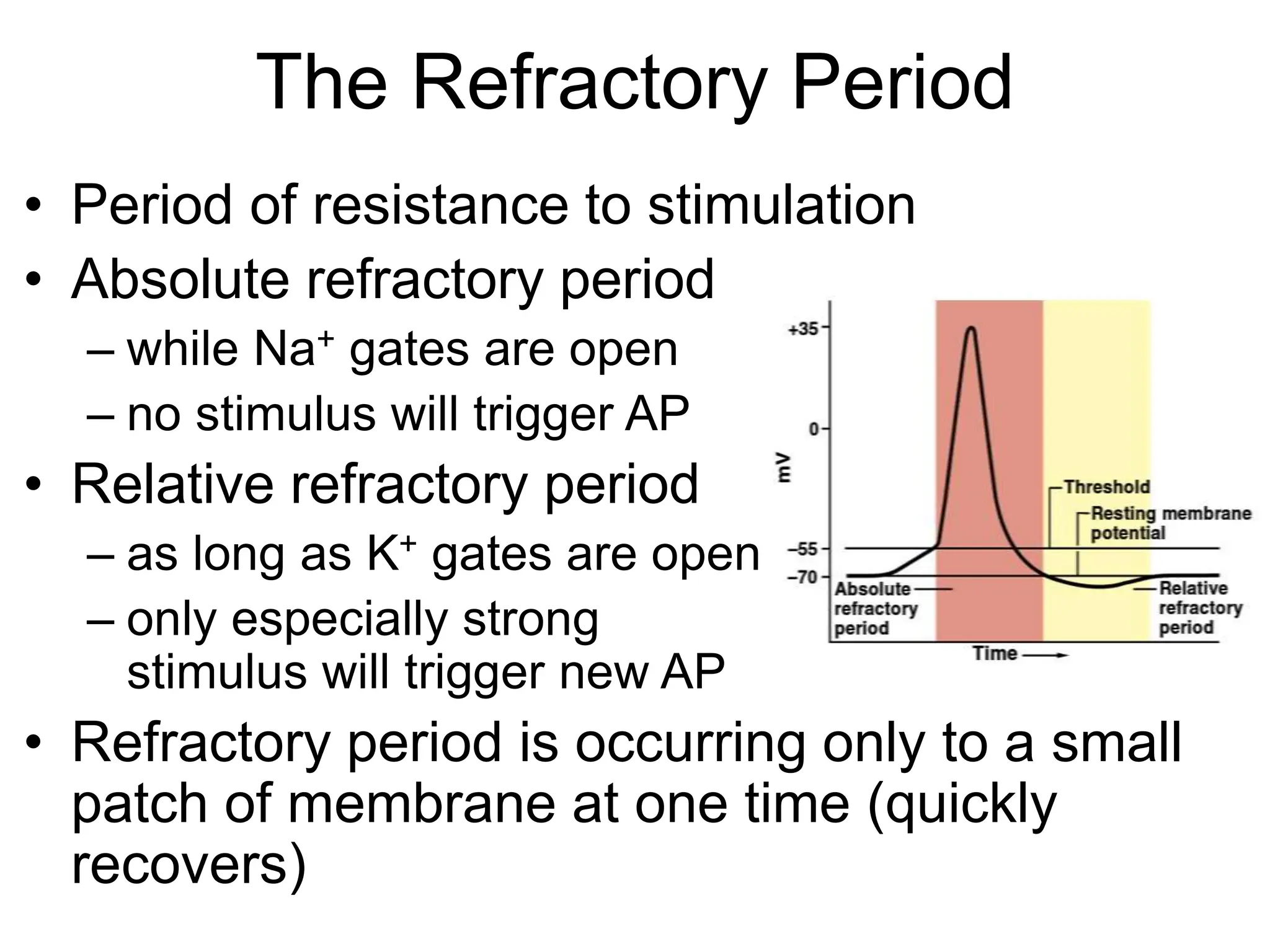
• Period of resistance to stimulation
• Absolute refractory period
– while Na+ gates are open
– no stimulus will trigger AP
• Relative refractory period
– as long as K+ gates are open
– only especially strong
stimulus will trigger new AP
• Refractory period is occurring only to a small
patch of membrane at one time (quickly
recovers)
Impulse Conduction in Unmyelinated Fibers
• Threshold voltage in trigger zone begins
impulse
• Nerve signal (impulse) - a chain reaction of
sequential opening of voltage-gated Na+
channels down entire length of axon
• Nerve signal (nondecremental) travels at 2m/sec
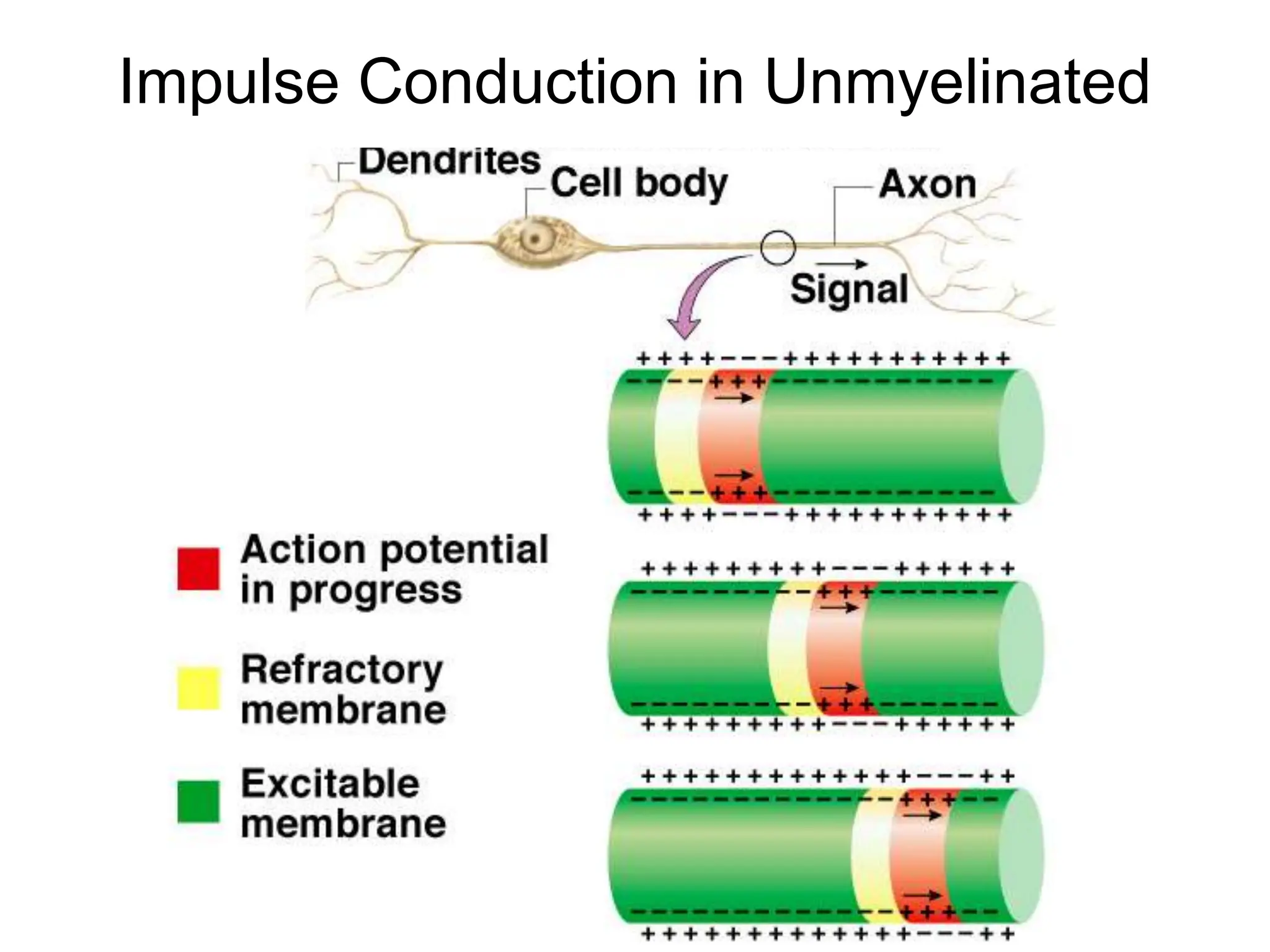
Impulse Conduction in Unmyelinated
Fibers
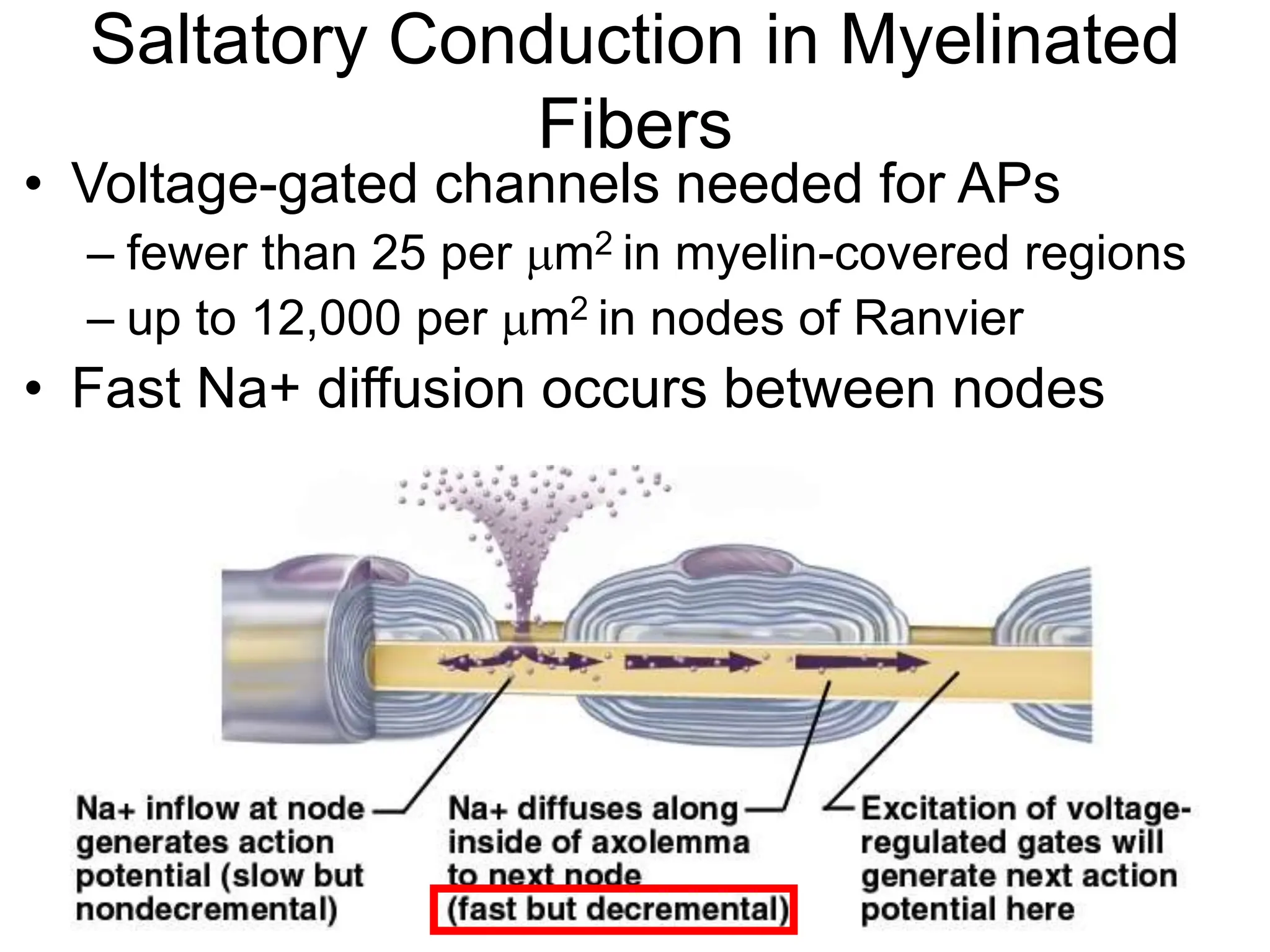
Saltatory Conduction in Myelinated
Fibers
• Voltage-gated channels needed for APs
– fewer than 25 per m2 in myelin-covered regions
– up to 12,000 per m2 in nodes of Ranvier
• Fast Na+ diffusion occurs between nodes
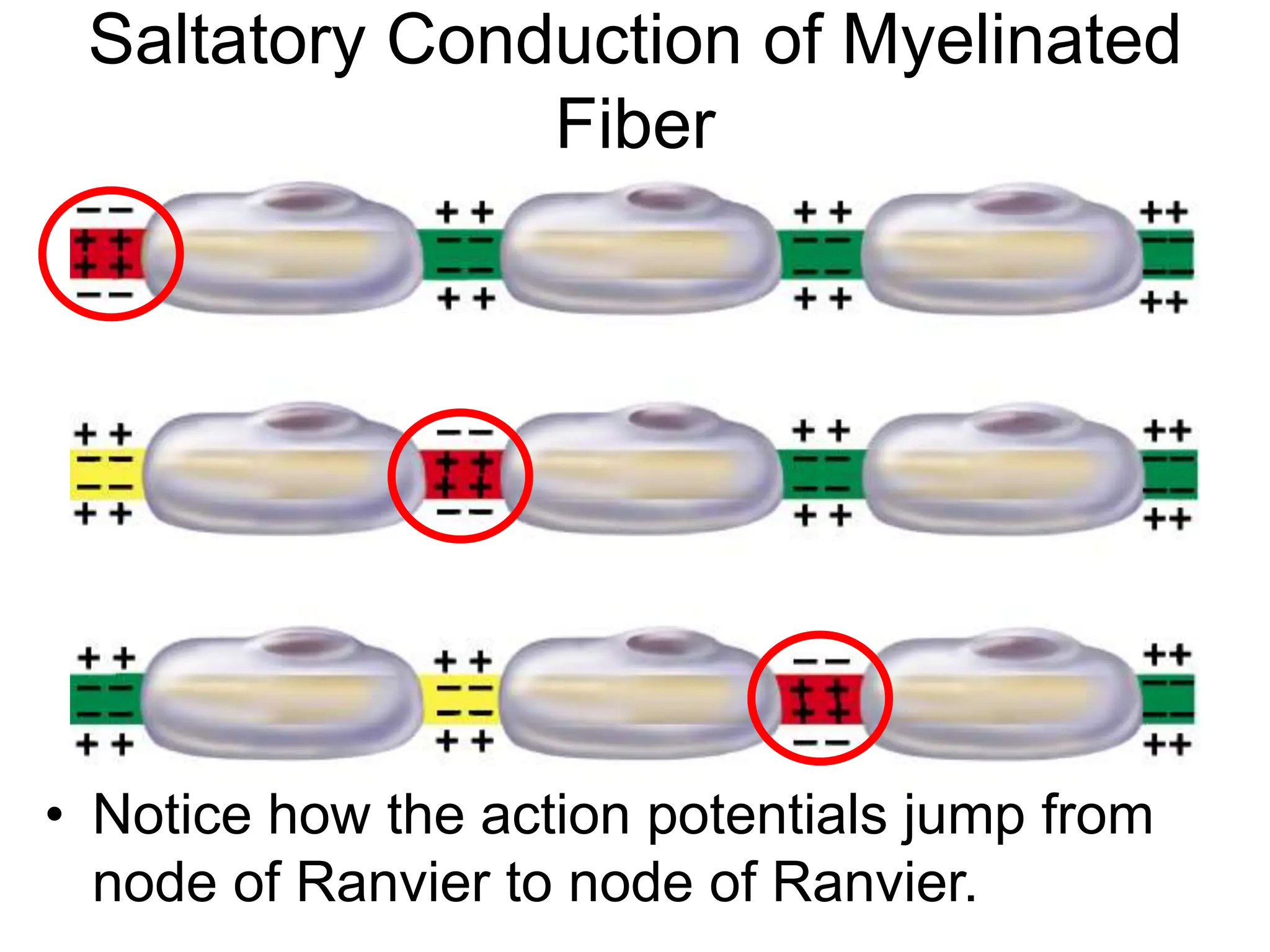
Saltatory Conduction of Myelinated
Fiber
• Notice how the action potentials jump from
node of Ranvier to node of Ranvier.
Synapses Between Two
Neurons
• First neuron in path releases
neurotransmitter onto second neuron that
responds to it
– 1st neuron is presynaptic neuron
– 2nd neuron is postsynaptic neuron
• Number of synapses on postsynaptic cell
variable
– 8000 on spinal motor neuron
– 100,000 on neuron in cerebellum
The Discovery of
Neurotransmitters
• Histological observations revealed a 20 to 40 nm
gap between neurons (synaptic cleft)
• Otto Loewi (1873-1961) first to demonstrate
function of neurotransmitters at chemical
synapse
– flooded exposed hearts of 2 frogs with saline
– stimulated vagus nerve of one frog --- heart
slows
– removed saline from that frog & found it would
slow heart of 2nd frog --- “vagus substance”
– later renamed acetylcholine
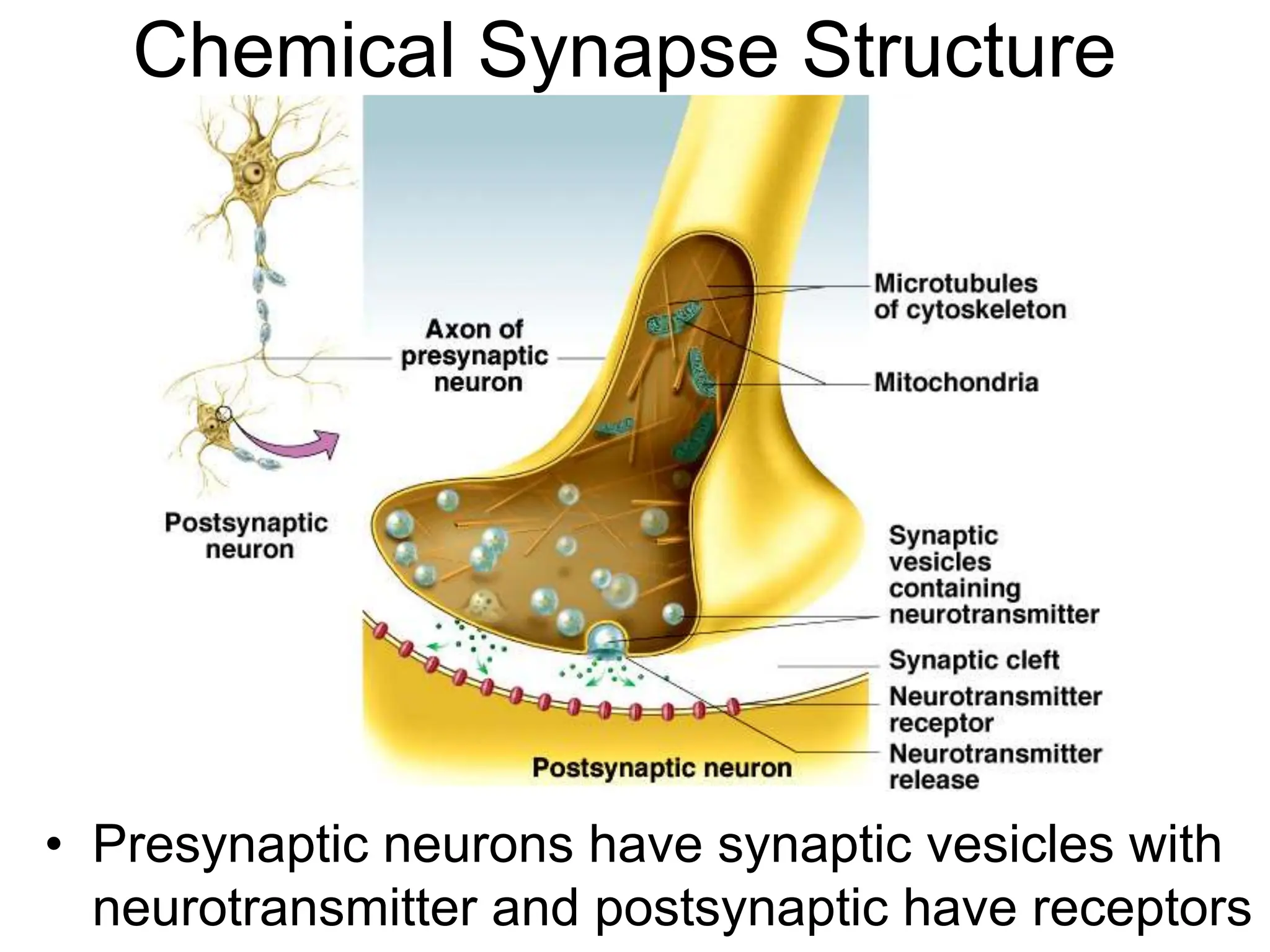
Chemical Synapse Structure
• Presynaptic neurons have synaptic vesicles with
neurotransmitter and postsynaptic have receptors
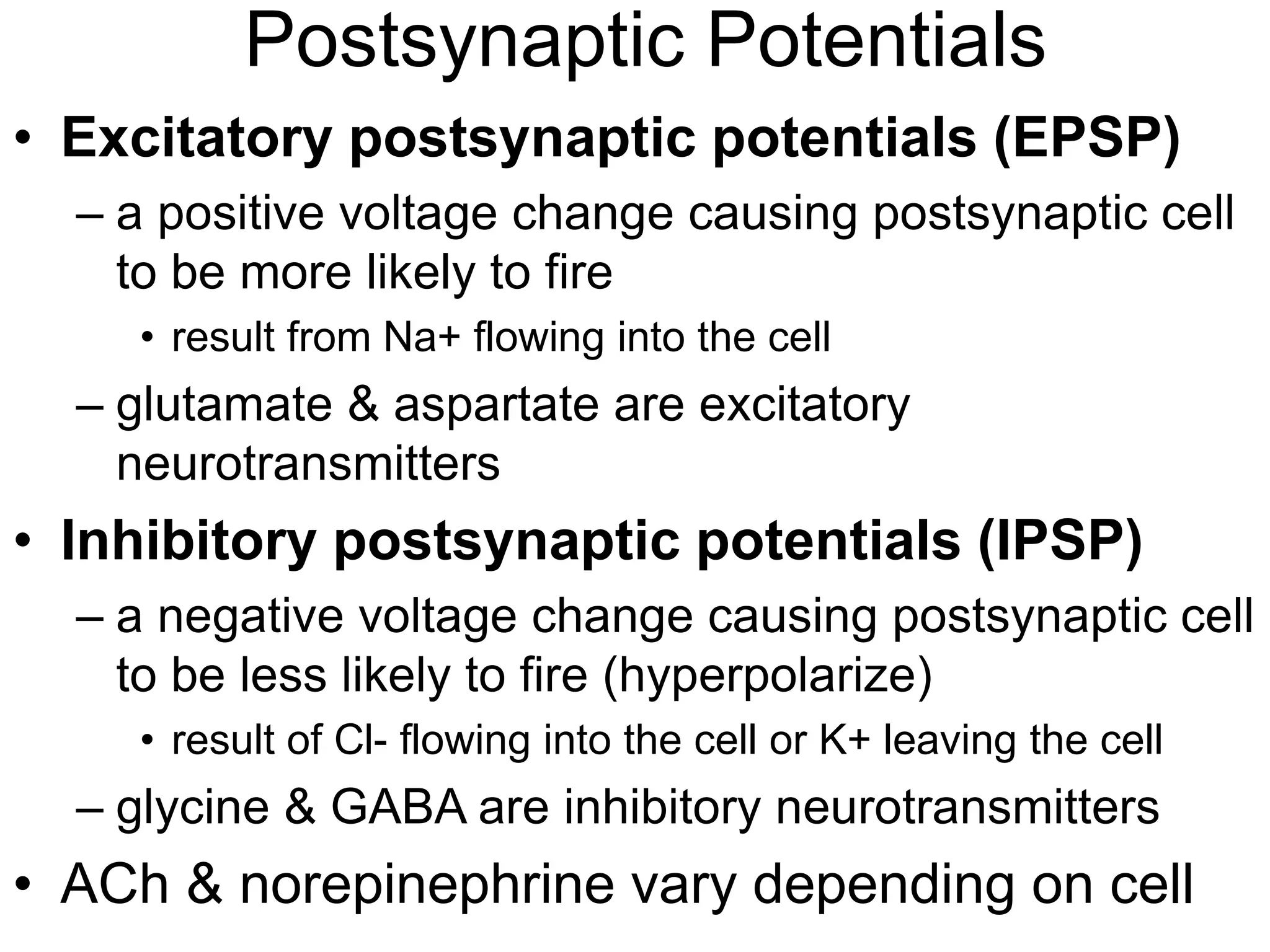
Postsynaptic Potentials
• Excitatory postsynaptic potentials (EPSP)
– a positive voltage change causing postsynaptic cell
to be more likely to fire
• result from Na+ flowing into the cell
– glutamate & aspartate are excitatory
neurotransmitters
• Inhibitory postsynaptic potentials (IPSP)
– a negative voltage change causing postsynaptic cell
to be less likely to fire (hyperpolarize)
• result of Cl- flowing into the cell or K+ leaving the cell
– glycine & GABA are inhibitory neurotransmitters
• ACh & norepinephrine vary depending on cell
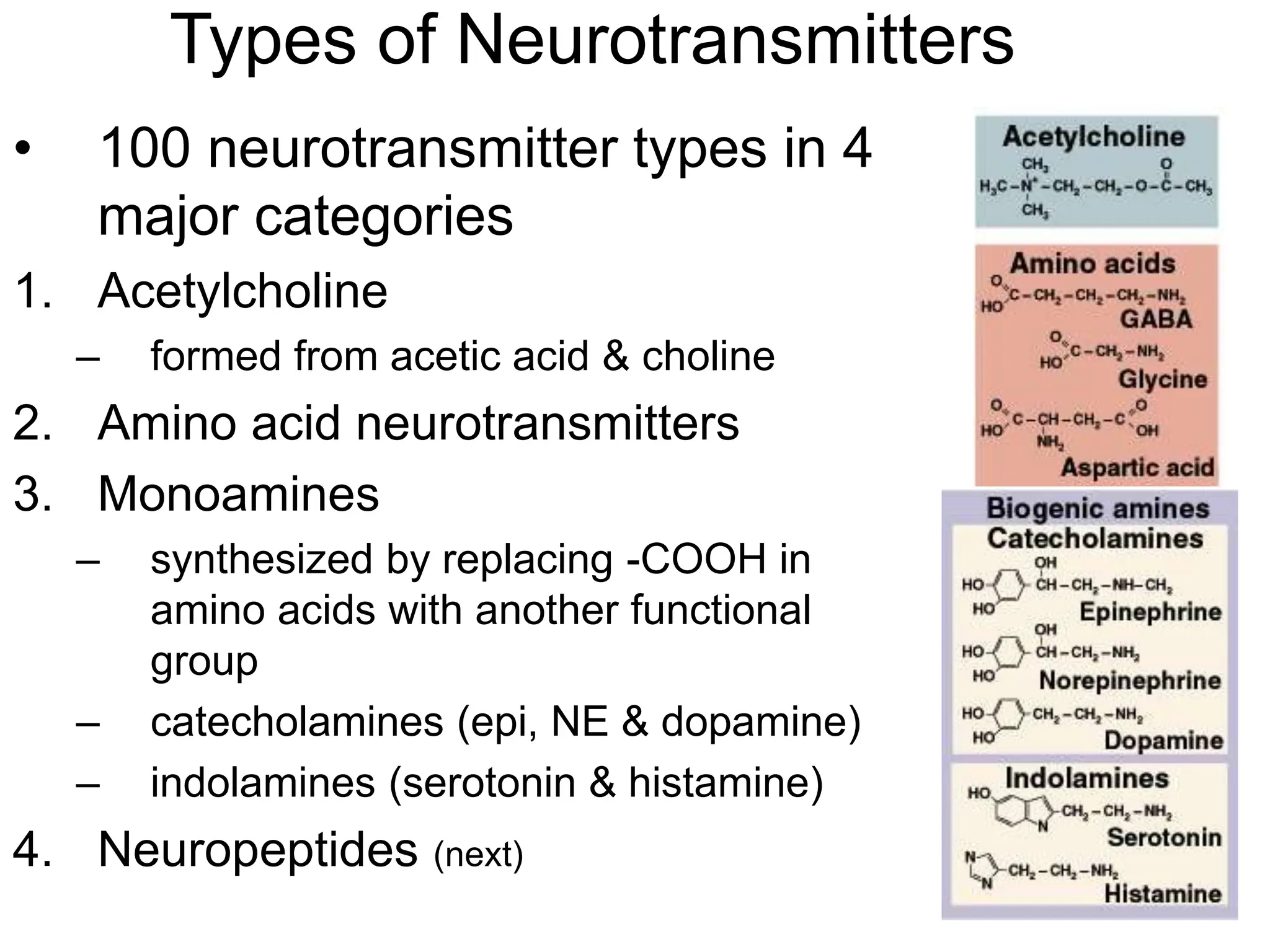
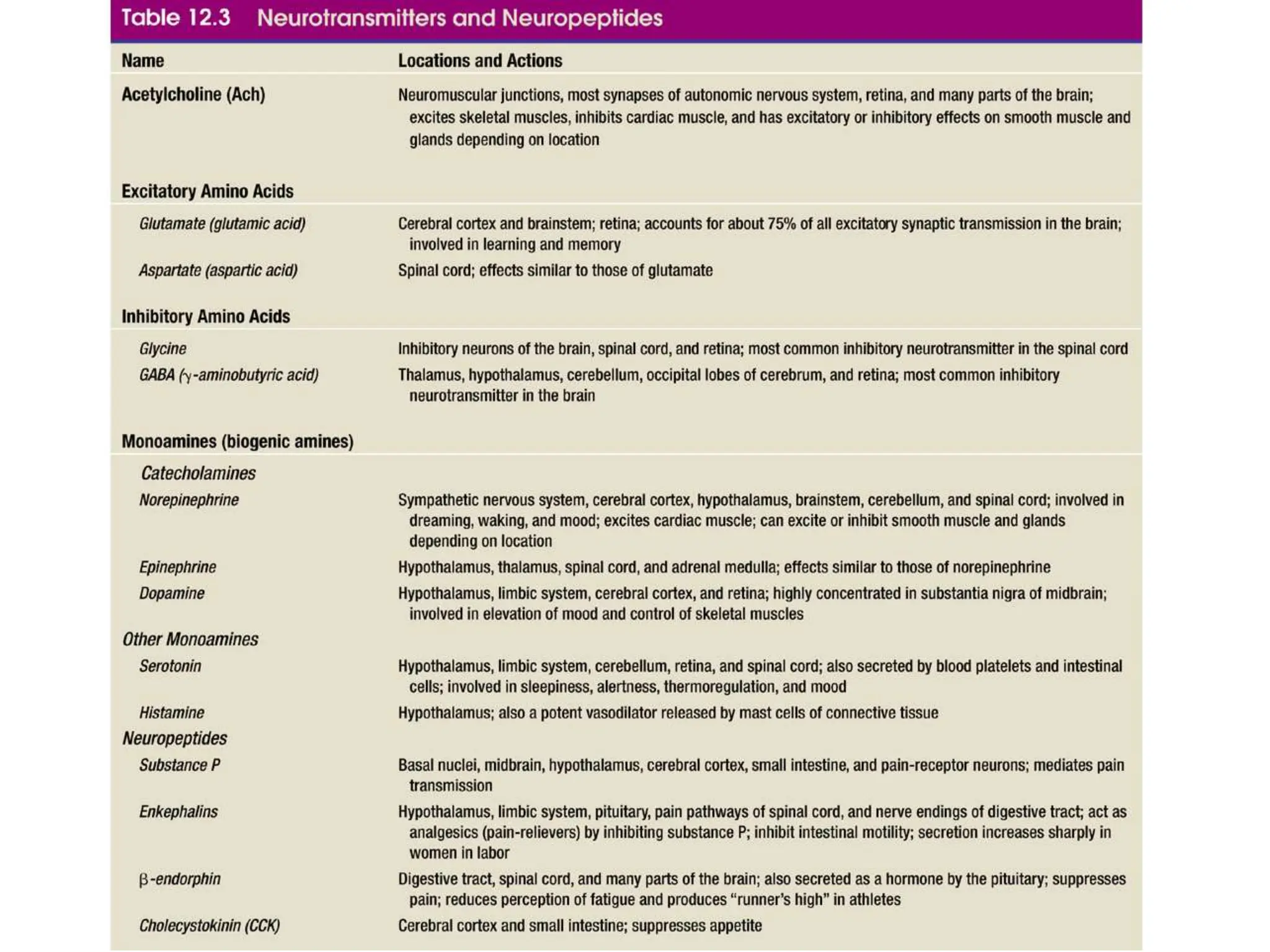
Types of Neurotransmitters
• 100 neurotransmitter types in 4
major categories
1. Acetylcholine
– formed from acetic acid & choline
2. Amino acid neurotransmitters
3. Monoamines
– synthesized by replacing -COOH in
amino acids with another functional
group
– catecholamines (epi, NE & dopamine)
– indolamines (serotonin & histamine)
4. Neuropeptides (next)
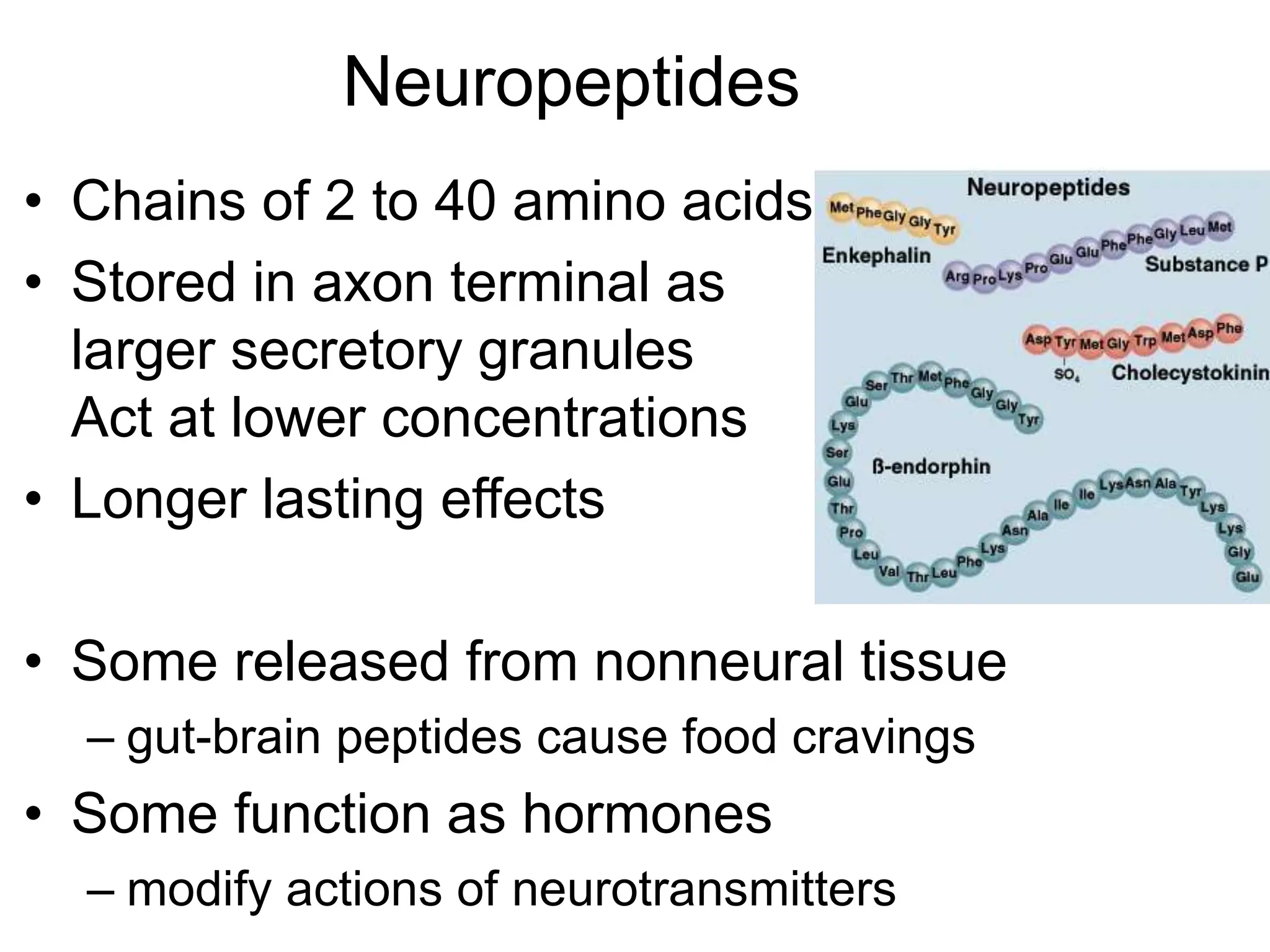
Neuropeptides
• Chains of 2 to 40 amino acids
• Stored in axon terminal as
larger secretory granules
Act at lower concentrations
• Longer lasting effects
• Some released from nonneural tissue
– gut-brain peptides cause food cravings
• Some function as hormones
– modify actions of neurotransmitters
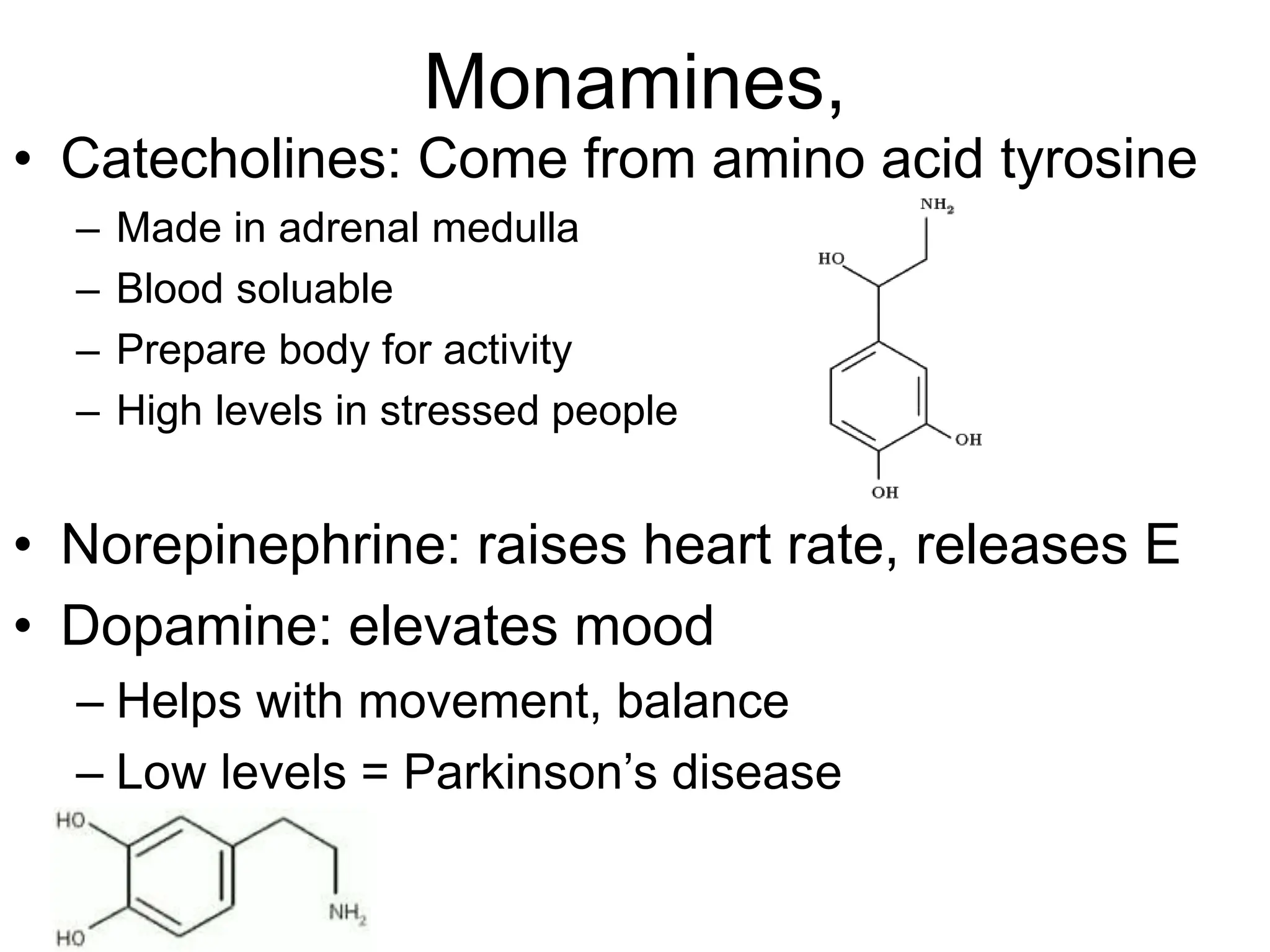
Monamines,
• Catecholines: Come from amino acid tyrosine
– Made in adrenal medulla
– Blood soluable
– Prepare body for activity
– High levels in stressed people
• Norepinephrine: raises heart rate, releases E
• Dopamine: elevates mood
– Helps with movement, balance
– Low levels = Parkinson’s disease
Fundamental Types of Neurons.ppt

Fundamental Types of Neurons.ppt

  • 1.
    Fundamental Types ofNeurons • Sensory (afferent) neurons – receptors detect changes in body and external environment – this information is transmitted into brain or spinal cord • Interneurons (association neurons) – lie between sensory & motor pathways in CNS – 90% of our neurons are interneurons – process, store & retrieve information • Motor (efferent) neuron – send signals out to muscles & gland cells – organs that carry out responses called effectors
  • 2.
  • 3.
    Fundamental Properties of Neurons •Excitability (irritability) – ability to respond to changes in the body and external environment called stimuli • Conductivity – produce traveling electrical signals • Secretion – when electrical signal reaches end of nerve fiber, a chemical neurotransmitter is secreted
  • 4.
    Structure of aNeuron • Cell body = soma – single, central nucleus with large nucleolus – cytoskeleton of microtubules & neurofibrils (bundles of actin filaments) • compartmentalizes RER into Nissl bodies – lipofuscin product of breakdown of worn-out organelles -- more with age • Vast number of short dendrites – for receiving signals • Singe axon (nerve fiber) arising from axon hillock for rapid conduction – axoplasm & axolemma & synaptic
  • 5.
    Axonal Transport • Manyproteins made in soma must be transported to axon & axon terminal – repair axolemma, for gated ion channel proteins, as enzymes or neurotransmitters • Fast anterograde axonal transport – either direction up to 400 mm/day for organelles, enzymes, vesicles & small molecules • Fast retrograde for recycled materials & pathogens • Slow axonal transport or axoplasmic flow – moves cytoskeletal & new axoplasm at 10 mm/day during repair & regeneration in damaged axons
  • 6.
    Electrical Potentials & Currents •Neuron doctrine -- nerve pathway is not a continuous “wire” but a series of separate cells • Neuronal communication is based on mechanisms for producing electrical potentials & currents – electrical potential - difference in concentration of charged particles between different parts of the cell – electrical current - flow of charged particles from one point to another within the cell • Living cells are polarized – resting membrane potential is -70 mV with a relatively negative charge on the inside of nerve cell membranes
  • 7.
    Resting Membrane Potential •Unequal electrolytes distribution – diffusion of ions down their concentration gradients – selective permeability of plasma membrane – electrical attraction of cations and anions • Explanation for -70 mV resting potential – membrane very permeable to K+ • leaks out until electrical gradient created attracts it back in – membrane much less permeable to Na+ – Na+/K+ pumps out 3 Na+ for every 2 K+ it brings in • works continuously & requires great deal of ATP • necessitates glucose & oxygen be supplied to nerve tissue
  • 8.
    Be clear onvocabulary • Polarize = to increase the difference in ion concentration. To move away from 0mV. – Resting potential is polarized (-70mV). – There’s a difference in Na+/K+ conc. • Depolarize = To move toward no electrical potential. – Allowing Na+/K+ to go where they want. – “Opening flood gates” • Repolarize = To go back to original potential
  • 9.
    Ionic Basis ofResting Membrane Potential • Na+ more concentrated outside of cell (ECF) • K+ more concentrated inside cell (ICF)
  • 10.
    Local Potentials • Localdisturbances in membrane potential – occur when neuron is stimulated by chemicals, light, heat or mechanical disturbance – depolarization decreases potential across cell membrane due to opening of gated Na+ channels • Na+ rushes in down concentration and electrical gradients • Na+ diffuses for short distance inside membrane producing a change in voltage called a local potential • Differences from action potential – are graded (vary in magnitude with stimulus strength) – are decremental (get weaker the farther they spread) – are reversible as K+ diffuses out, pumps restore balance – can be either excitatory or inhibitory (hyperpolarize)
  • 11.
  • 12.
    Action Potentials • Moredramatic change in membrane produced where high density of voltage-gated channels occur – trigger zone has 500 channels/m2 (normal is 75) • If threshold potential (-55mV) is reached voltage- gated Na+ channels open (Na+ enters causing depolarization) • Passes 0 mV & Na+ channels close (peaks at +35) • K+ gates fully open, K+ exits – no longer opposed by electrical gradient – repolarization occurs • Negative overshoot produces hyperpolarization
  • 13.
    Action Potentials • Calleda spike • Characteristics of AP – follows an all-or-none law • voltage gates either open or don’t – nondecremental (do not get weaker with distance) – irreversible (once started goes to completion and can not be stopped)
  • 14.
    The Refractory Period •Period of resistance to stimulation • Absolute refractory period – while Na+ gates are open – no stimulus will trigger AP • Relative refractory period – as long as K+ gates are open – only especially strong stimulus will trigger new AP • Refractory period is occurring only to a small patch of membrane at one time (quickly recovers)
  • 15.
    Impulse Conduction inUnmyelinated Fibers • Threshold voltage in trigger zone begins impulse • Nerve signal (impulse) - a chain reaction of sequential opening of voltage-gated Na+ channels down entire length of axon • Nerve signal (nondecremental) travels at 2m/sec
  • 16.
    Impulse Conduction inUnmyelinated Fibers
  • 17.
    Saltatory Conduction inMyelinated Fibers • Voltage-gated channels needed for APs – fewer than 25 per m2 in myelin-covered regions – up to 12,000 per m2 in nodes of Ranvier • Fast Na+ diffusion occurs between nodes
  • 18.
    Saltatory Conduction ofMyelinated Fiber • Notice how the action potentials jump from node of Ranvier to node of Ranvier.
  • 19.
    Synapses Between Two Neurons •First neuron in path releases neurotransmitter onto second neuron that responds to it – 1st neuron is presynaptic neuron – 2nd neuron is postsynaptic neuron • Number of synapses on postsynaptic cell variable – 8000 on spinal motor neuron – 100,000 on neuron in cerebellum
  • 20.
    The Discovery of Neurotransmitters •Histological observations revealed a 20 to 40 nm gap between neurons (synaptic cleft) • Otto Loewi (1873-1961) first to demonstrate function of neurotransmitters at chemical synapse – flooded exposed hearts of 2 frogs with saline – stimulated vagus nerve of one frog --- heart slows – removed saline from that frog & found it would slow heart of 2nd frog --- “vagus substance” – later renamed acetylcholine
  • 21.
    Chemical Synapse Structure •Presynaptic neurons have synaptic vesicles with neurotransmitter and postsynaptic have receptors
  • 22.
    Postsynaptic Potentials • Excitatorypostsynaptic potentials (EPSP) – a positive voltage change causing postsynaptic cell to be more likely to fire • result from Na+ flowing into the cell – glutamate & aspartate are excitatory neurotransmitters • Inhibitory postsynaptic potentials (IPSP) – a negative voltage change causing postsynaptic cell to be less likely to fire (hyperpolarize) • result of Cl- flowing into the cell or K+ leaving the cell – glycine & GABA are inhibitory neurotransmitters • ACh & norepinephrine vary depending on cell
  • 23.
    Types of Neurotransmitters •100 neurotransmitter types in 4 major categories 1. Acetylcholine – formed from acetic acid & choline 2. Amino acid neurotransmitters 3. Monoamines – synthesized by replacing -COOH in amino acids with another functional group – catecholamines (epi, NE & dopamine) – indolamines (serotonin & histamine) 4. Neuropeptides (next)
  • 24.
    Neuropeptides • Chains of2 to 40 amino acids • Stored in axon terminal as larger secretory granules Act at lower concentrations • Longer lasting effects • Some released from nonneural tissue – gut-brain peptides cause food cravings • Some function as hormones – modify actions of neurotransmitters
  • 25.
    Monamines, • Catecholines: Comefrom amino acid tyrosine – Made in adrenal medulla – Blood soluable – Prepare body for activity – High levels in stressed people • Norepinephrine: raises heart rate, releases E • Dopamine: elevates mood – Helps with movement, balance – Low levels = Parkinson’s disease