Endocrine System
 
Hormone   is a chemical messenger secreted by one endocrine gland or cell into the bloodstream and targeted toward cells in another organ. - specificity - receptor - distribution
Chemical Identity of Hormones   Steroid hormones 2)  Biogenic amines 3)  Peptide hormones
1) Steroid hormones Estrogens Progesterone Androgens glucocorticoids aldosterone - derived from cholesterol
2)  Biogenic amines Epinephrine Norepinephrine Dopamine Serotonin Melatonin thyroid hormones Synthesized from amino acids
Peptide hormones Hypothalamic hormones Pituitary hormones Pancreatic hormones GI hormones - are peptides
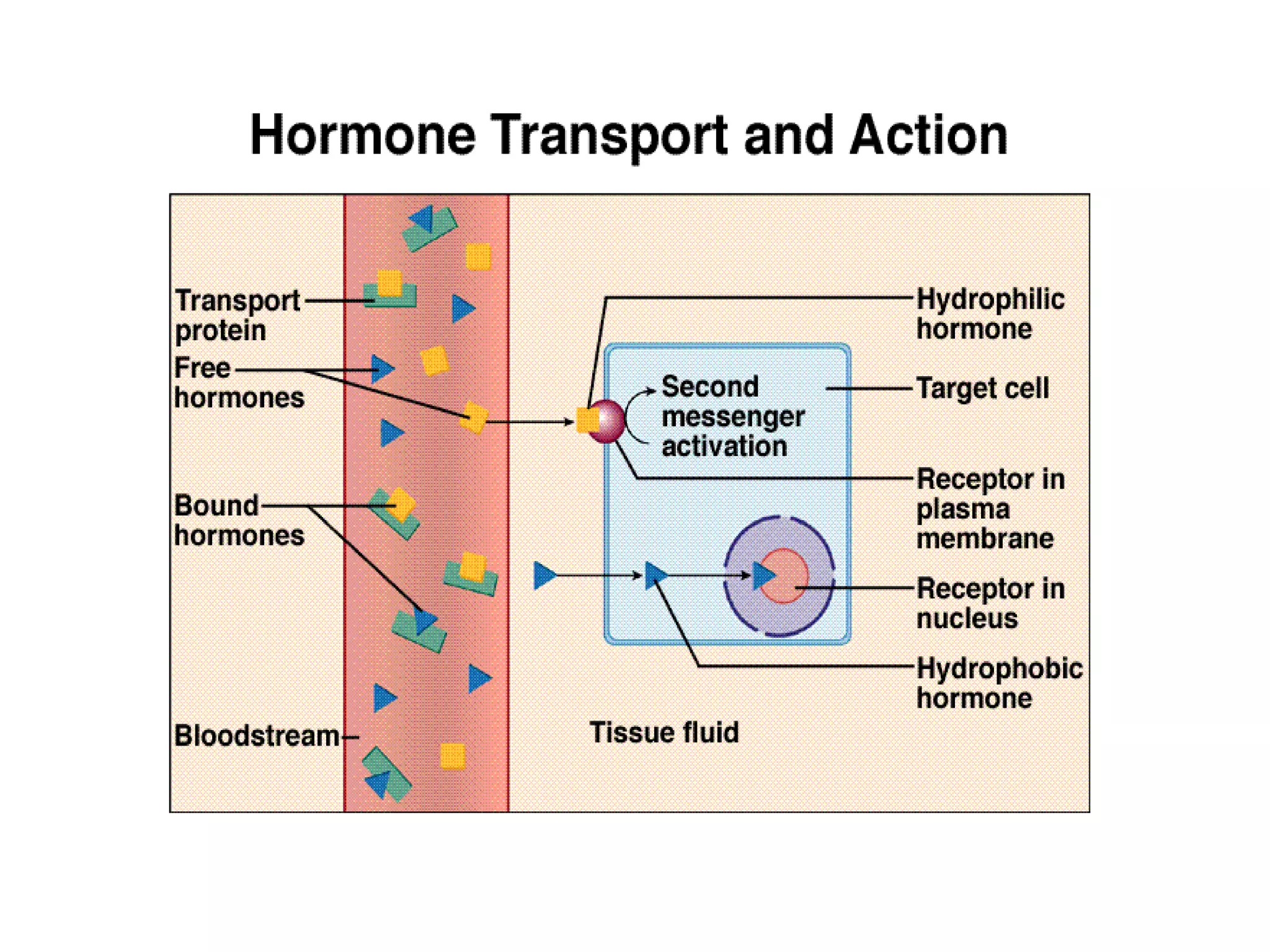
Water Solubility and Membrane Permeability Steroid + thyroid hormones All other hormones Hydrophobic Membrane-permeable Hydrophilic Membrane-impermeable
 
 
Effects after  hormones bind to their receptors   1)   Synthesis of new proteins (enzymes) 2)  Alterations of  activities of proteins that are already present
Effects of Hormone Concentration
Hormone Deactivation Hormones have short half-life (< 2 min) in the plasma.
Hormone Interactions   Synergistic effects Two hormones act together to produce an effect that is greater than the sum of their separate effects.   Permissive effects Only in the presence of one hormone, the target organ responds to a second hormone.   Antagonistic effects One hormone opposes the action of another hormone.
1) ADH Kidneys blood vessels reducing urine output vasoconstriction 2) Oxytocin Uterus,  mammary glands, Labor contractions milk ejection   Hormone Target Organ Principal Effects Posterior Pituitary
1) FSH   Ovaries and Testes   follicle/egg or sperm  development   (Follicle-Stimulating Hormone)  2) LH    Ovaries and testes  Ovulation/growth of  corpus luteum  (Luteinizing Hormone)     3) TSH   Thyroid gland   Growth of thyroid gland  Secretion of thyroid  hormone (Thyroid-Stimulating Hormone)   Hormone Target Organ Principal Effects Anterior Pituitary
Hormone Target Organ Principal Effects Anterior Pituitary 4) ACTH   Adrenal cortex   Growth of adrenal cortex  (Adrenocorticotropic Hormone)   secretion of glucocorticoids   5) PRL   Mammary gland   milk synthesis Testes   enhance secretion of testosterone   (Prolactin)
Hormone Target Organ Principal Effects Anterior Pituitary 6) GH   Most tissues  tissue/organ growth, cell mitosis and differentiation   (Growth hormone or somatotropin)
Hypothalamus hormones
Hormone Target Organ Principal Effects Hypothalamus 1) TRH   Pituitary   Promotes TSH and PRL  Thyrotropin-releasing hormone   2) CRH   Pituitary   Promotes ACTH  Corticotropin-releasing hormone   3) GnRH  Pituitary   Promotes FSH/LH  Gonadotropin-releasing hormone   4) PRF   Pituitary   Promotes PRL secretion   Prolactin-releasing factor   secretion   secretion secretion
Hormone Target Organ Principal Effects Hypothalamus 5) PIF   Pituitary   Inhibits PRL secretion   Prolactin-inhibiting factor Dopamine   6) GHRH   Pituitary   Promotes GH secretion   Growth hormone-releasing hormone   7) GHIH  Pituitary Inhibits GH/TSH secretion Growth hormone-inhibiting hormone  somatostatin
Hormone Target Organ Principal Effects Pineal Gland  1) Melatonin Brain  Regulate timing of puberty;  influence mood 2) Serotonin   Brain Regulate timing of puberty;  influence mood
Thymus  Hormone Target Organ Principal Effects Thymopoietin/  T lymphocytes   Promote T lymphocyte  Thymosins  development/ activation
1) Triiodothyronin (T3) Stimulate Na + -K +  pumps, metabolic rate,  heat production, alertness, protein synthesis, fetal and childhood growth, and CNS  development   Most tissues 2) Throxin (T4)   Thyroid Gland  Hormone Target Organ Principal Effects 3) Calcitonin   Osteoblasts   Stimulates calcium deposition and ossification; reduces blood calcium concentration
Parathyroid Gland  Hormone Target Organ Principal Effects PTH   Stimulates calcium absorption and retention; promotes bone resorption; elevates blood calcium concentration  Small intestine, Kidneys, and  Osteoclasts   Parathyroid hormone
Adrenal Gland
Adrenal Medulla  Hormone Target Organ Principal Effects Complement action of sympathetic nervous system   2) Norepinephrin 1) Epinephrin   3) Dopamine   Most tissues
Adrenal Cortex  Hormone Target Organ Principal Effects 1) Aldosterone   Kidneys   Promotes Na +  retention and K +  excretion; maintains blood pressure and volume 2) Glucocorticoids  Most tissues   Cortisol/Corticosterone  Promote fat and protein catabolism,  gluconeogesis, stress resistance, and tissue repair; inhibit inflammation
Adrenal Cortex  Hormone Target Organ Principal Effects 3) Androgen  Bone,  muscle,  Integument, many other organs  Stimulate growth of pubic and axillary hair in both sexes; stimulate libido; negligible effcts in males compared to teststerone from testes
Pancreatic Islets   Hormone Target Organ Principal Effects 1) Glucagon   Primarily liver   Stimulates glycogen and fat hydrolysis,  mobilization of glucose and fatty acids, and gluconeogenesis  2) Insulin   Most tissues  Promotes glucose and amino acid uptake and synthesis of glycogen, fat, and protein
The Ovaries   Hormone Target Organ Principal Effects Estradiol   Estragen   Ovaries, uterus,  mammary glands, brain, many other tissues  Regulates egg production; stimulates  adolescent growth; promotes development of female secondary sex characteristics; prepares mammary glands for lactation; prepares uterus for pregnancy
The Ovaries   Hormone Target Organ Principal Effects Progesterone   Ovaries, uterus,  mammary glands, many other tissues    Stimulates mammary development in  puberty and pregnancy; prepares uterus for pregnancy Inhibin   Anterior pituitary   Suppresses FSH  secretion
The Testes   Hormone Target Organ Principal Effects Testosterone  Most Tissues   Regulates sperm production; promotes  development of male reproductive system  and physique; stimulates adolescent growth, libido, and sexual behavior
Heart  Hormone Target Organ Principal Effects ANF   Kidneys   Increases Na +  excretion and urine output;  lowers blood pressure
Kidneys   Hormone Target Organ Principal Effects Calcitriol  Erythropoietin   Renin   Intestines Red Bone marrow   angiotensinogen   Increase absorption of calcium Stimulate RBC production Stimulate production of angiotensin I
Liver   Hormone Target Organ Principal Effects Angiotensi-nogen   Blood vessels,   adrenal cortex, hypothalamus   Stimulates  vasoconstriction,  aldosterone secretion, and thirst   Erythropoietin
GI tract  Hormone Target Organ Principal Effects Gastrin   Secretin   CCK  (cholecystokinin)   GIP  (gastric inhibitory peptide)   GI tract and its  accessory glands  Coordinate secretion and motility in  digestion
Placenta  Hormone Target Organ Principal Effects Estrogen   Progesterone   Maternal and fetal  tissues   Promotes fetal growth; regulate  pregnancy; prepare mammary glands for lactation
Exercise
11.           Digestion is a process to ___. A.          take food into the mouth B.          take absorbable nutrients into blood stream C.         break ingested food into absorbable forms D  store food in the digestive tract
  W2. Which of the following forms of nutrients cannot be directly absorbed into blood without digestion? A.          Proteins B.          fatty acids C.         vitamin A D.         glucose
  33.           The primary dietary carbohydrates are starch, which are ____. A.          Monosaccharides B.          polymers of glucose C.         polymers of amino acids D.         polymers of fatty acids
44.  Fats or triglycerides ___.   A.          can be absorbed without digestion   B.          are digested into monoglycerides and fatty acids, then absorbed in the small intestine   C.         are digested into glucose, then absorbed in the small intestine   D.         are digested into amino acids, then absorbed in the small intestine
55.  Which of the following is  not  secreted by gastric glands?   A.          pepsinogen   B.          trypsinogen   C.         HCl   D.         intrinsic factor  
66.  Which of the following is  not  a function of gastric acid?   A.          activating pepsinogen.   B.          digesting connective tissues in the ingested food   C.         destroying ingested pathogens   D.         activating pancreatic enzymes
77.  Intrinsic factor has the function of ___?   A.          activating pepsinogen   B.          helping absorb vitamin B12   C.         helping absorb vitamin B6   D.         activating pancreatic enzymes
88.  Pepsinogen is able to digest ___.   A.          proteins   B.          fats   C.         starch   D.         none of the above
99.  Food digestion is completed primarily in ____.   A.          stomach   B.          small intestine   C.         large intestine  
110.  Gastric motility and secretion is ____.   A.          inhibited when food is ingested into the mouth   B.          stimulated when food enters the stomach   C.         strongly stimulated after chyme have entered the small intestine
111. Bile is produced by ____.   A.          hepatocytes   B.          gallbladder   C.         pancreas   D.         small intestine
112.  Bile salts are needed for digestion and absorption of ____.   A.          carbohydrates   B.          proteins   C.         fats   D.         minerals  
113.  Which component of bile is reabsorbed via enterohepatic circulation?   A.          bile salts   B.          bile pigments   C.         cholesterol   D.         minerals
114.  Pancreatic juice is ____.   A.          acidic (low pH)   B.          basic (high pH)   C.         neutral
115.  Which of the following cannot be digested and absorbed by human pancreatic enzymes?   A.          starch   B.          proteins   C.         fats   D.         cellulose
  116.  Bile and pancreatic juice are released into duodenum when ___.   A.          chyme is not present in duodenum   B.          cholecystokinin is secreted by duodenal mucosa   C.         hepatopancreatic sphincter constricts    D.         gallbladder relaxes
117.  Pancreatic zymogens are ___.   A.          active when stored in pancreatic duct   B.          activated after being released into duodenum
118.  Proteins and carbohydrates can be digested into amino acids and glucose by ___.   A.          pancreatic enzymes alone   B.          pancreatic enzymes plus brush border enzymes   C.         brush border enzymes alone
119.  Which of the following is not a hormone?   A.          gastrin   B.          cholecystokinin   C.         secretin   D.         intrinsic factor
220.  Which type of the movement of the small intestine can push chyme towards the large intestine?   A.          peristalsis   B.          segmentation   C.         both peristalsis and segmentation
221.  Which of the following is a function of gastrin?   A.          to stimulate the secretion of HCl and pepsinogen   B.          to inhibit gastric motility   C.         to inhibit motility of the large intestine
222.  The functions of cholecystokinin include ___.   A.          to stimulate constriction of gallbladder   B.          to stimulate relaxation of hepatopanreatic sphincter   C.         to inhibit gastric secretion of motility   D.         all of the above
223.  Bacterial flora ____.   A.          are present primarily in small intestine   B.          synthesize vitamins   C.         are harmful to human health  
224.  The large intestine primarily absorbs ___.   A.          glucose   B.          fatty acids   C.         amino acids   D.         water
225.  Glucose is taken into intestinal epithelial cells directly by ____.   A.          Na + -K +  ATPase   B.          sodium-dependent glucose transporters   C.         potassium-dependent glucose transporters   D.         all of the above
226.  Emulsification is required to complete digestion of ___.   A.          fats   B.          proteins   C.         carbohydrates   D.         water
227.  Hunger and satiety are regulated by ____.   A.          the feeding center and satiety center at hypothalamus   B.          cholecystokinin   C.         appetite-stimulating hormones released by adipocytes   D.         all of the above  
228.  Which of the following nutrients is more often used to produce ATP?   A.          glucose   B.          fats   C.         proteins   D.         vitamins
229.  Which of the following can be stored in human body?   A.          ATP   B.          Glucose   C.         Glycogen and fats   D.         All of the above
330.  Which of the following fuel do neurons normally use?   A.          glucose   B.          amino acids   C.         fatty acids
31.  Absorption of blood glucose by most tissue cells depends on ____.   A.          insulin   B.          insulin receptors   C.         both of the above
332.  During absorptive state, ____.   A.          blood glucose is absorbed by all tissue cells   B.          excessive blood glucose is converted to glycogen or fat   C.         both of the above take place
333.  Glycogen is synthesized and stored primarily in ____.   A.          liver   B.          kidneys   C.         neurons
34.  Gluconeogenesis is a process that ____.   A.          glucose is synthesized from fats or amino acids   B.          occurs normally during absorptive state when blood glucose is abundant   C.         glycogen is hydrolyzed into glucose
335.  During postabsorptive state, ____.   A.          blood glucose comes from glycogen and fats.    B.          blood insulin level is high   C.         blood glucagon is low    D.  all of the above take place
336.  In which temporal order (first to last), are the following nutrients used to produce ATP when food is not available. A.          Glycogen --- fats --- skeletal muscle proteins --- cardiac muscle proteins   B.          skeletal muscle proteins --- glycogen --- fats --- cardiac muscle proteins   C.         fats --- skeletal muscle proteins --- glycogen --- cardiac muscle proteins   D.         cardiac muscle proteins --- skeletal muscle proteins --- fats --- glycogen
337.  Body heat is produced during ___.   A.          synthesis of ATP    B.          consumption of ATP   C.         both of the above
338.  Thermoregulation center is located in ___.   A.          medulla oblongata   B.          hypothalamus   C.         spinal cord   D.         cerebral cortex
339.  The body heat can be lost via ___.   A.          conduction   B.          radiation   C.         evaporation   D.         all of the above
440.  The sex of an individual is determined by ____.   A.          sex chromosomes   B.          primary sex organs   C.         secondary sex organs   D.         secondary sex characteristics
441.  Sperm cells are produced in ____.   A.          seminiferous tubules   B.          epididymus   C.         seminal vesicles   D.         vas differens
442.  Sperm cells are stored in ____.   A.          seminiferous tubules   B.          epididymus   C.         seminal vesicles   D.         vas defferens
443.  Semen contains ___.   A.          spermatozoan   B.          fructose   C.         prostaglandins   D.         all of the above
444.  Sperm cells ___.   A.          start to migrate towards uterus immediately after being ejaculated into vagina   B.          are not able to fertilize an egg without capacitation   C.         can all find the egg
445.  In which part of the female reproductive tract is an egg usually fertilized by a sperm cell? A.          uterus   B.          vagina   C.         one third of uterine tube that is proximal to the uterus   D.         one third of uterine tube that is distal to the uterus
446.  During which of the following period does a sexual intercourse have the maximum chance of resulting in pregnancy?    A.          starting at 48 hours before ovulation and ending at 14 hours after ovulation   B.          starting at 48 hours before ovulation and ending at 24 hours after ovulation   C.         starting at 48 hours before ovulation and ending at 48 hours after ovulation   D.         starting at 48 hours before ovulation and ending at 72 hours after ovulation
447.  Which of the following statement is incorrect?   A.          Only one egg is released by two ovaries in each ovarian cycle   B.          Ovulation is triggered by a sudden increase of blood FSH level at day 14   C.         FSH stimulates the development of follicles
448.  Which of the following statements about corpus luteum is incorrect ?   A.          Corpus luteum normally secrets progesterone and estrogen    B.          Corpus luteum secrets progesterone and estrogen for only ~10 days, then undergo degeneration, no matter if the egg is fertilized or not.   C.         Corpus luteum is formed after the oocyte is ovulated.
449.  Which of the following statement about uterus is incorrect?   A.          The growth and secretion of uterus depends on progesterone   B.          The uterus harbors embryo   C.         The uterus secrets nutrients   D.         The uterus does not contract at labor.
550.  The pH of vagina is usually ___.   A.          low (acidic)   B.          high (basic)   C.         neutral
551.  Which of the following statements about HCG is correct?   A.          HCG is secreted by ovaries.   B.          HCG is found in blood 8-10 days after fertilization   C.         HCG inhibits the secretion of progesterone from corpus luteum   D.         HCG stimulates the development of follicles.
552.  In which of the following events, are the chemical messengers transported by the blood?   A.          endocrine   B.          paracrine   C.         autocrine   D.         synaptic communication
553.  Hormones fall into the following chemical classes except ____.   A.          steroids   B.          biogenic amines   C.         fatty acids   D.         peptides
554.  Which of the following hormone classes has their receptors located in the nucleus?   A.          steroid hormones   B.          peptide hormones   C.         biogenic amine hormones (except thyroid hormones)
555.  Which of the following hormone classes stimulates synthesis of new proteins?   A.          steroid hormones   B.          peptide hormones   C.         biogenic amine hormones (except thyroid hormones)
556.  Long-term exposure to high levels of a hormone causes ____ in the number of receptors and sensitivity to the hormone   A.          a decrease    B.          an increase   C.         no change
557.  Which of the following statements is correct?   A.          Most hormones remain active for several hours after being released into the blood.   B.          About 50% of most hormones are deactivated a couple of minutes after being released into the blood.   C.         Hormones are primarily deactivated in muscles.
558.  Which of the following hormones is not secreted by pituitary?   A.          luteinizing hormone (LH)   B.          thyrotropin releasing hormone (TRH)   C.         adrenocorticotropic hormone (ACTH)   D.         growth hormone (GH)
559.  Which of the following hormones is synthesized in hypothalamus and secreted from pituitary?   A.          antidiuretic hormone   B.          prolactin   C.         follicle-stimulating hormone   D.         growth hormone
660.  Which of the following hormones stimulates gluconeogenesis ?   A.          insulin   B.          vasopressin   C.         glucagon   D.         gastrin
661.  Which of the following hormones has the strongest stimulatory effect on metabolic rate or heat production?   A.          thyroid hormone   B.          ADH   C.         Aldosterone   D.         oxytocin
662.  Which of the hormone stimulates uterine labor contractions?   A.          thyroid hormone   B.          ADH   C.         Aldosterone   D.         oxytocin
663.  Adrenal medulla secrets ____.   A.          catecholamines   B.          glucocorticoids   C.         aldosterone   D.         androgen

Endocrine System

  • 1.
  • 2.
  • 3.
    Hormone is a chemical messenger secreted by one endocrine gland or cell into the bloodstream and targeted toward cells in another organ. - specificity - receptor - distribution
  • 4.
    Chemical Identity ofHormones   Steroid hormones 2) Biogenic amines 3) Peptide hormones
  • 5.
    1) Steroid hormonesEstrogens Progesterone Androgens glucocorticoids aldosterone - derived from cholesterol
  • 6.
    2) Biogenicamines Epinephrine Norepinephrine Dopamine Serotonin Melatonin thyroid hormones Synthesized from amino acids
  • 7.
    Peptide hormones Hypothalamichormones Pituitary hormones Pancreatic hormones GI hormones - are peptides
  • 8.
    Water Solubility andMembrane Permeability Steroid + thyroid hormones All other hormones Hydrophobic Membrane-permeable Hydrophilic Membrane-impermeable
  • 9.
  • 10.
  • 11.
    Effects after hormones bind to their receptors   1) Synthesis of new proteins (enzymes) 2) Alterations of activities of proteins that are already present
  • 12.
    Effects of HormoneConcentration
  • 13.
    Effects of HormoneConcentration
  • 14.
    Hormone Deactivation Hormoneshave short half-life (< 2 min) in the plasma.
  • 15.
    Hormone Interactions  Synergistic effects Two hormones act together to produce an effect that is greater than the sum of their separate effects.   Permissive effects Only in the presence of one hormone, the target organ responds to a second hormone.   Antagonistic effects One hormone opposes the action of another hormone.
  • 16.
    1) ADH Kidneysblood vessels reducing urine output vasoconstriction 2) Oxytocin Uterus, mammary glands, Labor contractions milk ejection Hormone Target Organ Principal Effects Posterior Pituitary
  • 17.
    1) FSH Ovaries and Testes follicle/egg or sperm development (Follicle-Stimulating Hormone) 2) LH Ovaries and testes Ovulation/growth of corpus luteum (Luteinizing Hormone) 3) TSH Thyroid gland Growth of thyroid gland Secretion of thyroid hormone (Thyroid-Stimulating Hormone) Hormone Target Organ Principal Effects Anterior Pituitary
  • 18.
    Hormone Target OrganPrincipal Effects Anterior Pituitary 4) ACTH Adrenal cortex Growth of adrenal cortex (Adrenocorticotropic Hormone) secretion of glucocorticoids 5) PRL Mammary gland milk synthesis Testes enhance secretion of testosterone   (Prolactin)
  • 19.
    Hormone Target OrganPrincipal Effects Anterior Pituitary 6) GH Most tissues tissue/organ growth, cell mitosis and differentiation (Growth hormone or somatotropin)
  • 20.
  • 21.
    Hormone Target OrganPrincipal Effects Hypothalamus 1) TRH Pituitary Promotes TSH and PRL Thyrotropin-releasing hormone 2) CRH Pituitary Promotes ACTH Corticotropin-releasing hormone 3) GnRH Pituitary Promotes FSH/LH Gonadotropin-releasing hormone 4) PRF Pituitary Promotes PRL secretion Prolactin-releasing factor secretion secretion secretion
  • 22.
    Hormone Target OrganPrincipal Effects Hypothalamus 5) PIF Pituitary Inhibits PRL secretion Prolactin-inhibiting factor Dopamine 6) GHRH Pituitary Promotes GH secretion Growth hormone-releasing hormone 7) GHIH Pituitary Inhibits GH/TSH secretion Growth hormone-inhibiting hormone somatostatin
  • 23.
    Hormone Target OrganPrincipal Effects Pineal Gland 1) Melatonin Brain Regulate timing of puberty; influence mood 2) Serotonin Brain Regulate timing of puberty; influence mood
  • 24.
    Thymus HormoneTarget Organ Principal Effects Thymopoietin/ T lymphocytes Promote T lymphocyte Thymosins development/ activation
  • 25.
    1) Triiodothyronin (T3)Stimulate Na + -K + pumps, metabolic rate, heat production, alertness, protein synthesis, fetal and childhood growth, and CNS development Most tissues 2) Throxin (T4) Thyroid Gland Hormone Target Organ Principal Effects 3) Calcitonin Osteoblasts Stimulates calcium deposition and ossification; reduces blood calcium concentration
  • 26.
    Parathyroid Gland Hormone Target Organ Principal Effects PTH   Stimulates calcium absorption and retention; promotes bone resorption; elevates blood calcium concentration Small intestine, Kidneys, and Osteoclasts Parathyroid hormone
  • 27.
  • 28.
    Adrenal Medulla Hormone Target Organ Principal Effects Complement action of sympathetic nervous system 2) Norepinephrin 1) Epinephrin 3) Dopamine Most tissues
  • 29.
    Adrenal Cortex Hormone Target Organ Principal Effects 1) Aldosterone Kidneys Promotes Na + retention and K + excretion; maintains blood pressure and volume 2) Glucocorticoids Most tissues Cortisol/Corticosterone Promote fat and protein catabolism, gluconeogesis, stress resistance, and tissue repair; inhibit inflammation
  • 30.
    Adrenal Cortex Hormone Target Organ Principal Effects 3) Androgen Bone, muscle, Integument, many other organs Stimulate growth of pubic and axillary hair in both sexes; stimulate libido; negligible effcts in males compared to teststerone from testes
  • 31.
    Pancreatic Islets Hormone Target Organ Principal Effects 1) Glucagon Primarily liver Stimulates glycogen and fat hydrolysis, mobilization of glucose and fatty acids, and gluconeogenesis 2) Insulin Most tissues Promotes glucose and amino acid uptake and synthesis of glycogen, fat, and protein
  • 32.
    The Ovaries Hormone Target Organ Principal Effects Estradiol Estragen Ovaries, uterus, mammary glands, brain, many other tissues Regulates egg production; stimulates adolescent growth; promotes development of female secondary sex characteristics; prepares mammary glands for lactation; prepares uterus for pregnancy
  • 33.
    The Ovaries Hormone Target Organ Principal Effects Progesterone Ovaries, uterus, mammary glands, many other tissues Stimulates mammary development in puberty and pregnancy; prepares uterus for pregnancy Inhibin Anterior pituitary Suppresses FSH secretion
  • 34.
    The Testes Hormone Target Organ Principal Effects Testosterone Most Tissues Regulates sperm production; promotes development of male reproductive system and physique; stimulates adolescent growth, libido, and sexual behavior
  • 35.
    Heart HormoneTarget Organ Principal Effects ANF Kidneys Increases Na + excretion and urine output; lowers blood pressure
  • 36.
    Kidneys Hormone Target Organ Principal Effects Calcitriol Erythropoietin Renin Intestines Red Bone marrow angiotensinogen Increase absorption of calcium Stimulate RBC production Stimulate production of angiotensin I
  • 37.
    Liver Hormone Target Organ Principal Effects Angiotensi-nogen Blood vessels, adrenal cortex, hypothalamus Stimulates vasoconstriction, aldosterone secretion, and thirst Erythropoietin
  • 38.
    GI tract Hormone Target Organ Principal Effects Gastrin Secretin CCK (cholecystokinin) GIP (gastric inhibitory peptide) GI tract and its accessory glands Coordinate secretion and motility in digestion
  • 39.
    Placenta HormoneTarget Organ Principal Effects Estrogen Progesterone Maternal and fetal tissues Promotes fetal growth; regulate pregnancy; prepare mammary glands for lactation
  • 40.
  • 41.
    11.          Digestion is a process to ___. A.         take food into the mouth B.         take absorbable nutrients into blood stream C.        break ingested food into absorbable forms D store food in the digestive tract
  • 42.
      W2. Whichof the following forms of nutrients cannot be directly absorbed into blood without digestion? A.         Proteins B.         fatty acids C.        vitamin A D.        glucose
  • 43.
      33.          The primary dietary carbohydrates are starch, which are ____. A.         Monosaccharides B.         polymers of glucose C.        polymers of amino acids D.        polymers of fatty acids
  • 44.
    44. Fatsor triglycerides ___.   A.         can be absorbed without digestion   B.         are digested into monoglycerides and fatty acids, then absorbed in the small intestine   C.        are digested into glucose, then absorbed in the small intestine   D.        are digested into amino acids, then absorbed in the small intestine
  • 45.
    55. Whichof the following is not secreted by gastric glands?   A.         pepsinogen   B.         trypsinogen   C.        HCl   D.        intrinsic factor  
  • 46.
    66. Whichof the following is not a function of gastric acid?   A.         activating pepsinogen.   B.         digesting connective tissues in the ingested food   C.        destroying ingested pathogens   D.        activating pancreatic enzymes
  • 47.
    77. Intrinsicfactor has the function of ___?   A.         activating pepsinogen   B.         helping absorb vitamin B12   C.        helping absorb vitamin B6   D.        activating pancreatic enzymes
  • 48.
    88. Pepsinogenis able to digest ___.   A.         proteins   B.         fats   C.        starch   D.        none of the above
  • 49.
    99. Fooddigestion is completed primarily in ____.   A.         stomach   B.         small intestine   C.        large intestine  
  • 50.
    110. Gastricmotility and secretion is ____.   A.         inhibited when food is ingested into the mouth   B.         stimulated when food enters the stomach   C.        strongly stimulated after chyme have entered the small intestine
  • 51.
    111. Bile isproduced by ____.   A.         hepatocytes   B.         gallbladder   C.        pancreas   D.        small intestine
  • 52.
    112. Bilesalts are needed for digestion and absorption of ____.   A.         carbohydrates   B.         proteins   C.        fats   D.        minerals  
  • 53.
    113. Whichcomponent of bile is reabsorbed via enterohepatic circulation?   A.         bile salts   B.         bile pigments   C.        cholesterol   D.        minerals
  • 54.
    114. Pancreaticjuice is ____.   A.         acidic (low pH)   B.         basic (high pH)   C.        neutral
  • 55.
    115. Whichof the following cannot be digested and absorbed by human pancreatic enzymes?   A.         starch   B.         proteins   C.        fats   D.        cellulose
  • 56.
      116. Bile and pancreatic juice are released into duodenum when ___.   A.         chyme is not present in duodenum   B.         cholecystokinin is secreted by duodenal mucosa   C.        hepatopancreatic sphincter constricts   D.        gallbladder relaxes
  • 57.
    117. Pancreaticzymogens are ___.   A.         active when stored in pancreatic duct   B.         activated after being released into duodenum
  • 58.
    118. Proteinsand carbohydrates can be digested into amino acids and glucose by ___.   A.         pancreatic enzymes alone   B.         pancreatic enzymes plus brush border enzymes   C.        brush border enzymes alone
  • 59.
    119. Whichof the following is not a hormone?   A.         gastrin   B.         cholecystokinin   C.        secretin   D.        intrinsic factor
  • 60.
    220. Whichtype of the movement of the small intestine can push chyme towards the large intestine?   A.         peristalsis   B.         segmentation   C.        both peristalsis and segmentation
  • 61.
    221. Whichof the following is a function of gastrin?   A.         to stimulate the secretion of HCl and pepsinogen   B.         to inhibit gastric motility   C.        to inhibit motility of the large intestine
  • 62.
    222. Thefunctions of cholecystokinin include ___.   A.         to stimulate constriction of gallbladder   B.         to stimulate relaxation of hepatopanreatic sphincter   C.        to inhibit gastric secretion of motility   D.        all of the above
  • 63.
    223. Bacterialflora ____.   A.         are present primarily in small intestine   B.         synthesize vitamins   C.        are harmful to human health  
  • 64.
    224. Thelarge intestine primarily absorbs ___.   A.         glucose   B.         fatty acids   C.        amino acids   D.        water
  • 65.
    225. Glucoseis taken into intestinal epithelial cells directly by ____.   A.         Na + -K + ATPase   B.         sodium-dependent glucose transporters   C.        potassium-dependent glucose transporters   D.        all of the above
  • 66.
    226. Emulsificationis required to complete digestion of ___.   A.         fats   B.         proteins   C.        carbohydrates   D.        water
  • 67.
    227. Hungerand satiety are regulated by ____.   A.         the feeding center and satiety center at hypothalamus   B.         cholecystokinin   C.        appetite-stimulating hormones released by adipocytes   D.        all of the above  
  • 68.
    228. Whichof the following nutrients is more often used to produce ATP?   A.         glucose   B.         fats   C.        proteins   D.        vitamins
  • 69.
    229. Whichof the following can be stored in human body?   A.         ATP   B.         Glucose   C.        Glycogen and fats   D.        All of the above
  • 70.
    330. Whichof the following fuel do neurons normally use?   A.         glucose   B.         amino acids   C.        fatty acids
  • 71.
    31. Absorptionof blood glucose by most tissue cells depends on ____.   A.         insulin   B.         insulin receptors   C.        both of the above
  • 72.
    332. Duringabsorptive state, ____.   A.         blood glucose is absorbed by all tissue cells   B.         excessive blood glucose is converted to glycogen or fat   C.        both of the above take place
  • 73.
    333. Glycogenis synthesized and stored primarily in ____.   A.         liver   B.         kidneys   C.        neurons
  • 74.
    34. Gluconeogenesisis a process that ____.   A.         glucose is synthesized from fats or amino acids   B.         occurs normally during absorptive state when blood glucose is abundant   C.        glycogen is hydrolyzed into glucose
  • 75.
    335. Duringpostabsorptive state, ____.   A.         blood glucose comes from glycogen and fats.   B.         blood insulin level is high   C.        blood glucagon is low   D. all of the above take place
  • 76.
    336. Inwhich temporal order (first to last), are the following nutrients used to produce ATP when food is not available. A.         Glycogen --- fats --- skeletal muscle proteins --- cardiac muscle proteins   B.         skeletal muscle proteins --- glycogen --- fats --- cardiac muscle proteins   C.        fats --- skeletal muscle proteins --- glycogen --- cardiac muscle proteins   D.        cardiac muscle proteins --- skeletal muscle proteins --- fats --- glycogen
  • 77.
    337. Bodyheat is produced during ___.   A.         synthesis of ATP   B.         consumption of ATP   C.        both of the above
  • 78.
    338. Thermoregulationcenter is located in ___.   A.         medulla oblongata   B.         hypothalamus   C.        spinal cord   D.        cerebral cortex
  • 79.
    339. Thebody heat can be lost via ___.   A.         conduction   B.         radiation   C.        evaporation   D.        all of the above
  • 80.
    440. Thesex of an individual is determined by ____.   A.         sex chromosomes   B.         primary sex organs   C.        secondary sex organs   D.        secondary sex characteristics
  • 81.
    441. Spermcells are produced in ____.   A.         seminiferous tubules   B.         epididymus   C.        seminal vesicles   D.        vas differens
  • 82.
    442. Spermcells are stored in ____.   A.         seminiferous tubules   B.         epididymus   C.        seminal vesicles   D.        vas defferens
  • 83.
    443. Semencontains ___.   A.         spermatozoan   B.         fructose   C.        prostaglandins   D.        all of the above
  • 84.
    444. Spermcells ___.   A.         start to migrate towards uterus immediately after being ejaculated into vagina   B.         are not able to fertilize an egg without capacitation   C.        can all find the egg
  • 85.
    445. Inwhich part of the female reproductive tract is an egg usually fertilized by a sperm cell? A.         uterus   B.         vagina   C.        one third of uterine tube that is proximal to the uterus   D.        one third of uterine tube that is distal to the uterus
  • 86.
    446. Duringwhich of the following period does a sexual intercourse have the maximum chance of resulting in pregnancy?   A.         starting at 48 hours before ovulation and ending at 14 hours after ovulation   B.         starting at 48 hours before ovulation and ending at 24 hours after ovulation   C.        starting at 48 hours before ovulation and ending at 48 hours after ovulation   D.        starting at 48 hours before ovulation and ending at 72 hours after ovulation
  • 87.
    447. Whichof the following statement is incorrect?   A.         Only one egg is released by two ovaries in each ovarian cycle   B.         Ovulation is triggered by a sudden increase of blood FSH level at day 14   C.        FSH stimulates the development of follicles
  • 88.
    448. Whichof the following statements about corpus luteum is incorrect ?   A.         Corpus luteum normally secrets progesterone and estrogen   B.         Corpus luteum secrets progesterone and estrogen for only ~10 days, then undergo degeneration, no matter if the egg is fertilized or not.   C.        Corpus luteum is formed after the oocyte is ovulated.
  • 89.
    449. Whichof the following statement about uterus is incorrect?   A.         The growth and secretion of uterus depends on progesterone   B.         The uterus harbors embryo   C.        The uterus secrets nutrients   D.        The uterus does not contract at labor.
  • 90.
    550. ThepH of vagina is usually ___.   A.         low (acidic)   B.         high (basic)   C.        neutral
  • 91.
    551. Whichof the following statements about HCG is correct?   A.         HCG is secreted by ovaries.   B.         HCG is found in blood 8-10 days after fertilization   C.        HCG inhibits the secretion of progesterone from corpus luteum   D.        HCG stimulates the development of follicles.
  • 92.
    552. Inwhich of the following events, are the chemical messengers transported by the blood?   A.         endocrine   B.         paracrine   C.        autocrine   D.        synaptic communication
  • 93.
    553. Hormonesfall into the following chemical classes except ____.   A.         steroids   B.         biogenic amines   C.        fatty acids   D.        peptides
  • 94.
    554. Whichof the following hormone classes has their receptors located in the nucleus?   A.         steroid hormones   B.         peptide hormones   C.        biogenic amine hormones (except thyroid hormones)
  • 95.
    555. Whichof the following hormone classes stimulates synthesis of new proteins?   A.         steroid hormones   B.         peptide hormones   C.        biogenic amine hormones (except thyroid hormones)
  • 96.
    556. Long-termexposure to high levels of a hormone causes ____ in the number of receptors and sensitivity to the hormone   A.         a decrease   B.         an increase   C.        no change
  • 97.
    557. Whichof the following statements is correct?   A.         Most hormones remain active for several hours after being released into the blood.   B.         About 50% of most hormones are deactivated a couple of minutes after being released into the blood.   C.        Hormones are primarily deactivated in muscles.
  • 98.
    558. Whichof the following hormones is not secreted by pituitary?   A.         luteinizing hormone (LH)   B.         thyrotropin releasing hormone (TRH)   C.        adrenocorticotropic hormone (ACTH)   D.        growth hormone (GH)
  • 99.
    559. Whichof the following hormones is synthesized in hypothalamus and secreted from pituitary?   A.         antidiuretic hormone   B.         prolactin   C.        follicle-stimulating hormone   D.        growth hormone
  • 100.
    660. Whichof the following hormones stimulates gluconeogenesis ?   A.         insulin   B.         vasopressin   C.        glucagon   D.        gastrin
  • 101.
    661. Whichof the following hormones has the strongest stimulatory effect on metabolic rate or heat production?   A.         thyroid hormone   B.         ADH   C.        Aldosterone   D.        oxytocin
  • 102.
    662. Whichof the hormone stimulates uterine labor contractions?   A.         thyroid hormone   B.         ADH   C.        Aldosterone   D.        oxytocin
  • 103.
    663. Adrenalmedulla secrets ____.   A.         catecholamines   B.         glucocorticoids   C.        aldosterone   D.        androgen