Regeneration
Developmental Biology
Regeneration Definition
• Regeneration can be defined as;
“The natural ability of living organisms to replace
worn out parts, repair or renew damaged or lost
parts of the body, or to reconstitute the whole body
from a small fragment during the post embryonic
life of an organism”.
Regeneration in Vertebrates
• Regeneration in vertebrates involves the genetic
regulation of wound epithelium formation,
modulation of the immune response, remodeling of
the extracellular matrix, patterning of the re-
growing appendage, and activation of WNT/β-
catenin and FGF signaling pathways.
Regeneration
• Regeneration is thus also a developmental
process that involves;
a. growth,
b. morphogenesis and
c. differentiation.
Types of Regeneration
1. Physiological Regeneration
• There is a constant loss of many kinds of
cells due to wear and tear caused by day-
to-day activities.
• The replacement of these cells is known as
physiological regeneration.
Types of Regeneration
1. Physiological Regeneration
• Example: Replacement of R.B.C's
• The worn out R.B.C's are deposited in the
spleen and new R.B.C's regularly produced
from the bone marrow cells, since the life
span of R.B.C's is only 120days.
Types of Regeneration
1. Physiological Regeneration
• Example: Replacement of Epidermal Cells of
the Skin
• The cells from the outer layers of epidermis
are regularly peeled off by wear and tear.
• These are constantly being replaced by new
cells added by the malpighian layer of the
skin.
Types of Regeneration
2. Reparative Regeneration
• This is the replacement of lost parts or
repair of damaged body organs.
• In this type of regeneration, wound is
repaired or closed by the expansion of the
adjoining epidermis over the wound.
Types of Regeneration
2. Reparative Regeneration
Examples:
• Regeneration of limbs in salamanders
• Regeneration of lost tail in lizard
• Healing of wound
• Replacement of damaged cells.
Types of Regeneration
3. Autotomy
• In some animals like starfish, some part of
the body is broken off on being threatened
by a predator. This phenomenon of self-
mutilation of the body is called autotomy
Examples:
• Crabs break off their leg on approaching
of the enemy
• Holothurians throw off their internal
viscera
• Starfish breaks off an arm
Regeneration in Vertebrates
Fishes
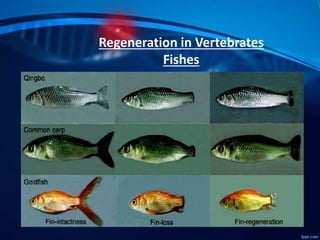
• Lamprey can regenerate its lost tail.
• Some fishes have the ability to regenerate
parts of its fins.
Regeneration in Vertebrates
Fishes
Regeneration in Vertebrates
Amphibians
• The regeneration power is well marked in
urodel amphibians like salamanders, newts
and their axolotl larvae.
• They can regenerate limbs, tail, external
gills, jaws, parts of eye like lens and retina.
• Tail and limb regeneration is found in the
larval stages of frogs and toads.
Regeneration in Vertebrates
Reptiles
Regeneration in Vertebrates
Reptiles
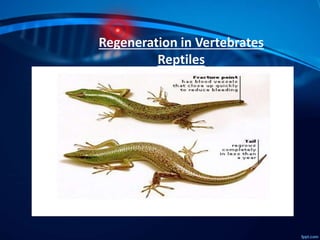
• Lizards exhibit autotomy.
• When threatened, the lizard detaches its
tail near the base to confuse its predator
and later regenerates a new tail.
• The new tail differs from the old one in its
shape, absence of vertebrae and the kind of
scales covering it.
Regeneration in Vertebrates
Amphibia
Regeneration in Vertebrates
Birds
• Regeneration is restricted to parts of the
beak.
Regeneration in Vertebrates
Mammals
• Regeneration is restricted to tissues only.
• External parts are not regenerated.
• Skin and skeletal tissues possess great
power of regeneration.
• The liver has the maximum capacity of
regeneration.
• If one kidney is damaged or removed, the
other enlarges to compensate the lost
kidney. This is called as compensatory
hypertrophy.
Regeneration of vertebrates
There are two types of regeneration:
1. Epimorphosis or epimorphic regeneration:
This type of regeneration involve the reconstruction of
the missing parts by local proliferation from the
blastema, or addition of parts to remaining piece .
For example: regeneration of tail, limbs and lens in
anurans and urodels and other vertebrates.
2. Morpholaxis or morphollactic regeneration:
This type of regeneration involving reorganization of the
remaining part of the body of an animal. For
example: Hydra, planaria and other invertebrates e.g.
regeneration of the new individual from body pieces.
Regeneration of Limb
Regeneration begins in 3 phases :
1. Phase of wound healing or pre -blastema stage :
Blood clotting and migration of epidermal cells from the basal
layer of epidermis toward the centre of the wound. The wound is
covered with epithelium which is thicker than the epidermis of
the limb .
2. Phase of blastema formation :
Cells accumulate beneath the epithelial covering and formed
the blastema. Mesenchymal cells accumulate beneath the cap .
Mesenchymal – blastemal cells differentiate into myoblasts and
muscle cells, early cartilage cells and cartilage. During the
dedifferentiate phase Hyaluronate (HA) increases in the distal
stump to form blastema . As the blastema forms, the HA will be
decrease. The production of HA and break down of collagen
represent the establishment of migration from stump tissues .
3. Phase of differentiate and morphogenesis :
The blastema begins to restore the part of which the limb was
deprived. Specifically, if the fore arm is removed, the blastema
differentiated directly into the muscle, bone, cartilage and skin of
the fore arm.
Factors Controlling Regeneration
1. Nervous system
2. Animal size
3. Pituitary gland
4. Vitamin A and its derivatives
5. Insulin

Regeneration in vertebrates

  • 1.
  • 2.
    Regeneration Definition • Regenerationcan be defined as; “The natural ability of living organisms to replace worn out parts, repair or renew damaged or lost parts of the body, or to reconstitute the whole body from a small fragment during the post embryonic life of an organism”.
  • 3.
    Regeneration in Vertebrates •Regeneration in vertebrates involves the genetic regulation of wound epithelium formation, modulation of the immune response, remodeling of the extracellular matrix, patterning of the re- growing appendage, and activation of WNT/β- catenin and FGF signaling pathways.
  • 4.
    Regeneration • Regeneration isthus also a developmental process that involves; a. growth, b. morphogenesis and c. differentiation.
  • 5.
    Types of Regeneration 1.Physiological Regeneration • There is a constant loss of many kinds of cells due to wear and tear caused by day- to-day activities. • The replacement of these cells is known as physiological regeneration.
  • 6.
    Types of Regeneration 1.Physiological Regeneration • Example: Replacement of R.B.C's • The worn out R.B.C's are deposited in the spleen and new R.B.C's regularly produced from the bone marrow cells, since the life span of R.B.C's is only 120days.
  • 7.
    Types of Regeneration 1.Physiological Regeneration • Example: Replacement of Epidermal Cells of the Skin • The cells from the outer layers of epidermis are regularly peeled off by wear and tear. • These are constantly being replaced by new cells added by the malpighian layer of the skin.
  • 8.
    Types of Regeneration 2.Reparative Regeneration • This is the replacement of lost parts or repair of damaged body organs. • In this type of regeneration, wound is repaired or closed by the expansion of the adjoining epidermis over the wound.
  • 9.
    Types of Regeneration 2.Reparative Regeneration Examples: • Regeneration of limbs in salamanders • Regeneration of lost tail in lizard • Healing of wound • Replacement of damaged cells.
  • 10.
    Types of Regeneration 3.Autotomy • In some animals like starfish, some part of the body is broken off on being threatened by a predator. This phenomenon of self- mutilation of the body is called autotomy Examples: • Crabs break off their leg on approaching of the enemy • Holothurians throw off their internal viscera • Starfish breaks off an arm
  • 11.
    Regeneration in Vertebrates Fishes •Lamprey can regenerate its lost tail. • Some fishes have the ability to regenerate parts of its fins.
  • 12.
  • 13.
    Regeneration in Vertebrates Amphibians •The regeneration power is well marked in urodel amphibians like salamanders, newts and their axolotl larvae. • They can regenerate limbs, tail, external gills, jaws, parts of eye like lens and retina. • Tail and limb regeneration is found in the larval stages of frogs and toads.
  • 14.
  • 15.
    Regeneration in Vertebrates Reptiles •Lizards exhibit autotomy. • When threatened, the lizard detaches its tail near the base to confuse its predator and later regenerates a new tail. • The new tail differs from the old one in its shape, absence of vertebrae and the kind of scales covering it.
  • 16.
  • 17.
    Regeneration in Vertebrates Birds •Regeneration is restricted to parts of the beak.
  • 18.
    Regeneration in Vertebrates Mammals •Regeneration is restricted to tissues only. • External parts are not regenerated. • Skin and skeletal tissues possess great power of regeneration. • The liver has the maximum capacity of regeneration. • If one kidney is damaged or removed, the other enlarges to compensate the lost kidney. This is called as compensatory hypertrophy.
  • 19.
    Regeneration of vertebrates Thereare two types of regeneration: 1. Epimorphosis or epimorphic regeneration: This type of regeneration involve the reconstruction of the missing parts by local proliferation from the blastema, or addition of parts to remaining piece . For example: regeneration of tail, limbs and lens in anurans and urodels and other vertebrates. 2. Morpholaxis or morphollactic regeneration: This type of regeneration involving reorganization of the remaining part of the body of an animal. For example: Hydra, planaria and other invertebrates e.g. regeneration of the new individual from body pieces.
  • 20.
    Regeneration of Limb Regenerationbegins in 3 phases : 1. Phase of wound healing or pre -blastema stage : Blood clotting and migration of epidermal cells from the basal layer of epidermis toward the centre of the wound. The wound is covered with epithelium which is thicker than the epidermis of the limb . 2. Phase of blastema formation : Cells accumulate beneath the epithelial covering and formed the blastema. Mesenchymal cells accumulate beneath the cap . Mesenchymal – blastemal cells differentiate into myoblasts and muscle cells, early cartilage cells and cartilage. During the dedifferentiate phase Hyaluronate (HA) increases in the distal stump to form blastema . As the blastema forms, the HA will be decrease. The production of HA and break down of collagen represent the establishment of migration from stump tissues . 3. Phase of differentiate and morphogenesis : The blastema begins to restore the part of which the limb was deprived. Specifically, if the fore arm is removed, the blastema differentiated directly into the muscle, bone, cartilage and skin of the fore arm.
  • 21.
    Factors Controlling Regeneration 1.Nervous system 2. Animal size 3. Pituitary gland 4. Vitamin A and its derivatives 5. Insulin