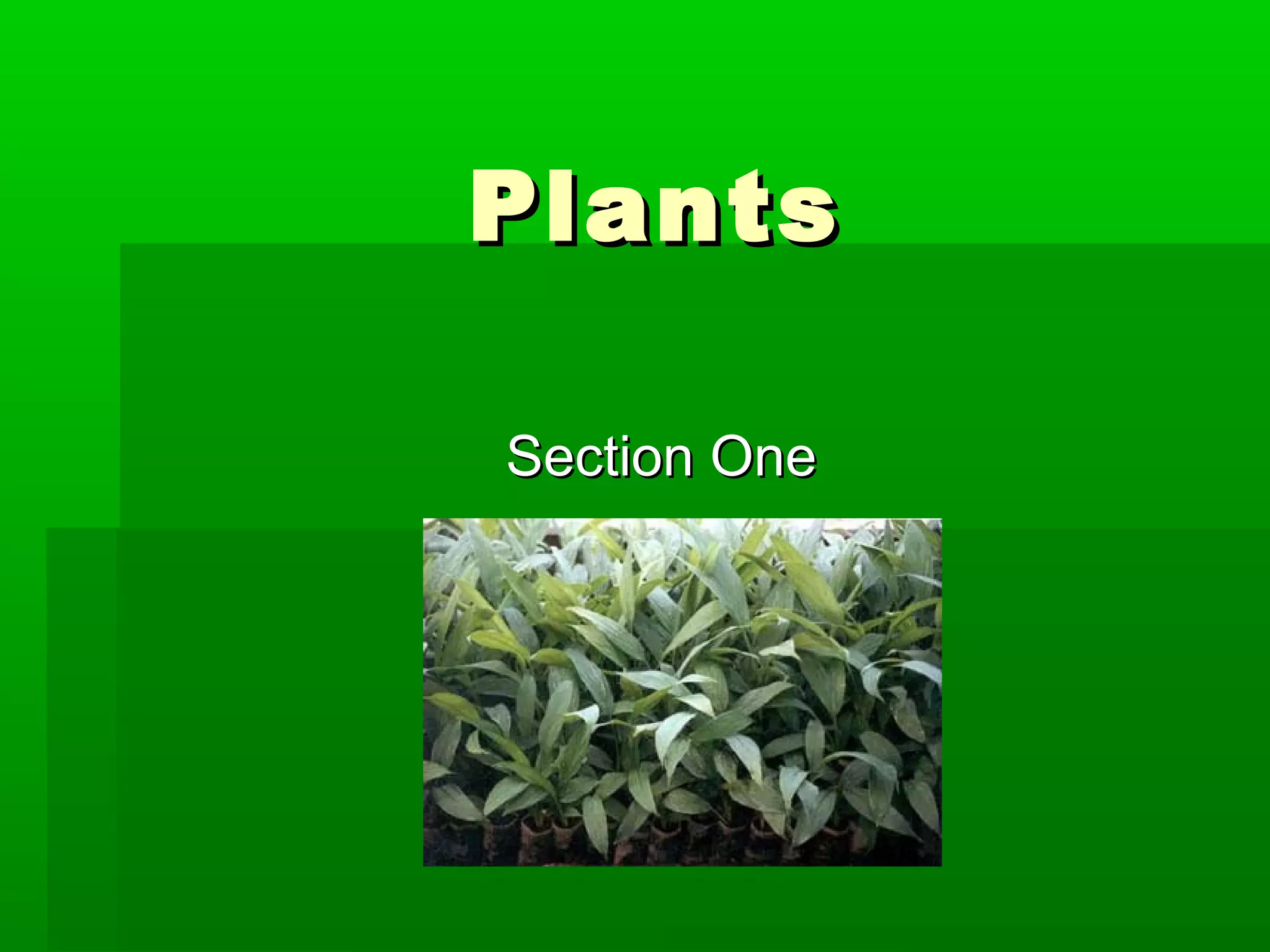
Plants

Section One
Objectives
 ď‚§ Summarize how plants are adapted to
   living on land.
 ď‚§ Distinguish nonvascular plants from
   vascular.
 ď‚§ Relate the success of plants on land to
   seeds and flowers.
 ď‚§ Describe the basic structure of a vascular
   plant.
Adaptations of Plants on
Land
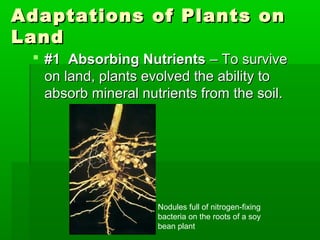
  #1 Absorbing Nutrients – To survive
   on land, plants evolved the ability to
   absorb mineral nutrients from the soil.


                     Nodules full of nitrogen-fixing
                     bacteria on the roots of a soy
                     bean plant
Adaptations of Plants on
Land
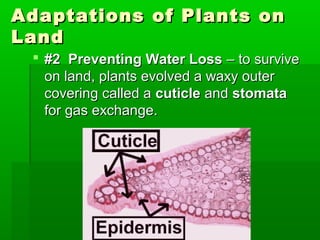
  #2 Preventing Water Loss – to survive
   on land, plants evolved a waxy outer
   covering called a cuticle and stomata
   for gas exchange.
Cuticle and Stoma
Sketches


                          Stoma
  Cuticle Cross Section
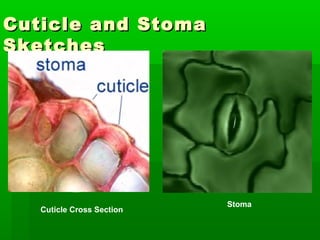
Cuticle and Stoma
Sketches


                           Stoma
   Cuticle Cross Section
Adaptations of Plants on
Land
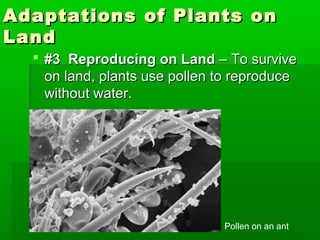
   #3 Reproducing on Land – To survive
    on land, plants use pollen to reproduce
    without water.


                               Pollen on an ant
Adaptations of Plant
Tissues
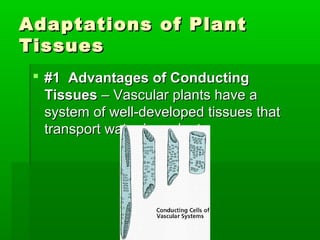
 ď‚§ #1 Advantages of Conducting
   Tissues – Vascular plants have a
   system of well-developed tissues that
   transport water in a plant.
Adaptations of Plant
Tissues
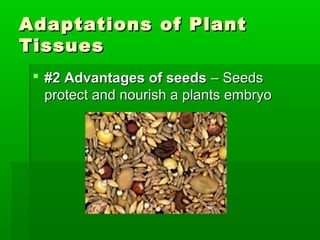
  #2 Advantages of seeds – Seeds
   protect and nourish a plants embryo
Adaptations of Plant
Tissues
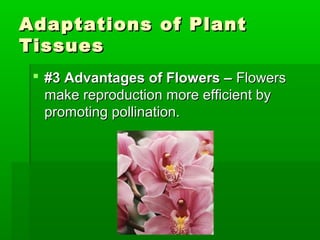
  #3 Advantages of Flowers – Flowers
   make reproduction more efficient by
   promoting pollination.
Kinds of Plants
              simple                           complex

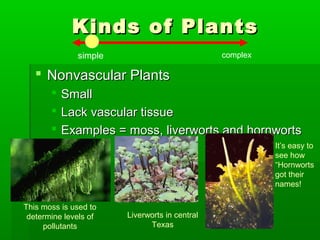
   ď‚§ Nonvascular Plants
       ď‚§ Small
       ď‚§ Lack vascular tissue
       ď‚§ Examples = moss, liverworts and hornworts
                                                         It’s easy to
                                                         see how
                                                         “Hornworts
                                                         got their
                                                         names!

This moss is used to
 determine levels of   Liverworts in central
     pollutants              Texas
Kinds of Plants
                simple                            complex

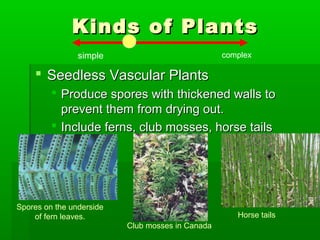
    ď‚§ Seedless Vascular Plants
         ď‚§ Produce spores with thickened walls to
           prevent them from drying out.
         ď‚§ Include ferns, club mosses, horse tails


Spores on the underside
    of fern leaves.                                  Horse tails

                          Club mosses in Canada
Kinds of Plants
                simple                          complex

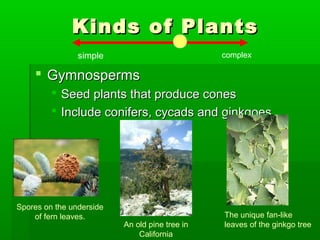
    ď‚§ Gymnosperms
         ď‚§ Seed plants that produce cones
         ď‚§ Include conifers, cycads and ginkgoes


Spores on the underside
    of fern leaves.                             The unique fan-like

                          An old pine tree in   leaves of the ginkgo tree
                              California
Kinds of Plants
               simple                              complex

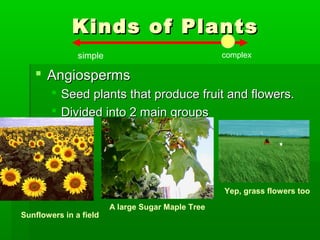
   ď‚§ Angiosperms
        ď‚§ Seed plants that produce fruit and flowers.
        ď‚§ Divided into 2 main groups


                                                   Yep, grass flowers too

                        A large Sugar Maple Tree
Sunflowers in a field
Monocots Verses
 Dicots
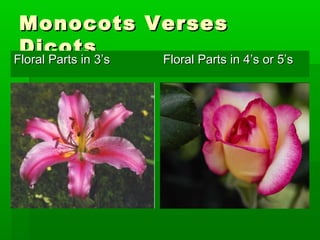
Floral Parts in 3’s
Floral Parts in 3’s Floral Parts in 4’s or 5’s
                        Floral Parts in 4’s or 5’s
Monocots Verses
 Dicots
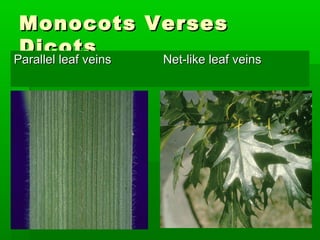
Parallel leaf veins
Parallel leaf veins Net-like leaf veins
                       Net-like leaf veins
Monocots Verses
 Dicots
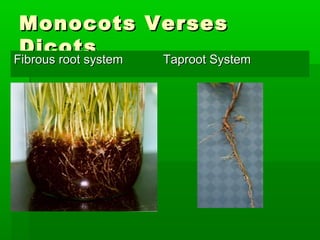
Fibrous root system
Fibrous root system Taproot System
                      Taproot System
Monocots Verses
 Dicots
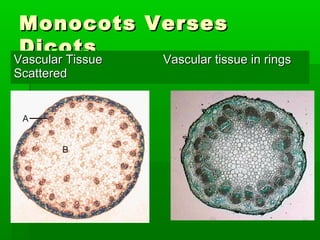
Vascular Tissue
Vascular Tissue Vascular tissue in rings
                     Vascular tissue in rings
Scattered
Monocots Verses
 Dicots
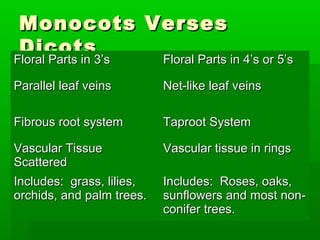
Floral Parts in 3’s
Floral Parts in 3’s Floral Parts in 4’s or 5’s
                           Floral Parts in 4’s or 5’s

Parallel leaf veins        Net-like leaf veins

Fibrous root system        Taproot System

Vascular Tissue            Vascular tissue in rings
Scattered
Includes: grass, lilies,   Includes: Roses, oaks,
orchids, and palm trees.   sunflowers and most non-
                           conifer trees.
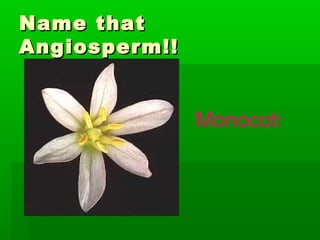
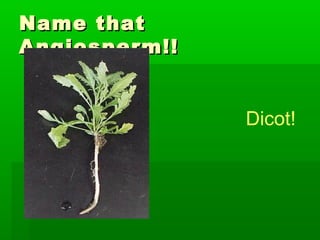
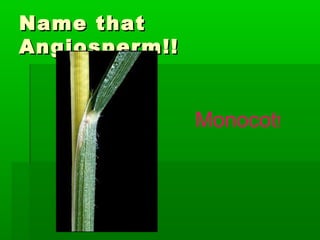
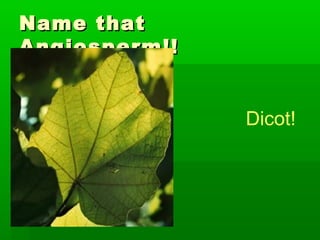
Name that
Angiosperm!!


               Monocot!
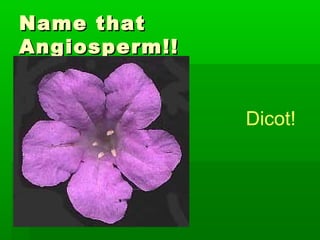
Name that
Angiosperm!!


               Dicot!
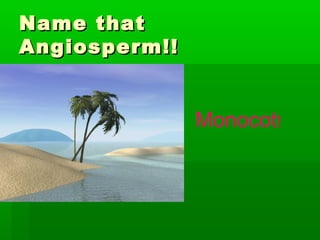
Name that
Angiosperm!!


               Monocot!
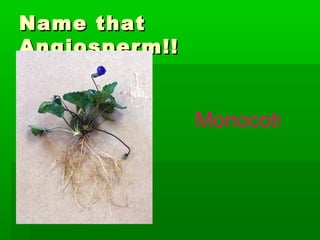
Name that
Angiosperm!!


               Monocot!
Name that
Angiosperm!!


               Dicot!
Name that
Angiosperm!!


               Monocot!
Name that
Angiosperm!!


               Dicot!
Plants in our lives
ď‚§ Fruits and vegetables
ď‚§ Crops
ď‚§ Wood
ď‚§ medicine
ď‚§ Fibers
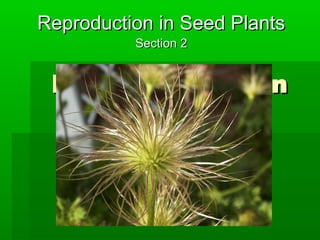
Reproduction in Seed Plants
          Section 2


 Reproduction in
     Plants
         section 2
Sexual Reproduction in Seed
Plants

 ď‚§ Objectives
   ď‚§ Distinguish the male and female
     gametophytes of seed plants.
   ď‚§ Describe the function of a seed.
   ď‚§ Relate the parts of a flower to their
     function
   ď‚§ Summarize the life cycle of an
     angiosperm
Important Vocabulary
1
 ď‚§ anther
    ď‚§ The pollen bearing portion of a stamen in flowering plants.
 ď‚§ carpels
    ď‚§ A leaf like floral structure enclosing the ovule or ovules of
      angiosperms.
 ď‚§ corolla
    ď‚§ Petals, collectively; usually the colored flower parts.
 ď‚§ egg
    ď‚§ A female gamete.
 ď‚§ embryo sac
    ď‚§ The female gametophyte of a flowering plant, inside the ovule.
Important Vocabulary
2
 ď‚§ endosperm
    ď‚§ In plants a triploid tissue containing stored food, develops from
      the union of a sperm nucleus and two nuclei of the central cell
      of the female gametophyte. Found only in angiosperms.
 ď‚§ filament
    ď‚§ A chain of cells, but in flowers it is the stalk of a stamen.
 ď‚§ fruit
    ď‚§ In angiosperms a matured, ripened ovary or group of ovaries
      and associated structure. Contains the seeds.
 ď‚§ gametophyte
    ď‚§ The haploid (n) gamete producing gerneration (plants have
      alternating haploid and diploid generations).
Important Vocabulary
3
 ď‚§ ovary
    ď‚§ In flowering plants the enlarged basal portion of a carpel or fused
      carpel containing the ovule or ovules. Ovary matures to become the
      fruit.
 ď‚§ ovules
    ď‚§ In seed plants a structure composed of a protective outer coat, a
      tissue specialized for food storage, and a female gametophyte with an
      egg cell. Becomes a seed after it is fertilized.
 ď‚§ pollen
    ď‚§ In seed plants, spore consisting of an immature male gametophyte
      and a protective outer covering.
 ď‚§ seed
    ď‚§ A complex structure formed by the maturation of the ovule of seed
      plants following fertilization; upon germination a seed develops into a
      plant. Seed is made up of a seed coat, embryo and a food reserve.
Important Vocabulary
4
 ď‚§ stamens
    ď‚§ The male structure of a flower which produces pollen.
 ď‚§ stigma
    ď‚§ In plants, the region of a carpel serving as a receptive surface
      for pollen.
 ď‚§ style
    ď‚§ In angiosperms, the stalk of a carpel which the pollen tube
      grows through.
 ď‚§ zygote
    ď‚§ The diploid (2n) cell resulting from the union of male and
      female gametes (fertilization).
Reproductive
Structures
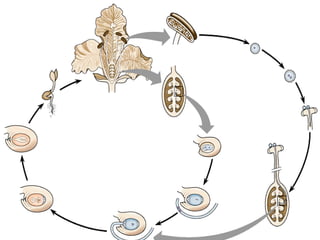
ď‚§ Tiny gametophytes of seed plants
  develop from spores that remain within
  saprophyte tissues.
Introduction to plants 1233859493415311-3

Introduction to plants 1233859493415311-3

  • 1.
  • 2.
    Objectives ď‚§ Summarizehow plants are adapted to living on land. ď‚§ Distinguish nonvascular plants from vascular. ď‚§ Relate the success of plants on land to seeds and flowers. ď‚§ Describe the basic structure of a vascular plant.
  • 3.
    Adaptations of Plantson Land  #1 Absorbing Nutrients – To survive on land, plants evolved the ability to absorb mineral nutrients from the soil. Nodules full of nitrogen-fixing bacteria on the roots of a soy bean plant
  • 4.
    Adaptations of Plantson Land  #2 Preventing Water Loss – to survive on land, plants evolved a waxy outer covering called a cuticle and stomata for gas exchange.
  • 5.
    Cuticle and Stoma Sketches Stoma Cuticle Cross Section
  • 6.
    Cuticle and Stoma Sketches Stoma Cuticle Cross Section
  • 7.
    Adaptations of Plantson Land  #3 Reproducing on Land – To survive on land, plants use pollen to reproduce without water. Pollen on an ant
  • 8.
    Adaptations of Plant Tissues  #1 Advantages of Conducting Tissues – Vascular plants have a system of well-developed tissues that transport water in a plant.
  • 9.
    Adaptations of Plant Tissues  #2 Advantages of seeds – Seeds protect and nourish a plants embryo
  • 10.
    Adaptations of Plant Tissues  #3 Advantages of Flowers – Flowers make reproduction more efficient by promoting pollination.
  • 11.
    Kinds of Plants simple complex  Nonvascular Plants  Small  Lack vascular tissue  Examples = moss, liverworts and hornworts It’s easy to see how “Hornworts got their names! This moss is used to determine levels of Liverworts in central pollutants Texas
  • 12.
    Kinds of Plants simple complex ď‚§ Seedless Vascular Plants ď‚§ Produce spores with thickened walls to prevent them from drying out. ď‚§ Include ferns, club mosses, horse tails Spores on the underside of fern leaves. Horse tails Club mosses in Canada
  • 13.
    Kinds of Plants simple complex ď‚§ Gymnosperms ď‚§ Seed plants that produce cones ď‚§ Include conifers, cycads and ginkgoes Spores on the underside of fern leaves. The unique fan-like An old pine tree in leaves of the ginkgo tree California
  • 14.
    Kinds of Plants simple complex ď‚§ Angiosperms ď‚§ Seed plants that produce fruit and flowers. ď‚§ Divided into 2 main groups Yep, grass flowers too A large Sugar Maple Tree Sunflowers in a field
  • 15.
    Monocots Verses Dicots FloralParts in 3’s Floral Parts in 3’s Floral Parts in 4’s or 5’s Floral Parts in 4’s or 5’s
  • 16.
    Monocots Verses Dicots Parallelleaf veins Parallel leaf veins Net-like leaf veins Net-like leaf veins
  • 17.
    Monocots Verses Dicots Fibrousroot system Fibrous root system Taproot System Taproot System
  • 18.
    Monocots Verses Dicots VascularTissue Vascular Tissue Vascular tissue in rings Vascular tissue in rings Scattered
  • 19.
    Monocots Verses Dicots FloralParts in 3’s Floral Parts in 3’s Floral Parts in 4’s or 5’s Floral Parts in 4’s or 5’s Parallel leaf veins Net-like leaf veins Fibrous root system Taproot System Vascular Tissue Vascular tissue in rings Scattered Includes: grass, lilies, Includes: Roses, oaks, orchids, and palm trees. sunflowers and most non- conifer trees.
  • 20.
  • 21.
  • 22.
  • 23.
  • 24.
  • 25.
  • 26.
  • 27.
    Plants in ourlives ď‚§ Fruits and vegetables ď‚§ Crops ď‚§ Wood ď‚§ medicine ď‚§ Fibers
  • 28.
    Reproduction in SeedPlants Section 2 Reproduction in Plants section 2
  • 29.
    Sexual Reproduction inSeed Plants ď‚§ Objectives ď‚§ Distinguish the male and female gametophytes of seed plants. ď‚§ Describe the function of a seed. ď‚§ Relate the parts of a flower to their function ď‚§ Summarize the life cycle of an angiosperm
  • 30.
    Important Vocabulary 1 ď‚§anther ď‚§ The pollen bearing portion of a stamen in flowering plants. ď‚§ carpels ď‚§ A leaf like floral structure enclosing the ovule or ovules of angiosperms. ď‚§ corolla ď‚§ Petals, collectively; usually the colored flower parts. ď‚§ egg ď‚§ A female gamete. ď‚§ embryo sac ď‚§ The female gametophyte of a flowering plant, inside the ovule.
  • 31.
    Important Vocabulary 2 ď‚§endosperm ď‚§ In plants a triploid tissue containing stored food, develops from the union of a sperm nucleus and two nuclei of the central cell of the female gametophyte. Found only in angiosperms. ď‚§ filament ď‚§ A chain of cells, but in flowers it is the stalk of a stamen. ď‚§ fruit ď‚§ In angiosperms a matured, ripened ovary or group of ovaries and associated structure. Contains the seeds. ď‚§ gametophyte ď‚§ The haploid (n) gamete producing gerneration (plants have alternating haploid and diploid generations).
  • 32.
    Important Vocabulary 3 ď‚§ovary ď‚§ In flowering plants the enlarged basal portion of a carpel or fused carpel containing the ovule or ovules. Ovary matures to become the fruit. ď‚§ ovules ď‚§ In seed plants a structure composed of a protective outer coat, a tissue specialized for food storage, and a female gametophyte with an egg cell. Becomes a seed after it is fertilized. ď‚§ pollen ď‚§ In seed plants, spore consisting of an immature male gametophyte and a protective outer covering. ď‚§ seed ď‚§ A complex structure formed by the maturation of the ovule of seed plants following fertilization; upon germination a seed develops into a plant. Seed is made up of a seed coat, embryo and a food reserve.
  • 33.
    Important Vocabulary 4 ď‚§stamens ď‚§ The male structure of a flower which produces pollen. ď‚§ stigma ď‚§ In plants, the region of a carpel serving as a receptive surface for pollen. ď‚§ style ď‚§ In angiosperms, the stalk of a carpel which the pollen tube grows through. ď‚§ zygote ď‚§ The diploid (2n) cell resulting from the union of male and female gametes (fertilization).
  • 34.
    Reproductive Structures ď‚§ Tiny gametophytesof seed plants develop from spores that remain within saprophyte tissues.