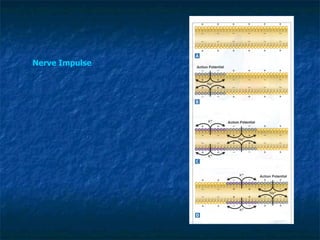
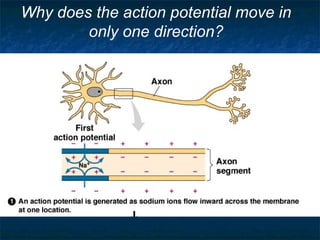
1) An impulse travels along a neuron when the inside becomes more positively charged than the outside due to the flow of sodium ions into the cell during depolarization.
2) The sodium-potassium pump normally keeps the inside negatively charged by pumping out 3 sodium ions and pumping in 2 potassium ions for each pump cycle.
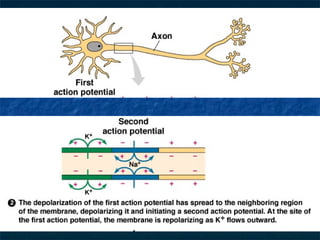
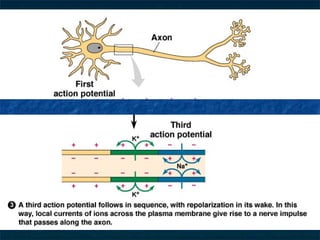
3) When the membrane potential reaches threshold, voltage-gated sodium channels open, sodium rushes in, and the inside becomes positively charged, allowing the impulse to move along. Then, voltage-gated potassium channels open and potassium exits, repolarizing the cell back to its resting potential.