Nasal Polyps
Landmarks Of Lateral Wall Of 
Nasal Cavity 
 Lateral wall is marked by three bony 
projections called turbinates or conchae 
superior ,middle ,inferior 
2
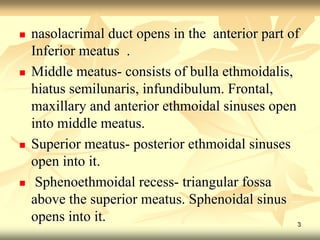
 nasolacrimal duct opens in the anterior part of 
Inferior meatus . 
 Middle meatus- consists of bulla ethmoidalis, 
hiatus semilunaris, infundibulum. Frontal, 
maxillary and anterior ethmoidal sinuses open 
into middle meatus. 
 Superior meatus- posterior ethmoidal sinuses 
open into it. 
 Sphenoethmoidal recess- triangular fossa 
above the superior meatus. Sphenoidal sinus 
opens into it. 
3
4
Nasal Polyps 
• abnormal lesions that originate from 
any portion of the nasal mucosa or 
paranasal sinuses.
 Polyps are an end result of varying disease 
processes in the nasal cavities. 
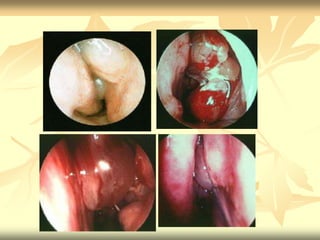
 The most commonly discussed polyps 
are benign semitransparent nasal lesions
7
Classification: 
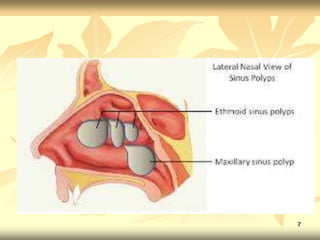
1/ Bilateral Ethmoidal polyps 
2/ Antrochoanal Polyps 
3/ Neoplastic
Ethmoidal polyps 
. arise from Middle meatus 
• Insensitive to touch 
• blood supply is poor.(Pale colour) 
• When unilateral, exclude malignancy.
Antrochoanal Polyp 
arise from maxillary sinus. 
3 parts channel,nasal, antrum. 
end result of prolong sinus infection 
unilateral
Differential diagnosis: 
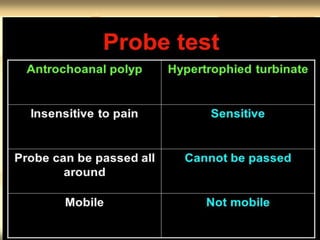
1/ hypertrophied middle turbinate, probe test, 
2/ Angiofibroma 
3/other neoplasm, fleshy appearance. and 
bleed easily. e.g. squamous cell carcinoma, 
adenocarcinoma
13
Histopathology 
 Nasal polyps are characterized by a pseudostratified 
ciliated columnar epithelium, thickening of the 
epithelial basement membrane, and few nerve 
endings. The stroma of nasal polyps is edematous 
. 
 Eosinophil cells are the most commonly identified 
inflammatory cell, occurring in 80-90% of polyps. 
 Neutrophils in 7% of polyps
Multiple Vs Solitary 
 Multiple polyps can occur in children with chronic 
sinusitis, allergic rhinitis, CF, and AFS 
 An isolated polyp could be an antral-choanal 
polyp , a benign massive polyp, a nasolacrimal duct 
cyst or any congenital lesion or benign or malignant 
tumor . 
 Evaluate all children with benign multiple nasal 
polyposis for CF and asthma.
chronic inflammation (from whatever 
source) apparently has an initial 
role in the pathogenesis of nasal 
polyps.
Simple polyps can arise any time after age 
2yrs, before this suspect 
meningocele,encephalocoel.(do CT scan) 
Before age 10 yrs. Rare….. 
if found suspect cystic fibrosis,(do sweat 
test)
Frequency 
 Adults 1-4% 
 Children 0.1% 
 All races and social classes 
 M/F 3:1 in adults 
 Increasing incidence with age
Theories 
 Bernstein theory 
 Vasomotor theory 
 Epithelia rupture theory
Bernstein theory 
 Inflammatory changes in lateral nasal wall or sinus 
mucosa 
 Polyps originate from contact area 
 Ulceration, reepithelialisation and new gland 
formation 
 Inflammatory processes from epithelial cells, 
endothelium and fibroblasts 
 Integrity of sodium channels affected
 the heightened inflammatory process from 
epithelial cells, vascular endothelial cells, and 
fibroblasts affects the bioelectric integrity of 
the sodium channels 
 This response increases sodium absorption, 
leading to water retention and polyp 
formation.
The vasomotor imbalance theory 
 postulates that increased vascular permeability 
and impaired vascular regulation cause 
detoxification of mast-cell products (eg, 
histamine). 
 The prolonged effects of these products within the 
polyp stroma result in marked edema (especially 
in the polyp pedicle) that is worsened by venous 
drainage obstruction.
The epithelial rupture theory 
 suggests that rupture of the epithelium of the nasal 
mucosa is caused by increased tissue turgor in 
illness (eg, allergies, infections). This rupture 
leads to prolapse of the lamina propria mucosa, 
forming polyps. 
 The defects are possibly enlarged by gravitational 
effects or venous drainage obstruction, causing 
the polyps.
Clinical Presentation 
 Airway obstruction 
 Postnasal drip 
 Dull headaches 
 Snoring 
 Rhinorhoea 
 Hyposmia / Anosmia 
 Epistaxis (often other lesion) 
 Obstructive sleep apnoea
Investigations 
 Sweat test.(Cystic fibrosis) 
 RAST(radioallergosorbent test/ skin testing) 
 Nasal smear 
 Microbiology 
 Eosinophils (allergic component) 
 Neutrophils (chronic sinusitis)
Imaging 
 Coronal CT scan 
 MRI scan 
 Flexible nasendoscopy 
 Rigid nasendoscopy
Fiber optic Nasophyrangoscopy.
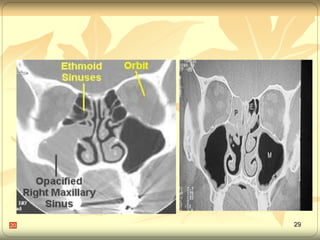
 Coronal CT scan 
through anterior 
sinuses. Opacification 
of left maxillary sinus, 
opacification of 
inferior half of nasal 
cavity. Due to antro 
coanal polyp.
20 29
Management 
Conservative : Oral steroid. Prednisolon 
30mg for 3 days,20mg for 3 days,10mg for 3 
days. 
Surgery 
1/ simple polypctomy 
2/ Nasal polytectomy (With debrider and 
FESS.)
 Endoscopic sinus surgery (ESS) is a better 
technique that not only removes the polyps but 
also opens the clefts in the middle meatus, where 
they most often form, which helps decrease the 
recurrence rate.
Nasal Polypectomy 
 Microdebrider 
entering left 
middle meatus
Summary 
 Common condition in adults 
 Aetiology not fully understood 
 Majority are not allergic in nature 
 Medical treatment can be effective 
 Even with surgery, recurrence is common
جزاكم الله خير ا

Nasal polyps

  • 1.
  • 2.
    Landmarks Of LateralWall Of Nasal Cavity  Lateral wall is marked by three bony projections called turbinates or conchae superior ,middle ,inferior 2
  • 3.
     nasolacrimal ductopens in the anterior part of Inferior meatus .  Middle meatus- consists of bulla ethmoidalis, hiatus semilunaris, infundibulum. Frontal, maxillary and anterior ethmoidal sinuses open into middle meatus.  Superior meatus- posterior ethmoidal sinuses open into it.  Sphenoethmoidal recess- triangular fossa above the superior meatus. Sphenoidal sinus opens into it. 3
  • 4.
  • 5.
    Nasal Polyps •abnormal lesions that originate from any portion of the nasal mucosa or paranasal sinuses.
  • 6.
     Polyps arean end result of varying disease processes in the nasal cavities.  The most commonly discussed polyps are benign semitransparent nasal lesions
  • 7.
  • 9.
    Classification: 1/ BilateralEthmoidal polyps 2/ Antrochoanal Polyps 3/ Neoplastic
  • 10.
    Ethmoidal polyps .arise from Middle meatus • Insensitive to touch • blood supply is poor.(Pale colour) • When unilateral, exclude malignancy.
  • 11.
    Antrochoanal Polyp arisefrom maxillary sinus. 3 parts channel,nasal, antrum. end result of prolong sinus infection unilateral
  • 12.
    Differential diagnosis: 1/hypertrophied middle turbinate, probe test, 2/ Angiofibroma 3/other neoplasm, fleshy appearance. and bleed easily. e.g. squamous cell carcinoma, adenocarcinoma
  • 13.
  • 14.
    Histopathology  Nasalpolyps are characterized by a pseudostratified ciliated columnar epithelium, thickening of the epithelial basement membrane, and few nerve endings. The stroma of nasal polyps is edematous .  Eosinophil cells are the most commonly identified inflammatory cell, occurring in 80-90% of polyps.  Neutrophils in 7% of polyps
  • 15.
    Multiple Vs Solitary  Multiple polyps can occur in children with chronic sinusitis, allergic rhinitis, CF, and AFS  An isolated polyp could be an antral-choanal polyp , a benign massive polyp, a nasolacrimal duct cyst or any congenital lesion or benign or malignant tumor .  Evaluate all children with benign multiple nasal polyposis for CF and asthma.
  • 16.
    chronic inflammation (fromwhatever source) apparently has an initial role in the pathogenesis of nasal polyps.
  • 17.
    Simple polyps canarise any time after age 2yrs, before this suspect meningocele,encephalocoel.(do CT scan) Before age 10 yrs. Rare….. if found suspect cystic fibrosis,(do sweat test)
  • 18.
    Frequency  Adults1-4%  Children 0.1%  All races and social classes  M/F 3:1 in adults  Increasing incidence with age
  • 19.
    Theories  Bernsteintheory  Vasomotor theory  Epithelia rupture theory
  • 20.
    Bernstein theory Inflammatory changes in lateral nasal wall or sinus mucosa  Polyps originate from contact area  Ulceration, reepithelialisation and new gland formation  Inflammatory processes from epithelial cells, endothelium and fibroblasts  Integrity of sodium channels affected
  • 21.
     the heightenedinflammatory process from epithelial cells, vascular endothelial cells, and fibroblasts affects the bioelectric integrity of the sodium channels  This response increases sodium absorption, leading to water retention and polyp formation.
  • 22.
    The vasomotor imbalancetheory  postulates that increased vascular permeability and impaired vascular regulation cause detoxification of mast-cell products (eg, histamine).  The prolonged effects of these products within the polyp stroma result in marked edema (especially in the polyp pedicle) that is worsened by venous drainage obstruction.
  • 23.
    The epithelial rupturetheory  suggests that rupture of the epithelium of the nasal mucosa is caused by increased tissue turgor in illness (eg, allergies, infections). This rupture leads to prolapse of the lamina propria mucosa, forming polyps.  The defects are possibly enlarged by gravitational effects or venous drainage obstruction, causing the polyps.
  • 24.
    Clinical Presentation Airway obstruction  Postnasal drip  Dull headaches  Snoring  Rhinorhoea  Hyposmia / Anosmia  Epistaxis (often other lesion)  Obstructive sleep apnoea
  • 25.
    Investigations  Sweattest.(Cystic fibrosis)  RAST(radioallergosorbent test/ skin testing)  Nasal smear  Microbiology  Eosinophils (allergic component)  Neutrophils (chronic sinusitis)
  • 26.
    Imaging  CoronalCT scan  MRI scan  Flexible nasendoscopy  Rigid nasendoscopy
  • 27.
  • 28.
     Coronal CTscan through anterior sinuses. Opacification of left maxillary sinus, opacification of inferior half of nasal cavity. Due to antro coanal polyp.
  • 29.
  • 30.
    Management Conservative :Oral steroid. Prednisolon 30mg for 3 days,20mg for 3 days,10mg for 3 days. Surgery 1/ simple polypctomy 2/ Nasal polytectomy (With debrider and FESS.)
  • 31.
     Endoscopic sinussurgery (ESS) is a better technique that not only removes the polyps but also opens the clefts in the middle meatus, where they most often form, which helps decrease the recurrence rate.
  • 32.
    Nasal Polypectomy Microdebrider entering left middle meatus
  • 33.
    Summary  Commoncondition in adults  Aetiology not fully understood  Majority are not allergic in nature  Medical treatment can be effective  Even with surgery, recurrence is common
  • 34.