Mohammad Ihmeidan ,PGY2
Physiology of kidney
 Kidney physiology is considered one of the
most complex topics in physiology because
they have many different functions.
•Regulation of blood ionic composition
•Regulation of blood pH
•Regulation of blood volume
•Regulation of blood pressure
•Maintenance of blood osmolarity
•Production of some hormones
•Excretion of metabolic wastes
Kidney Functions
Nephron
 A nephron is the basic structural and functional unit of
the kidney.
 Around 1 million nephrons per kidney
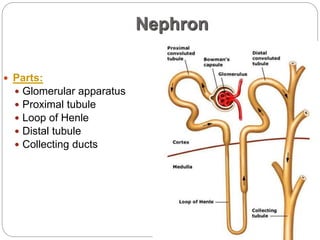
Nephron
 Parts:
 Glomerular apparatus
 Proximal tubule
 Loop of Henle
 Distal tubule
 Collecting ducts
Renal corpuscle
 It is the nephron's initial filtering component.
 Glomerulus - is a capillary tuft that receives its blood
supply from an afferent arteriole and passes into efferent
arteriole of the renal circulation.
 Bowman's capsule - surrounds the glomerulus and is
composed of visceral (inner) and parietal (outer) layers.
Glomerulus
Glomerular filter:
the capillary endothelium
basal membrane
epithelium of the Bowman’s capsule (PODOCYTES)
Podocytes: special cells which have numerous of
pseudopodia (pedicles) that interdigitate to form
filtration slits along the capillary wall.
 The glomerulus has several characteristics that
deviate from the features of most other capillaries of
the body:
 the endothelial cells of the glomerulus contain numerous
pores (fenestrae)
 glomerular endothelium sits on a very thick basement
membrane
 On the surface of the cells are negatively charged
glycosaminoglycans such as heparan sulfate. The
negatively-charged basement membrane repels negatively-
charged ions from the blood, helping to prevent their
passage into Bowman's space.
GLOMERULAR FILTRATION
 Depends on:
 Pressure gradient across the filtration slit (endothelium,
basal membrane, epithelium = podocytes)
 Blood circulation throughout the kidneys
 Permeability of the filtration barrier
 Filtration surface
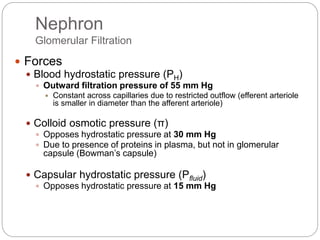
Nephron
Glomerular Filtration
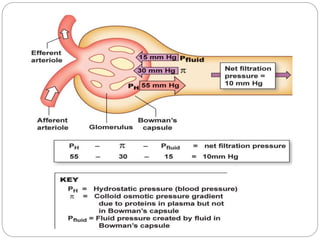
 Forces
 Blood hydrostatic pressure (PH)
 Outward filtration pressure of 55 mm Hg
 Constant across capillaries due to restricted outflow (efferent arteriole
is smaller in diameter than the afferent arteriole)
 Colloid osmotic pressure (π)
 Opposes hydrostatic pressure at 30 mm Hg
 Due to presence of proteins in plasma, but not in glomerular
capsule (Bowman’s capsule)
 Capsular hydrostatic pressure (Pfluid)
 Opposes hydrostatic pressure at 15 mm Hg
Glomerular Filtration
 10 mm Hg of filtration pressure
 Not high, but has a large surface area and nature of
filtration membrane
 creates a glomerular filtration rate (GFR) of 125 ml/min
which equates to a fluid volume of 180L/day entering
the glomerular capsule.
 Plasma volume is filtered 60 times/day or 2 ½ times
per hour
 Requires that most of the filtrate must be reabsorbed,
or we would be out of plasma in 24 minutes!
 Still…. GFR must be under regulation to meet the
demands of the body.
Proximal tubule
 Reabsorption of the largest volume of solution filtered
in glomerular apparatus.
 75 - 80 % water
 Na+, Cl-, HCO3
-, K+, Ca2+, Mg2+, HPO4
2-
 Glucose
 Results in ISOOSMOTIC SOLUTION
 Fluid in the filtrate entering the proximal convoluted tubule is reabsorbed into
the vasa recta, including approximately 2/3 of the filtered salt and water and
all filtered organic solutes (primarily glucose and amino acids).
Proximal tubule
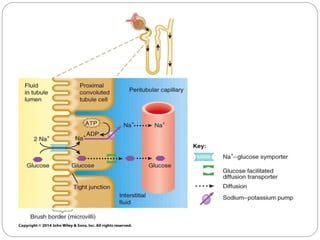
 This is driven by sodium transport from the lumen into
the blood by the Na+/K+ ATPase in the basolateral
membrane of the epithelial cells.
 Glucose and amino acids are absorbed actively via
cotransport channels driven by the sodium gradient
out of the nephron.
Loop of Henle
 A U-shaped tube that consists of a descending limb (thin
part) and ascending limb (thin and thick part) .
 Begins in the cortex, receiving filtrate from the proximal
convoluted tubule, extends into the medulla, and then
returns to the cortex to empty into the distal convoluted
tubule.
 Its primary role is to concentrate the salt in the interstitium,
the tissue surrounding the loop.
Loop of Henle - Descending limb
 Permeable to water and salt
 As the filtrate descends deeper into the hypertonic
interstitium of the renal medulla, water flows freely out
of the descending limb by osmosis until the tonicity of
the filtrate and interstitium equilibrate.
 Results in hypertonic solution in tubuli.
Loop of Henle –
Ascending limb
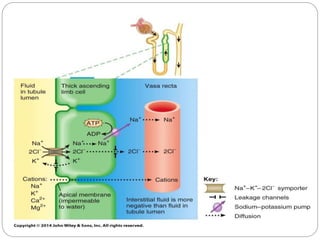
 Impermeable to water, permeable for salts.
 Actively pumps sodium out of the filtrate, generating the
hypertonic interstitium that drives countercurrent
exchange.
 Results in hypotonic solution in tubuli.
 This hypotonic filtrate is passed to the distal convoluted
tubule in the renal cortex.
Distal tubule
 The distal convoluted tubule is similar to the proximal
convoluted tubule in structure and function.
 Cells lining the tubule have numerous mitochondria, enabling
active transport to take place by the energy supplied by ATP.
 Much of the ion transport taking place in the
distal convoluted tubule is regulated by the
endocrine system.
 In the presence of parathyroid hormone, the distal
convoluted tubule reabsorbs more Ca2+ and excretes
more phosphate.
 When aldosterone is present, more Na+ is reabsorbed
and more K+ excreted.
 Atrial natriuretic peptide causes the distal convoluted
tubule to excrete more Na+ .
 In addition, the tubule also secretes hydrogen
and ammonium to regulate pH.
Collecting duct
 Final adjustment
 Results in HYPERTONIC SOLUTION
 Each distal convoluted tubule delivers its filtrate to a
collecting duct, most of which begin in the renal
cortex and extend deep into the medulla.
 As the urine travels down the collecting duct, it
passes by the medullary interstitium which has a high
sodium concentration as a result of the loop of
Henle's.
Collecting duct
 The collecting duct is normally impermeable to water, it
becomes permeable under the actions of antidiuretic
hormone (ADH).
 As much as 3/4 of the water from urine can be
reabsorbed as it leaves the collecting duct by osmosis.
 The levels of ADH determine whether urine will be
concentrated or dilute.
 Dehydration results in an increase in ADH, while water
sufficiency results in low ADH allowing for diluted urine.
Collecting duct
 Lower portions of the collecting duct are also
permeable to urea, allowing some of it to enter the
medulla of the kidney,
 Urine leaves the collecting duct through the renal
papilla, emptying into the renal calyces, the renal
pelvis, and finally into the bladder via the ureter.
 Because it has a different embryonic origin than the
rest of the nephron (the collecting duct is from
endoderm whereas the nephron is from mesoderm),
the collecting duct is usually not considered a part of
the nephron proper.
Endocrine Functions
 Kidneys synthesize
renin, prostaglandins and erythropoietin
 Renin:
 Renin is the initial member of the renin-
angiotensin-aldosterone system
 help regulate sodium and potassium in the
blood, fluid levels in the body, and blood
pressure.
25
Prostaglandins
 A group of potent cyclic fatty acids
 Behave like hormones
 Prostaglandins produced by the kidney increase
renal blood flow, sodium & water excretion
 They oppose renal vasoconstriction due to
angiotensin
26
 Erythropoietin
 It is a single chain polypeptide.
 It is produced by cells close to the proximal tubules.
 Its production is regulated by blood oxygen levels
"hypoxia increases its production".
 Erythropoietin acts on the erythroid progenitor cells
in the bone marrow, causing their maturation and
increasing the number of RBCs.
 In chronic renal insufficiency, erythropoietin
production is significantly reduced causing anemia.
27
 Also ,the kidneys are the target for the action
of aldosterone
 For the catabolism of insulin, glucagon and
aldosterone
 The point of activation for vitamin D
28
Thank You

Renal physiology

  • 1.
  • 2.
     Kidney physiologyis considered one of the most complex topics in physiology because they have many different functions.
  • 3.
    •Regulation of bloodionic composition •Regulation of blood pH •Regulation of blood volume •Regulation of blood pressure •Maintenance of blood osmolarity •Production of some hormones •Excretion of metabolic wastes Kidney Functions
  • 4.
    Nephron  A nephronis the basic structural and functional unit of the kidney.  Around 1 million nephrons per kidney
  • 5.
    Nephron  Parts:  Glomerularapparatus  Proximal tubule  Loop of Henle  Distal tubule  Collecting ducts
  • 6.
    Renal corpuscle  Itis the nephron's initial filtering component.  Glomerulus - is a capillary tuft that receives its blood supply from an afferent arteriole and passes into efferent arteriole of the renal circulation.  Bowman's capsule - surrounds the glomerulus and is composed of visceral (inner) and parietal (outer) layers.
  • 7.
    Glomerulus Glomerular filter: the capillaryendothelium basal membrane epithelium of the Bowman’s capsule (PODOCYTES) Podocytes: special cells which have numerous of pseudopodia (pedicles) that interdigitate to form filtration slits along the capillary wall.
  • 8.
     The glomerulushas several characteristics that deviate from the features of most other capillaries of the body:  the endothelial cells of the glomerulus contain numerous pores (fenestrae)  glomerular endothelium sits on a very thick basement membrane  On the surface of the cells are negatively charged glycosaminoglycans such as heparan sulfate. The negatively-charged basement membrane repels negatively- charged ions from the blood, helping to prevent their passage into Bowman's space.
  • 9.
    GLOMERULAR FILTRATION  Dependson:  Pressure gradient across the filtration slit (endothelium, basal membrane, epithelium = podocytes)  Blood circulation throughout the kidneys  Permeability of the filtration barrier  Filtration surface
  • 10.
    Nephron Glomerular Filtration  Forces Blood hydrostatic pressure (PH)  Outward filtration pressure of 55 mm Hg  Constant across capillaries due to restricted outflow (efferent arteriole is smaller in diameter than the afferent arteriole)  Colloid osmotic pressure (π)  Opposes hydrostatic pressure at 30 mm Hg  Due to presence of proteins in plasma, but not in glomerular capsule (Bowman’s capsule)  Capsular hydrostatic pressure (Pfluid)  Opposes hydrostatic pressure at 15 mm Hg
  • 12.
    Glomerular Filtration  10mm Hg of filtration pressure  Not high, but has a large surface area and nature of filtration membrane  creates a glomerular filtration rate (GFR) of 125 ml/min which equates to a fluid volume of 180L/day entering the glomerular capsule.  Plasma volume is filtered 60 times/day or 2 ½ times per hour  Requires that most of the filtrate must be reabsorbed, or we would be out of plasma in 24 minutes!  Still…. GFR must be under regulation to meet the demands of the body.
  • 13.
    Proximal tubule  Reabsorptionof the largest volume of solution filtered in glomerular apparatus.  75 - 80 % water  Na+, Cl-, HCO3 -, K+, Ca2+, Mg2+, HPO4 2-  Glucose  Results in ISOOSMOTIC SOLUTION  Fluid in the filtrate entering the proximal convoluted tubule is reabsorbed into the vasa recta, including approximately 2/3 of the filtered salt and water and all filtered organic solutes (primarily glucose and amino acids).
  • 14.
    Proximal tubule  Thisis driven by sodium transport from the lumen into the blood by the Na+/K+ ATPase in the basolateral membrane of the epithelial cells.  Glucose and amino acids are absorbed actively via cotransport channels driven by the sodium gradient out of the nephron.
  • 16.
    Loop of Henle A U-shaped tube that consists of a descending limb (thin part) and ascending limb (thin and thick part) .  Begins in the cortex, receiving filtrate from the proximal convoluted tubule, extends into the medulla, and then returns to the cortex to empty into the distal convoluted tubule.  Its primary role is to concentrate the salt in the interstitium, the tissue surrounding the loop.
  • 17.
    Loop of Henle- Descending limb  Permeable to water and salt  As the filtrate descends deeper into the hypertonic interstitium of the renal medulla, water flows freely out of the descending limb by osmosis until the tonicity of the filtrate and interstitium equilibrate.  Results in hypertonic solution in tubuli.
  • 19.
    Loop of Henle– Ascending limb  Impermeable to water, permeable for salts.  Actively pumps sodium out of the filtrate, generating the hypertonic interstitium that drives countercurrent exchange.  Results in hypotonic solution in tubuli.  This hypotonic filtrate is passed to the distal convoluted tubule in the renal cortex.
  • 20.
    Distal tubule  Thedistal convoluted tubule is similar to the proximal convoluted tubule in structure and function.  Cells lining the tubule have numerous mitochondria, enabling active transport to take place by the energy supplied by ATP.
  • 21.
     Much ofthe ion transport taking place in the distal convoluted tubule is regulated by the endocrine system.  In the presence of parathyroid hormone, the distal convoluted tubule reabsorbs more Ca2+ and excretes more phosphate.  When aldosterone is present, more Na+ is reabsorbed and more K+ excreted.  Atrial natriuretic peptide causes the distal convoluted tubule to excrete more Na+ .  In addition, the tubule also secretes hydrogen and ammonium to regulate pH.
  • 22.
    Collecting duct  Finaladjustment  Results in HYPERTONIC SOLUTION  Each distal convoluted tubule delivers its filtrate to a collecting duct, most of which begin in the renal cortex and extend deep into the medulla.  As the urine travels down the collecting duct, it passes by the medullary interstitium which has a high sodium concentration as a result of the loop of Henle's.
  • 23.
    Collecting duct  Thecollecting duct is normally impermeable to water, it becomes permeable under the actions of antidiuretic hormone (ADH).  As much as 3/4 of the water from urine can be reabsorbed as it leaves the collecting duct by osmosis.  The levels of ADH determine whether urine will be concentrated or dilute.  Dehydration results in an increase in ADH, while water sufficiency results in low ADH allowing for diluted urine.
  • 24.
    Collecting duct  Lowerportions of the collecting duct are also permeable to urea, allowing some of it to enter the medulla of the kidney,  Urine leaves the collecting duct through the renal papilla, emptying into the renal calyces, the renal pelvis, and finally into the bladder via the ureter.  Because it has a different embryonic origin than the rest of the nephron (the collecting duct is from endoderm whereas the nephron is from mesoderm), the collecting duct is usually not considered a part of the nephron proper.
  • 25.
    Endocrine Functions  Kidneyssynthesize renin, prostaglandins and erythropoietin  Renin:  Renin is the initial member of the renin- angiotensin-aldosterone system  help regulate sodium and potassium in the blood, fluid levels in the body, and blood pressure. 25
  • 26.
    Prostaglandins  A groupof potent cyclic fatty acids  Behave like hormones  Prostaglandins produced by the kidney increase renal blood flow, sodium & water excretion  They oppose renal vasoconstriction due to angiotensin 26
  • 27.
     Erythropoietin  Itis a single chain polypeptide.  It is produced by cells close to the proximal tubules.  Its production is regulated by blood oxygen levels "hypoxia increases its production".  Erythropoietin acts on the erythroid progenitor cells in the bone marrow, causing their maturation and increasing the number of RBCs.  In chronic renal insufficiency, erythropoietin production is significantly reduced causing anemia. 27
  • 28.
     Also ,thekidneys are the target for the action of aldosterone  For the catabolism of insulin, glucagon and aldosterone  The point of activation for vitamin D 28
  • 29.

Editor's Notes

  • #7 It is the nephron's initial filtering component. Glomerulus - is a capillary tuft that receives its blood supply from an afferent arteriole and passes into efferent arteriole of the renal circulation. Efferent arterioles of juxtamedullary nephrons (ie, the 15% of nephrons closest to the medulla) send straight capillary branches that deliver isotonic blood to the renal medulla. Along with the loop of Henle, these vasa recta play a crucial role in the establishment of the nephron's countercurrent exchange system. Bowman's capsule - surrounds the glomerulus and is composed of visceral (inner) and parietal (outer) layers.
  • #21 Principal Cells – receptors for ADH and aldosterone Intercalated Cells – help to manage blood pH
  • #27 arachidonic acid