Tonsillectomy,
Adenoidectomy
and Quinsy
Dr. Krishna
Koirala2016/12/12
History
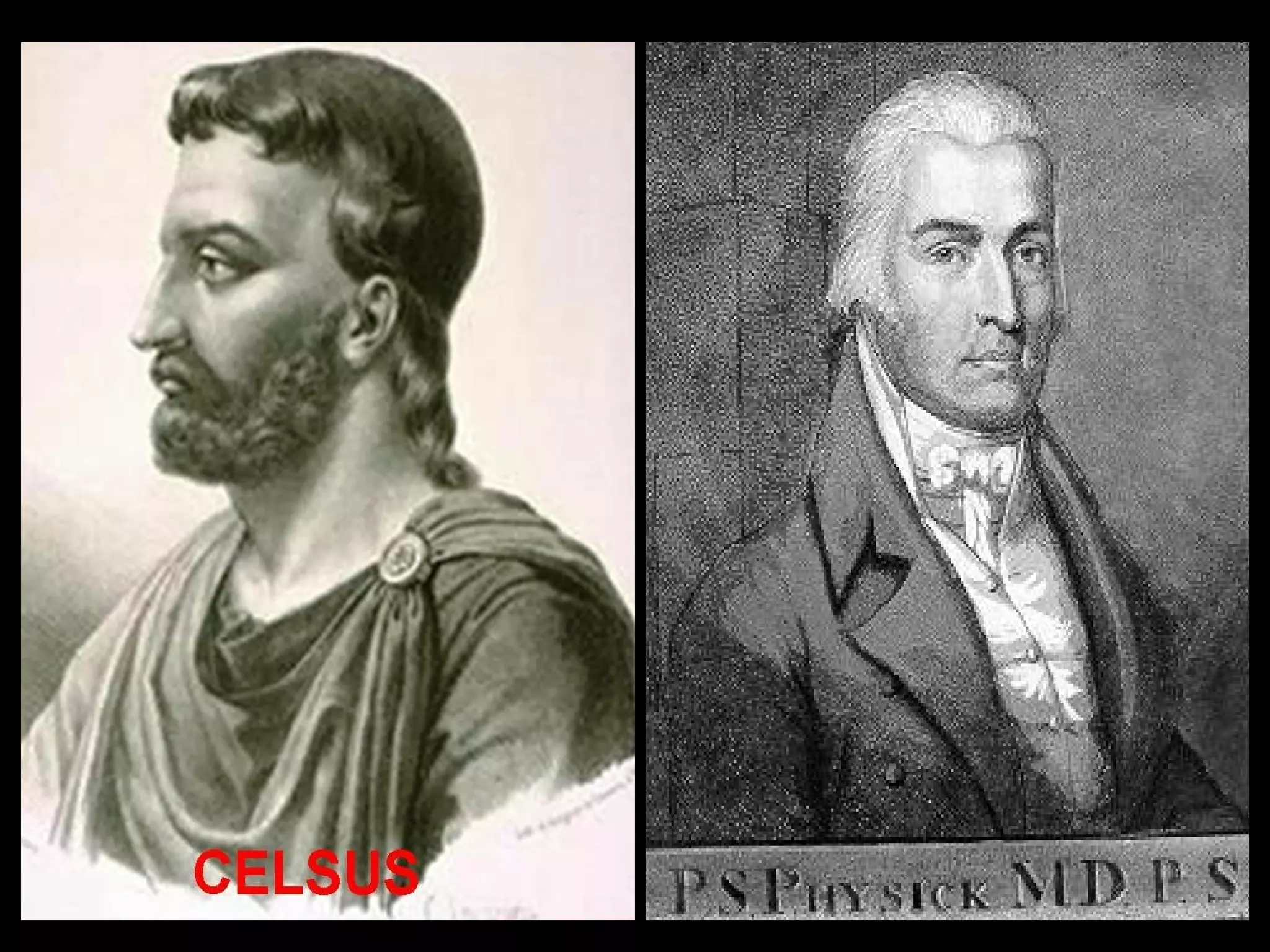
• Cornelius Celsus (30 A.D. )
– Described tonsillectomy by finger dissection
and used vinegar for hemostasis
• Philip Physick (early 1800s)
– Developed tonsillectomy
• Wilhelm Meyer (1867)
– Reported removal of adenoid through nose
with a ring knife
• George Waugh(1909)
Tonsillectomy
Indications
• Local indications
• Focal indications
• Systemic indications
• As part of other surgery
Local indications
1. Recurrent tonsillitis meeting Paradise
criteria : ( ≥ 7 episodes in 1 yr or 5 episodes / yr for 2
yrs or 3 episodes / yr for 3 yrs)
2. After second attack of Quinsy
3. Intra tonsillar abscess
4. Malignant or benign tumour or
unilateral tonsillar enlargement of
suspicious cause
5. Tonsil enlargement with stridor or
Systemic indications
1. Rheumatic fever with
arthritis
2. Sub-acute bacterial
endocarditis
3. Glomerulonephritis
As an approach to other
surgeries
1. Styloid process excision (Eagle’s
syndrome)
2. Glossopharyngeal neurectomy
3. Uvulopalatopharyngoplasty
4. Branchial fistula excision
Contraindications
• Age < 3 yr
– Limited space; immunity is lost; blood
loss not tolerated; lingual tonsils
hypertrophy
• Acute infection : More bleeding
• Aneurysm of internal carotid or tonsillar
artery
• Bleeding disorders : Hemophilia
Contraindications
• Cervical spondylosis : affects surgical
position
• Diabetes mellitus; hypertension;
tuberculosis
• Epidemic of polio : bulbar poliomyelitis
• Female patient during menstruation
Subcapsular vs Intracapsular
Tonsillectomy
• Subcapsular total tonsillectomy
– Removes tonsil tissue completely
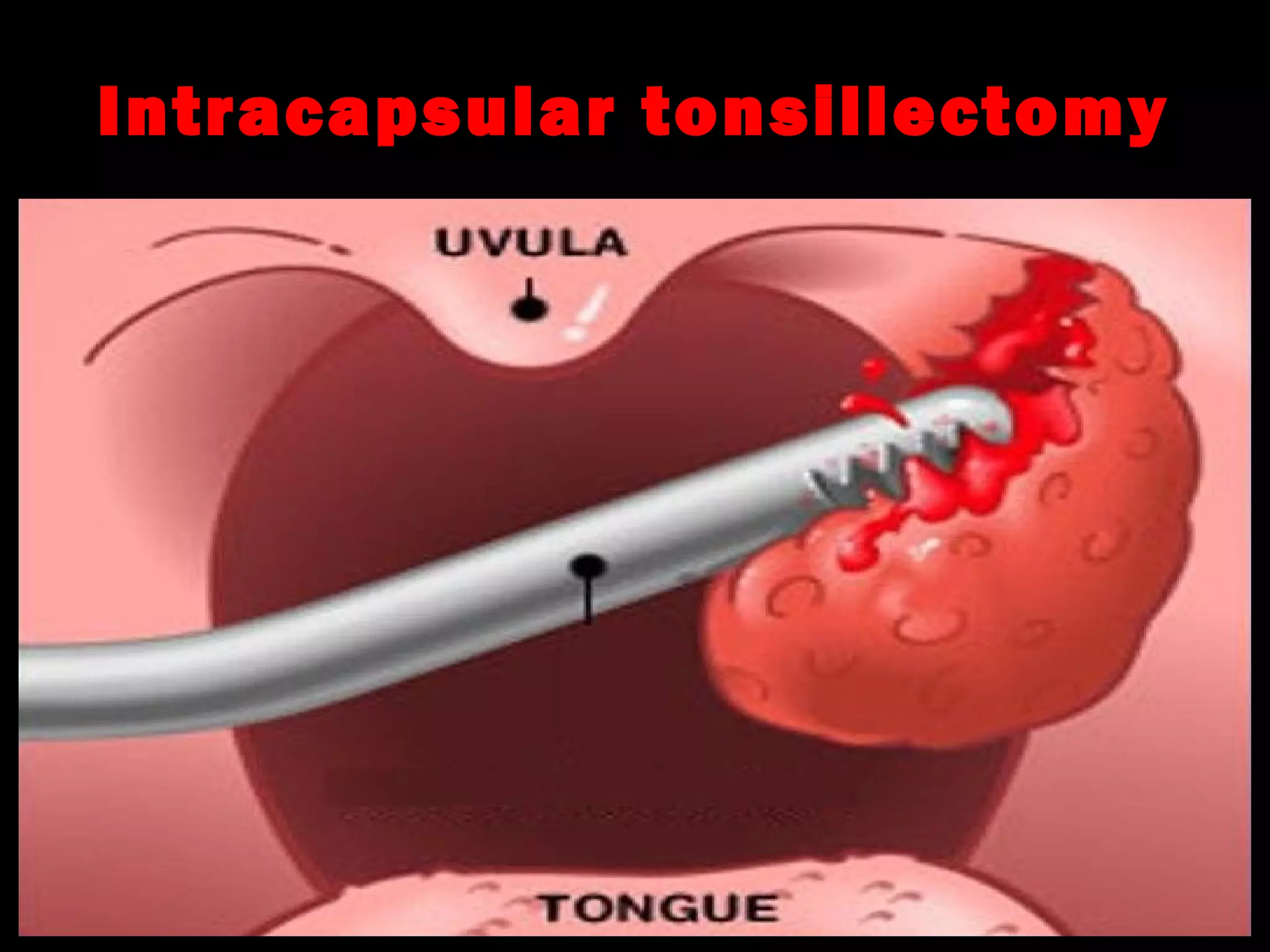
• Intracapsular tonsillectomy
– Removes 90% of tonsils leaving behind
a layer of tonsil tissue
– Protects tonsillar bed and reduces
post-op pain and recovery time
– Not appropriate for recurrent tonsillitis
Subcapsular tonsillectomy
Intracapsular tonsillectomy
Methods of Tonsillectomy
Hot
• Dissection and
snare
• Microdebrider
• Harmonic scalpel
• Cryosurgery
• Cold knife
Cold
• Electro-cautery
• Laser
• Coblation
• Radiofrequency
Tonsillectomy by
Dissection and Snare
Technique
Rose Position and Incision
Blunt dissection
Cutting of triangular
ligament
Snaring and Hemostasis
Steps of tonsillectomy
• 1. Rose position: patient kept supine
with extension of neck and atlanto-
occiptal joint
• 2. Boyle Davis mouth gag inserted and
fixed with Draffin’s bipod & Mac
Gauren’s plate
• 3. Incision made between tonsil and
anterior pillar
Steps of tonsillectomy contd….
5. Lower tonsil pedicle snared with Eve’s
tonsillar snare
6. Tonsil removed and fossa packed with
H2O2 soaked gauze for 5 min
7. Bleeder ligated with silk suture or
cauterized by bipolar cautery
Micro- debrider
Ultrasonic Harmonic scalpel
Cryosurgery
Cold knife dissection and
snare method
Guillotine
Electro-cautery
Laser tonsillectomy
Bipolar radiofrequency
Post-operative care
1. Keep the patient in left lateral position with
head low
2. Inform surgeon immediately in case of
– Fever above 100 0
F
– Difficulty in breathing or swallowing
– Excessive bleeding from oral cavity
3. Eat soft foods and ice-cream
4. Encourage swallowing and gum chewing
5. Drink plenty of cold fluids
Surgical
• Hemorrhage
– Primary
(operative)
– Reactionary ( < 24
hrs)
• Injury to lip / teeth /
uvula / pillars
• Surgical emphysema
Anesthetic
• Aspiration
• Cardiac arrest
Early Complications (within
24 hrs)
Late Complications (After
24 hrs)
Surgical
• Secondary hemorrhage
• Scarring of soft palate
leading to
velopharyngeal
insufficiency
• Lingual tonsil
hypertrophy
Anesthetic
•Lung
collapse
Hemorrhage after
Tonsillectomy
• Primary hemorrhage
– Occurs during surgery, due to injury to
blood vessels
– Normal = 80 ml.
• Reactionary hemorrhage
– Within 24 hr of surgery (commonly
within 8 hr)
• Secondary hemorrhage
Causes for reactionary
hemorrhage
• Slippage of ligature
• Displacement of clot
• Re-opening of collapsed blood vessels
– Caused by high B.P. due to cough /
retching and wearing off effect of
hypotensive anesthesia
• Clots in tonsillar fossa
– Prevent contraction of superior
Management of Post- op
tonsillar bleeding
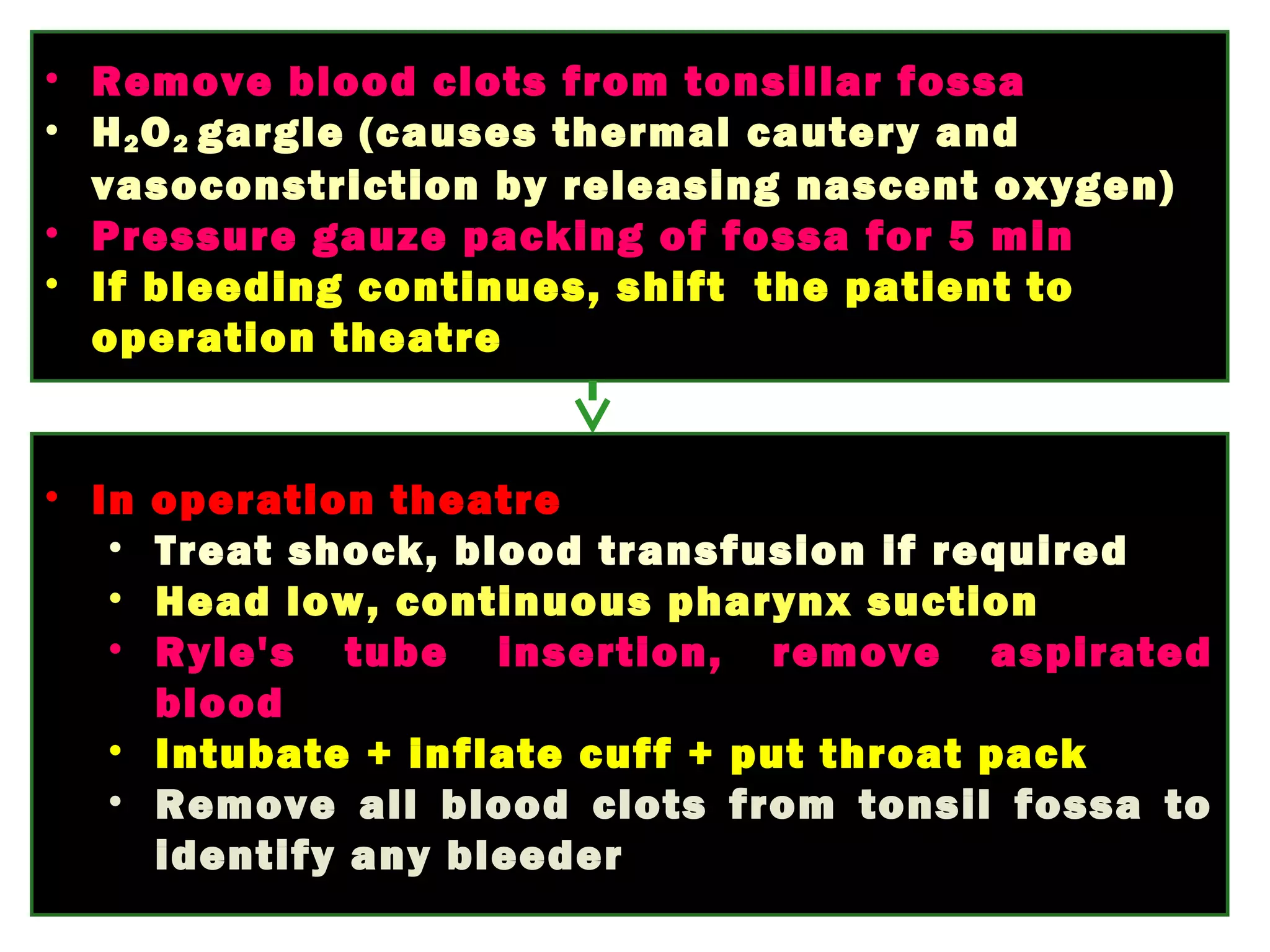
• Remove blood clots from tonsillar fossa
• H2O2 gargle (causes thermal cautery and
vasoconstriction by releasing nascent oxygen)
• Pressure gauze packing of fossa for 5 min
• If bleeding continues, shift the patient to
operation theatre
• In operation theatre
• Treat shock, blood transfusion if required
• Head low, continuous pharynx suction
• Ryle's tube insertion, remove aspirated
blood
• Intubate + inflate cuff + put throat pack
• Remove all blood clots from tonsil fossa to
identify any bleeder
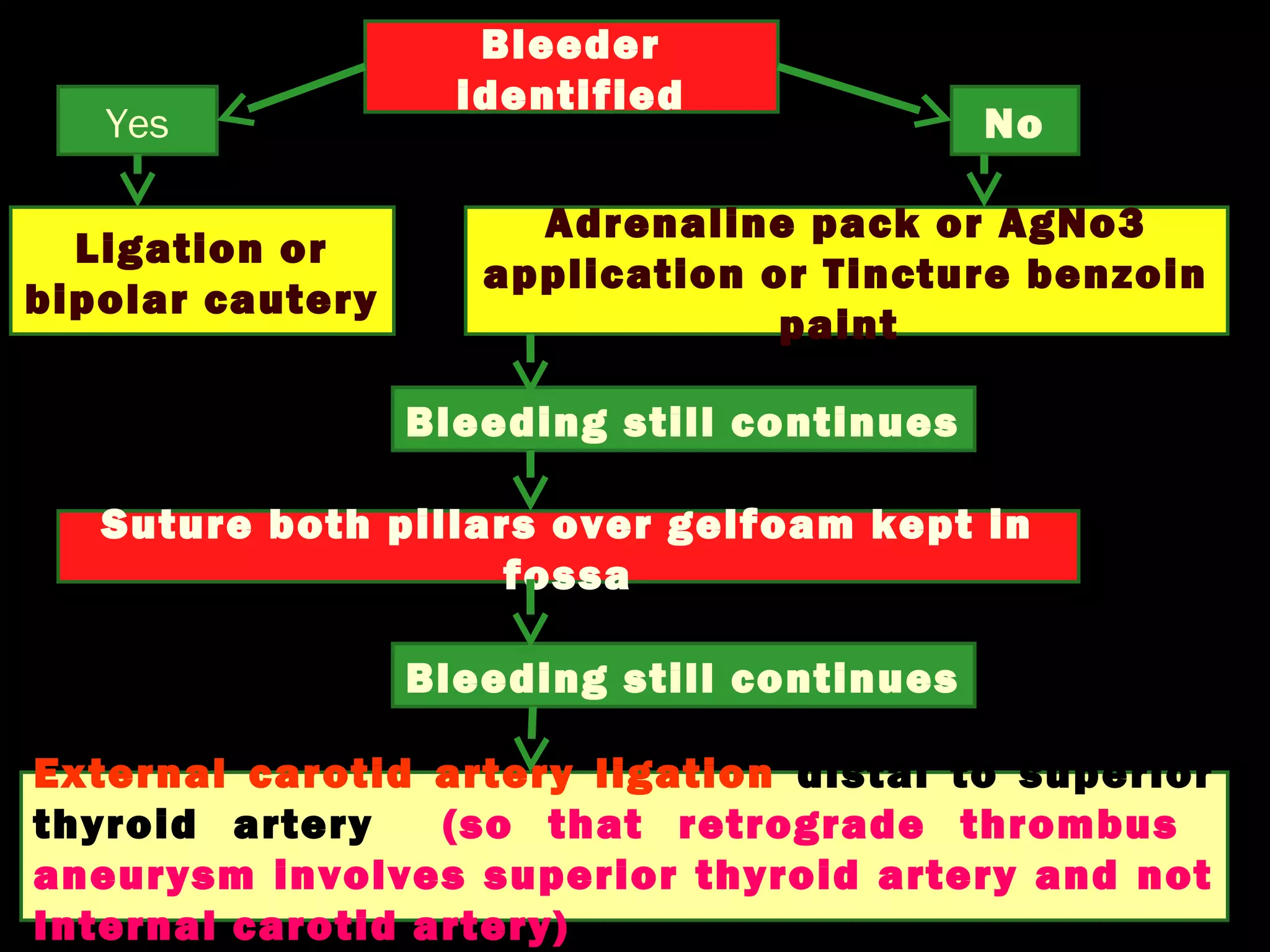
Bleeder
identified
Yes No
Ligation or
bipolar cautery
Adrenaline pack or AgNo3
application or Tincture benzoin
paint
Bleeding still continues
Suture both pillars over gelfoam kept in
fossa
Bleeding still continues
External carotid artery ligation distal to superior
thyroid artery (so that retrograde thrombus
aneurysm involves superior thyroid artery and not
Internal carotid artery)
Adenoidectomy
• First do adenoidectomy then only
tonsillectomy (hemostasis performed by
blind nasopharynx packing)
• Indications: Adenoids with
– Adenoid facies
– Sleep apnea / snoring
– Rhinolalia clausa
– Recurrent sinusitis
– Refractory O.M.E.
– C.S.O.M.
Tonsillectomy & Adenoidectomy
positions
Procedure
Procedure
• Rose position but atlanto-occipital joint
neutral
• Mouth gag inserted, finger palpation done
– To assess the size of adenoids
– To bring the adenoid mass in midline
– To check the position of Eustachian
tube
• Adenoid curetted keeping head slightly
Microdebrider adenoidectomy
Complications
• Hemorrhage → 10
, R0
, 20
→ post nasal
pack
• Damage to E.T. orifice → scarring →
O.M.E.
• Subluxation of Atlanto-Occipital joint
→ torticollis (Griesel disease)
• Velopharyngeal insufficiency → nasal
twang + regurgitation from nose
Contraindications
• Acute infection
• Bleeding disorders
• Cleft palate: symptoms will be
worsened
Peritonsillar abscess
(Quinsy)
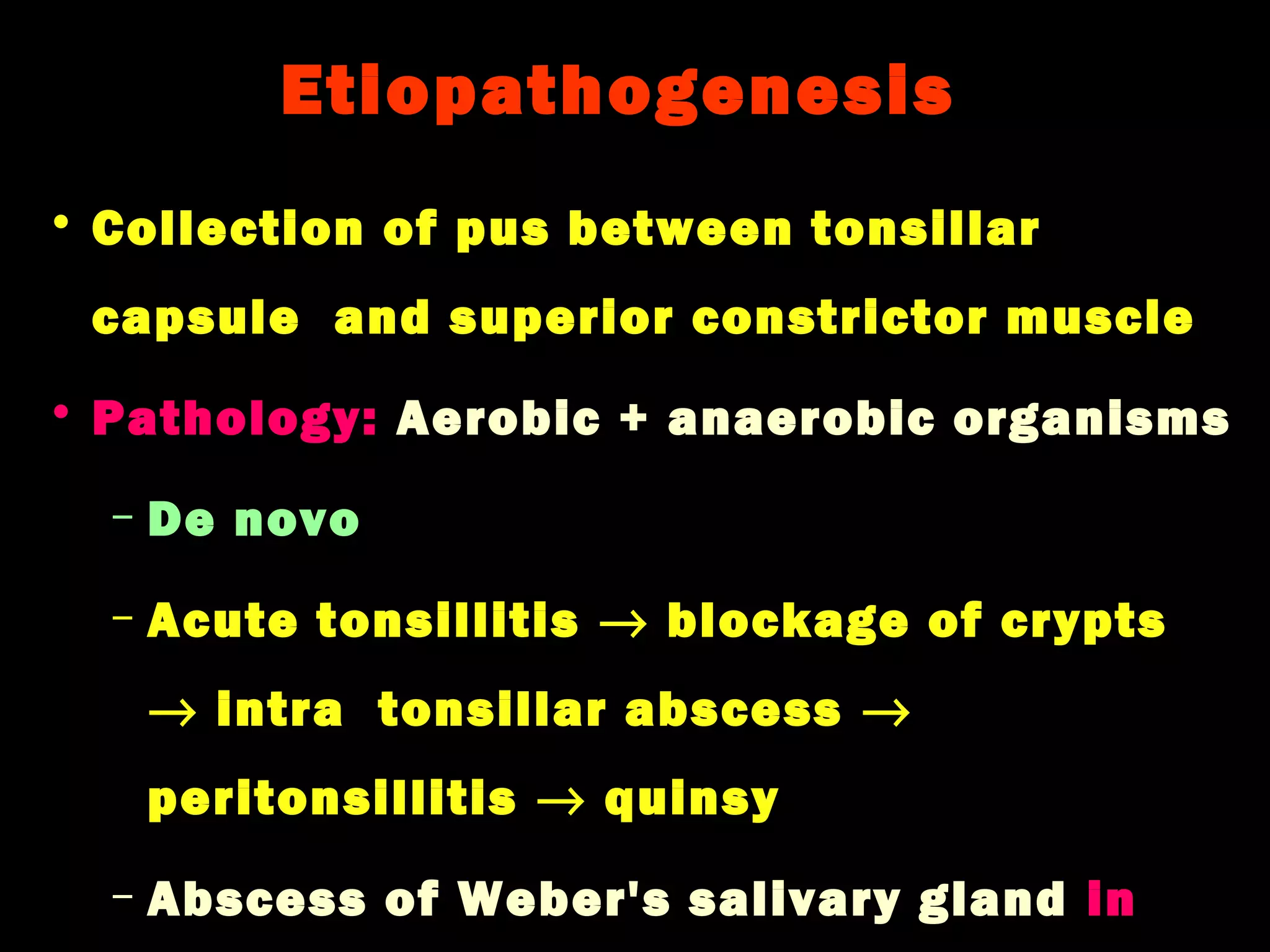
Etiopathogenesis
• Collection of pus between tonsillar
capsule and superior constrictor muscle
• Pathology: Aerobic + anaerobic organisms
– De novo
– Acute tonsillitis → blockage of crypts
→ intra tonsillar abscess →
peritonsillitis → quinsy
– Abscess of Weber's salivary gland in
Clinical features
• Symptoms: Young adult with severe
odynophagia, fever, halitosis and muffled
voice
• Signs:
– Peritonsillar area swollen and
congested
– Tonsil hidden behind the anterior
pillar, pushed medially and congested
–
Management
• Diagnosis:
– Wide bore needle aspiration (18G)
reveals pus
• Medical treatment:
– Urgent admission, I.V. fluids
– I.V. ceftriaxone + ornidazole
– Antihistamine - decongestant +
analgesic
Incision and Drainage
• Incision made with # 11 blade or
Thilenius peritonsillar abscess drainage
forceps
• Nick made above and lateral to junction
of 2 imaginary lines, horizontal along
base of uvula and vertical along anterior
Incision line and quinsy
forceps
Surgical treatment
1. Interval tonsillectomy → after 4 – 6 wk.
2. Hot tonsillectomy or abscess
tonsillectomy is avoided as it leads to
– More bleeding
– Septicemia
Complications of quinsy
1. Parapharyngeal abscess
2. Retropharyngeal abscess
3. Laryngitis and laryngeal
edema
4. Lung abscess
5. Internal jugular vein
thrombosis

Tonsillectomy, adenoidectomy and quinsy

  • 1.
  • 2.
    History • Cornelius Celsus(30 A.D. ) – Described tonsillectomy by finger dissection and used vinegar for hemostasis • Philip Physick (early 1800s) – Developed tonsillectomy • Wilhelm Meyer (1867) – Reported removal of adenoid through nose with a ring knife • George Waugh(1909)
  • 4.
  • 5.
    Indications • Local indications •Focal indications • Systemic indications • As part of other surgery
  • 6.
    Local indications 1. Recurrenttonsillitis meeting Paradise criteria : ( ≥ 7 episodes in 1 yr or 5 episodes / yr for 2 yrs or 3 episodes / yr for 3 yrs) 2. After second attack of Quinsy 3. Intra tonsillar abscess 4. Malignant or benign tumour or unilateral tonsillar enlargement of suspicious cause 5. Tonsil enlargement with stridor or
  • 7.
    Systemic indications 1. Rheumaticfever with arthritis 2. Sub-acute bacterial endocarditis 3. Glomerulonephritis
  • 8.
    As an approachto other surgeries 1. Styloid process excision (Eagle’s syndrome) 2. Glossopharyngeal neurectomy 3. Uvulopalatopharyngoplasty 4. Branchial fistula excision
  • 9.
    Contraindications • Age <3 yr – Limited space; immunity is lost; blood loss not tolerated; lingual tonsils hypertrophy • Acute infection : More bleeding • Aneurysm of internal carotid or tonsillar artery • Bleeding disorders : Hemophilia
  • 10.
    Contraindications • Cervical spondylosis: affects surgical position • Diabetes mellitus; hypertension; tuberculosis • Epidemic of polio : bulbar poliomyelitis • Female patient during menstruation
  • 11.
    Subcapsular vs Intracapsular Tonsillectomy •Subcapsular total tonsillectomy – Removes tonsil tissue completely • Intracapsular tonsillectomy – Removes 90% of tonsils leaving behind a layer of tonsil tissue – Protects tonsillar bed and reduces post-op pain and recovery time – Not appropriate for recurrent tonsillitis
  • 12.
  • 13.
  • 14.
    Methods of Tonsillectomy Hot •Dissection and snare • Microdebrider • Harmonic scalpel • Cryosurgery • Cold knife Cold • Electro-cautery • Laser • Coblation • Radiofrequency
  • 15.
  • 16.
  • 18.
  • 19.
  • 20.
  • 21.
    Steps of tonsillectomy •1. Rose position: patient kept supine with extension of neck and atlanto- occiptal joint • 2. Boyle Davis mouth gag inserted and fixed with Draffin’s bipod & Mac Gauren’s plate • 3. Incision made between tonsil and anterior pillar
  • 22.
    Steps of tonsillectomycontd…. 5. Lower tonsil pedicle snared with Eve’s tonsillar snare 6. Tonsil removed and fossa packed with H2O2 soaked gauze for 5 min 7. Bleeder ligated with silk suture or cauterized by bipolar cautery
  • 23.
  • 24.
  • 25.
  • 26.
    Cold knife dissectionand snare method
  • 27.
  • 28.
  • 29.
  • 30.
  • 31.
    Post-operative care 1. Keepthe patient in left lateral position with head low 2. Inform surgeon immediately in case of – Fever above 100 0 F – Difficulty in breathing or swallowing – Excessive bleeding from oral cavity 3. Eat soft foods and ice-cream 4. Encourage swallowing and gum chewing 5. Drink plenty of cold fluids
  • 33.
    Surgical • Hemorrhage – Primary (operative) –Reactionary ( < 24 hrs) • Injury to lip / teeth / uvula / pillars • Surgical emphysema Anesthetic • Aspiration • Cardiac arrest Early Complications (within 24 hrs)
  • 34.
    Late Complications (After 24hrs) Surgical • Secondary hemorrhage • Scarring of soft palate leading to velopharyngeal insufficiency • Lingual tonsil hypertrophy Anesthetic •Lung collapse
  • 35.
    Hemorrhage after Tonsillectomy • Primaryhemorrhage – Occurs during surgery, due to injury to blood vessels – Normal = 80 ml. • Reactionary hemorrhage – Within 24 hr of surgery (commonly within 8 hr) • Secondary hemorrhage
  • 36.
    Causes for reactionary hemorrhage •Slippage of ligature • Displacement of clot • Re-opening of collapsed blood vessels – Caused by high B.P. due to cough / retching and wearing off effect of hypotensive anesthesia • Clots in tonsillar fossa – Prevent contraction of superior
  • 37.
    Management of Post-op tonsillar bleeding
  • 38.
    • Remove bloodclots from tonsillar fossa • H2O2 gargle (causes thermal cautery and vasoconstriction by releasing nascent oxygen) • Pressure gauze packing of fossa for 5 min • If bleeding continues, shift the patient to operation theatre • In operation theatre • Treat shock, blood transfusion if required • Head low, continuous pharynx suction • Ryle's tube insertion, remove aspirated blood • Intubate + inflate cuff + put throat pack • Remove all blood clots from tonsil fossa to identify any bleeder
  • 39.
    Bleeder identified Yes No Ligation or bipolarcautery Adrenaline pack or AgNo3 application or Tincture benzoin paint Bleeding still continues Suture both pillars over gelfoam kept in fossa Bleeding still continues External carotid artery ligation distal to superior thyroid artery (so that retrograde thrombus aneurysm involves superior thyroid artery and not Internal carotid artery)
  • 40.
  • 41.
    • First doadenoidectomy then only tonsillectomy (hemostasis performed by blind nasopharynx packing) • Indications: Adenoids with – Adenoid facies – Sleep apnea / snoring – Rhinolalia clausa – Recurrent sinusitis – Refractory O.M.E. – C.S.O.M.
  • 42.
  • 43.
  • 44.
    Procedure • Rose positionbut atlanto-occipital joint neutral • Mouth gag inserted, finger palpation done – To assess the size of adenoids – To bring the adenoid mass in midline – To check the position of Eustachian tube • Adenoid curetted keeping head slightly
  • 45.
  • 46.
    Complications • Hemorrhage →10 , R0 , 20 → post nasal pack • Damage to E.T. orifice → scarring → O.M.E. • Subluxation of Atlanto-Occipital joint → torticollis (Griesel disease) • Velopharyngeal insufficiency → nasal twang + regurgitation from nose
  • 47.
    Contraindications • Acute infection •Bleeding disorders • Cleft palate: symptoms will be worsened
  • 48.
  • 49.
    Etiopathogenesis • Collection ofpus between tonsillar capsule and superior constrictor muscle • Pathology: Aerobic + anaerobic organisms – De novo – Acute tonsillitis → blockage of crypts → intra tonsillar abscess → peritonsillitis → quinsy – Abscess of Weber's salivary gland in
  • 50.
    Clinical features • Symptoms:Young adult with severe odynophagia, fever, halitosis and muffled voice • Signs: – Peritonsillar area swollen and congested – Tonsil hidden behind the anterior pillar, pushed medially and congested –
  • 51.
    Management • Diagnosis: – Widebore needle aspiration (18G) reveals pus • Medical treatment: – Urgent admission, I.V. fluids – I.V. ceftriaxone + ornidazole – Antihistamine - decongestant + analgesic
  • 52.
    Incision and Drainage •Incision made with # 11 blade or Thilenius peritonsillar abscess drainage forceps • Nick made above and lateral to junction of 2 imaginary lines, horizontal along base of uvula and vertical along anterior
  • 53.
    Incision line andquinsy forceps
  • 54.
    Surgical treatment 1. Intervaltonsillectomy → after 4 – 6 wk. 2. Hot tonsillectomy or abscess tonsillectomy is avoided as it leads to – More bleeding – Septicemia
  • 55.
    Complications of quinsy 1.Parapharyngeal abscess 2. Retropharyngeal abscess 3. Laryngitis and laryngeal edema 4. Lung abscess 5. Internal jugular vein thrombosis