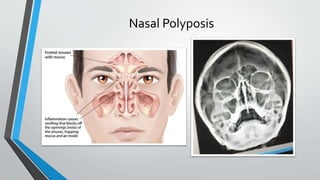
Nasal Polyposis
Dr. Asmatullah Achakzai
MBBS, DLO, MCPS, FCPS
Associate Professor ENT Head and Neck Surgery
Bolan MedicalCollege Quetta.
Nasal Polyposis
Introduction
• Polyposis means 'many feet'. Nasal polyp is an inflammatory condition of
unknown etiology, consists of edematous mucosa involving usually the
ethmoid sinus and rarely the maxillary sinus. It presents as soft, jelly-like
overgrowth of the lining of the sinus wall. The ethmoidal polyps appear like
grapes on the end of a stalk.
Definition
• Nasal polyp is an inflammatory condition of unknown etiology and occurs as
an apparent new growth. It is defined as a prolapsed, edematous,
pediculated nasal mucosa, which may arise from the sinuses or the nasal
cavity
ClinicalTypes
• The polyp can be divided into following types:
• Common
• Ethmoidal
• Antrochoanal
• Rare
• Sphenochoanal
• True choanal
Ethmoidal Polyp
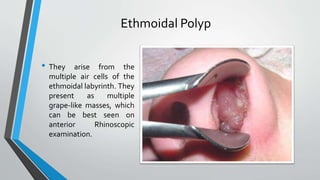
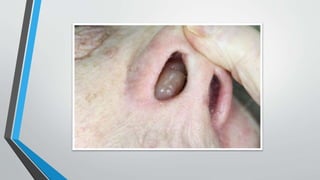
• They arise from the
multiple air cells of the
ethmoidal labyrinth. They
present as multiple
grape-like masses, which
can be best seen on
anterior Rhinoscopic
examination.
Etiology
• Exact etiology of nasal polyp is not known, and precise mechanism of polyp
formation is incompletely understood. Causation of nasal polyp appers to be
multi-factorial.
Incidence
• The overall prevalence rate of nasal polyposis ranges 1 to 4 percent, 7
percent have associated asthma, 2 percent of chronic rhinitis patients have
nasal polyp. 10 percent of children with cystic fibrosis may have nasal polyp.
Etiological factors
postulated
• Heredity
• Bernoulli's phenomenon
• Allergy
• Infection
• Vasomotor response
• Polysaccharide metabolism disorder
• Endocrine
• Polypeptide theory
• Increased incidence in children with cystic fibrosis and persons
with known aspirin hypersensitivity
• Allergic fungal sinusitis is found to be associated with recurrent
ethmoidal Polyposis, which was poorly diagnosed in the past.
Pathogenesis
• There is no single etiological factor that responsible for the development of nasal polyposis.
10 pathogenic theories of nasal polyp formation
1. Adenoma and fibroma theories
2. Necrotizing ethmoiditis theory
3. Glandular cyst theory
4. Mucosal exudate theory
5. Cystic dilatation of the excretory duct and vessel obstruction theory
6. Blockade theory
7. Periphlebitis and perilymph angitis theory
8. Glandular fiyperplasia theory
9. Gland new formation theory
10. Ion transport theory
Pathology
• Pathology The nasal polyp may be multiple or solitary. The nasal polyps are
found to commonly arise from , the mucosa of the ostia, clefts, and recesses
in the osteo meatal complex where the initial stage of sinunasal Polyposis
seems" to take place.
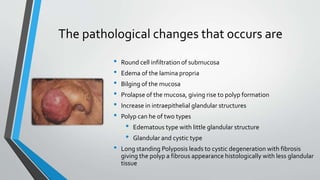
The pathological changes that occurs are
• Round cell infiltration of submucosa
• Edema of the lamina propria
• Bilging of the mucosa
• Prolapse of the mucosa, giving rise to polyp formation
• Increase in intraepithelial glandular structures
• Polyp can he of two types
• Edematous type with little glandular structure
• Glandular and cystic type
• Long standing Polyposis leads to cystic degeneration with fibrosis
giving the polyp a fibrous appearance histologically with less glandular
tissue
Histopathological Features
• Polyp is lined by respiratory epithelium with less ciliary activity.
• In long standing cases the mucosa may undergo squamous metaplasia.
• Edematous stroma with few goblet cells and subrnucous glands.
Histologically there are 2 types:
• Neutrophil type
• Eosinophil type
Clinical Features
• Symptoms
• Nasal obstruction
• Hyposmia
• Nasal discharge
• Hawking sensation
• Altered or reduced sensation of taste
• Symptoms of nasal allergy like sneezing, itchy nose, watery rhinrrhea
• Broadening of the nose in long standing cases
• Snoring and sleep apnea
Signs
• External Examination
• Widening of the intercanthal distance with 'frog face' deformity in extensive ethmoidal
Polyposis.
• Signs of nasal allergy as described under 'allergic rhinitis' may be present.
• Cold spatula test reveals reduced or absence of fogging.
Anterior Rhinoscopic Examination
• Examination multiple pule grayish or bluish white.
• On probing the masses are insensitive to touch, soft, mobile and
pedunculated.
• Polyp tend to present more anteriorly.
Investigations
• Diagnostic nasal endoscopy
• Radiological
• Allergy tests
• Nasal swab for fungal culture
• Biopsy
Treatment
• Endoscopic sinus surgery is the treatment of choice. However, the causative
factor like allergy should be treated adequately by medical measures or
desensitization to prevent recurrence. Medical treatment following surgery
With steroid nasal spray helps in preventing recurrence.
Antrochoanal Polyp
Synonym: Killian’s Polyp
• Definition
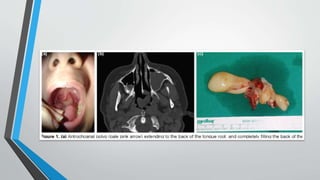
• It is defined as a polyp originating in the maxillary sinus, protruding in the middle
meatus through the ethmoidal infundibulum or an accessory ostium and further
extending posteriorly through the choana into the nasopharynx / oropharynx.
• Thus,Antrochoanal polyp has three parts which include :
• Antral part
• Nasal part
• Choanal part.
Etiology
• Exact etiology is not known.
• Commonly seen in children.
• Seen both in males and females.
• Probably caused by infection of the sinus.
• Proetz attributed the causation to faulty development of the maxillary
ostium, Accessory ostium is frequently associated in such cases.
• Bernoulli's phenomenon may play a role.
• Often unilateral but can be bilateral occasionally.
• Symptoms of allergy are usually not elicited.
Pathogenesis
• Possible reasons for posterior extension of the Antrochoanal polyp are:
• Ostium of the maxillary sinus is situated more posteriorly, more so the accessory
ostium.
• Sloping of the inferior turbinate is posteroinferiorly, on which the polyp slides, aided by
gravity.
• Anteroinferior part of the middle turbinate is more bulbous and is often associated
With a concha bullosa.This part of the middle turbinate is anterior to the maxillary
ostium, It probably prevents anterior extension of the polyp.
• The mucocilliary transport is from anterior to posterior due to effective beating of the
cilia from anterior to posterior.
• Posterior choana is larger in comparison to the anterior nasal aperture.
• The inspiratory current is more forceful than the expiratory current.
• Suction effect during swallowing probably pulls the polyp posteriorly.
Pathology
• It is usually dumb-bell shape and emerges usually through the accessory
ostium or rarely through the natural ostium. The polyp is constricted at the
ostium giving it a dumb-bell shape. In the antrum. it arises usually from the
floor or the lateral wall.
Clinical Features
• Symptoms
• Unilateral nasal obstruction is the most common symptom. The obstruction is usually
during the expiration due to ball value effect (valvular obstruction), obstruction may
become both the choana in the nasopharynx. Bilateral Antrochoanal Polyp may be
suspected in such cases.
• Nasal Discharge and postnasal dip may be present.
• Anosmia or hyposmia is not common.
Signs
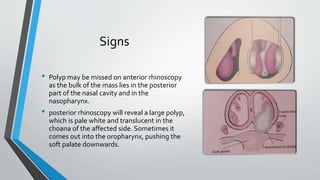
• Polyp may be missed on anterior rhinoscopy
as the bulk of the mass lies in the posterior
part of the nasal cavity and in the
nasopharynx.
• posterior rhinoscopy will reveal a large polyp,
which is pale white and translucent in the
choana of the affected side. Sometimes it
comes out into the oropharynx, pushing the
soft palate downwards.
Investigations
• X-Ray PNS
• X-ray of the neck lateral
• CT scan
• Diagnostic nasal endoscopy
Differential Diagnosis
• Juvenile nasopharyngeal angiofibroma
• Meningocele
• Hamartoma
• Hypertrophied posterior end of the turbinate
• Sphenochoanal polyp
• Nasopharyngeal rhinosporidiosis
• Thronwaldt's cyst
• Rathke's pouch tumors like cranio-pharyngioma.
Treatment
• Complete surgical removal of the polyp transnasally or transorally is the
commonly employed treatment and incomplete resection is associated with
a relatively high recurrence rate.
• Endoscopic polypectomy with a middle meatal antrostomy by joining the
accessory and natural ostia together is the present treatment of choice.
Any Questions ??
Thank you

Nasal polyposis

  • 2.
    Nasal Polyposis Dr. AsmatullahAchakzai MBBS, DLO, MCPS, FCPS Associate Professor ENT Head and Neck Surgery Bolan MedicalCollege Quetta.
  • 3.
  • 4.
    Introduction • Polyposis means'many feet'. Nasal polyp is an inflammatory condition of unknown etiology, consists of edematous mucosa involving usually the ethmoid sinus and rarely the maxillary sinus. It presents as soft, jelly-like overgrowth of the lining of the sinus wall. The ethmoidal polyps appear like grapes on the end of a stalk.
  • 5.
    Definition • Nasal polypis an inflammatory condition of unknown etiology and occurs as an apparent new growth. It is defined as a prolapsed, edematous, pediculated nasal mucosa, which may arise from the sinuses or the nasal cavity
  • 6.
    ClinicalTypes • The polypcan be divided into following types: • Common • Ethmoidal • Antrochoanal • Rare • Sphenochoanal • True choanal
  • 7.
    Ethmoidal Polyp • Theyarise from the multiple air cells of the ethmoidal labyrinth. They present as multiple grape-like masses, which can be best seen on anterior Rhinoscopic examination.
  • 9.
    Etiology • Exact etiologyof nasal polyp is not known, and precise mechanism of polyp formation is incompletely understood. Causation of nasal polyp appers to be multi-factorial. Incidence • The overall prevalence rate of nasal polyposis ranges 1 to 4 percent, 7 percent have associated asthma, 2 percent of chronic rhinitis patients have nasal polyp. 10 percent of children with cystic fibrosis may have nasal polyp.
  • 10.
    Etiological factors postulated • Heredity •Bernoulli's phenomenon • Allergy • Infection • Vasomotor response • Polysaccharide metabolism disorder • Endocrine • Polypeptide theory • Increased incidence in children with cystic fibrosis and persons with known aspirin hypersensitivity • Allergic fungal sinusitis is found to be associated with recurrent ethmoidal Polyposis, which was poorly diagnosed in the past.
  • 11.
    Pathogenesis • There isno single etiological factor that responsible for the development of nasal polyposis. 10 pathogenic theories of nasal polyp formation 1. Adenoma and fibroma theories 2. Necrotizing ethmoiditis theory 3. Glandular cyst theory 4. Mucosal exudate theory 5. Cystic dilatation of the excretory duct and vessel obstruction theory 6. Blockade theory 7. Periphlebitis and perilymph angitis theory 8. Glandular fiyperplasia theory 9. Gland new formation theory 10. Ion transport theory
  • 12.
    Pathology • Pathology Thenasal polyp may be multiple or solitary. The nasal polyps are found to commonly arise from , the mucosa of the ostia, clefts, and recesses in the osteo meatal complex where the initial stage of sinunasal Polyposis seems" to take place.
  • 13.
    The pathological changesthat occurs are • Round cell infiltration of submucosa • Edema of the lamina propria • Bilging of the mucosa • Prolapse of the mucosa, giving rise to polyp formation • Increase in intraepithelial glandular structures • Polyp can he of two types • Edematous type with little glandular structure • Glandular and cystic type • Long standing Polyposis leads to cystic degeneration with fibrosis giving the polyp a fibrous appearance histologically with less glandular tissue
  • 14.
    Histopathological Features • Polypis lined by respiratory epithelium with less ciliary activity. • In long standing cases the mucosa may undergo squamous metaplasia. • Edematous stroma with few goblet cells and subrnucous glands. Histologically there are 2 types: • Neutrophil type • Eosinophil type
  • 15.
    Clinical Features • Symptoms •Nasal obstruction • Hyposmia • Nasal discharge • Hawking sensation • Altered or reduced sensation of taste • Symptoms of nasal allergy like sneezing, itchy nose, watery rhinrrhea • Broadening of the nose in long standing cases • Snoring and sleep apnea
  • 16.
    Signs • External Examination •Widening of the intercanthal distance with 'frog face' deformity in extensive ethmoidal Polyposis. • Signs of nasal allergy as described under 'allergic rhinitis' may be present. • Cold spatula test reveals reduced or absence of fogging.
  • 17.
    Anterior Rhinoscopic Examination •Examination multiple pule grayish or bluish white. • On probing the masses are insensitive to touch, soft, mobile and pedunculated. • Polyp tend to present more anteriorly.
  • 18.
    Investigations • Diagnostic nasalendoscopy • Radiological • Allergy tests • Nasal swab for fungal culture • Biopsy
  • 19.
    Treatment • Endoscopic sinussurgery is the treatment of choice. However, the causative factor like allergy should be treated adequately by medical measures or desensitization to prevent recurrence. Medical treatment following surgery With steroid nasal spray helps in preventing recurrence.
  • 20.
    Antrochoanal Polyp Synonym: Killian’sPolyp • Definition • It is defined as a polyp originating in the maxillary sinus, protruding in the middle meatus through the ethmoidal infundibulum or an accessory ostium and further extending posteriorly through the choana into the nasopharynx / oropharynx. • Thus,Antrochoanal polyp has three parts which include : • Antral part • Nasal part • Choanal part.
  • 22.
    Etiology • Exact etiologyis not known. • Commonly seen in children. • Seen both in males and females. • Probably caused by infection of the sinus. • Proetz attributed the causation to faulty development of the maxillary ostium, Accessory ostium is frequently associated in such cases. • Bernoulli's phenomenon may play a role. • Often unilateral but can be bilateral occasionally. • Symptoms of allergy are usually not elicited.
  • 23.
    Pathogenesis • Possible reasonsfor posterior extension of the Antrochoanal polyp are: • Ostium of the maxillary sinus is situated more posteriorly, more so the accessory ostium. • Sloping of the inferior turbinate is posteroinferiorly, on which the polyp slides, aided by gravity. • Anteroinferior part of the middle turbinate is more bulbous and is often associated With a concha bullosa.This part of the middle turbinate is anterior to the maxillary ostium, It probably prevents anterior extension of the polyp. • The mucocilliary transport is from anterior to posterior due to effective beating of the cilia from anterior to posterior. • Posterior choana is larger in comparison to the anterior nasal aperture. • The inspiratory current is more forceful than the expiratory current. • Suction effect during swallowing probably pulls the polyp posteriorly.
  • 24.
    Pathology • It isusually dumb-bell shape and emerges usually through the accessory ostium or rarely through the natural ostium. The polyp is constricted at the ostium giving it a dumb-bell shape. In the antrum. it arises usually from the floor or the lateral wall.
  • 25.
    Clinical Features • Symptoms •Unilateral nasal obstruction is the most common symptom. The obstruction is usually during the expiration due to ball value effect (valvular obstruction), obstruction may become both the choana in the nasopharynx. Bilateral Antrochoanal Polyp may be suspected in such cases. • Nasal Discharge and postnasal dip may be present. • Anosmia or hyposmia is not common.
  • 26.
    Signs • Polyp maybe missed on anterior rhinoscopy as the bulk of the mass lies in the posterior part of the nasal cavity and in the nasopharynx. • posterior rhinoscopy will reveal a large polyp, which is pale white and translucent in the choana of the affected side. Sometimes it comes out into the oropharynx, pushing the soft palate downwards.
  • 27.
    Investigations • X-Ray PNS •X-ray of the neck lateral • CT scan • Diagnostic nasal endoscopy
  • 28.
    Differential Diagnosis • Juvenilenasopharyngeal angiofibroma • Meningocele • Hamartoma • Hypertrophied posterior end of the turbinate • Sphenochoanal polyp • Nasopharyngeal rhinosporidiosis • Thronwaldt's cyst • Rathke's pouch tumors like cranio-pharyngioma.
  • 29.
    Treatment • Complete surgicalremoval of the polyp transnasally or transorally is the commonly employed treatment and incomplete resection is associated with a relatively high recurrence rate. • Endoscopic polypectomy with a middle meatal antrostomy by joining the accessory and natural ostia together is the present treatment of choice.
  • 30.
  • 31.