















URETHRAL TRAUMA
Mohammad Ihmeidan PGY2
 Urethral injury is a breach in the structural
integrity of the urethra
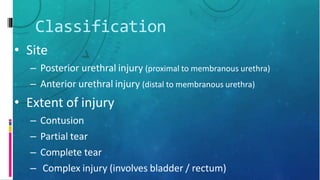
Classification
• Site
– Posterior urethral injury (proximal to membranous urethra)
– Anterior urethral injury (distal to membranous urethra)
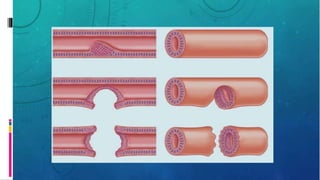
• Extent of injury
– Contusion
– Partial tear
– Complete tear
– Complex injury (involves bladder / rectum)
Etiology
– Pelvic fracture
– 10% associated with urethral injury.
– Almost all posterior urethral injury
– RTA is the commonest cause of pelvic fracture in young
– Often assoc with multiple organ trauma
– Iatrogenic
– Catheter-related
– Endoscopy – mechanical or electrical
– SURGERY – e.g. Radical prostatectomy, traumatic vaginal
birth
– Straddle injury
– Injury usually occurs in bulbar urethra
– Penetrating injury
– Gunshot
– Direct blunt trauma
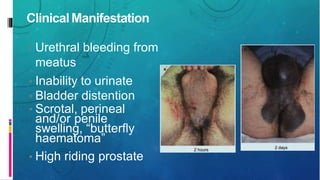
Clinical Manifestation
• Urethral bleeding from
meatus
• Inability to urinate
• Bladder distention
• Scrotal, perineal
and/or penile
swelling, “butterfly
haematoma”
• High riding prostate
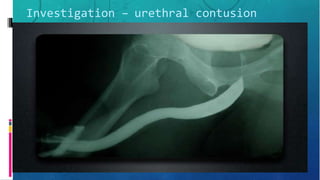
Investigation
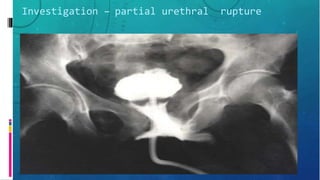
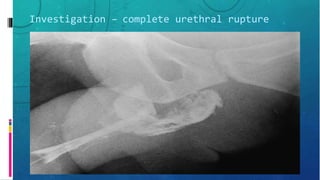
– Retrograde urethrography
• Confirms injury
• Location
• Severity
• Presence of foreign body
• Assoc injury e.g. Bladder
Investigation – urethral contusion
Investigation – partial urethral rupture
Investigation – complete urethral rupture
Flexible cystoscopy
is an option to diagnose an acute urethral injury
and may differntiate between complete- and
incomplete rupture
In addition, it allows a guidewire to be passed
into the bladder for early catheterisation.
The Aim of treatment
• to have a continent patient with
satisfactory voiding and sexual
function
Principles of management
• Stabilization of patient
• Treating associated injuries according to
priorities
• Analgesia
• Avoid attempts of blind urethral
catheterization
• Definitive treatment
Posterior urethra injuries
management
Suprapubic Cystostomy
Immediate suprapubic tube placement remains
the standard of care in patients with
posterior urethral injuries.
Immediate Open Reconstruction.
Immediate anastomotic reconstruction of
posterior urethral disruption injuries in males has
been abandoned because of its association
with unsatisfactory outcomes,such as impotence
and incontinence, stricture formation,and
operative blood loss
Incases of female urethral disruption related to pelvic
fracture,most authorities suggest immediate
primary repair, or at least urethral realignment
over a catheter, to avoid subsequent
urethrovaginal fistulas or urethral obliteration
Concomitant vaginal lacerations also must be closed
acutely to prevent vaginal stenosis.
Delayed reconstruction is problematic because the
female urethra is too short (about 4 cm) to be
amenable for mobilization during an anastomotic
repair when it becomes embedded in scar
Primary Realignment
An attempt at primary realignment of the
distraction with a urethral catheter is
reasonable in patients whose condition is
stable, either acutely or within several days
of injury. a simple technique consisting of
passage of a coudé catheter antegrade from
an anterior cystotomy to the urethral meatus
When the urethral catheter is removed after 4 to 6 weeks,
it is imperative to retain a suprapubic catheter because
many patients will, despite realignment, develop
posterior urethral stenosis.
If the patient voids satisfactorily through the urethra, the
suprapubic catheter can be removed 7 to 14 days later.
Primary realignment may sometimes allow healing without
stricture ,but mild stenosis 1 to 2 cm in length develops in
many patients).
Patients managed with suprapubic tubes alone virtually
always develop complete stenosis requiring posterior
urethroplasty.
Delayed Reconstruction
In posterior urethral disruption the rupture defect
between the two severed ends fills with scar
tissue, resulting in a complete lackof urethral
continuity.
This separation is not a stricture; it is a true urethral
rupture defect filled with fibrosis.
At 3 months, scartissue at the urethral disruption
site is stable enough to allow posterior
urethroplasty to be undertaken safely,
Endoscopic Treatments
Endoscopic treatments such as direct-vision
internal urethrotomy are best reserved for
selected short urethral stenoses, such as
partial distraction injuries for which early
catheterization achieved urethral
continuity.
Surgical Reconstruction
Open posterior urethroplasty through a
perineal anastomotic approach is the
treatment of choice for most urethral
distraction injuries because it definitively
cures the patient without the need for
multiple procedures.
Anterior urethra injuries
management
Contusions and incomplete injuries can be treated
with urethral catheter diversion alone.
Initial suprapubic cystostomy is the standard of
care for major straddle injuries involving the
urethra
However, primary anterior urethral realignment
has shown promising results with respect to
stricture rate and erectile dysfunction in patients
with straddle injuries of lesser magnitude
Anastomotic urethroplasty is the procedure of choice in the totally
obliterated bulbar urethra after a straddle injury.
The typical scar is 1.5 to 2 cm long and can readily be completely
excised.
The proximal and distal urethra can be mobilized for a tension-free,
end-to-end anastomosis.
This is a highly successful procedure in more than 95% of cases
Open repair should be delayed for several weeks after
instrumentation to allow the urethra to
stabilize, and a 2-month period of suprapubic urinary diversion may
be prudent preoperatively to optimize conditions for repair of
complex or recurrent strictures that have been catheter
dependent.
Endoscopic treatment
Endoscopic incision through the scar tissue of an obliterated
urethra is a hopeless procedure doomed to failure.
Partial urethral narrowing can initially be treated by endoscopic
incision or dilation with higher success.
Neither clinically effective nor cost effective
Patients who undergo repeated endoscopic procedures are also
more likely to require complex reconstructive procedures such as
grafts .
ThankYou

Urethral trauma

  • 1.
  • 2.
     Urethral injuryis a breach in the structural integrity of the urethra
  • 3.
    Classification • Site – Posteriorurethral injury (proximal to membranous urethra) – Anterior urethral injury (distal to membranous urethra) • Extent of injury – Contusion – Partial tear – Complete tear – Complex injury (involves bladder / rectum)
  • 5.
    Etiology – Pelvic fracture –10% associated with urethral injury. – Almost all posterior urethral injury – RTA is the commonest cause of pelvic fracture in young – Often assoc with multiple organ trauma – Iatrogenic – Catheter-related – Endoscopy – mechanical or electrical – SURGERY – e.g. Radical prostatectomy, traumatic vaginal birth
  • 6.
    – Straddle injury –Injury usually occurs in bulbar urethra – Penetrating injury – Gunshot – Direct blunt trauma
  • 7.
    Clinical Manifestation • Urethralbleeding from meatus • Inability to urinate • Bladder distention • Scrotal, perineal and/or penile swelling, “butterfly haematoma” • High riding prostate
  • 8.
    Investigation – Retrograde urethrography •Confirms injury • Location • Severity • Presence of foreign body • Assoc injury e.g. Bladder
  • 9.
  • 10.
    Investigation – partialurethral rupture
  • 11.
  • 12.
    Flexible cystoscopy is anoption to diagnose an acute urethral injury and may differntiate between complete- and incomplete rupture In addition, it allows a guidewire to be passed into the bladder for early catheterisation.
  • 13.
    The Aim oftreatment • to have a continent patient with satisfactory voiding and sexual function
  • 14.
    Principles of management •Stabilization of patient • Treating associated injuries according to priorities • Analgesia • Avoid attempts of blind urethral catheterization • Definitive treatment
  • 15.
  • 16.
    Suprapubic Cystostomy Immediate suprapubictube placement remains the standard of care in patients with posterior urethral injuries.
  • 17.
    Immediate Open Reconstruction. Immediateanastomotic reconstruction of posterior urethral disruption injuries in males has been abandoned because of its association with unsatisfactory outcomes,such as impotence and incontinence, stricture formation,and operative blood loss
  • 18.
    Incases of femaleurethral disruption related to pelvic fracture,most authorities suggest immediate primary repair, or at least urethral realignment over a catheter, to avoid subsequent urethrovaginal fistulas or urethral obliteration Concomitant vaginal lacerations also must be closed acutely to prevent vaginal stenosis. Delayed reconstruction is problematic because the female urethra is too short (about 4 cm) to be amenable for mobilization during an anastomotic repair when it becomes embedded in scar
  • 19.
    Primary Realignment An attemptat primary realignment of the distraction with a urethral catheter is reasonable in patients whose condition is stable, either acutely or within several days of injury. a simple technique consisting of passage of a coudé catheter antegrade from an anterior cystotomy to the urethral meatus
  • 20.
    When the urethralcatheter is removed after 4 to 6 weeks, it is imperative to retain a suprapubic catheter because many patients will, despite realignment, develop posterior urethral stenosis. If the patient voids satisfactorily through the urethra, the suprapubic catheter can be removed 7 to 14 days later. Primary realignment may sometimes allow healing without stricture ,but mild stenosis 1 to 2 cm in length develops in many patients). Patients managed with suprapubic tubes alone virtually always develop complete stenosis requiring posterior urethroplasty.
  • 21.
    Delayed Reconstruction In posteriorurethral disruption the rupture defect between the two severed ends fills with scar tissue, resulting in a complete lackof urethral continuity. This separation is not a stricture; it is a true urethral rupture defect filled with fibrosis. At 3 months, scartissue at the urethral disruption site is stable enough to allow posterior urethroplasty to be undertaken safely,
  • 22.
    Endoscopic Treatments Endoscopic treatmentssuch as direct-vision internal urethrotomy are best reserved for selected short urethral stenoses, such as partial distraction injuries for which early catheterization achieved urethral continuity.
  • 23.
    Surgical Reconstruction Open posteriorurethroplasty through a perineal anastomotic approach is the treatment of choice for most urethral distraction injuries because it definitively cures the patient without the need for multiple procedures.
  • 24.
  • 25.
    Contusions and incompleteinjuries can be treated with urethral catheter diversion alone. Initial suprapubic cystostomy is the standard of care for major straddle injuries involving the urethra However, primary anterior urethral realignment has shown promising results with respect to stricture rate and erectile dysfunction in patients with straddle injuries of lesser magnitude
  • 26.
    Anastomotic urethroplasty isthe procedure of choice in the totally obliterated bulbar urethra after a straddle injury. The typical scar is 1.5 to 2 cm long and can readily be completely excised. The proximal and distal urethra can be mobilized for a tension-free, end-to-end anastomosis. This is a highly successful procedure in more than 95% of cases Open repair should be delayed for several weeks after instrumentation to allow the urethra to stabilize, and a 2-month period of suprapubic urinary diversion may be prudent preoperatively to optimize conditions for repair of complex or recurrent strictures that have been catheter dependent.
  • 27.
    Endoscopic treatment Endoscopic incisionthrough the scar tissue of an obliterated urethra is a hopeless procedure doomed to failure. Partial urethral narrowing can initially be treated by endoscopic incision or dilation with higher success. Neither clinically effective nor cost effective Patients who undergo repeated endoscopic procedures are also more likely to require complex reconstructive procedures such as grafts .
  • 28.