NASAL
POLYPS
Definition
• Nasal polyps are soft, painless, noncancerous
growths on the lining of your nasal passages
or sinuses.
• They hang down like teardrops or grapes.
• They result from chronic inflammation and
are associated with asthma, recurring
infection, allergies, drug sensitivity or certain
immune disorders.
dr. Albaba Khalil
• Multiple polyps can occur with chronic
sinusitis ,cystic fibrosis ,allergic rhinitis or
allergic fungal sinusitis (AFS).
• Single polyp could be an antral-choanal
polyp, a benign massive polyp, or any benign
or malignant tumor
• All children with benign multiple nasal
polyposis should be evaluated for CF
and asthma
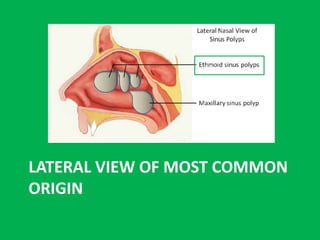
LATERAL VIEW OF MOST COMMON
ORIGIN
EPIDEMIOLOGY
• The prevalence of nasal polyps (NP) in the population has
been grossly estimated as 1–4%.
• It increases with age, reaching a peak in those aged 50 years
and older.
• NP before the age of 20 are unusual and should lead to an
investigation of possible CF or primary ciliary dyskinesia (PCD)
• Male: Female = 2:1
• Nasal polyposis occurs with a higher frequency in groups of
patients having specific airway diseases
• Genetic inheritance has been proposed as a possible etiology
of NP.(CF,AR,ASTHMA, non oesinophilic polyp common in
Asian population)
Histologic finding:
NPs are characterized by:
• Pseudo stratified ciliated columnar epithelium
• Thickening of epithelial basement membrane
• Stroma of NP is oedematous
• Vascularization is poor and lacks innervation
• Hyperplasia of seromucous gland when comparing
with inferior or middle turbinate.
• The underlying stroma of NPs has historically
been divided into three subtypes:
Edematous, oesinophilic
Fibroinfiammatory
glandular
edematous, oesinophilic polyp
• are the most common. representing up to 85% of
polyp specimens.
• These consist of scattered :fibroblasts with tissue
edema and a variable infiltrate of mononuclear
cells and other granulocytes such as neutrophils
and mast cells.
• Colonization with Staphylococcus aurous occurs
in up to 80% of patients with NP and may initiate
the inflammatory response via nonspecific
upregulation of T cells mediated through
superantigen production.
dr. Albaba Khalil
Association
• This oesinophilic edematous histopathology may
be seen with a wide variety of conditions that
are associated with NP disease including
 aspirin exacerbated respiratory disease (AERD),
AFRS
Churg-Strauss syndrome
Cystic fibrosis :polyps in CF are more likely to
have significant neutrophilia and therefore
labeled "neutrophilic polyps."
THEORIES OF ETIOLOGY AND PATHOGENESIS
• The first of these was the fungal hypothesis
o which attributed all CRS cases to an excessive host response to
Alternaria fungi
o Although most investigators have rejected the basic tenets as
originally proposed
• The leukotriene hypothesis
o proposes that defects in the eicosanoid pathway, most closely
associated with aspirin intolerance
o are also key components in the pathogenesis of other eosinophilic
subtypes of CRS(LT-C4)
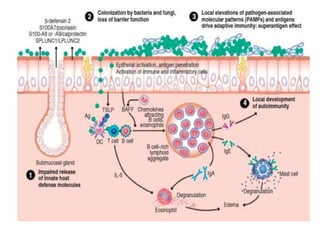
• The immune barrier hypothesis
o proposes that defects in the mechanical barrier
and/or the innate immune response of the
sinonasal epithelium manifests as CRS.
o Increased microbial colonization and accentuated
barrier damage lead to increased stimulation of
the immune system with a compensatory adaptive
immune response.
dr. Albaba Khalil
• The staphylococcal superantigen hypothesis
o proposes that exotoxins liberated by staphylococcal
bacteria foster nasal polyposis via effects on multiple cell
types
o Multiclonal IgE antibody formation to SAE can be seen in
nasal polyp tissue, but rarely in CRS.
o It is positive in about 30-50% of the patients with NP and
in about 60-80% of nasal polyp subjects with asthma
• Biofilm theory The biofilm hypothesis can be
considered an offshoot of the staphylococcal
superantigen hypothesis, as this is the organism most
commonly identified in the biofilms of resistant CRS
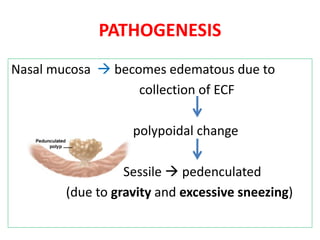
PATHOGENESIS
Nasal mucosa  becomes edematous due to
collection of ECF
polypoidal change
Sessile  pedenculated
(due to gravity and excessive sneezing)
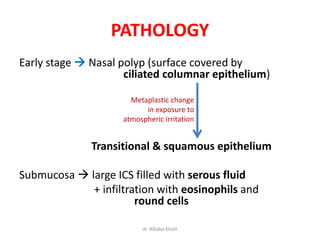
PATHOLOGY
Early stage  Nasal polyp (surface covered by
ciliated columnar epithelium)
Transitional & squamous epithelium
Submucosa  large ICS filled with serous fluid
+ infiltration with eosinophils and
round cells
Metaplastic change
in exposure to
atmospheric irritation
dr. Albaba Khalil
• Chemical mediators:
Cytokines:
o IL-5 are found regularly oesinophilic (oesinophilic
attractor)
o IL- 8 (neutrophil attractor )
•Immunoglobulin
IgA = Increased
IgE = Increased
SITE OF ORIGIN
• Multiple nasal polyps always arise from the lateral
wall of nose, usually from the middle meatus
• Common sites:
 Uncinate process
 Bulla ethmoidalis
 Ostia of sinuses
 Medial surface & edge of middle turbinate
• Oesinophilic nasal polyp almost Never arise from
the septum or the floor of nose
SYMPTOMS
1. Nasal stuffiness leading to total
nasal obstruction may be the
presenting symptom.
2. Partial or total loss of sense of
smell.
3. Headache due to associated
sinusitis.
4. Sneezing and watery nasal
discharge due to associated allergy.
5. Mass protruding from the nostril,
in sever cases
dr. Albaba Khalil
SIGNS
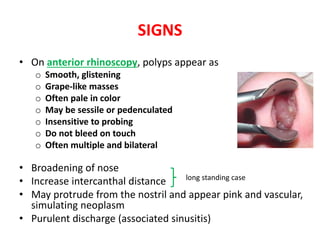
• On anterior rhinoscopy, polyps appear as
o Smooth, glistening
o Grape-like masses
o Often pale in color
o May be sessile or pedenculated
o Insensitive to probing
o Do not bleed on touch
o Often multiple and bilateral
• Broadening of nose
• Increase intercanthal distance
• May protrude from the nostril and appear pink and vascular,
simulating neoplasm
• Purulent discharge (associated sinusitis)
long standing case
Staging & score by Meltzer
• Staging Polyps can be staged as following
according to their size & palce(Meltzer et al):
A. Stage I: Limited to the extent of middle turbinate.
B. Stage II: Extending beyond the limit of middle
turbinate. „
C. Stage III: Approaching to inferior turbinate.
D. Stage IV: Going up to the floor of nose.
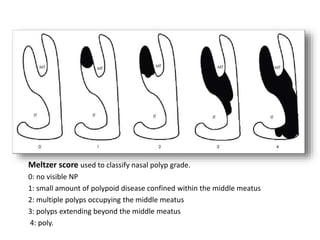
Meltzer score used to classify nasal polyp grade.
0: no visible NP
1: small amount of polypoid disease confined within the middle meatus
2: multiple polyps occupying the middle meatus
3: polyps extending beyond the middle meatus
4: poly.
TREATMENT
CONSERVATIVE
– Nasal corticosteroids.
– Oral corticosteroids
– Antihistamines
– Antibiotics
– Anti-luckatrins
– Immunotherapy
Surgical
• Classic transnasal
• Fess/Ess.
dr. Albaba Kalil
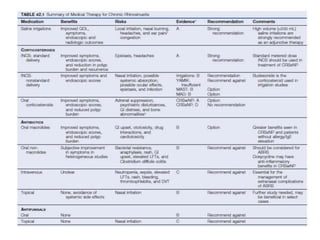
Corticosteroid
 Corticosteroids are the treatment of choice, either topically
or systemically.
 Direct injection into the polyp is not approved by the US Food and
Drug Administration (FDA)
 Oral steroids
 are the most effective medical treatment for nasal polyposis.
 In adults, most authors use prednisone (30-60 mg) for 4-7 days and
taper the medicine for 1-3 weeks.
 In children, maximum dosage is usually 1 mg/kg/day for 5-7 days,
which is then tapered over 1-3 weeks.
 Responsiveness to corticosteroids appears to depend on
the presence or absence of eosinophilia; thus, patients
with polyps and allergic rhinitis or asthma should respond
to this treatment.
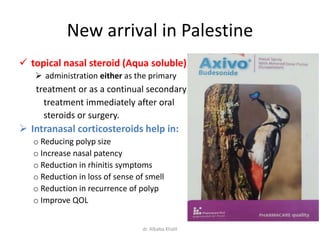
New arrival in Palestine
 topical nasal steroid (Aqua soluble)
 administration either as the primary
treatment or as a continual secondary
treatment immediately after oral
steroids or surgery.
 Intranasal corticosteroids help in:
o Reducing polyp size
o Increase nasal patency
o Reduction in rhinitis symptoms
o Reduction in loss of sense of smell
o Reduction in recurrence of polyp
o Improve QOL
dr. Albaba Khalil
• decrease capillary permeability.
o decrease arachodinic metabolism (  PG,  LT ).
o inhibition of cytokine & chemokins.
o decrease recurmint & production of eosinophils.
o decrease activity of mast cell & basophils.
o decrease migration of APC, T-cells, B-cells.
o promote IL10 production.
• Side effect :
• local burning, crusting, epistaxis, drying, irritation,
perforation, glaucoma, cataract may occur (as rare
complication)
Failure to Rx TREATMENT
SURGICAL
• Endoscopic sinus surgery followed with
medical treatment
THANK YOU

nasal polyp abu zneid.pptx

  • 1.
  • 2.
    Definition • Nasal polypsare soft, painless, noncancerous growths on the lining of your nasal passages or sinuses. • They hang down like teardrops or grapes. • They result from chronic inflammation and are associated with asthma, recurring infection, allergies, drug sensitivity or certain immune disorders. dr. Albaba Khalil
  • 3.
    • Multiple polypscan occur with chronic sinusitis ,cystic fibrosis ,allergic rhinitis or allergic fungal sinusitis (AFS). • Single polyp could be an antral-choanal polyp, a benign massive polyp, or any benign or malignant tumor • All children with benign multiple nasal polyposis should be evaluated for CF and asthma
  • 4.
    LATERAL VIEW OFMOST COMMON ORIGIN
  • 5.
    EPIDEMIOLOGY • The prevalenceof nasal polyps (NP) in the population has been grossly estimated as 1–4%. • It increases with age, reaching a peak in those aged 50 years and older. • NP before the age of 20 are unusual and should lead to an investigation of possible CF or primary ciliary dyskinesia (PCD) • Male: Female = 2:1 • Nasal polyposis occurs with a higher frequency in groups of patients having specific airway diseases • Genetic inheritance has been proposed as a possible etiology of NP.(CF,AR,ASTHMA, non oesinophilic polyp common in Asian population)
  • 6.
    Histologic finding: NPs arecharacterized by: • Pseudo stratified ciliated columnar epithelium • Thickening of epithelial basement membrane • Stroma of NP is oedematous • Vascularization is poor and lacks innervation • Hyperplasia of seromucous gland when comparing with inferior or middle turbinate.
  • 7.
    • The underlyingstroma of NPs has historically been divided into three subtypes: Edematous, oesinophilic Fibroinfiammatory glandular
  • 8.
    edematous, oesinophilic polyp •are the most common. representing up to 85% of polyp specimens. • These consist of scattered :fibroblasts with tissue edema and a variable infiltrate of mononuclear cells and other granulocytes such as neutrophils and mast cells. • Colonization with Staphylococcus aurous occurs in up to 80% of patients with NP and may initiate the inflammatory response via nonspecific upregulation of T cells mediated through superantigen production. dr. Albaba Khalil
  • 9.
    Association • This oesinophilicedematous histopathology may be seen with a wide variety of conditions that are associated with NP disease including  aspirin exacerbated respiratory disease (AERD), AFRS Churg-Strauss syndrome Cystic fibrosis :polyps in CF are more likely to have significant neutrophilia and therefore labeled "neutrophilic polyps."
  • 10.
    THEORIES OF ETIOLOGYAND PATHOGENESIS • The first of these was the fungal hypothesis o which attributed all CRS cases to an excessive host response to Alternaria fungi o Although most investigators have rejected the basic tenets as originally proposed • The leukotriene hypothesis o proposes that defects in the eicosanoid pathway, most closely associated with aspirin intolerance o are also key components in the pathogenesis of other eosinophilic subtypes of CRS(LT-C4)
  • 11.
    • The immunebarrier hypothesis o proposes that defects in the mechanical barrier and/or the innate immune response of the sinonasal epithelium manifests as CRS. o Increased microbial colonization and accentuated barrier damage lead to increased stimulation of the immune system with a compensatory adaptive immune response. dr. Albaba Khalil
  • 13.
    • The staphylococcalsuperantigen hypothesis o proposes that exotoxins liberated by staphylococcal bacteria foster nasal polyposis via effects on multiple cell types o Multiclonal IgE antibody formation to SAE can be seen in nasal polyp tissue, but rarely in CRS. o It is positive in about 30-50% of the patients with NP and in about 60-80% of nasal polyp subjects with asthma • Biofilm theory The biofilm hypothesis can be considered an offshoot of the staphylococcal superantigen hypothesis, as this is the organism most commonly identified in the biofilms of resistant CRS
  • 14.
    PATHOGENESIS Nasal mucosa becomes edematous due to collection of ECF polypoidal change Sessile  pedenculated (due to gravity and excessive sneezing)
  • 15.
    PATHOLOGY Early stage Nasal polyp (surface covered by ciliated columnar epithelium) Transitional & squamous epithelium Submucosa  large ICS filled with serous fluid + infiltration with eosinophils and round cells Metaplastic change in exposure to atmospheric irritation dr. Albaba Khalil
  • 16.
    • Chemical mediators: Cytokines: oIL-5 are found regularly oesinophilic (oesinophilic attractor) o IL- 8 (neutrophil attractor ) •Immunoglobulin IgA = Increased IgE = Increased
  • 17.
    SITE OF ORIGIN •Multiple nasal polyps always arise from the lateral wall of nose, usually from the middle meatus • Common sites:  Uncinate process  Bulla ethmoidalis  Ostia of sinuses  Medial surface & edge of middle turbinate • Oesinophilic nasal polyp almost Never arise from the septum or the floor of nose
  • 18.
    SYMPTOMS 1. Nasal stuffinessleading to total nasal obstruction may be the presenting symptom. 2. Partial or total loss of sense of smell. 3. Headache due to associated sinusitis. 4. Sneezing and watery nasal discharge due to associated allergy. 5. Mass protruding from the nostril, in sever cases dr. Albaba Khalil
  • 19.
    SIGNS • On anteriorrhinoscopy, polyps appear as o Smooth, glistening o Grape-like masses o Often pale in color o May be sessile or pedenculated o Insensitive to probing o Do not bleed on touch o Often multiple and bilateral • Broadening of nose • Increase intercanthal distance • May protrude from the nostril and appear pink and vascular, simulating neoplasm • Purulent discharge (associated sinusitis) long standing case
  • 20.
    Staging & scoreby Meltzer • Staging Polyps can be staged as following according to their size & palce(Meltzer et al): A. Stage I: Limited to the extent of middle turbinate. B. Stage II: Extending beyond the limit of middle turbinate. „ C. Stage III: Approaching to inferior turbinate. D. Stage IV: Going up to the floor of nose.
  • 21.
    Meltzer score usedto classify nasal polyp grade. 0: no visible NP 1: small amount of polypoid disease confined within the middle meatus 2: multiple polyps occupying the middle meatus 3: polyps extending beyond the middle meatus 4: poly.
  • 22.
    TREATMENT CONSERVATIVE – Nasal corticosteroids. –Oral corticosteroids – Antihistamines – Antibiotics – Anti-luckatrins – Immunotherapy Surgical • Classic transnasal • Fess/Ess. dr. Albaba Kalil
  • 23.
    Corticosteroid  Corticosteroids arethe treatment of choice, either topically or systemically.  Direct injection into the polyp is not approved by the US Food and Drug Administration (FDA)  Oral steroids  are the most effective medical treatment for nasal polyposis.  In adults, most authors use prednisone (30-60 mg) for 4-7 days and taper the medicine for 1-3 weeks.  In children, maximum dosage is usually 1 mg/kg/day for 5-7 days, which is then tapered over 1-3 weeks.  Responsiveness to corticosteroids appears to depend on the presence or absence of eosinophilia; thus, patients with polyps and allergic rhinitis or asthma should respond to this treatment.
  • 24.
    New arrival inPalestine  topical nasal steroid (Aqua soluble)  administration either as the primary treatment or as a continual secondary treatment immediately after oral steroids or surgery.  Intranasal corticosteroids help in: o Reducing polyp size o Increase nasal patency o Reduction in rhinitis symptoms o Reduction in loss of sense of smell o Reduction in recurrence of polyp o Improve QOL dr. Albaba Khalil
  • 25.
    • decrease capillarypermeability. o decrease arachodinic metabolism (  PG,  LT ). o inhibition of cytokine & chemokins. o decrease recurmint & production of eosinophils. o decrease activity of mast cell & basophils. o decrease migration of APC, T-cells, B-cells. o promote IL10 production. • Side effect : • local burning, crusting, epistaxis, drying, irritation, perforation, glaucoma, cataract may occur (as rare complication)
  • 28.
    Failure to RxTREATMENT SURGICAL • Endoscopic sinus surgery followed with medical treatment
  • 29.

Editor's Notes

  • #4 An individual polyp could be an antral-choanal polyp, a benign massive polyp, or any benign or malignant tumor (eg, encephalocele, glioma, hemangioma, papilloma, juvenile nasopharyngeal angiofibroma, rhabdomyosarcoma, lymphoma, neuroblastoma, sarcoma, chordoma, nasopharyngeal carcinoma, inverting papilloma)
  • #11 The first of these was the fungal hypothesis, which attributed all CRS cases to an excessive host response to Alternaria fungi Although most investigators have rejected the basic tenets as originally proposed, fungi are still likely to play a role in the pathogenesis of at least some forms of CRS as reviewed above
  • #14 The net effect is TH2 skewing, Treg inhibition, accentuated eosinophil and mast cell activity, and heightened tissue damage and remodeling. Multiclonal IgE antibody formation to SAE can be seen in nasal polyp tissue, but rarely in CRS. It is positive in about 30-50% of the patients with NP and in about 60-80% of nasal polyp subjects with asthma
  • #16 In early stages, surface of nasal polypi is covered by ciliated columnar epithelium like that of normal nasal mucosa. • But later it undergoes a metaplastic change to transitional and squamous type on exposure to atmospheric irritation. • Sub mucosa shows large intercellular spaces filled with serous fluid. • There is also infiltration with eosinophils and round cells.
  • #29 Polypectomy. One or two polyps which are pedunculated can be removed with snare. . • Intranasal ethmoidectomy. When polypi are multiple and sessile, they require uncapping of the ethmoidal air cells by intranasal route, a procedure called intranasal ethmoidectomy. Extranasal ethmoidectomy. This is indicated when polypi recur after intranasal procedures and surgical landmarks are ill-defined due to previous surgery. Approach is through the medial wall of the orbit by an external incision, medial to medial canthus. • Jansen Horgan’s transantral ethmoidectomy: It is done in case maxillary antra also needs to be cleared along with the ethmoids. Ethmoids are approached through medial wall of maxillary antra Endoscopic sinus surgery. These days, ethmoidal polypi are removed by endoscopic sinus surgery more popularly called functional endoscopic sinus surgery (FESS). It is done with various endoscopes of 0°, 30° and 70° angulation. Polypi can be removed more accurately when ethmoid cells are removed, and drainage and ventilation provided to the other involved sinuses such as maxillary, sphenoidal or frontal. • Polypectomy using microdebrider is another addition in the treatment of nasal polypi