D i f f e r e n t i a l diagnosis
of nasal mass
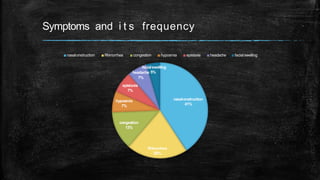
Symptoms and i t s frequency
nasalonstruction
41%
Rhinorrhea
20%
congestion
13%
hyposmia
7%
facialswelling
headache 5%
7%
epistaxis
7%
nasalonstruction Rhinorrhea congestion hyposmia epistaxis headache facialswelling
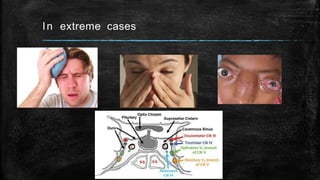
In extreme cases
Physical examination
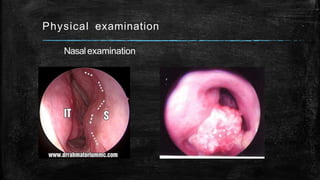
Nasalexamination
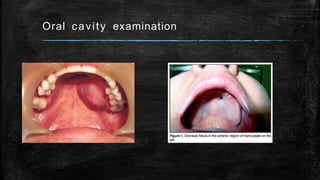
Oral cavity examination
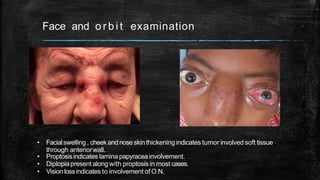
Face and o r b i t examination
• Facialswelling , cheek and noseskinthickening indicates tumor involved soft tissue
through anteriorwall.
• Proptosisindicates lamina papyraceainvolvement.
• Diplopiapresent along with proptosis in most cases.
• Visionlossindicates to involvement of O.N.
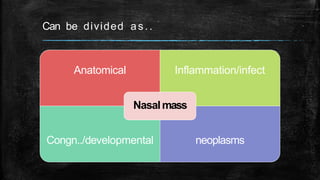
Can be divided as..
Anatomical Inflammation/infect
Congn../developmental neoplasms
Nasalmass
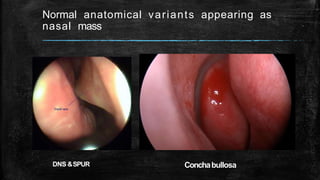
Normal anatomical variants appearing as
nasal mass
ConchabullosaDNS &SPUR
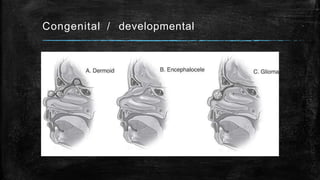
Congenital / developmental
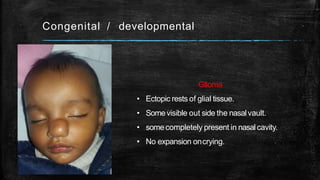
Glioma
• Ectopic rests of glial tissue.
• Somevisible out side the nasalvault.
• somecompletely present in nasalcavity.
• No expansion oncrying.
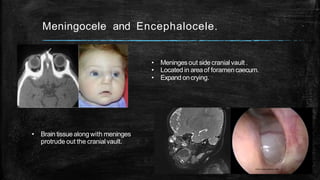
Meningocele and Encephalocele.
• Meningesout sidecranialvault .
• Located in areaof foramencaecum.
• Expand oncrying.
• Brain tissuealong with meninges
protrude out the cranialvault.
Inflammatory and infectious
▪ Nasalpolyps
▪ Sarcoidosis
▪ Wegner's granulomatosis
▪ Rhinoscleroma
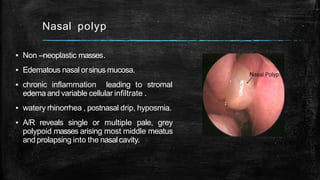
Nasal polyp
▪ Non –neoplastic masses.
▪ Edematous nasal orsinus mucosa.
▪ chronic inflammation leading to stromal
edema and variable cellular infiltrate .
▪ watery rhinorrhea , postnasal drip, hyposmia.
▪ A/R reveals single or multiple pale, grey
polypoid masses arising most middle meatus
and prolapsing into the nasalcavity.
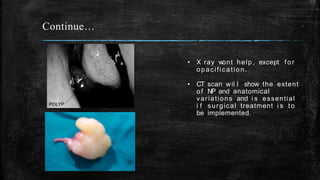
Continue…
• X ray wont help, except for
opacification.
• CT scan wil l show the extent
of NP and anatomical
variations and i s essential
i f surgical treatment i s to
be implemented.
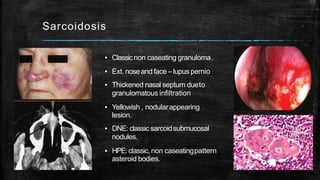
Sarcoidosis
▪ Classicnon caseating granuloma.
▪ Ext. noseandface –lupus pernio
▪ Thickened nasal septum dueto
granulomatous infiltration
▪ Yellowish , nodularappearing
lesion.
▪ DNE: classic sarcoidsubmucosal
nodules.
▪ HPE:classic, non caseatingpattern
asteroid bodies.
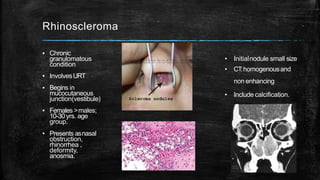
Rhinoscleroma
▪ Chronic
granulomatous
condition
▪ InvolvesURT
▪ Begins in
mucocutaneous
junction(vestibule)
▪ Females >males;
10-30yrs. age
group.
▪ Presents asnasal
obstruction,
rhinorrhea ,
deformity,
anosmia.
• Initialnodule small size
• CT:homogenousand
non enhancing
• Include calcification.
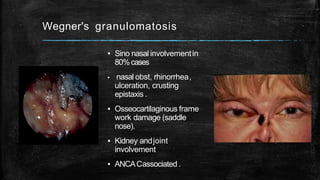
Wegner's granulomatosis
▪ Sino nasal involvementin
80%cases
▪ nasal obst, rhinorrhea,
ulceration, crusting
epistaxis .
▪ Osseocartilaginous frame
work damage (saddle
nose).
▪ Kidney andjoint
involvement
▪ ANCACassociated .
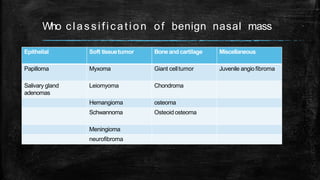
Who classification of benign nasal mass
Epithelial Soft tissuetumor Boneandcartilage Miscellaneous
Papilloma Myxoma Giant celltumor Juvenile angiofibroma
Salivary gland
adenomas
Leiomyoma Chondroma
Hemangioma osteoma
Schwannoma Osteoid osteoma
Meningioma
neurofibroma
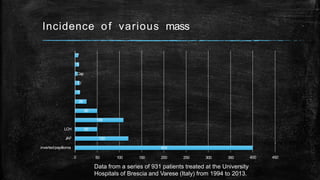
Incidence of various mass
120
50
109
50
26
11
Cap
10
9
7
0 400 450
invertedpapilloma
JAF
LCH
400
50 100 150 200 250 300 350
Data from a series of 931 patients treated at the University
Hospitals of Brescia and Varese (Italy) from 1994 to 2013.
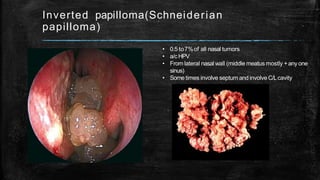
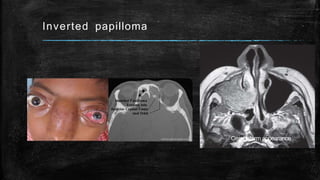
Inverted papilloma(Schneiderian
papilloma)
• 0.5 to7%of all nasal tumors
• a/c HPV
• From lateral nasal wall (middle meatus mostly +any one
sinus)
• Some times involve septum and involve C/Lcavity
Inverted papilloma
Cerebriform appearance
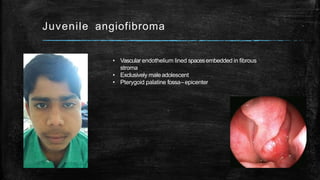
Juvenile angiofibroma
• Vascular endothelium lined spacesembedded in fibrous
stroma
• Exclusively maleadolescent
• Pterygoid palatine fossa–epicenter
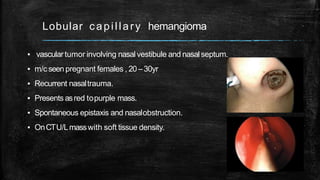
Lobular capillary hemangioma
▪ vascular tumor involving nasalvestibule and nasalseptum.
▪ m/c seenpregnant females , 20 –30yr
▪ Recurrent nasaltrauma.
▪ Presents asred topurple mass.
▪ Spontaneous epistaxis and nasalobstruction.
▪ OnCTU/Lmasswith soft tissue density.
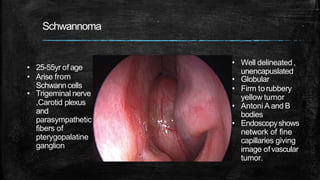
Schwannoma
• 25-55yr of age
• Arise from
Schwanncells
• Trigeminal nerve
,Carotid plexus
and
parasympathetic
fibers of
pterygopalatine
ganglion
• Well delineated,
unencapuslated
• Globular
• Firm torubbery
yellow tumor
• Antoni Aand B
bodies
• Endoscopyshows
network of fine
capillaries giving
image ofvascular
tumor.
Schwannoma
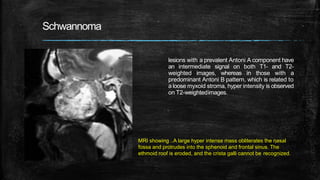
lesions with a prevalent Antoni A component have
an intermediate signal on both T1- and T2-
weighted images, whereas in those with a
predominant Antoni B pattern, which is related to
a loose myxoid stroma, hyper intensity is observed
on T2-weightedimages.
MRI showing ..A large hyper intense mass obliterates the nasal
fossa and protrudes into the sphenoid and frontal sinus. The
ethmoid roof is eroded, and the crista galli cannot be recognized.
Hamartomas
▪ Hamartomas are defined asbenign massesof disorganized mature
cells ofany tissue type.
Malignant nasal mass
 Carcioma
 Squamous cell Ca
 Adenocarcinoma
 Malignant melanoma
 Olfactory neuroblastoma
 Haemangiopericytoma
 Lymphoma
 Solitary plasmacytoma
 Various types of sarcoma
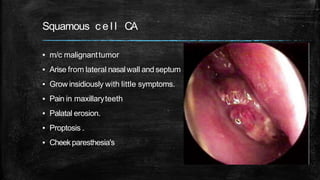
Squamous c e l l CA
▪ m/c malignanttumor
▪ Arise from lateral nasalwall and septum
▪ Grow insidiously with little symptoms.
▪ Pain in maxillaryteeth
▪ Palatal erosion.
▪ Proptosis .
▪ Cheekparesthesia's
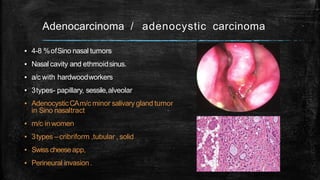
Adenocarcinoma / adenocystic carcinoma
▪ 4-8 %ofSino nasal tumors
▪ Nasal cavity and ethmoidsinus.
▪ a/c with hardwoodworkers
▪ 3types- papillary, sessile,alveolar
▪ AdenocysticCAm/c minor salivary gland tumor
in Sino nasaltract
▪ m/c inwomen
▪ 3types –cribriform ,tubular , solid
▪ Swiss cheeseapp,
▪ Perineural invasion.
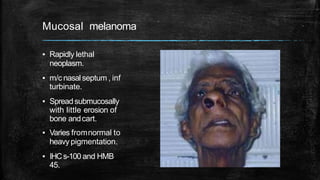
Mucosal melanoma
▪ Rapidly lethal
neoplasm.
▪ m/c nasalseptum , inf
turbinate.
▪ Spreadsubmucosally
with little erosion of
bone andcart.
▪ Varies fromnormal to
heavy pigmentation.
▪ IHCs-100 and HMB
45.
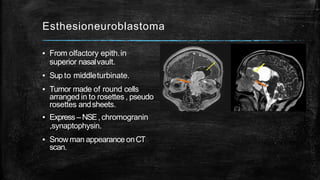
Esthesioneuroblastoma
▪ From olfactory epith.in
superior nasalvault.
▪ Sup to middleturbinate.
▪ Tumor made of round cells
arranged in to rosettes , pseudo
rosettes andsheets.
▪ Express –NSE, chromogranin
,synaptophysin.
▪ Snowman appearance onCT
scan.
Miscellaneous
▪ Rhinolith: Formswhen anintranasal foreign body acts asanidus
upon
▪ which salts from inspissated mucusprecipitate; symptoms include
purulent secretions, recurrent infections, fetid odor, and nasal
obstruction;
▪ canappear asbone-density onCT.
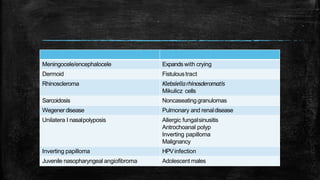
Meningocele/encephalocele Expands with crying
Dermoid Fistuloustract
Rhinoscleroma Klebsiellarhinosderomatis
Mikulicz cells
Sarcoidosis Noncaseatinggranulomas
Wegenerdisease Pulmonary and renaldisease
Unilatera I nasalpolyposis Allergic fungalsinusitis
Antrochoanal polyp
Inverting papilloma
Malignancy
Inverting papilloma HPVinfection
Juvenile nasopharyngeal angiofibroma Adolescent males
Thankyou

Unilateral Nasal Mass

  • 1.
    D i ff e r e n t i a l diagnosis of nasal mass
  • 2.
    Symptoms and it s frequency nasalonstruction 41% Rhinorrhea 20% congestion 13% hyposmia 7% facialswelling headache 5% 7% epistaxis 7% nasalonstruction Rhinorrhea congestion hyposmia epistaxis headache facialswelling
  • 3.
  • 4.
  • 5.
  • 6.
    Face and or b i t examination • Facialswelling , cheek and noseskinthickening indicates tumor involved soft tissue through anteriorwall. • Proptosisindicates lamina papyraceainvolvement. • Diplopiapresent along with proptosis in most cases. • Visionlossindicates to involvement of O.N.
  • 7.
    Can be dividedas.. Anatomical Inflammation/infect Congn../developmental neoplasms Nasalmass
  • 8.
    Normal anatomical variantsappearing as nasal mass ConchabullosaDNS &SPUR
  • 9.
  • 10.
    Congenital / developmental Glioma •Ectopic rests of glial tissue. • Somevisible out side the nasalvault. • somecompletely present in nasalcavity. • No expansion oncrying.
  • 11.
    Meningocele and Encephalocele. •Meningesout sidecranialvault . • Located in areaof foramencaecum. • Expand oncrying. • Brain tissuealong with meninges protrude out the cranialvault.
  • 12.
    Inflammatory and infectious ▪Nasalpolyps ▪ Sarcoidosis ▪ Wegner's granulomatosis ▪ Rhinoscleroma
  • 13.
    Nasal polyp ▪ Non–neoplastic masses. ▪ Edematous nasal orsinus mucosa. ▪ chronic inflammation leading to stromal edema and variable cellular infiltrate . ▪ watery rhinorrhea , postnasal drip, hyposmia. ▪ A/R reveals single or multiple pale, grey polypoid masses arising most middle meatus and prolapsing into the nasalcavity.
  • 14.
    Continue… • X raywont help, except for opacification. • CT scan wil l show the extent of NP and anatomical variations and i s essential i f surgical treatment i s to be implemented.
  • 15.
    Sarcoidosis ▪ Classicnon caseatinggranuloma. ▪ Ext. noseandface –lupus pernio ▪ Thickened nasal septum dueto granulomatous infiltration ▪ Yellowish , nodularappearing lesion. ▪ DNE: classic sarcoidsubmucosal nodules. ▪ HPE:classic, non caseatingpattern asteroid bodies.
  • 16.
    Rhinoscleroma ▪ Chronic granulomatous condition ▪ InvolvesURT ▪Begins in mucocutaneous junction(vestibule) ▪ Females >males; 10-30yrs. age group. ▪ Presents asnasal obstruction, rhinorrhea , deformity, anosmia. • Initialnodule small size • CT:homogenousand non enhancing • Include calcification.
  • 17.
    Wegner's granulomatosis ▪ Sinonasal involvementin 80%cases ▪ nasal obst, rhinorrhea, ulceration, crusting epistaxis . ▪ Osseocartilaginous frame work damage (saddle nose). ▪ Kidney andjoint involvement ▪ ANCACassociated .
  • 18.
    Who classification ofbenign nasal mass Epithelial Soft tissuetumor Boneandcartilage Miscellaneous Papilloma Myxoma Giant celltumor Juvenile angiofibroma Salivary gland adenomas Leiomyoma Chondroma Hemangioma osteoma Schwannoma Osteoid osteoma Meningioma neurofibroma
  • 19.
    Incidence of variousmass 120 50 109 50 26 11 Cap 10 9 7 0 400 450 invertedpapilloma JAF LCH 400 50 100 150 200 250 300 350 Data from a series of 931 patients treated at the University Hospitals of Brescia and Varese (Italy) from 1994 to 2013.
  • 20.
    Inverted papilloma(Schneiderian papilloma) • 0.5to7%of all nasal tumors • a/c HPV • From lateral nasal wall (middle meatus mostly +any one sinus) • Some times involve septum and involve C/Lcavity
  • 21.
  • 22.
    Juvenile angiofibroma • Vascularendothelium lined spacesembedded in fibrous stroma • Exclusively maleadolescent • Pterygoid palatine fossa–epicenter
  • 23.
    Lobular capillary hemangioma ▪vascular tumor involving nasalvestibule and nasalseptum. ▪ m/c seenpregnant females , 20 –30yr ▪ Recurrent nasaltrauma. ▪ Presents asred topurple mass. ▪ Spontaneous epistaxis and nasalobstruction. ▪ OnCTU/Lmasswith soft tissue density.
  • 24.
    Schwannoma • 25-55yr ofage • Arise from Schwanncells • Trigeminal nerve ,Carotid plexus and parasympathetic fibers of pterygopalatine ganglion • Well delineated, unencapuslated • Globular • Firm torubbery yellow tumor • Antoni Aand B bodies • Endoscopyshows network of fine capillaries giving image ofvascular tumor.
  • 25.
    Schwannoma lesions with aprevalent Antoni A component have an intermediate signal on both T1- and T2- weighted images, whereas in those with a predominant Antoni B pattern, which is related to a loose myxoid stroma, hyper intensity is observed on T2-weightedimages. MRI showing ..A large hyper intense mass obliterates the nasal fossa and protrudes into the sphenoid and frontal sinus. The ethmoid roof is eroded, and the crista galli cannot be recognized.
  • 26.
    Hamartomas ▪ Hamartomas aredefined asbenign massesof disorganized mature cells ofany tissue type.
  • 27.
    Malignant nasal mass Carcioma  Squamous cell Ca  Adenocarcinoma  Malignant melanoma  Olfactory neuroblastoma  Haemangiopericytoma  Lymphoma  Solitary plasmacytoma  Various types of sarcoma
  • 28.
    Squamous c el l CA ▪ m/c malignanttumor ▪ Arise from lateral nasalwall and septum ▪ Grow insidiously with little symptoms. ▪ Pain in maxillaryteeth ▪ Palatal erosion. ▪ Proptosis . ▪ Cheekparesthesia's
  • 29.
    Adenocarcinoma / adenocysticcarcinoma ▪ 4-8 %ofSino nasal tumors ▪ Nasal cavity and ethmoidsinus. ▪ a/c with hardwoodworkers ▪ 3types- papillary, sessile,alveolar ▪ AdenocysticCAm/c minor salivary gland tumor in Sino nasaltract ▪ m/c inwomen ▪ 3types –cribriform ,tubular , solid ▪ Swiss cheeseapp, ▪ Perineural invasion.
  • 30.
    Mucosal melanoma ▪ Rapidlylethal neoplasm. ▪ m/c nasalseptum , inf turbinate. ▪ Spreadsubmucosally with little erosion of bone andcart. ▪ Varies fromnormal to heavy pigmentation. ▪ IHCs-100 and HMB 45.
  • 31.
    Esthesioneuroblastoma ▪ From olfactoryepith.in superior nasalvault. ▪ Sup to middleturbinate. ▪ Tumor made of round cells arranged in to rosettes , pseudo rosettes andsheets. ▪ Express –NSE, chromogranin ,synaptophysin. ▪ Snowman appearance onCT scan.
  • 32.
    Miscellaneous ▪ Rhinolith: Formswhenanintranasal foreign body acts asanidus upon ▪ which salts from inspissated mucusprecipitate; symptoms include purulent secretions, recurrent infections, fetid odor, and nasal obstruction; ▪ canappear asbone-density onCT.
  • 33.
    Meningocele/encephalocele Expands withcrying Dermoid Fistuloustract Rhinoscleroma Klebsiellarhinosderomatis Mikulicz cells Sarcoidosis Noncaseatinggranulomas Wegenerdisease Pulmonary and renaldisease Unilatera I nasalpolyposis Allergic fungalsinusitis Antrochoanal polyp Inverting papilloma Malignancy Inverting papilloma HPVinfection Juvenile nasopharyngeal angiofibroma Adolescent males
  • 34.