Rhinosinusitis 
by : Sameer S. Sawaed - MD
• Inflammation of the mucous membrane of 
nose and paranasal sinuses 
• since the nasal cavity & sinuses have the same 
MM, so any pathological changes affecting the 
nasal mucosa can spread to the paranasal 
sinuses.
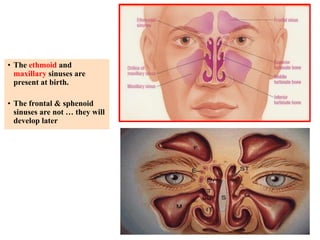
• The paranasal sinuses are a group of air containing 
spaces that surround the nasal cavity 
• Each sinus is name for the bone in which it is located: 
 Maxillary (one sinus located in each cheek) 
 Ethmoid (approximately 6-12 small sinuses per side, 
located between the eyes) 
 Frontal (one sinus per side, located in the forehead) 
 Sphenoid (one sinus per side, located behind the 
ethmoid sinuses, near the middle of the skull)
• The ethmoid and 
maxillary sinuses are 
present at birth. 
• The frontal & sphenoid 
sinuses are not … they will 
develop later
Ethmoid sinuses 
As u go posteriorly become: 
• Larger 
• Less in no.
Sinuses have small orifices (ostia) which open into recesses 
(meati) of the nasal cavities. 
• Meati are covered by turbinates (conchae). 
• Turbinates consist of bony shelves surrounded by erectile soft 
tissue. 
• There are 3 turbinates and 3 meati in each nasal cavity 
(superior, middle, and inferior). 
 The drainage of the sinuses 
• Frontal, maxillary, anterior ethmiod  middle meatus 
• Posterior ethmoid  superior meatus 
• Sphenoid  sphenoethmoidal recess
• Solid facial skeletal elements surrounding the nose are invaded 
by respiratory mucosa and subsequently pneumatized. 
• Begins in 3rd- 4th month of fetal life and further development 
takes place after birth 
• The Ethmoid sinuses are present at birth, reach adult size by 
age 12. 
• The Maxillary present at birth. 
• Frontal sinus rarely present at birth; usually not visible until 
age 2, great variability in size; congenitally absent in 5% 
• Sphenoid sinuses are rarely present at birth, usually seen 
around age 4.
1. Sinuses are normally sterile, but their proximity to 
nasopharyngeal flora allows bacterial and viral 
inoculation following rhinitis. 
2. Diseases that obstruct drainage can result in a 
reduced ability of the paranasal sinuses to function 
normally. The sinus ostia become occluded, leading to 
mucosal congestion. 
3. The mucociliary transport system becomes 
impaired, leading to stagnation of secretions and 
epithelial damage, followed by decreased oxygen 
tension and subsequent bacterial growth.
Why pain ?? 
Air trapped within a blocked sinus, along with pus or 
other secretions may cause pressure on the sinus wall that 
can cause the intense pain of a sinus attack.
• Acute Rhinosinusitis … up to 4 weeks 
• Sub acute Rhinosinusitis … 4 to 12 weeks 
• Chronic Rhinosinusitis .. > 12 weeks 
• Recurrent acute Rhinosinusitis
o It is an inflammatory condition of one or more 
of the para-nasal cavities 
o Lasts up to 4 weeks 
o Can range from acute viral rhinitis (common 
cold) to acute bacterial rhino-sinusitis
• lasts 4-12 weeks 
• Sub-acute rhino-sinusitis usually involves one 
or two pairs of the paranasal cavities.
• It is the inflammatory and infection that 
concurrently affects the nose and para-nasal 
sinuses 
• Lasts for longer than 12 weeks
• 4 or more recurrences of acute disease within a 12- 
month period, 
• With resolution of symptoms between each episode 
lasts greater than 2 months . 
• In most cases, each episode lasts for at least 7 days
• URTI 
• Cold weather 
• Day care attendance 
• Smoking in the home 
• Anatomic abnormalities (nasal polyps, ciliary disorder, septal deviation, 
concha bullosa, turbinate hypertrophy, tumors, congenital abnormalities i.e. 
cleft palate) 
• Immunesupressed 
• Direct extension: dental infection, facial fractures 
• Inflammatory disorder: 
– Wegener's Granulomatosis 
– Sarcoidosis 
• Mucosal disorder 
– CF 
– Allergic Rhinitis and other hyperreactivity 
– Samter syndrome 
• Asthma 
• Nasal Polyps 
• Aspirin intolerance .
• Viral (10-15%) - Rhinovirus (most common viral sinusitis cause), 
Influenza, Parainfluenza, Adenovirus 
• Bacterial 
– Acute Sinusitis: S.Pneumoniae, H.Influenzae, Moraxella, 
Streptococcus Pyogenes 
– Chronic Sinusitis: 
• Anaerobes (>50%) 
– Bacteroides, Anaerobic Gram Positive Cocci, Fusobacterium 
species 
• Other less common causes 
– Staphylococcus aureus, Hemophilus Influenzae, Pseudomonas 
aeruginosa, Escherichia coli, Beta-hemolytic Streptococcus, 
Neisseria causes 
• Fungal (Immunocompromised or DM) 
Aspergillus, Mucormycosis…
Allergic Rhinitis
Definition 
• Hypersensitivity of the nasal mucosa due to 
exposure to allergens 
• Acute & seasonal or 
• chronic & perennial
What happens in allergic rhinitis? 
1. Exposure to allergen 
2. IgE production by the body 
3. Formation of allergen IgE complex 
4. Binding of the complex to mast cells 
5. Degranulation of the mast cells and release of 
inflamatory mediators including histamine. 
6. Vasodilation 
7. Increase in capillary permability.
Clinical features 
Symptoms: 
 Nasal obstruction with sneezing 
 Clear rhinorrhea (containing increased eosinophils) 
 Itching of eyes with tearing 
 Frontal headache and pressure 
Signs: 
 Mucosa  edematous, pale or violet in color 
 Allergic salute  transverse nasal skin crease from 
rubbing the nose
Allergic salute
Allergic Rhinitis
Allergic Rhinitis
Types 
2 Types: 
• Seasonal (summer, spring, early autumn) 
– Tree pollens, grass pollens, mold spores 
– Lasts several weeks 
– Disappears and recurs following year at the same time 
• Perennial 
– Inhaled: house dust, wool, feathers, foods, tobacco, hair 
– Ingested: wheat, eggs, milk, nuts 
 occurs intermittently for years with no pattern or may be 
constantly present
Complications 
• Chronic sinusitis 
• Polyps (swollen edematous nasal mucosal 
tissue, they can cause complete nasal 
obstruction) 
• Serous otitis media
Diagnosis 
• History (atopy & family history) 
• Physical examination: 
1. Redness ,swelling of the mucosa (particularly 
the turbinates) & mucoid discharge. 
2. Check for structural anomalies (septal deviation 
or nasl polyps). 
• Sensitivity test for specific allergen (skin prick tests)
Treatment 
1. Identification and avoidance of allergen 
2. During the acute attack: 
1. Antihistamine (systemic or intranasal) 
2. Local steroids 
3. Decongestant (ephedrine) 
3. Sodium cromoglycate (mast cell stabilizer used as 
prophyaxis) 
4. Desensitization (we keep exposing the body to gradually 
increased amounts of allergen until the body fails to produce 
IgE as a result to exposure).
Allergic Rhinitis
Vasomotor Rhinitis
Definition 
• Very common 
• Non-inflammatory, non-allergic rhinitis 
• Characterized by a combination of symptoms that 
includes nasal obstruction and rhinorrhea 
• Vasomotor rhinitis is a diagnosis of exclusion reached 
after taking a careful history, performing a physical 
examination, and, in select cases, testing the patient with 
known allergens 
• 2 types ; eosinophilic & non-eosinophilic (according to 
the number of eosinophils found in the nasal secretion)
Causes 
• Temperature change 
• Alcohol, dust, smoke 
• Stress, anxiety, neurosis 
• Endocrine – hypothyroidism, pregnancy, 
menopause 
• Parasympathomimetic drugs
Clinical features 
Symptoms: 
• Chronic intermittent nasal obstruction 
• Rihinorhea (thin, watery) 
Signs: 
• Mucosa & turbinates : swollen, pale between 
exposure
Treatment 
• Elimination of irritant factor 
• Symptomatic relief with exercise 
• Parasympathetic blocker 
• Steroids 
• Surgery
Acute Suppurative Sinusitis
Defenition 
• Acute infection and inflammation of paranasal 
sinuses
Diagnosis 
At least 2 major symptoms or 1 major and 2 minor symptoms 
Major sx 
 Fever 
 Facial pain/ pressure 
 Facial fullness 
 Nasal obstruction 
 Nasal dicharge 
 Hyposmia/ anosmia 
Minor sx 
 Headache 
 Fatigue 
 Ear pressure/ fullness 
 Halitosis 
 Dental pain 
 Cough
Etiology 
• Viral: Rhinovirus, Influenza, Parainfluenza 
• Bacterial: Streptococcus Pneumoniae, 
Haemophilus Influenzae, Moraxella catarhalis, 
anaerobes
Clinical features 
Sudden onset of : 
• Facial pain or pressure 
• Nasal blockage & or nasal discharge/ posterior nasal drip 
• Hyposmia 
Signs more suggestive of a bacterial etiology: 
• Erythematus nasal mucosa 
• Mucopurulent discharge 
• Pus originating from middle meatus 
• Presence of nasal polyps of a deviated septum 
Acute viral rhinsinusitis lasts < 10 days.
Diagnosis 
• History & PE 
• Anterior rhinoscopy 
• X-ray/ CT scan not recomnded unless 
complications are suspected
Management 
• Symptoms relieved within 5 days  symptomatic 
relief and expectant management 
• Moderate symptoms that worsen or persist 
beyond 5 days  intranasal corticosteroid spray 
• Severe symptoms that worsen or persist beyond 5 
days and refractory to intranasal corticosteroid  
Clarythromycin, INCS , referral to specialist 
• Surgery if medical treatment fails
Chronic Sinusitis
Defintion 
• Inflammation of the paranasal sinuses lasting 
>3months
Etiology 
• Inadequate treatment of acute sinusitis 
• Untreated nasal allergy 
• Allergic fungal rhinosinusitis 
• Anatomic abnormality e.g. deviated septum 
• Underlying dental disease 
• Cilliary disorder e.g. CF 
• Chronic inflammatory disorder e.g. wegener’s
Organisms 
• Bacterial: S. Pneumoniae, H. Influenzae, M. 
catarhalis, S.pyogenes, S.auereus, anaerobes 
• Fungal: Aspergillus
Clinical features 
• Chronic nasal obstruction 
• Purulent nasal discharge 
• Headache & Pain over sinuses 
• Halitosis 
• Yellow-brown post-nasal discharge 
• Chronic cough 
• Maxillary dental pain
Treatment 
• Antibiotics for 3 to 6 weeks for infectious etiology 
– Augmented penicillin (Clavulin™) 
– Macrolide (clarithromycin) 
– Fluoroquinolone (levofloxacin) 
– Clindamycin, FlagyjTM 
• Topical nasal steroid, saline spray 
• Surgery if medical therapy fails or fungal sinusitis 
• Surgical Treatment 
– Removal of all diseased soft tissue and bone 
– Post-op drainage 
– Obliteration of pre-existing sinus cavity 
• FESS: functional endoscopic sinus surgery
• Benign to potentially fatal 
• The incidence of complications from both acute and 
chronic rhinosinusitis has decreased as a result of the 
use of antibiotics. 
• Complications can be divided into 3 categories: 
– Orbital 
– Intracranial 
– Bony 
Complications
Orbital complications 
• Most commonly involved in complicated sinusitis. 
• Orbital extension is usually the result of ethmoid 
sinusitis. 
• Children are more prone to orbital complications, 
probably secondary to high incidence of URI and 
sinusitis.
IC complications 
• Uncommon but devastating. 
• 2 major mechanism: 
– Direct extension. 
– Retrograde thrombophlebitis via valveless 
diploe veins. 
* Frontal sinus is rich in diploe veins 
especially during adolescence
Complications 
• Meningitis Sphenoid, ethmoid 
• Epidural abscess  Frontal 
• Subdural abscess  Frontal 
• Intracerebral abscess Frontal 
• Superior sagittal sinus thrombosis  Frontal 
• Cavernous sinus thrombosis  Sphenoid, ethmoid 
– Proptosis 
– Chemosis 
– Opthalmoplegia
X-ray
  rhinosinusitis
  rhinosinusitis

rhinosinusitis

  • 1.
    Rhinosinusitis by :Sameer S. Sawaed - MD
  • 2.
    • Inflammation ofthe mucous membrane of nose and paranasal sinuses • since the nasal cavity & sinuses have the same MM, so any pathological changes affecting the nasal mucosa can spread to the paranasal sinuses.
  • 3.
    • The paranasalsinuses are a group of air containing spaces that surround the nasal cavity • Each sinus is name for the bone in which it is located:  Maxillary (one sinus located in each cheek)  Ethmoid (approximately 6-12 small sinuses per side, located between the eyes)  Frontal (one sinus per side, located in the forehead)  Sphenoid (one sinus per side, located behind the ethmoid sinuses, near the middle of the skull)
  • 4.
    • The ethmoidand maxillary sinuses are present at birth. • The frontal & sphenoid sinuses are not … they will develop later
  • 6.
    Ethmoid sinuses Asu go posteriorly become: • Larger • Less in no.
  • 7.
    Sinuses have smallorifices (ostia) which open into recesses (meati) of the nasal cavities. • Meati are covered by turbinates (conchae). • Turbinates consist of bony shelves surrounded by erectile soft tissue. • There are 3 turbinates and 3 meati in each nasal cavity (superior, middle, and inferior).  The drainage of the sinuses • Frontal, maxillary, anterior ethmiod  middle meatus • Posterior ethmoid  superior meatus • Sphenoid  sphenoethmoidal recess
  • 11.
    • Solid facialskeletal elements surrounding the nose are invaded by respiratory mucosa and subsequently pneumatized. • Begins in 3rd- 4th month of fetal life and further development takes place after birth • The Ethmoid sinuses are present at birth, reach adult size by age 12. • The Maxillary present at birth. • Frontal sinus rarely present at birth; usually not visible until age 2, great variability in size; congenitally absent in 5% • Sphenoid sinuses are rarely present at birth, usually seen around age 4.
  • 12.
    1. Sinuses arenormally sterile, but their proximity to nasopharyngeal flora allows bacterial and viral inoculation following rhinitis. 2. Diseases that obstruct drainage can result in a reduced ability of the paranasal sinuses to function normally. The sinus ostia become occluded, leading to mucosal congestion. 3. The mucociliary transport system becomes impaired, leading to stagnation of secretions and epithelial damage, followed by decreased oxygen tension and subsequent bacterial growth.
  • 13.
    Why pain ?? Air trapped within a blocked sinus, along with pus or other secretions may cause pressure on the sinus wall that can cause the intense pain of a sinus attack.
  • 14.
    • Acute Rhinosinusitis… up to 4 weeks • Sub acute Rhinosinusitis … 4 to 12 weeks • Chronic Rhinosinusitis .. > 12 weeks • Recurrent acute Rhinosinusitis
  • 15.
    o It isan inflammatory condition of one or more of the para-nasal cavities o Lasts up to 4 weeks o Can range from acute viral rhinitis (common cold) to acute bacterial rhino-sinusitis
  • 16.
    • lasts 4-12weeks • Sub-acute rhino-sinusitis usually involves one or two pairs of the paranasal cavities.
  • 17.
    • It isthe inflammatory and infection that concurrently affects the nose and para-nasal sinuses • Lasts for longer than 12 weeks
  • 18.
    • 4 ormore recurrences of acute disease within a 12- month period, • With resolution of symptoms between each episode lasts greater than 2 months . • In most cases, each episode lasts for at least 7 days
  • 19.
    • URTI •Cold weather • Day care attendance • Smoking in the home • Anatomic abnormalities (nasal polyps, ciliary disorder, septal deviation, concha bullosa, turbinate hypertrophy, tumors, congenital abnormalities i.e. cleft palate) • Immunesupressed • Direct extension: dental infection, facial fractures • Inflammatory disorder: – Wegener's Granulomatosis – Sarcoidosis • Mucosal disorder – CF – Allergic Rhinitis and other hyperreactivity – Samter syndrome • Asthma • Nasal Polyps • Aspirin intolerance .
  • 20.
    • Viral (10-15%)- Rhinovirus (most common viral sinusitis cause), Influenza, Parainfluenza, Adenovirus • Bacterial – Acute Sinusitis: S.Pneumoniae, H.Influenzae, Moraxella, Streptococcus Pyogenes – Chronic Sinusitis: • Anaerobes (>50%) – Bacteroides, Anaerobic Gram Positive Cocci, Fusobacterium species • Other less common causes – Staphylococcus aureus, Hemophilus Influenzae, Pseudomonas aeruginosa, Escherichia coli, Beta-hemolytic Streptococcus, Neisseria causes • Fungal (Immunocompromised or DM) Aspergillus, Mucormycosis…
  • 21.
  • 22.
    Definition • Hypersensitivityof the nasal mucosa due to exposure to allergens • Acute & seasonal or • chronic & perennial
  • 23.
    What happens inallergic rhinitis? 1. Exposure to allergen 2. IgE production by the body 3. Formation of allergen IgE complex 4. Binding of the complex to mast cells 5. Degranulation of the mast cells and release of inflamatory mediators including histamine. 6. Vasodilation 7. Increase in capillary permability.
  • 24.
    Clinical features Symptoms:  Nasal obstruction with sneezing  Clear rhinorrhea (containing increased eosinophils)  Itching of eyes with tearing  Frontal headache and pressure Signs:  Mucosa  edematous, pale or violet in color  Allergic salute  transverse nasal skin crease from rubbing the nose
  • 25.
  • 26.
  • 27.
  • 28.
    Types 2 Types: • Seasonal (summer, spring, early autumn) – Tree pollens, grass pollens, mold spores – Lasts several weeks – Disappears and recurs following year at the same time • Perennial – Inhaled: house dust, wool, feathers, foods, tobacco, hair – Ingested: wheat, eggs, milk, nuts  occurs intermittently for years with no pattern or may be constantly present
  • 29.
    Complications • Chronicsinusitis • Polyps (swollen edematous nasal mucosal tissue, they can cause complete nasal obstruction) • Serous otitis media
  • 30.
    Diagnosis • History(atopy & family history) • Physical examination: 1. Redness ,swelling of the mucosa (particularly the turbinates) & mucoid discharge. 2. Check for structural anomalies (septal deviation or nasl polyps). • Sensitivity test for specific allergen (skin prick tests)
  • 31.
    Treatment 1. Identificationand avoidance of allergen 2. During the acute attack: 1. Antihistamine (systemic or intranasal) 2. Local steroids 3. Decongestant (ephedrine) 3. Sodium cromoglycate (mast cell stabilizer used as prophyaxis) 4. Desensitization (we keep exposing the body to gradually increased amounts of allergen until the body fails to produce IgE as a result to exposure).
  • 32.
  • 33.
  • 34.
    Definition • Verycommon • Non-inflammatory, non-allergic rhinitis • Characterized by a combination of symptoms that includes nasal obstruction and rhinorrhea • Vasomotor rhinitis is a diagnosis of exclusion reached after taking a careful history, performing a physical examination, and, in select cases, testing the patient with known allergens • 2 types ; eosinophilic & non-eosinophilic (according to the number of eosinophils found in the nasal secretion)
  • 35.
    Causes • Temperaturechange • Alcohol, dust, smoke • Stress, anxiety, neurosis • Endocrine – hypothyroidism, pregnancy, menopause • Parasympathomimetic drugs
  • 36.
    Clinical features Symptoms: • Chronic intermittent nasal obstruction • Rihinorhea (thin, watery) Signs: • Mucosa & turbinates : swollen, pale between exposure
  • 37.
    Treatment • Eliminationof irritant factor • Symptomatic relief with exercise • Parasympathetic blocker • Steroids • Surgery
  • 38.
  • 39.
    Defenition • Acuteinfection and inflammation of paranasal sinuses
  • 40.
    Diagnosis At least2 major symptoms or 1 major and 2 minor symptoms Major sx  Fever  Facial pain/ pressure  Facial fullness  Nasal obstruction  Nasal dicharge  Hyposmia/ anosmia Minor sx  Headache  Fatigue  Ear pressure/ fullness  Halitosis  Dental pain  Cough
  • 41.
    Etiology • Viral:Rhinovirus, Influenza, Parainfluenza • Bacterial: Streptococcus Pneumoniae, Haemophilus Influenzae, Moraxella catarhalis, anaerobes
  • 42.
    Clinical features Suddenonset of : • Facial pain or pressure • Nasal blockage & or nasal discharge/ posterior nasal drip • Hyposmia Signs more suggestive of a bacterial etiology: • Erythematus nasal mucosa • Mucopurulent discharge • Pus originating from middle meatus • Presence of nasal polyps of a deviated septum Acute viral rhinsinusitis lasts < 10 days.
  • 43.
    Diagnosis • History& PE • Anterior rhinoscopy • X-ray/ CT scan not recomnded unless complications are suspected
  • 44.
    Management • Symptomsrelieved within 5 days  symptomatic relief and expectant management • Moderate symptoms that worsen or persist beyond 5 days  intranasal corticosteroid spray • Severe symptoms that worsen or persist beyond 5 days and refractory to intranasal corticosteroid  Clarythromycin, INCS , referral to specialist • Surgery if medical treatment fails
  • 45.
  • 46.
    Defintion • Inflammationof the paranasal sinuses lasting >3months
  • 47.
    Etiology • Inadequatetreatment of acute sinusitis • Untreated nasal allergy • Allergic fungal rhinosinusitis • Anatomic abnormality e.g. deviated septum • Underlying dental disease • Cilliary disorder e.g. CF • Chronic inflammatory disorder e.g. wegener’s
  • 48.
    Organisms • Bacterial:S. Pneumoniae, H. Influenzae, M. catarhalis, S.pyogenes, S.auereus, anaerobes • Fungal: Aspergillus
  • 49.
    Clinical features •Chronic nasal obstruction • Purulent nasal discharge • Headache & Pain over sinuses • Halitosis • Yellow-brown post-nasal discharge • Chronic cough • Maxillary dental pain
  • 50.
    Treatment • Antibioticsfor 3 to 6 weeks for infectious etiology – Augmented penicillin (Clavulin™) – Macrolide (clarithromycin) – Fluoroquinolone (levofloxacin) – Clindamycin, FlagyjTM • Topical nasal steroid, saline spray • Surgery if medical therapy fails or fungal sinusitis • Surgical Treatment – Removal of all diseased soft tissue and bone – Post-op drainage – Obliteration of pre-existing sinus cavity • FESS: functional endoscopic sinus surgery
  • 51.
    • Benign topotentially fatal • The incidence of complications from both acute and chronic rhinosinusitis has decreased as a result of the use of antibiotics. • Complications can be divided into 3 categories: – Orbital – Intracranial – Bony Complications
  • 52.
    Orbital complications •Most commonly involved in complicated sinusitis. • Orbital extension is usually the result of ethmoid sinusitis. • Children are more prone to orbital complications, probably secondary to high incidence of URI and sinusitis.
  • 53.
    IC complications •Uncommon but devastating. • 2 major mechanism: – Direct extension. – Retrograde thrombophlebitis via valveless diploe veins. * Frontal sinus is rich in diploe veins especially during adolescence
  • 54.
    Complications • MeningitisSphenoid, ethmoid • Epidural abscess  Frontal • Subdural abscess  Frontal • Intracerebral abscess Frontal • Superior sagittal sinus thrombosis  Frontal • Cavernous sinus thrombosis  Sphenoid, ethmoid – Proptosis – Chemosis – Opthalmoplegia
  • 55.

Editor's Notes