DR. DAVISTHOMAS
 Defined as simple, edematous, non-neoplatic,
hypertrophied mucosa of paranasal sinuses and
nasal cavity.
 2 main types:
 Ethmoidal Polypi
 Antrochoanal Polyp
 They can also be presenting features of fungal sinusitis
and sino-nasal malignancy
PATHOGENESIS OF NASAL POLYPS
There are 3 main factors involved:
• The mucosal reactions at the Cellular level
• Relatively poorly developed blood supply of the ethmoid
sinuses
• The complex anatomy of the ethmoid labyrinth
1. Bernoulli Phenomenon
Bernoulli’s theorem postulates that, when gases or fluids pass
through a constricted area, a negative pressure may develop in the vicinity
of constriction. The lowered pressure leads to an increased formation of
tissue fluid and subsequent Polyp formation.
2. Polysaccharide Changes
An alteration in the polysaccharides of ground substances has been
postulated by Jackson and Arihood.
3. Vasomotor imbalance
This is implied because of the majority of cases are not atopic and
no obvious allergen can be found.
THEORIES OF PATHOGENESIS
4. Infection
Non-capsulated haemophilus influenzae.
5. Allergy
This has been implicated because of three factor:
• Histological picture where 90% or more of nasal polyps have an
Eosinophilia
• Association with asthma
• Finally, the nasal findings which may mimic allergic symptoms and
signs.
PROETZ THEORY:
 Disease could be due to faulty development of the
maxillary sinus ostium.
 Hypertrophic mucosa of maxillary antrum sprouts
out through this enlarged maxillary sinus ostium to
get into the nasal cavity.
 The growth of the polyp is due to
impediment to the venous return from the polyp at
the level of the maxillary sinus ostium.
 Samter’s triad
 NARE syndrome
 Kartagener syndrome
 Young’s syndrome
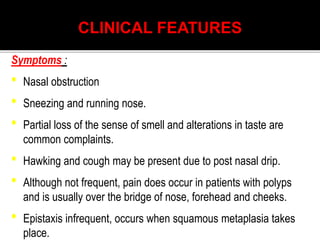
CLINICAL FEATURES
Symptoms :
• Nasal obstruction
• Sneezing and running nose.
• Partial loss of the sense of smell and alterations in taste are
common complaints.
• Hawking and cough may be present due to post nasal drip.
• Although not frequent, pain does occur in patients with polyps
and is usually over the bridge of nose, forehead and cheeks.
• Epistaxis infrequent, occurs when squamous metaplasia takes
place.
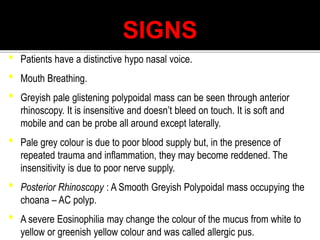
SIGNS
• Patients have a distinctive hypo nasal voice.
• Mouth Breathing.
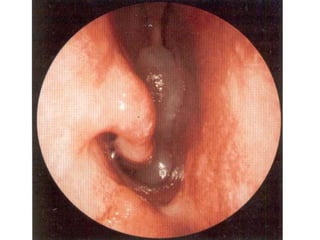
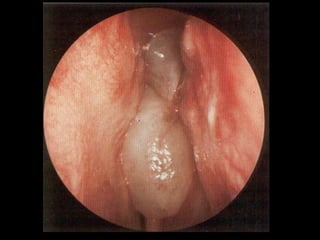
• Greyish pale glistening polypoidal mass can be seen through anterior
rhinoscopy. It is insensitive and doesn’t bleed on touch. It is soft and
mobile and can be probe all around except laterally.
• Pale grey colour is due to poor blood supply but, in the presence of
repeated trauma and inflammation, they may become reddened. The
insensitivity is due to poor nerve supply.
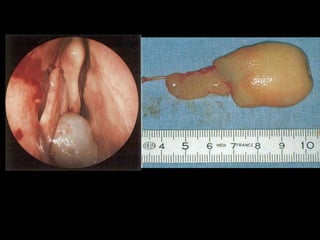
• Posterior Rhinoscopy : A Smooth Greyish Polypoidal mass occupying the
choana – AC polyp.
• A severe Eosinophilia may change the colour of the mucus from white to
yellow or greenish yellow colour and was called allergic pus.
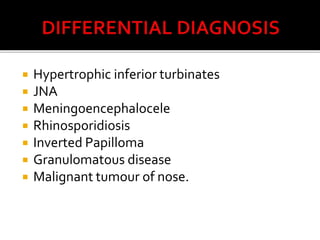
 Hypertrophic inferior turbinates
 JNA
 Meningoencephalocele
 Rhinosporidiosis
 Inverted Papilloma
 Granulomatous disease
 Malignant tumour of nose.
AC Polyp Ethmoidal Polyps
Common in Children and
adolescents
Arises from maxillary
antrum
Usually Singale, Unilateral ,
3 components – (Antral,
Choanal, Nasal)
Extends backward due to wide
choana, gravity, aircurrent, Ciliary
movement , Accessory ostium is
more posteriorly placed.
Recurrence less common
Common in middle age and elderly male.
Arises from anterior, middle and posterior group
of ethmoids.
Usually, multiple, bilateral.
Extends forward
Common, about 20 - 40%
In long standing cases, there may be expansion
or broadening of external nose, known as frog-
face deformity
• Haematological
TC, DC, Hb%, ESR
Absolute eosinophil count
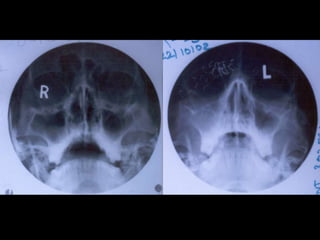
• X-ray PNS
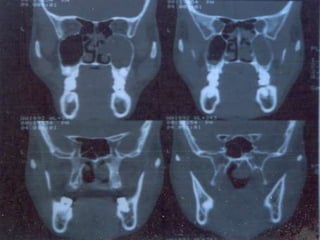
• CT Scan PNS (Coronal and Axial views)
DNE
INVESTIGATIONS
•Simple removal of the polyp by nasal Krause’s or Glegg’s snare or forceps
•Caldwell- luc operation
•Endoscopic assisted polypectomy
SURGERY FOR AC POLYP
SURGERY FOR ETHMOIDAL POLYPS
MEDICAL MANAGEMENT
Antihistamines & Intranasal steroid sprays.
SURGICAL MANAGEMENT
• Internal Ethmoidectomy – more recurrence
• External Ethmoidectomy – more recurrence
• Transantral Ethmoidectomy
• Endoscopic assisted
polypectomy followed by
nasal steroids spray – less recurrence
 In most cases etiology is unknown
 Polyps are associated with asthma, aspirin
sensitivity, cystic fibrosis.
 Symptomatic nasal polyps occur in 2% pts.
 Osteomeatal complex is most common site.
 Unilateral polyps should always be regarded
with suspicion and HPE is needed to rule out
malignancy
Nasal polyposis 06.06.16 - dr.davis

Nasal polyposis 06.06.16 - dr.davis

  • 1.
  • 2.
     Defined assimple, edematous, non-neoplatic, hypertrophied mucosa of paranasal sinuses and nasal cavity.  2 main types:  Ethmoidal Polypi  Antrochoanal Polyp  They can also be presenting features of fungal sinusitis and sino-nasal malignancy
  • 4.
    PATHOGENESIS OF NASALPOLYPS There are 3 main factors involved: • The mucosal reactions at the Cellular level • Relatively poorly developed blood supply of the ethmoid sinuses • The complex anatomy of the ethmoid labyrinth
  • 5.
    1. Bernoulli Phenomenon Bernoulli’stheorem postulates that, when gases or fluids pass through a constricted area, a negative pressure may develop in the vicinity of constriction. The lowered pressure leads to an increased formation of tissue fluid and subsequent Polyp formation. 2. Polysaccharide Changes An alteration in the polysaccharides of ground substances has been postulated by Jackson and Arihood. 3. Vasomotor imbalance This is implied because of the majority of cases are not atopic and no obvious allergen can be found. THEORIES OF PATHOGENESIS
  • 6.
    4. Infection Non-capsulated haemophilusinfluenzae. 5. Allergy This has been implicated because of three factor: • Histological picture where 90% or more of nasal polyps have an Eosinophilia • Association with asthma • Finally, the nasal findings which may mimic allergic symptoms and signs.
  • 7.
    PROETZ THEORY:  Diseasecould be due to faulty development of the maxillary sinus ostium.  Hypertrophic mucosa of maxillary antrum sprouts out through this enlarged maxillary sinus ostium to get into the nasal cavity.  The growth of the polyp is due to impediment to the venous return from the polyp at the level of the maxillary sinus ostium.
  • 8.
     Samter’s triad NARE syndrome  Kartagener syndrome  Young’s syndrome
  • 9.
    CLINICAL FEATURES Symptoms : •Nasal obstruction • Sneezing and running nose. • Partial loss of the sense of smell and alterations in taste are common complaints. • Hawking and cough may be present due to post nasal drip. • Although not frequent, pain does occur in patients with polyps and is usually over the bridge of nose, forehead and cheeks. • Epistaxis infrequent, occurs when squamous metaplasia takes place.
  • 10.
    SIGNS • Patients havea distinctive hypo nasal voice. • Mouth Breathing. • Greyish pale glistening polypoidal mass can be seen through anterior rhinoscopy. It is insensitive and doesn’t bleed on touch. It is soft and mobile and can be probe all around except laterally. • Pale grey colour is due to poor blood supply but, in the presence of repeated trauma and inflammation, they may become reddened. The insensitivity is due to poor nerve supply. • Posterior Rhinoscopy : A Smooth Greyish Polypoidal mass occupying the choana – AC polyp. • A severe Eosinophilia may change the colour of the mucus from white to yellow or greenish yellow colour and was called allergic pus.
  • 11.
     Hypertrophic inferiorturbinates  JNA  Meningoencephalocele  Rhinosporidiosis  Inverted Papilloma  Granulomatous disease  Malignant tumour of nose.
  • 13.
    AC Polyp EthmoidalPolyps Common in Children and adolescents Arises from maxillary antrum Usually Singale, Unilateral , 3 components – (Antral, Choanal, Nasal) Extends backward due to wide choana, gravity, aircurrent, Ciliary movement , Accessory ostium is more posteriorly placed. Recurrence less common Common in middle age and elderly male. Arises from anterior, middle and posterior group of ethmoids. Usually, multiple, bilateral. Extends forward Common, about 20 - 40% In long standing cases, there may be expansion or broadening of external nose, known as frog- face deformity
  • 15.
    • Haematological TC, DC,Hb%, ESR Absolute eosinophil count • X-ray PNS • CT Scan PNS (Coronal and Axial views) DNE INVESTIGATIONS
  • 18.
    •Simple removal ofthe polyp by nasal Krause’s or Glegg’s snare or forceps •Caldwell- luc operation •Endoscopic assisted polypectomy SURGERY FOR AC POLYP
  • 19.
    SURGERY FOR ETHMOIDALPOLYPS MEDICAL MANAGEMENT Antihistamines & Intranasal steroid sprays. SURGICAL MANAGEMENT • Internal Ethmoidectomy – more recurrence • External Ethmoidectomy – more recurrence • Transantral Ethmoidectomy • Endoscopic assisted polypectomy followed by nasal steroids spray – less recurrence
  • 20.
     In mostcases etiology is unknown  Polyps are associated with asthma, aspirin sensitivity, cystic fibrosis.  Symptomatic nasal polyps occur in 2% pts.  Osteomeatal complex is most common site.  Unilateral polyps should always be regarded with suspicion and HPE is needed to rule out malignancy