
Mohammad Ihmeidan PGY2
 is a severe, life-threatening, systemic
hypersensitivity reaction resulting from the
sudden release of mast cell and basophil-derived
mediators
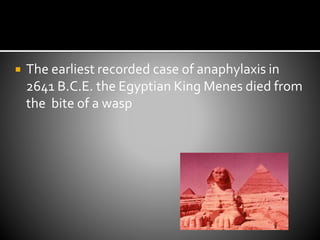
 The earliest recorded case of anaphylaxis in
2641 B.C.E. the Egyptian King Menes died from
the bite of a wasp
The incidence of anaphylaxis during peri-operative
period is about 1:13,000
 Can be catagorized into :
IgE-mediated reactions (calassical)
non-IgE mediated (anaphylactoid)
 is a type I immunologic reaction
 happens when a sensitized person is re-exposed
to an allergen
 Type I: Immediate (IgE-dependent)
 Type II: Cytotoxic (IgG, IgM-dependent)
 Type III: Immune complexes (IgG, IgM-
dependent
 complex)
 Type IV: Delayed (T lymphocyte-dependent)
1. Initial exposure to allergen
2. IgE antibody produced in reponse to allergen
3. Re-exposure of patient to same allergen
4. Preformed IgE cross links on mast cell
surface
5. Mediators (esp. histamine) released by mast
cell
 Non-IgE-DependentAnaphylaxis
 the release of the mediators can be initiated by
different factors that directly interfere with the
mast cells and basophils
 For this type of a reaction, no sensitization is
needed, and therefore this type of anaphylactic
reaction may occur with the first contact to the
allergen.
Mast cells
Final common pathway of all allergic reactions
Present in most tissues
When activated, release :
Histamine
Bradykinins
Prostaglandins
Leukotrienes
Clinical effects are due to these above mediators
3 types with the following effects when
stimulated :
H1 : brochoconstriction, increases vascular
permeability, smooth muscle contraction
H2 : increases gastric acid secretion, cardiac
chronotropy & inotropy
H3 : inhibition of histamine formation & release
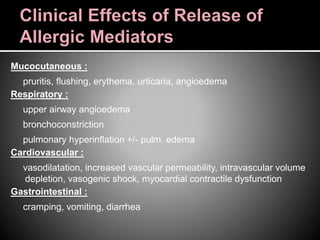
Mucocutaneous :
pruritis, flushing, erythema, urticaria, angioedema
Respiratory :
upper airway angioedema
bronchoconstriction
pulmonary hyperinflation +/- pulm. edema
Cardiovascular :
vasodilatation, increased vascular permeability, intravascular volume
depletion, vasogenic shock, myocardial contractile dysfunction
Gastrointestinal :
cramping, vomiting, diarrhea
IgE mediated allergies :
Beta lactams, stings, food, latex
Direct mast cell degranulation :
Xray contrast media, opiates, mannitol, anesthetic
agents
Penicillin is most common cause
Incidence of hypersensitivity about 4 %
Anaphylaxis in 1 per 10,000 administrations
100 to 500 deaths per year in U.S.
Co-reactivity with cephalosporins < 5%
Can undergo desensitization process but risky
and many alternative antibiotics now available
An increasingly recognized problem
Can result in fatal anaphylaxis
More common in patients with Spina bifida &
congenital syndromes
Physician should select non-latex gloves &
catheters for patients with this allergy
Occur in 1 % of cases if given I.V
10 % of these are severe
About 500 ( ? ) fatal reactions in U.S. annually
 Anaphylactoid like reactions have been reported to
occure during the non-vascular administration of
iodinated contrast media.
 Underreported ;nonvascular iodinated contrast media
absorption is slower than vascular absorption.
Therefore, mild reactions such as rashes are delayed
and attributed to something else
 Asthma
 Prior allergic rection
 Eczema
 Seasonal allergy
 Hepatic or renal impairment
 Other diagnoses that might mimic anaphylaxis
shouldbe considered, since there are several
conditions that can also cause abrupt and dramatic
patient collapse.
Acute reactions should be excluded if possible; these
include
 vasovagal reactions
 myocardial dysfunction
 pulmonary embolism
 Aspiration
 Hypoglycemia.
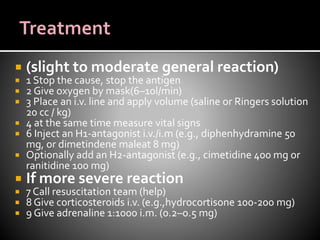
 (slight to moderate general reaction)
 1 Stop the cause, stop the antigen
 2 Give oxygen by mask(6–10l/min)
 3 Place an i.v. line and apply volume (saline or Ringers solution
20 cc / kg)
 4 at the same time measure vital signs
 6 Inject an H1-antagonist i.v./i.m (e.g., diphenhydramine 50
mg, or dimetindene maleat 8 mg)
 Optionally add an H2-antagonist (e.g., cimetidine 400 mg or
ranitidine 100 mg)
 If more severe reaction
 7 Call resuscitation team (help)
 8 Give corticosteroids i.v. (e.g.,hydrocortisone 100-200 mg)
 9 Give adrenaline 1:1000 i.m. (0.2–0.5 mg)
 Patients with an anaphylactic reaction need
continuous surveillance for 24 h in hospital.
 Thisis also necessary in patients with a good
reaction to appropriatetherapy because of the
possibility of recurrenceand the delayed
reaction (up to 12 h after the initial reaction)
with arrhythmia, myocardial ischaemia or
respiratory insufficiency .
Peri-operative Anaphylaxis

Peri-operative Anaphylaxis

  • 1.
  • 2.
     is asevere, life-threatening, systemic hypersensitivity reaction resulting from the sudden release of mast cell and basophil-derived mediators
  • 3.
     The earliestrecorded case of anaphylaxis in 2641 B.C.E. the Egyptian King Menes died from the bite of a wasp
  • 4.
    The incidence ofanaphylaxis during peri-operative period is about 1:13,000
  • 5.
     Can becatagorized into : IgE-mediated reactions (calassical) non-IgE mediated (anaphylactoid)
  • 6.
     is atype I immunologic reaction  happens when a sensitized person is re-exposed to an allergen
  • 7.
     Type I:Immediate (IgE-dependent)  Type II: Cytotoxic (IgG, IgM-dependent)  Type III: Immune complexes (IgG, IgM- dependent  complex)  Type IV: Delayed (T lymphocyte-dependent)
  • 8.
    1. Initial exposureto allergen 2. IgE antibody produced in reponse to allergen 3. Re-exposure of patient to same allergen 4. Preformed IgE cross links on mast cell surface 5. Mediators (esp. histamine) released by mast cell
  • 9.
     Non-IgE-DependentAnaphylaxis  therelease of the mediators can be initiated by different factors that directly interfere with the mast cells and basophils  For this type of a reaction, no sensitization is needed, and therefore this type of anaphylactic reaction may occur with the first contact to the allergen.
  • 10.
    Mast cells Final commonpathway of all allergic reactions Present in most tissues When activated, release : Histamine Bradykinins Prostaglandins Leukotrienes Clinical effects are due to these above mediators
  • 11.
    3 types withthe following effects when stimulated : H1 : brochoconstriction, increases vascular permeability, smooth muscle contraction H2 : increases gastric acid secretion, cardiac chronotropy & inotropy H3 : inhibition of histamine formation & release
  • 12.
    Mucocutaneous : pruritis, flushing,erythema, urticaria, angioedema Respiratory : upper airway angioedema bronchoconstriction pulmonary hyperinflation +/- pulm. edema Cardiovascular : vasodilatation, increased vascular permeability, intravascular volume depletion, vasogenic shock, myocardial contractile dysfunction Gastrointestinal : cramping, vomiting, diarrhea
  • 13.
    IgE mediated allergies: Beta lactams, stings, food, latex Direct mast cell degranulation : Xray contrast media, opiates, mannitol, anesthetic agents
  • 14.
    Penicillin is mostcommon cause Incidence of hypersensitivity about 4 % Anaphylaxis in 1 per 10,000 administrations 100 to 500 deaths per year in U.S. Co-reactivity with cephalosporins < 5% Can undergo desensitization process but risky and many alternative antibiotics now available
  • 15.
    An increasingly recognizedproblem Can result in fatal anaphylaxis More common in patients with Spina bifida & congenital syndromes Physician should select non-latex gloves & catheters for patients with this allergy
  • 16.
    Occur in 1% of cases if given I.V 10 % of these are severe About 500 ( ? ) fatal reactions in U.S. annually
  • 17.
     Anaphylactoid likereactions have been reported to occure during the non-vascular administration of iodinated contrast media.  Underreported ;nonvascular iodinated contrast media absorption is slower than vascular absorption. Therefore, mild reactions such as rashes are delayed and attributed to something else
  • 18.
     Asthma  Priorallergic rection  Eczema  Seasonal allergy  Hepatic or renal impairment
  • 19.
     Other diagnosesthat might mimic anaphylaxis shouldbe considered, since there are several conditions that can also cause abrupt and dramatic patient collapse. Acute reactions should be excluded if possible; these include  vasovagal reactions  myocardial dysfunction  pulmonary embolism  Aspiration  Hypoglycemia.
  • 20.
     (slight tomoderate general reaction)  1 Stop the cause, stop the antigen  2 Give oxygen by mask(6–10l/min)  3 Place an i.v. line and apply volume (saline or Ringers solution 20 cc / kg)  4 at the same time measure vital signs  6 Inject an H1-antagonist i.v./i.m (e.g., diphenhydramine 50 mg, or dimetindene maleat 8 mg)  Optionally add an H2-antagonist (e.g., cimetidine 400 mg or ranitidine 100 mg)  If more severe reaction  7 Call resuscitation team (help)  8 Give corticosteroids i.v. (e.g.,hydrocortisone 100-200 mg)  9 Give adrenaline 1:1000 i.m. (0.2–0.5 mg)
  • 21.
     Patients withan anaphylactic reaction need continuous surveillance for 24 h in hospital.  Thisis also necessary in patients with a good reaction to appropriatetherapy because of the possibility of recurrenceand the delayed reaction (up to 12 h after the initial reaction) with arrhythmia, myocardial ischaemia or respiratory insufficiency .