Mohammad Ihmeidan PGY2
2
History
●
●
Also known as nephroblastoma
First descriped by Thomas F. Rance (1814)
Max Wilms thoroughly reviewed the disease and
described it histologically as “mixed tumors” of the
kidney
●
3
Epidemiology
●
●
●
●
●
Annual incidence of Wilms' tumor in the United States is 7.6
cases per million children younger than15 years.
6 % of pediatric tumors – commonest pediatric tumor affecting
the kidney
higher in blacks, lower in Asians
Male to female ratio is:
– 0.92:1.00 for unilateral disease
– 0.60:1.00 for bilateral disease
4
Epidemiology
●
Mean age of diagnosis:
–
– 46.9 months for females (29.5 mo for B/Ltumors(
41.5 months for males (32.6 mo for B/L tumors(
5
Pathogenesis
7
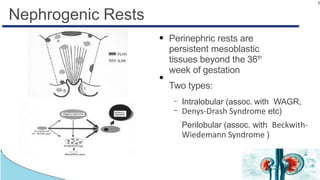
Nephrogenic Rests
●
●
Perinephric rests are
persistent mesoblastic
tissues beyond the 36th
week of gestation
Two types:
–
– Intralobular (assoc. with WAGR,
Denys-Drash Syndrome etc(
Perilobular (assoc. with Beckwith-
Wiedemann Syndrome (
Pathology
11
Histology
 Mostly mixed form of
epithelial, blastemic and
stromal cellular
components as well as
with various degrees of
cell differentiation.
Clinical
Features
19
Signs and symptoms
●
●
Classically appears as a silent abdominal mass during
childhood (60-70%)
Other signs and symptoms:
–
–
–
– Abdominal pain (30-40%)
Hematuria (25%)
– Hypertension (25%)
Varicocele (tumor thrombus in IVC)
Associated genitourinary abnormalities
Associated stigma of congenital anomalies
21
Congenital Anomalies
●
●
Around 9 - 10% of individuals with Wilms tumour have a
congenital anomaly
Long term F/U of individuals reveals a syndrome in 17%
patients
22
Congenital Anomalies
●
●
●
●
WT1 deletions (including
WAGR syndrome)
Truncating and pathogenic
missense WT1 mutations
(including Denys-Drash
syndrome)
Familial Wilms tumour
●High risk (>20%) ●Moderate risk (5–20%)
●
●
WT1 intron 9 splice mutations
(Frasier syndrome)
Beckwith-Wiedemann
syndrome
●Low risk (<5%)
●
Isolated hemihypertrophy
23
WAGR Syndrome
Wilms Tumor
Aniridia
Genitourinary abnormalities
Mental Retardation
24
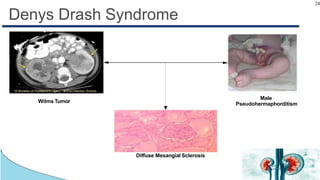
Denys Drash Syndrome
Diffuse Mesangial Sclerosis
Male
PseudohermaphorditismWilms Tumor
25
Beckwith-Wiedemann Syndrome
Microcephaly
Umbilical Hernia
Ear lobe crease Macroglossia
Hemihypertrophy
Workup
27
Investigations
◄ To establish the diagnosis
◄ Delineate tumor extent
◄ Confirm contralateral renal
functional status
◄ Discover any metastasis
◄ Assess fitness for surgery / anaesthesia
AIMS
29
Imaging
●
USG abdomen:
– Imaging investigation of
choice for screening
●
To assess renal function:
DMSA renal scan
●
CT scans:
–
–
– Accurate delineation of intra-
abdominal tumor.
Extension into surrounding
organs
Detection of mets
30
Special investigations
●
●
CT brain:
– Rhabdoid tumor of kidney
Bone scan:
– Clear cell sarcoma
Staging
47
Study Groups
●
●
●
●
●
●
National Wilms Tumor Study Group )NWTSG) – Now in
Children Oncology Group (COG)
International Society of Pediatric Oncology (SIOP)
German Pediatric Oncology (GPO) group,
The Brazilian Pediatric Oncology Group
The French Societe d’Oncologie Pediatrique (SFOP(
Italian Association of Pediatric Hematology and
Oncology (AIEOP (
17
Classification
SIOP
● Low risk
–
–
–
– Cystic
partially diff. WT Mesoblastic
completely necrotic
● Intermediate risk– in between
●
High risk
–
–
– blastemal
diffuse anaplastic
Histology: NWTSG(National Wilms Tumor Study Group )
• Absence of anaplasia (favorable histology):
• Typically triphasic in appearance and includes blastemal, stromal, and epithelial
elements
• Presence of abortive tubules and glomeruli surrounded by a spindled cell stroma.
• Presence of anaplasia (unfavorable histology):
• Gigantic (>3 times the diameter of adjacent cells) hyperchromatic nuclei
• Identification of polypoid mitotic figures
• Focal anaplasia: anaplastic nuclear changes confined to restricted foci within the
primary tumor
• Diffuse anaplasia: involvement of any extrarenal site, renal sinus, extracapsular
involvement, sinus, nodal, and distant metastases, or extreme nuclear pleomorphism in
one area or involvement of multiple areas within one slide.
35
Stage I
SIOP System:
●
●
●
Tumor confined to
the kidney
Completely
excised
Capsule intact
NWTS System:
●
●
●
Tumor confined to the kidney
Completely excised
Capsule intact
36
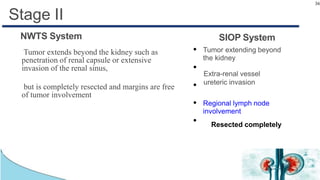
Stage II
SIOP System
●
Tumor extending beyond
the kidney
●
Extra-renal vessel
ureteric invasion●
●
Regional lymph node
involvement
●
Resected completely
NWTS System
Tumor extends beyond the kidney such as
penetration of renal capsule or extensive
invasion of the renal sinus,
but is completely resected and margins are free
of tumor involvement
37
Stage III
SIOP System:
Invasion beyond capsule
with incomplete excision
Pre/peri-op Bx
Pre/per-op rupture
NWTS System:
●
Microscopic or gross residual or
unresectable non-hematogenous tumor is
present and confined to the abdomen.
This may represent tumor positive lymph
nodes within the abdomen or pelvis,
peritoneal implants, or penetration
●
38
Stage IV
SIOP System:
●
●
Hematogenous
metastasis
LAD beyond the
abdomen/pelvis
NWTS System:
● Hematogenous metastases
(i.e., lung, liver, bone,
brain)
or lymph node metastases
outside the abdomino-
pelvic region are present.
39
Stage V
SIOP System:
●
Bilateral tumor
NWTS System:
●
Bilateral Tumor
N.B.: Both systems specify that the tumors should be individually staged.
Treatment
48
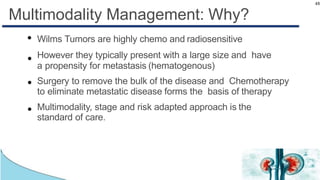
Multimodality Management: Why?
●
●
●
●
Wilms Tumors are highly chemo and radiosensitive
However they typically present with a large size and have
a propensity for metastasis (hematogenous(
Surgery to remove the bulk of the disease and Chemotherapy
to eliminate metastatic disease forms the basis of therapy
Multimodality, stage and risk adapted approach is the
standard of care.
49
Management Protocol
●
Management protocol varies according to:
–
–
–
– Age of patient
Preoperative extent on imaging
Operative stage
Post operative histology
83
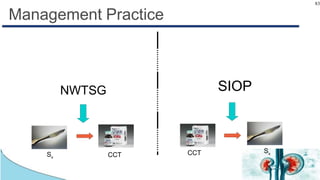
Management Practice
NWTSG SIOP
Sx CCT
SxCCT
84
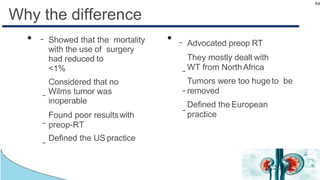
Why the difference
●
–
–
–
– Showed that the mortality
with the use of surgery
had reduced to
<1%
Considered that no
Wilms tumor was
inoperable
Found poor resultswith
preop-RT
Defined the US practice
●
–
–
–
– Advocated preop RT
They mostly dealt with
WT from NorthAfrica
Tumors were too hugeto be
removed
Defined the European
practice
53
Surgery
●
●
●
Operability should be determined
Surgical excision is done through a
transverse abdominal incision
The standard procedure includes:
–
–
–
– Unilateral radical nephrectomy
Selective sampling of nodes (RPL
dissection doesn't alter outcome)
Renal vein and IVC (6% involvement)
should be palpated to exclude
intravascular tumor extension
Exploration of the opposite kidney
54
Issues in surgery
●
Role of nephron-sparing surgery
–
–
–
–
– Indicated in bilateral Wilms tumor
WT in patients with genetic predisposition
Also in WT in solitary functional kidney / renal failure
Very young infants < 6 months age
●
Role of biopsy of opposite kidney
–
–
May be indicated in the opposite kidney if there is suspicion of
nephrogenic rests on preop imaging
Not to be use routinely, however part of protocol in NTWS 1-4
55
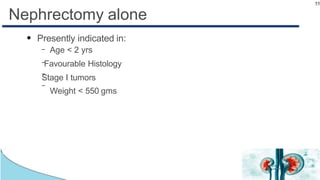
Nephrectomy alone
●
Presently indicated in:
–
–
–
– Age < 2 yrs
Favourable Histology
Stage I tumors
Weight < 550 gms
56
Surgical Complications
●
●
●
Surgical mortality is < 1% in modern day series
19.8% incidence of surgical complications (NWTS-4)
Most common complications of nephrectomy are:
–
–
–
– Small bowel obstruction (7%)
Hemorrhage (6%)
Wound infection, hernia (4%)
Vascular complications (2%)
●
Risk factors associated with increased surgical complications:
–
–
–
– Higher local tumor stage
Incorrect preoperative diagnosis
Intravascular extension
En bloc resection of other visceral organs
78
Preoperative Chemotherapy- pros
●
●
●
●
●
●
●
Achieves down-staging of the tumor:
Allows better surgical resection
Reduces surgical morbidity
Reduces risk of local relapse
Reduction in need for radiation therapy in event of tumor
spillage
Assessment of tumor response to CCT important
predictive factor in selecting future therapy
Allows reduction in CCT/RT intensity in the postoperative period
79
Preoperative Chemotherapy- cons
●
●
●
●
●
Loss of staging information secondary to down-staging makes
comparision of results difficult
Treatment according to the reduced stage may be detrimental as
occult tumor may be missed – higher probablity of abdominal
relapse
Unnecessary Chemotherapy if incorrectly diagnosed.
Loss of histological information in the post operative specimen
Chances of customization of therapy are reduced.
120
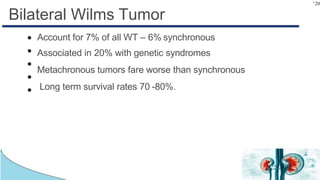
Bilateral Wilms Tumor
●
●
●
●
●
Account for 7% of all WT – 6% synchronous
Associated in 20% with genetic syndromes
Metachronous tumors fare worse than synchronous
Long term survival rates 70 -80%.
126
Conclusion
●
●
●
●
●
MC renal tumor of childhood
Usually has a large size on presentation and high chance of
distant spread
However prognosis excellent with modern day therapy
Surgery with adjuvant chemotherapy vs neo-adjuvent chemotherapy
is the mainstay of therapy
Radiation therapy given judiciously can reduce recurrences
Wilms tumors

Wilms tumors

  • 1.
  • 2.
    2 History ● ● Also known asnephroblastoma First descriped by Thomas F. Rance (1814) Max Wilms thoroughly reviewed the disease and described it histologically as “mixed tumors” of the kidney ●
  • 3.
    3 Epidemiology ● ● ● ● ● Annual incidence ofWilms' tumor in the United States is 7.6 cases per million children younger than15 years. 6 % of pediatric tumors – commonest pediatric tumor affecting the kidney higher in blacks, lower in Asians Male to female ratio is: – 0.92:1.00 for unilateral disease – 0.60:1.00 for bilateral disease
  • 4.
    4 Epidemiology ● Mean age ofdiagnosis: – – 46.9 months for females (29.5 mo for B/Ltumors( 41.5 months for males (32.6 mo for B/L tumors(
  • 5.
  • 6.
    7 Nephrogenic Rests ● ● Perinephric restsare persistent mesoblastic tissues beyond the 36th week of gestation Two types: – – Intralobular (assoc. with WAGR, Denys-Drash Syndrome etc( Perilobular (assoc. with Beckwith- Wiedemann Syndrome (
  • 7.
  • 8.
    11 Histology  Mostly mixedform of epithelial, blastemic and stromal cellular components as well as with various degrees of cell differentiation.
  • 9.
  • 10.
    19 Signs and symptoms ● ● Classicallyappears as a silent abdominal mass during childhood (60-70%) Other signs and symptoms: – – – – Abdominal pain (30-40%) Hematuria (25%) – Hypertension (25%) Varicocele (tumor thrombus in IVC) Associated genitourinary abnormalities Associated stigma of congenital anomalies
  • 11.
    21 Congenital Anomalies ● ● Around 9- 10% of individuals with Wilms tumour have a congenital anomaly Long term F/U of individuals reveals a syndrome in 17% patients
  • 12.
    22 Congenital Anomalies ● ● ● ● WT1 deletions(including WAGR syndrome) Truncating and pathogenic missense WT1 mutations (including Denys-Drash syndrome) Familial Wilms tumour ●High risk (>20%) ●Moderate risk (5–20%) ● ● WT1 intron 9 splice mutations (Frasier syndrome) Beckwith-Wiedemann syndrome ●Low risk (<5%) ● Isolated hemihypertrophy
  • 13.
  • 14.
    24 Denys Drash Syndrome DiffuseMesangial Sclerosis Male PseudohermaphorditismWilms Tumor
  • 15.
  • 16.
  • 17.
    27 Investigations ◄ To establishthe diagnosis ◄ Delineate tumor extent ◄ Confirm contralateral renal functional status ◄ Discover any metastasis ◄ Assess fitness for surgery / anaesthesia AIMS
  • 18.
    29 Imaging ● USG abdomen: – Imaginginvestigation of choice for screening ● To assess renal function: DMSA renal scan ● CT scans: – – – Accurate delineation of intra- abdominal tumor. Extension into surrounding organs Detection of mets
  • 19.
    30 Special investigations ● ● CT brain: –Rhabdoid tumor of kidney Bone scan: – Clear cell sarcoma
  • 20.
  • 21.
    47 Study Groups ● ● ● ● ● ● National WilmsTumor Study Group )NWTSG) – Now in Children Oncology Group (COG) International Society of Pediatric Oncology (SIOP) German Pediatric Oncology (GPO) group, The Brazilian Pediatric Oncology Group The French Societe d’Oncologie Pediatrique (SFOP( Italian Association of Pediatric Hematology and Oncology (AIEOP (
  • 22.
    17 Classification SIOP ● Low risk – – – –Cystic partially diff. WT Mesoblastic completely necrotic ● Intermediate risk– in between ● High risk – – – blastemal diffuse anaplastic
  • 23.
    Histology: NWTSG(National WilmsTumor Study Group ) • Absence of anaplasia (favorable histology): • Typically triphasic in appearance and includes blastemal, stromal, and epithelial elements • Presence of abortive tubules and glomeruli surrounded by a spindled cell stroma. • Presence of anaplasia (unfavorable histology): • Gigantic (>3 times the diameter of adjacent cells) hyperchromatic nuclei • Identification of polypoid mitotic figures • Focal anaplasia: anaplastic nuclear changes confined to restricted foci within the primary tumor • Diffuse anaplasia: involvement of any extrarenal site, renal sinus, extracapsular involvement, sinus, nodal, and distant metastases, or extreme nuclear pleomorphism in one area or involvement of multiple areas within one slide.
  • 24.
    35 Stage I SIOP System: ● ● ● Tumorconfined to the kidney Completely excised Capsule intact NWTS System: ● ● ● Tumor confined to the kidney Completely excised Capsule intact
  • 25.
    36 Stage II SIOP System ● Tumorextending beyond the kidney ● Extra-renal vessel ureteric invasion● ● Regional lymph node involvement ● Resected completely NWTS System Tumor extends beyond the kidney such as penetration of renal capsule or extensive invasion of the renal sinus, but is completely resected and margins are free of tumor involvement
  • 26.
    37 Stage III SIOP System: Invasionbeyond capsule with incomplete excision Pre/peri-op Bx Pre/per-op rupture NWTS System: ● Microscopic or gross residual or unresectable non-hematogenous tumor is present and confined to the abdomen. This may represent tumor positive lymph nodes within the abdomen or pelvis, peritoneal implants, or penetration ●
  • 27.
    38 Stage IV SIOP System: ● ● Hematogenous metastasis LADbeyond the abdomen/pelvis NWTS System: ● Hematogenous metastases (i.e., lung, liver, bone, brain) or lymph node metastases outside the abdomino- pelvic region are present.
  • 28.
    39 Stage V SIOP System: ● Bilateraltumor NWTS System: ● Bilateral Tumor N.B.: Both systems specify that the tumors should be individually staged.
  • 29.
  • 30.
    48 Multimodality Management: Why? ● ● ● ● WilmsTumors are highly chemo and radiosensitive However they typically present with a large size and have a propensity for metastasis (hematogenous( Surgery to remove the bulk of the disease and Chemotherapy to eliminate metastatic disease forms the basis of therapy Multimodality, stage and risk adapted approach is the standard of care.
  • 31.
    49 Management Protocol ● Management protocolvaries according to: – – – – Age of patient Preoperative extent on imaging Operative stage Post operative histology
  • 32.
  • 33.
    84 Why the difference ● – – – –Showed that the mortality with the use of surgery had reduced to <1% Considered that no Wilms tumor was inoperable Found poor resultswith preop-RT Defined the US practice ● – – – – Advocated preop RT They mostly dealt with WT from NorthAfrica Tumors were too hugeto be removed Defined the European practice
  • 34.
    53 Surgery ● ● ● Operability should bedetermined Surgical excision is done through a transverse abdominal incision The standard procedure includes: – – – – Unilateral radical nephrectomy Selective sampling of nodes (RPL dissection doesn't alter outcome) Renal vein and IVC (6% involvement) should be palpated to exclude intravascular tumor extension Exploration of the opposite kidney
  • 35.
    54 Issues in surgery ● Roleof nephron-sparing surgery – – – – – Indicated in bilateral Wilms tumor WT in patients with genetic predisposition Also in WT in solitary functional kidney / renal failure Very young infants < 6 months age ● Role of biopsy of opposite kidney – – May be indicated in the opposite kidney if there is suspicion of nephrogenic rests on preop imaging Not to be use routinely, however part of protocol in NTWS 1-4
  • 36.
    55 Nephrectomy alone ● Presently indicatedin: – – – – Age < 2 yrs Favourable Histology Stage I tumors Weight < 550 gms
  • 37.
    56 Surgical Complications ● ● ● Surgical mortalityis < 1% in modern day series 19.8% incidence of surgical complications (NWTS-4) Most common complications of nephrectomy are: – – – – Small bowel obstruction (7%) Hemorrhage (6%) Wound infection, hernia (4%) Vascular complications (2%) ● Risk factors associated with increased surgical complications: – – – – Higher local tumor stage Incorrect preoperative diagnosis Intravascular extension En bloc resection of other visceral organs
  • 38.
    78 Preoperative Chemotherapy- pros ● ● ● ● ● ● ● Achievesdown-staging of the tumor: Allows better surgical resection Reduces surgical morbidity Reduces risk of local relapse Reduction in need for radiation therapy in event of tumor spillage Assessment of tumor response to CCT important predictive factor in selecting future therapy Allows reduction in CCT/RT intensity in the postoperative period
  • 39.
    79 Preoperative Chemotherapy- cons ● ● ● ● ● Lossof staging information secondary to down-staging makes comparision of results difficult Treatment according to the reduced stage may be detrimental as occult tumor may be missed – higher probablity of abdominal relapse Unnecessary Chemotherapy if incorrectly diagnosed. Loss of histological information in the post operative specimen Chances of customization of therapy are reduced.
  • 40.
    120 Bilateral Wilms Tumor ● ● ● ● ● Accountfor 7% of all WT – 6% synchronous Associated in 20% with genetic syndromes Metachronous tumors fare worse than synchronous Long term survival rates 70 -80%.
  • 41.
    126 Conclusion ● ● ● ● ● MC renal tumorof childhood Usually has a large size on presentation and high chance of distant spread However prognosis excellent with modern day therapy Surgery with adjuvant chemotherapy vs neo-adjuvent chemotherapy is the mainstay of therapy Radiation therapy given judiciously can reduce recurrences