DISCLAIMER
This lecture isnot a substitute for a practical first aid training by an
accredited first aid training provider.
This is only an overview of the basic first aid knowledge that can be used in
everyday life.
3.
COVERAGE OF TOPICS
Basic Principles in First Aid
Airway and Breathing Emergencies
Choking
Asthma
Anaphylaxis
Sudden Illnesses
Seizures
Fainting
Environmental Emergencies
Heat-Related Illnesses
Insect Stings
Soft Tissue Injuries
Wounds
Burns
Muscles, Bones and Joints Injuries
4.
BASIC PRINCIPLES INFIRST AID
FIRST AID
Immediate help provided to a sick or
injured person until professional
medical help arrives or becomes
available
Scope and Limitation
Does not imply medical treatment
and is by no means a replacement
for it
5.
BASIC PRINCIPLES INFIRST AID:
EMERGENCY ACTION PRINCIPLES
Scene Size-up
• Scene Safety
• Know What Happened
• Number of casualties
Primary
Assessment
• Assess
Responsiveness
• Activate Medical Help
6.
BASIC PRINCIPLES INFIRST AID:
EMERGENCY ACTION PRINCIPLES
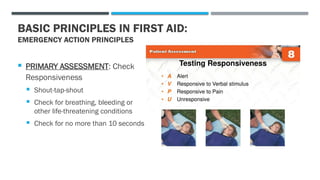
PRIMARY ASSESSMENT: Check
Responsiveness
Shout-tap-shout
Check for breathing, bleeding or
other life-threatening conditions
Check for no more than 10 seconds
7.
PRIMARY ASSESSMENT:
ACTIVATION OFMEDICAL HELP
If responsive, fully awake and not in life-threatening condition,
ask SAM
• Signs and symptoms
• Allergies
• Medications, medical conditions
Offer emotional support,
comfort and reassurance
to the injured or ill party
8.
PRIMARY ASSESSMENT:
ACTIVATION OFMEDICAL HELP
Call First if
• Any unconscious adult or child
> 12 years old
• A child or infant collapses
within your sight/presence
• Unconscious child or infant
known to have heart problems
Care First if
• Any unconscious child less than
12 years old who collapsed out
of sight
• Any drowning victim
• Give 2 mins of care, then call ARMU
9.
BASIC PRINCIPLES INFIRST AID:
EMERGENCY ACTION PRINCIPLES
PRIMARY ASSESSMENT: Activation of Medical Help
What happened?
Location of emergency?
Number of persons injured or ill?
Cause and extent of injury and nature of illness and first aid given?
Telephone number from where call is made
Name of person who called medical help
Person must identify him/herself before ending the call
FIRST AID: ASTHMA
ASTHMAATTACK
increasing wheezing, cough, chest
tightness or shortness of breath
waking often at night with asthma
symptoms
Increased usage of reliever inhaler
ASTHMA EMERGENCY
Severe shortness of breath
Blue/Cyanotic lips
Unable to speak in sentences
Rapid progression of symptoms
No improvement with inhaler
16.
FIRST AID: ASTHMA
SIGNS AND SYMPTOMS
Wheezing
Trouble breathing or shortness of breath
Rapid, shallow breathing
Sweating
Tightness in the chest
Inability to talk without stopping for a
breath
17.
FIRST AID: ANAPHYLAXIS
Common Allergens (triggers)
Milk, Eggs, Peanuts, Tree Nuts,
Sesame, Fish, Crustaceans, Wheat,
Soy
Insect Venom – Bee, Wasp and
Jumper Ant
Certain medications – Aspirin,
Penicillin, Herbal Medicines
18.
FIRST AID: ANAPHYLAXIS
MILDTO MODERATE ALLERGIC
REACTIONS
Swelling of lips, face, eyes
Hives or welts
Tingling mouth
Abdominal pain, vomiting
ANAPHYLAXIS (SEVERE ALLERGIC
REACTIONS)
Difficult or noisy breathing
Swelling of tongue
Swelling or tightness in throat
Wheeze or persistent cough
Difficulty talking or hoarse voice
Persistent dizziness or collapse
Pale and floppy (young children)
19.
FIRST AID: ANAPHYLAXIS
Assessif allergic
reaction vs
anaphylaxis
Call for medical
assistance
If mild to
moderate allergic
reaction
Give
Diphenhydramine
50mg orally
If anaphylactic
reaction
Administer Epi-
pen/Epinephrine
FIRST AID: SEIZURES
Signsand Symptoms
Unusual sensations or feelings (e.g. visual hallucinations)
Irregular breathing patterns
Drooling
Upward rolling of eyes
Sudden, uncontrollable, rhythmic muscle contractions and convulsions
Decreased level of responsiveness
Loss of bladder or bowel control
23.
FIRST AID: SEIZURES
Reassure the victim
Remove nearby objects that might
cause injury
Protect the victim’s head by placing a
thinly folded towel or piece of clothing
beneath it
Time the duration of the seizure
Stay and watch over the victim until
fully conscious
Do not hold or restrain the patient when
a seizure is in progress
Do not place anything between the
victim’s teeth or put anything in the
victim’s mouth
Loosen clothing around the neck that
could block breathing
Ensure that the victim’s airway is open
and check for breathing and other
injuries once seizure is over
24.
FIRST AID: SEIZURES
Whento call emergency medical help
seizure lasts longer than 5 minutes
have another seizure soon after
the first one
trouble breathing or waking up
after the seizure
injured during the seizure
seizure happens in water
No prior history of seizure
Has diabetes and lost
consciousness
Is pregnant
25.
FIRST AID: FAINTING
Signsand Symptoms
Lightheadedness or dizziness
Signs of shock, such as pale, cool or
moist skin
Nausea, numbness or tingling in the
finger and toes
Distortion/dimming of vision
26.
FIRST AID: FAINTING
Position the victim on his or her
back
Raise the person's legs above
heart level if possible.
about 12 inches (30 centimeters).
Loosen belts, collars or other tight
clothing
Check for any other conditions
This Photo by Unknown Author is licensed under CC BY-NC-ND
To reduce the chance of fainting
again, don't get the victim up too
fast. Do not give anything to eat or
drink
FIRST AID: HEAT-RELATEDILLNESSES
Remove the victim from the hot environment
Cool the victim by fanning, applying ice bags or spraying water on the skin
If conscious, oral rehydration with a beverage containing salt (e.g. ORS, Pocari
Sweat)
30.
FIRST AID: INSECTSTINGS
Remove any visible stinger.
Wash the site with soap and water. If necessary, change contaminated
clothing.
Cover the site with a dressing
Apply cold compress to the area to reduce pain and swelling
Call for medical assistance if there is any difficulty in breathing or other signs
of anaphylactic reaction
FIRST AID: CLOSEDWOUND (BRUISE)
Apply an ice pack
Do this for 15 to 20 minutes every 2 to 4 hours for
24 to 48 hours.
Elevate the injured part
Help the victim to rest
Provide comfort and reassure the victim
This Photo by Unknown Author is licensed
under CC BY-NC-ND
33.
FIRST AID: OPENWOUND
Minor Open Wounds
Use a barrier between your hand and the
wound
Using a gauze or clean cloth, apply direct
pressure
Wash abrasions, other superficial wounds
Apply betadine wound solution or if
available, antibiotic ointment/cream
Cover the wound with sterile dressing
Major Open Wounds
Call for medical assistance
Put on PPE (gloves)
Control bleeding by applying direct
pressure
Monitor airway and breathing
Have the person rest comfortably
and provide reassurance
34.
FIRST AID: OPENWOUND
Dress the wound
• Put on gloves or use other protection to prevent
contact with the victim's blood.
• Clean the wound with mild soap and water.
• Do not use toxic solutions like hydrogen peroxide.
• In cases where there are no known allergies,
antibiotic ointments may be used.
• Place a clean dressing over the entire wound.
• If blood soaks through the dressing, place another
dressing over the first one.
Cover the dressing
• Wrap roller gauze or cloth strips over the dressing
and around the wound several times.
• Extend the bandage at least an inch beyond both
sides of the dressing.
• Don't wrap the bandage so tight that it interferes
with blood flow to healthy tissue.
35.
FIRST AID: OPENWOUND
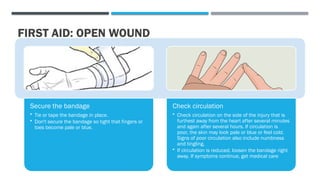
Secure the bandage
• Tie or tape the bandage in place.
• Don't secure the bandage so tight that fingers or
toes become pale or blue.
Check circulation
• Check circulation on the side of the injury that is
furthest away from the heart after several minutes
and again after several hours. If circulation is
poor, the skin may look pale or blue or feel cold.
Signs of poor circulation also include numbness
and tingling.
• If circulation is reduced, loosen the bandage right
away. If symptoms continue, get medical care
36.
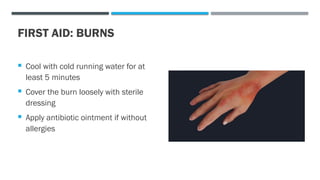
FIRST AID: BURNS
Cool with cold running water for at
least 5 minutes
Cover the burn loosely with sterile
dressing
Apply antibiotic ointment if without
allergies
37.
FIRST AID: BONES,JOINTS AND MUSCLE INJURIES
Strain
• Injuries of the muscles
or tendons
Sprain
• Injuries of the ligaments
Dislocation
• Disalignment of a joint
Fracture
• Break in the bone
38.
FIRST AID: BONES,JOINTS AND MUSCLE INJURIES
Rest Immobilize Cool/Cold
Elevate
For first
48 – 72 hours
RECOMMENDED CONTENT OF
FIRSTAID KIT
Quality Unit Particulars
1 pc 1-inch medical paper tape
1 pc 2-inch elastic bandages
1 pc 3-inch elastic bandages
10 pc Alcohol Wipes
4 pc Antacid (Kremil-S or Maalox-1 chewable tab)
5 pc Band-Aid
10 pc Betadine Solution/Wipes
3 pc Carbocisteine 500 mg/cap
4 pc Celecoxib 200 mg/tab
5 pc Cetirizine 10 mg/tab
2 pairs Clean Gloves
1 pc Cold Packs/Cold Compress Bags
10 pc Cotton Balls
1 sachet Dextromethorpan 5mg/lozenges (optional)
1 pc Hydrogen Peroxide 60ml bottle
4 pc Hyoscine10mg tab
5 pc Ibuprofen 200 mg/tab
5 pc Loperamide 2mg
1 pc Mupirocin Ointment
1 pc Nail Clippers (optional)
5 pc Oral Rehydration Solution (optional)
1 pc Plastic Tweezers
1 pc Scissors
2 pc Sterile Gauze Pads (4x4)
1 pc Thermometer
#6 Scene Assessment - Look for Clear and Apparent Dangers, Look for Less Obvious Hazards
#17 Remain calm
Help the person sit comfortably
Loosen any tight clothing around the neck and abdomen
Assist the person with prescribed quick-relief medication
#18 Skin becomes swollen and turns red (angioedema)
Difficulty in breathing, wheezing or shortness of breath
Tight feeling in the chest and throat
Swelling of the face, throat or tongue
Weakness, dizziness or confusion
Rashes or hives
Low Blood Pressure
Shock
#19 Skin becomes swollen and turns red (angioedema)
Difficulty in breathing, wheezing or shortness of breath
Tight feeling in the chest and throat
Swelling of the face, throat or tongue
Weakness, dizziness or confusion
Rashes or hives
Low Blood Pressure
Shock
#20 Skin becomes swollen and turns red (angioedema)
Difficulty in breathing, wheezing or shortness of breath
Tight feeling in the chest and throat
Swelling of the face, throat or tongue
Weakness, dizziness or confusion
Rashes or hives
Low Blood Pressure
Shock
#22 Skin becomes swollen and turns red (angioedema)
Difficulty in breathing, wheezing or shortness of breath
Tight feeling in the chest and throat
Swelling of the face, throat or tongue
Weakness, dizziness or confusion
Rashes or hives
Low Blood Pressure
Shock
#25 Time the seizure to track if it lasts more than 5 minutes. If it does, seek immediate medical attention or call 911.
Don't offer water or food until they are fully alert. This is not necessary and could cause them to choke.
#26 Time the seizure to track if it lasts more than 5 minutes. If it does, seek immediate medical attention or call 911.
#28 If the person doesn't regain consciousness within one minute, call 911 or your local emergency number.
#35 Always wash your hands before and after applying a bandage.
Step 1. Dress the wound
Put on gloves or use other protection to prevent contact with the victim's blood.
Clean the wound with mild soap and water. Avoid getting soap directly into the wound.
Do not use toxic solutions like hydrogen peroxide. They can irritate the wound and are harmful to wound healing.
In cases where there are no known allergies, antibiotic ointments may be used. Apply a thin layer of topical antibiotic if desired.
Place a clean dressing over the entire wound. Nonstick dressings have a special surface that won't cling to the wound.
If blood soaks through the dressing, place another dressing over the first one.
#36 Always wash your hands before and after applying a bandage.
Step 1. Dress the wound
Put on gloves or use other protection to prevent contact with the victim's blood.
Clean the wound with mild soap and water. Avoid getting soap directly into the wound.
Do not use toxic solutions like hydrogen peroxide. They can irritate the wound and are harmful to wound healing.
In cases where there are no known allergies, antibiotic ointments may be used. Apply a thin layer of topical antibiotic if desired.
Place a clean dressing over the entire wound. Nonstick dressings have a special surface that won't cling to the wound.
If blood soaks through the dressing, place another dressing over the first one.
#37 Always wash your hands before and after applying a bandage.
Step 1. Dress the wound
Put on gloves or use other protection to prevent contact with the victim's blood.
Clean the wound with mild soap and water. Avoid getting soap directly into the wound.
Do not use toxic solutions like hydrogen peroxide. They can irritate the wound and are harmful to wound healing.
In cases where there are no known allergies, antibiotic ointments may be used. Apply a thin layer of topical antibiotic if desired.
Place a clean dressing over the entire wound. Nonstick dressings have a special surface that won't cling to the wound.
If blood soaks through the dressing, place another dressing over the first one.
#39 Strain – pulled muscle, caused by overstretcing and tearing of muscles or tendons, usually involved muscles in the neck, back , thigh, or back of lower leg
Sprain – tearing of ligaments at a joint – ankle, knee, wrist and fingers are the most easily injured
Dislocation – movement of a bone at a joint away from its normal position
Fracture
#40 Mainly for sprain
REST – stop any current activities and rest without moving or straightening the injured body part
IMMOBILIZE – keep the injured area at the position in which it is found
COOL – injured part for 20 mins every hour to reduce swelling and pain. Do not rub the ice or cold pack. Put a thin dry cloth or pad between the ice compress and bare skin
ELEVATE – above the heart
Avoid applying heat during the first 48 hours to minimize swelling
#41 Mainly for sprain
REST – stop any current activities and rest without moving or straightening the injured body part
IMMOBILIZE – keep the injured area at the position in which it is found
COOL – injured part for 20 mins every hour to reduce swelling and pain. Do not rub the ice or cold pack. Put a thin dry cloth or pad between the ice compress and bare skin
ELEVATE – above the heart
Avoid applying heat during the first 48 hours to minimze swelling