SEROUS OTITIS MEDIA
Dr Chandra Bhan
Assistant professor
MRAMC
SYNONYMS
Serous Otitis Media
Secretory Otitis Media
Glue Ear
Mucoid otitis media
otitis media with effusion
Exudative otitis media
Tubotympanic catarrh
DEFINITION
 Chronic accumulation of non purulent serous or
mucoid fluid within middle ear cleft.
 Time that fluid has to be present for the condition to be
chronic is usually taken as 12 weeks.
 Mostly affects children
 Insidious onset
 Sterile in nature.
 Behind an intact and retracted TM.
 With conductive hearing loss
 50% of all children- before the first birthday, 80% of all
children - before the third birthday – have OME
 Prevalence bimodal at 2 & 5 yrs when child first
attends play group school & when goes to primary
school
 More during winters
 Each episode of ASOM increases odd ratio of
developing OME by 12
 M > F
AETIOLOGY
ET Malfunctioning.
 Obstruction
 Adenoid hyperplasia
 Tumours (nasopharyngeal carcinoma)
 Palatal defects
 Palatal paralysis
 Hyperbaric oxygen therapy
 Oedema during radiation therapy
 Spread of Infection
 Chronic adenoiditis
 Chronic rhino-sinusitis
 Chronic tonsillitis
 High prevalence in HIV patients
Increased Secretions
 Allergy
 Milk
 Cigarette smoke (specially mother smoking)
 Obstruct the ET by oedema and increases the secretion
as mucosa act as shock organ in such cases.
 Infections
 Unresolved AOM
 Viral Infections
PATHOGENESIS
 Eustachian tube dysfunction
 Failure of aeration
 Failure of drainage
 Increased secretion in ME
 Due to Increase in secretory glands
 Spontaneous resolution if
 Drainage via ET restablished
 Perforation of the tympanic membrane ocure
 If both continue  OME
CLINICAL FEATURES
 Hearing loss- up to 40 db
 Mild otalgia
 Ear fullness
 Tinnitus
 Children
 Delayed Speech and defective speech
 PoorAcademics
SYMPTOMS
Clinical Features: Signs
 Conductive hearing Loss - TFT
 Otoscopy
-Signs of TM retraction.
-Loss of light reflex
-Colour – Yellow/Grey/ Blue
-Thin blood vessel along handle of malleus ant periphery of tm
 Signs of Effusion
Air Bubbles
Fluid Levels
 Pneumatic Otoscopy
 Used to assess the mobility and position of TM
 Observe TM movement by
Increasing Pressure in EAM – Siegel’s speculum
Increasing pressure in ME - Valsalva namoeuver
 TM may be Mobile/ Partially Mobile/ Immobile
Evaluation
 TFT-
Rinne - negative
Weber- lateralized towards more diseased ear.
ABC –normal both ear
 Audiometry
 Pure ToneAudiometry
Bilateral Conductive Hearng Loss
20 – 40dB
Sometimes SNHL due to fluid pressing round window
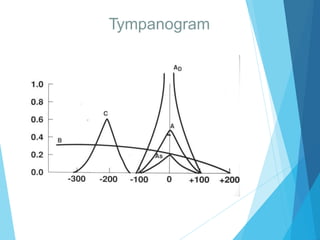
 Tympanometry (sensitivity 96 %)
 Assess compliance of TM
 Mobility of TM on increase/ decrease of pressure in EAM
 Graphic representation
 4 patterns
A/As/Ad/B/C
 In OME – B & C
 Reduced compliance with flat curve with a shift to
negative side.
Tympanogram
2012
 Radiology
Xray Skull Lateral view
Adenoid Hyperplasia
 Xray Mastoid Schuller’s View
Clouding of air cell
 MRI
 Absence of fluid does not imply an absence of OME, as
one-third of patients in MRI study had fluid in mastoid, but
not in the mesotympanum (Kew et al)
 Nasal and nasopharyngeal examination.
TREATMENT
 Medical Treatment
 Nasal decongestants
Systemic
 Triaminic Syr 5-10 ml 8 hrly
• Phenylpropanolamine 12.5 mg/5ml
• Chlorpheniramine 2 mg/5ml
 Pseudoephedrine 25 mg
Local
 Nasivion – Oxymetazoline 0.05% drops.
 Otrivin – Xylometazoline 0.1% drops.
 Anti-allergy measures
 Antihistamines
 Nasal Steroids spray
 Surface tension lowering agent
 N acetyl cyteine 30 mg tds X 15 days beneficial
 Antibiotics (no long term benefit, can be used for initial 2 wks)
 Middle Ear Aeration
 Valsalva Maneuver
 Surgical Treatment
 Myringotomy
 Myringotomy with ventillation tubes (improves hearing by 12
dB)
 Adenoidectomy (improves hearing by 8 dB)
 Tonsillectomy
 Cortical Matoidectomy (in failure of ventilation tube cases)
Ventilation tubes
 Also known as grommet
 Inserted through radial incision in AS or AI quadrant of
TM.
 Longer a tube stays in situ longer it can be potentially
benefit
 On other hand, longer a tube is in situ the greater the
chance of complications like-
 Infection
 Granulation tissue
 Permanent perforation
 Thinning of TM with possible retraction
TYPES
 Shepard Armstrong
 Reuter Bobbin
 Goodie t tube
 Silicone T tube
 Shah tube
FUNCTION
 Ventilate the middle ear
 Drain the middle ear
 Improve the hearing
 Epithelium will revert back to normal
Complications of ventilation tubes
 Intra op


Displacement into middle ear
Damage to ossicles
 Early post op




Blockage
Granulation around tube
Ear infection
Otorrhoea
 Late post op



Permanent perforation
Tympanosclerosis
TM atrophy & retraction
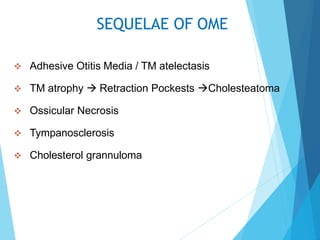
SEQUELAE OF OME
 Adhesive Otitis Media / TM atelectasis
 TM atrophy  Retraction Pockests Cholesteatoma
 Ossicular Necrosis
 Tympanosclerosis
 Cholesterol grannuloma
Serous otitis media

Serous otitis media

  • 1.
    SEROUS OTITIS MEDIA DrChandra Bhan Assistant professor MRAMC
  • 2.
    SYNONYMS Serous Otitis Media SecretoryOtitis Media Glue Ear Mucoid otitis media otitis media with effusion Exudative otitis media Tubotympanic catarrh
  • 3.
    DEFINITION  Chronic accumulationof non purulent serous or mucoid fluid within middle ear cleft.  Time that fluid has to be present for the condition to be chronic is usually taken as 12 weeks.  Mostly affects children  Insidious onset  Sterile in nature.  Behind an intact and retracted TM.  With conductive hearing loss
  • 4.
     50% ofall children- before the first birthday, 80% of all children - before the third birthday – have OME  Prevalence bimodal at 2 & 5 yrs when child first attends play group school & when goes to primary school  More during winters  Each episode of ASOM increases odd ratio of developing OME by 12  M > F
  • 5.
    AETIOLOGY ET Malfunctioning.  Obstruction Adenoid hyperplasia  Tumours (nasopharyngeal carcinoma)  Palatal defects  Palatal paralysis  Hyperbaric oxygen therapy  Oedema during radiation therapy  Spread of Infection  Chronic adenoiditis  Chronic rhino-sinusitis  Chronic tonsillitis  High prevalence in HIV patients
  • 6.
    Increased Secretions  Allergy Milk  Cigarette smoke (specially mother smoking)  Obstruct the ET by oedema and increases the secretion as mucosa act as shock organ in such cases.  Infections  Unresolved AOM  Viral Infections
  • 7.
    PATHOGENESIS  Eustachian tubedysfunction  Failure of aeration  Failure of drainage  Increased secretion in ME  Due to Increase in secretory glands  Spontaneous resolution if  Drainage via ET restablished  Perforation of the tympanic membrane ocure  If both continue  OME
  • 8.
    CLINICAL FEATURES  Hearingloss- up to 40 db  Mild otalgia  Ear fullness  Tinnitus  Children  Delayed Speech and defective speech  PoorAcademics SYMPTOMS
  • 9.
    Clinical Features: Signs Conductive hearing Loss - TFT  Otoscopy -Signs of TM retraction. -Loss of light reflex -Colour – Yellow/Grey/ Blue -Thin blood vessel along handle of malleus ant periphery of tm  Signs of Effusion Air Bubbles Fluid Levels
  • 10.
     Pneumatic Otoscopy Used to assess the mobility and position of TM  Observe TM movement by Increasing Pressure in EAM – Siegel’s speculum Increasing pressure in ME - Valsalva namoeuver  TM may be Mobile/ Partially Mobile/ Immobile
  • 11.
    Evaluation  TFT- Rinne -negative Weber- lateralized towards more diseased ear. ABC –normal both ear  Audiometry  Pure ToneAudiometry Bilateral Conductive Hearng Loss 20 – 40dB Sometimes SNHL due to fluid pressing round window
  • 12.
     Tympanometry (sensitivity96 %)  Assess compliance of TM  Mobility of TM on increase/ decrease of pressure in EAM  Graphic representation  4 patterns A/As/Ad/B/C  In OME – B & C  Reduced compliance with flat curve with a shift to negative side.
  • 13.
  • 14.
     Radiology Xray SkullLateral view Adenoid Hyperplasia  Xray Mastoid Schuller’s View Clouding of air cell  MRI  Absence of fluid does not imply an absence of OME, as one-third of patients in MRI study had fluid in mastoid, but not in the mesotympanum (Kew et al)  Nasal and nasopharyngeal examination.
  • 15.
    TREATMENT  Medical Treatment Nasal decongestants Systemic  Triaminic Syr 5-10 ml 8 hrly • Phenylpropanolamine 12.5 mg/5ml • Chlorpheniramine 2 mg/5ml  Pseudoephedrine 25 mg Local  Nasivion – Oxymetazoline 0.05% drops.  Otrivin – Xylometazoline 0.1% drops.
  • 16.
     Anti-allergy measures Antihistamines  Nasal Steroids spray  Surface tension lowering agent  N acetyl cyteine 30 mg tds X 15 days beneficial  Antibiotics (no long term benefit, can be used for initial 2 wks)  Middle Ear Aeration  Valsalva Maneuver
  • 17.
     Surgical Treatment Myringotomy  Myringotomy with ventillation tubes (improves hearing by 12 dB)  Adenoidectomy (improves hearing by 8 dB)  Tonsillectomy  Cortical Matoidectomy (in failure of ventilation tube cases)
  • 18.
    Ventilation tubes  Alsoknown as grommet  Inserted through radial incision in AS or AI quadrant of TM.  Longer a tube stays in situ longer it can be potentially benefit  On other hand, longer a tube is in situ the greater the chance of complications like-  Infection  Granulation tissue  Permanent perforation  Thinning of TM with possible retraction
  • 19.
    TYPES  Shepard Armstrong Reuter Bobbin  Goodie t tube  Silicone T tube  Shah tube FUNCTION  Ventilate the middle ear  Drain the middle ear  Improve the hearing  Epithelium will revert back to normal
  • 20.
    Complications of ventilationtubes  Intra op   Displacement into middle ear Damage to ossicles  Early post op     Blockage Granulation around tube Ear infection Otorrhoea  Late post op    Permanent perforation Tympanosclerosis TM atrophy & retraction
  • 21.
    SEQUELAE OF OME Adhesive Otitis Media / TM atelectasis  TM atrophy  Retraction Pockests Cholesteatoma  Ossicular Necrosis  Tympanosclerosis  Cholesterol grannuloma