ED Case Discussion - Trauma
  Presented by: Hakimah Khani Binti Suhaimi
  Supervised by: Dr Farina (ED Sungai Buloh)
Chief Complaint
• Mr. AZ, a 21 year-old Malay
  gentleman was brought to the
  ED on the 18th October due to
  an MVA.
History
• Mr. AZ, a 21 year-old Malay gentleman was brought in
  by ambulance at around 11pm due to an MVA.
• According to MA, it was a motorbike-vs-car accident.
• Patient was the rider on the motorbike.
• Exact mechanism of injury was unknown.
• Patient was unable to recall anything, not even what he
  was driving.
History (contd.)
Post-trauma, injuries sustained:
• Left forearm - pain and bleeding
• Upper chest abrasions - pain and bleeding

•   No LOC, no headache
•   No ENT bleed
•   No SOB
•   No abdominal pain, no nausea/vomiting
History (contd.)
During the process of transfer,
  Patient was put on spinal board, and cervical collar was
  applied.
  He was then managed by resusc. team in red zone.
Past Medical History
         Nil


 Drugs & Allergies
         Nil
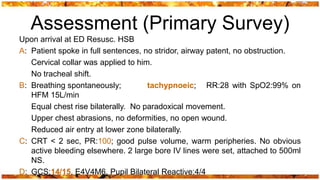
Assessment (Primary Survey)
Upon arrival at ED Resusc. HSB
A: Patient spoke in full sentences, no stridor, airway patent, no obstruction.
   Cervical collar was applied to him.
   No tracheal shift.
B: Breathing spontaneously;          tachypnoeic; RR:28 with SpO2:99% on
   HFM 15L/min
   Equal chest rise bilaterally. No paradoxical movement.
   Upper chest abrasions, no deformities, no open wound.
   Reduced air entry at lower zone bilaterally.
C: CRT < 2 sec, PR:100; good pulse volume, warm peripheries. No obvious
   active bleeding elsewhere. 2 large bore IV lines were set, attached to 500ml
   NS.
D: GCS:14/15, E4V4M6, Pupil Bilateral Reactive:4/4
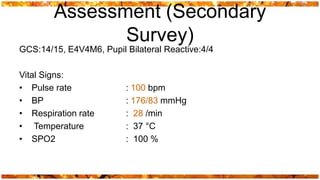
Assessment (Secondary
               Survey)
GCS:14/15, E4V4M6, Pupil Bilateral Reactive:4/4

Vital Signs:
• Pulse rate             : 100 bpm
• BP                     : 176/83 mmHg
• Respiration rate       : 28 /min
• Temperature            : 37 °C
• SPO2                   : 100 %
Assessment (Secondary Survey)
                                  (contd.)

Head-to-toe examination:
• Head: No lacerations/contusion, no ENT bleed, no swollen eyes, presence
  of abrasion at chin area
• Neck: Minor abrasion over left shoulder and neck, no distended jugular
  veins, no cervical tenderness, no tracheal deviation
• Chest: Negative chest spring, no palpable crepitus over chest wall. Cvs:
  Dual rhythm, no murmur
• Abdomen: No bruises, distension, bleeding. Soft, non tender. Normal bowel
  sounds
Assessment (Secondary Survey)
                                 (contd.)

Head-to-toe examination:
• Pelvic Spring: Negative
• No scrotal hematoma
• Log roll: No evidence of spine tenderness/swelling/deformity
• PR: Normal anal tone, no bleeding
• Lower extremities: No bleeding, swelling or deformity
• Upper extremities: Open wound exposing bone in left forearm and
  contused muscle, no active bleeding. Spo2 on all fingers: 98-100%. Limb
  immobilization by backslab was done.
• All peripheral pulses are palpable, equal bilaterally, good volume
• Fast Scan at 11pm: No free fluid with sliding sign present
Impression
• Open fracture left radius and
  closed fracture of left ulna
• Bilateral lung contusion
• Possible     skull    fracture /
  intracranial bleed
Management
Vital signs were reevaluated every 5 mins
Put on CBD for strict I/O Chart
   Total intake: 2000ml,
   Total output: 0ml
Patient was kept NBM
IM ATT given
Management
Medications:
-IV Morphine 2.5mg stat and titrated accordingly
-IV Zinacef 1.5mg stat
-IV Flagyl 500mg stat

FBC: Hb:16.3/WBC:11.1(Lymp:38.9/Gran:57.5)HCT:51.4/PLT:345
ABG on HFM: pH:7.397/pCO2:30/pO2:57.8/HCO3:20.1/BE:-5.9
Coagulation profile, RP, GXM 4 pint packed cell were ordered
Management
Wound irrigation over chin, neck and chest was done
Radiological investigations were done
• CXR & Pelvic X-Ray
• Bilateral Radius & Ulnar X-Ray
• CT Brain & Lateral c-spine
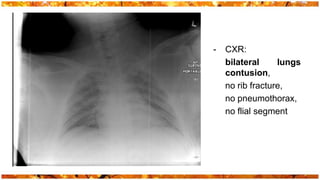
-   CXR:
    bilateral     lungs
    contusion,
    no rib fracture,
    no pneumothorax,
    no flial segment
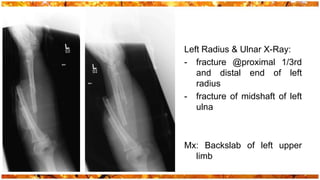
Left Radius & Ulnar X-Ray:
- fracture @proximal 1/3rd
   and distal end of left
   radius
- fracture of midshaft of left
   ulna


Mx: Backslab of left upper
  limb
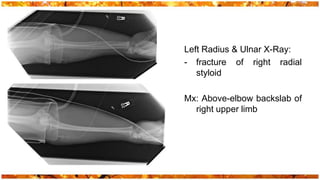
Left Radius & Ulnar X-Ray:
- fracture of right radial
   styloid

Mx: Above-elbow backslab of
  right upper limb
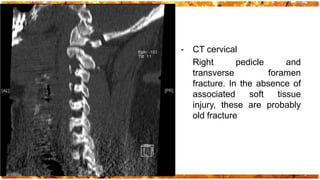
-   CT cervical
    Right       pedicle       and
    transverse          foramen
    fracture. In the absence of
    associated     soft    tissue
    injury, these are probably
    old fracture
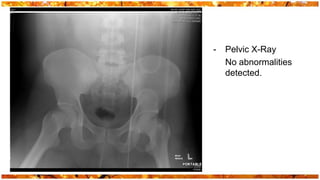
-   Pelvic X-Ray
    No abnormalities
    detected.
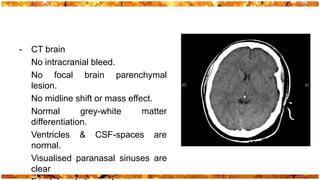
-   CT brain
    No intracranial bleed.
    No focal brain parenchymal
    lesion.
    No midline shift or mass effect.
    Normal        grey-white     matter
    differentiation.
    Ventricles & CSF-spaces are
    normal.
    Visualised paranasal sinuses are
    clear
Impression
1)open fracture @proximal 1/3rd
  and distal end of left radius and
  frcature of midshaft of left ulna
2)closed fracture of right radial
  styloid
3)bilateral lung contusion
Progress
@ 1.30am
• In spite of 2 liter fluids transfused, BP was still unstable;

• dropped to 87/46mmHg, RR 32bpm, PR 101bpm
  ~ Hypovolemic Shock Class III

•  resuscitated with IV 1 pint EO blood  125/96mmHg
Disposition
• Refer to orthopaedics &
  surgical team once patient is
  hemodynamically stable.

ED Case Discussion - Trauma (reviewed)

  • 1.
    ED Case Discussion- Trauma Presented by: Hakimah Khani Binti Suhaimi Supervised by: Dr Farina (ED Sungai Buloh)
  • 2.
    Chief Complaint • Mr.AZ, a 21 year-old Malay gentleman was brought to the ED on the 18th October due to an MVA.
  • 3.
    History • Mr. AZ,a 21 year-old Malay gentleman was brought in by ambulance at around 11pm due to an MVA. • According to MA, it was a motorbike-vs-car accident. • Patient was the rider on the motorbike. • Exact mechanism of injury was unknown. • Patient was unable to recall anything, not even what he was driving.
  • 4.
    History (contd.) Post-trauma, injuriessustained: • Left forearm - pain and bleeding • Upper chest abrasions - pain and bleeding • No LOC, no headache • No ENT bleed • No SOB • No abdominal pain, no nausea/vomiting
  • 5.
    History (contd.) During theprocess of transfer, Patient was put on spinal board, and cervical collar was applied. He was then managed by resusc. team in red zone.
  • 6.
    Past Medical History Nil Drugs & Allergies Nil
  • 7.
    Assessment (Primary Survey) Uponarrival at ED Resusc. HSB A: Patient spoke in full sentences, no stridor, airway patent, no obstruction. Cervical collar was applied to him. No tracheal shift. B: Breathing spontaneously; tachypnoeic; RR:28 with SpO2:99% on HFM 15L/min Equal chest rise bilaterally. No paradoxical movement. Upper chest abrasions, no deformities, no open wound. Reduced air entry at lower zone bilaterally. C: CRT < 2 sec, PR:100; good pulse volume, warm peripheries. No obvious active bleeding elsewhere. 2 large bore IV lines were set, attached to 500ml NS. D: GCS:14/15, E4V4M6, Pupil Bilateral Reactive:4/4
  • 8.
    Assessment (Secondary Survey) GCS:14/15, E4V4M6, Pupil Bilateral Reactive:4/4 Vital Signs: • Pulse rate : 100 bpm • BP : 176/83 mmHg • Respiration rate : 28 /min • Temperature : 37 °C • SPO2 : 100 %
  • 9.
    Assessment (Secondary Survey) (contd.) Head-to-toe examination: • Head: No lacerations/contusion, no ENT bleed, no swollen eyes, presence of abrasion at chin area • Neck: Minor abrasion over left shoulder and neck, no distended jugular veins, no cervical tenderness, no tracheal deviation • Chest: Negative chest spring, no palpable crepitus over chest wall. Cvs: Dual rhythm, no murmur • Abdomen: No bruises, distension, bleeding. Soft, non tender. Normal bowel sounds
  • 10.
    Assessment (Secondary Survey) (contd.) Head-to-toe examination: • Pelvic Spring: Negative • No scrotal hematoma • Log roll: No evidence of spine tenderness/swelling/deformity • PR: Normal anal tone, no bleeding • Lower extremities: No bleeding, swelling or deformity • Upper extremities: Open wound exposing bone in left forearm and contused muscle, no active bleeding. Spo2 on all fingers: 98-100%. Limb immobilization by backslab was done. • All peripheral pulses are palpable, equal bilaterally, good volume • Fast Scan at 11pm: No free fluid with sliding sign present
  • 11.
    Impression • Open fractureleft radius and closed fracture of left ulna • Bilateral lung contusion • Possible skull fracture / intracranial bleed
  • 12.
    Management Vital signs werereevaluated every 5 mins Put on CBD for strict I/O Chart Total intake: 2000ml, Total output: 0ml Patient was kept NBM IM ATT given
  • 13.
    Management Medications: -IV Morphine 2.5mgstat and titrated accordingly -IV Zinacef 1.5mg stat -IV Flagyl 500mg stat FBC: Hb:16.3/WBC:11.1(Lymp:38.9/Gran:57.5)HCT:51.4/PLT:345 ABG on HFM: pH:7.397/pCO2:30/pO2:57.8/HCO3:20.1/BE:-5.9 Coagulation profile, RP, GXM 4 pint packed cell were ordered
  • 14.
    Management Wound irrigation overchin, neck and chest was done Radiological investigations were done • CXR & Pelvic X-Ray • Bilateral Radius & Ulnar X-Ray • CT Brain & Lateral c-spine
  • 15.
    - CXR: bilateral lungs contusion, no rib fracture, no pneumothorax, no flial segment
  • 16.
    Left Radius &Ulnar X-Ray: - fracture @proximal 1/3rd and distal end of left radius - fracture of midshaft of left ulna Mx: Backslab of left upper limb
  • 17.
    Left Radius &Ulnar X-Ray: - fracture of right radial styloid Mx: Above-elbow backslab of right upper limb
  • 18.
    - CT cervical Right pedicle and transverse foramen fracture. In the absence of associated soft tissue injury, these are probably old fracture
  • 19.
    - Pelvic X-Ray No abnormalities detected.
  • 20.
    - CT brain No intracranial bleed. No focal brain parenchymal lesion. No midline shift or mass effect. Normal grey-white matter differentiation. Ventricles & CSF-spaces are normal. Visualised paranasal sinuses are clear
  • 21.
    Impression 1)open fracture @proximal1/3rd and distal end of left radius and frcature of midshaft of left ulna 2)closed fracture of right radial styloid 3)bilateral lung contusion
  • 22.
    Progress @ 1.30am • Inspite of 2 liter fluids transfused, BP was still unstable; • dropped to 87/46mmHg, RR 32bpm, PR 101bpm ~ Hypovolemic Shock Class III •  resuscitated with IV 1 pint EO blood  125/96mmHg
  • 23.
    Disposition • Refer toorthopaedics & surgical team once patient is hemodynamically stable.

Editor's Notes

  • #4 In addition to that, it was believed that he was only one casualty since the driver of the car just went away / vanishedUnsure velocity, ejection, alone?, ejection?, death?
  • #5 No other significant complaints
  • #7 AMPLE history – allergy, medications / drugs, past medical hx, last meal, event
  • #8 Unable to percuss and do chest rise on upper chest.
  • #9 BP slightly high – prollybecause the sympathetic response following trauma
  • #10 Unable to percuss and do chest rise on upper chest.
  • #12 Possible skull fracture as supported by history of retrograde amnesia, abrasion over the chin, GCS!
  • #13 Simultaneously done along with the assessment
  • #14 Cefuroxime – antibiotic cover – open fracture
  • #15 Adjunct to the impression upon 1 &amp; 2 survey
  • #16 oedema and blood collecting in alveolar spaces and loss of normal lung structure &amp; functionobvious signs of chest wall trauma such as bruisingCrackles may be heard on auscultation but are rarely heard in the emergency room and are non-specificno specific therapy, close monitoring is required and supplemental oxygen should be administered. adequate and appropriate analgesiausually resolve in 3 to 5 days
  • #17 Unable to percuss and do chest rise on upper chest.
  • #18 Unable to percuss and do chest rise on upper chest.
  • #19 Unable to percuss and do chest rise on upper chest.
  • #20 Unable to percuss and do chest rise on upper chest.
  • #21 Unable to percuss and do chest rise on upper chest.
  • #24 For fixation