•Explain the main functions of a
good mortar mix
• State how good workmanship will
improve the sealing properties of a
mix
• Calculate mortar quantities for
walling areas
Lesson Objectives
Mortars Generally
Mortar fulfills a number of functions. These include:
It cements the bricks together to provide stability -
and solidity, while holding them apart to spread loads
evenly.
It compensates for irregularity between units when
straight, level and plumb walling is laid.
It also seals any gaps to resist wind or rain
penetration.
As well as its gap-filling adhesive function it is
required to have durability and strength to suit the
application.
It also contributes to the aesthetic qualities of the
wall.
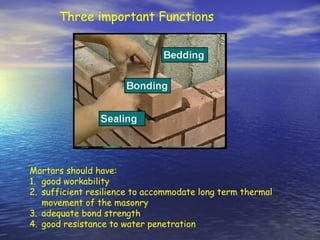
Three important Functions
Mortars should have:
1. good workability
2. sufficient resilience to accommodate long term thermal
movement of the masonry
3. adequate bond strength
4. good resistance to water penetration
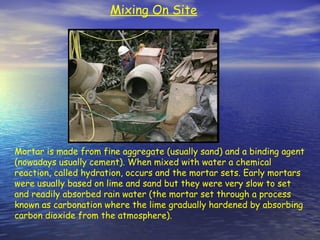
Mortar is made from fine aggregate (usually sand) and a binding agent
(nowadays usually cement). When mixed with water a chemical
reaction, called hydration, occurs and the mortar sets. Early mortars
were usually based on lime and sand but they were very slow to set
and readily absorbed rain water (the mortar set through a process
known as carbonation where the lime gradually hardened by absorbing
carbon dioxide from the atmosphere).
Mixing On Site
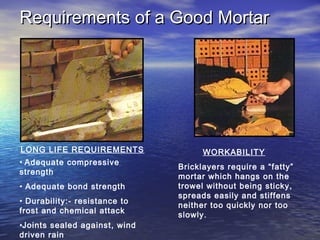
Requirements of a Good MortarRequirements of a Good Mortar
• Adequate compressive
strength
• Adequate bond strength
• Durability:- resistance to
frost and chemical attack
•Joints sealed against, wind
driven rain
LONG LIFE REQUIREMENTS WORKABILITY
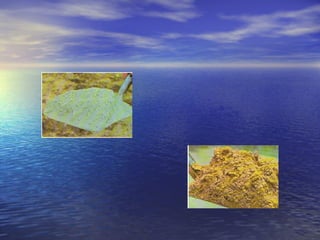
Bricklayers require a “fatty”
mortar which hangs on the
trowel without being sticky,
spreads easily and stiffens
neither too quickly nor too
slowly.
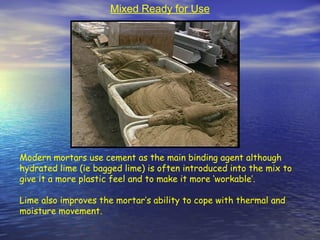
Modern mortars use cement as the main binding agent although
hydrated lime (ie bagged lime) is often introduced into the mix to
give it a more plastic feel and to make it more ‘workable’.
Lime also improves the mortar’s ability to cope with thermal and
moisture movement.
Mixed Ready for Use
Mortar & Mixing

Mortar & Mixing

  • 1.
    •Explain the mainfunctions of a good mortar mix • State how good workmanship will improve the sealing properties of a mix • Calculate mortar quantities for walling areas Lesson Objectives
  • 2.
    Mortars Generally Mortar fulfillsa number of functions. These include: It cements the bricks together to provide stability - and solidity, while holding them apart to spread loads evenly. It compensates for irregularity between units when straight, level and plumb walling is laid. It also seals any gaps to resist wind or rain penetration. As well as its gap-filling adhesive function it is required to have durability and strength to suit the application. It also contributes to the aesthetic qualities of the wall.
  • 3.
    Three important Functions Mortarsshould have: 1. good workability 2. sufficient resilience to accommodate long term thermal movement of the masonry 3. adequate bond strength 4. good resistance to water penetration
  • 5.
    Mortar is madefrom fine aggregate (usually sand) and a binding agent (nowadays usually cement). When mixed with water a chemical reaction, called hydration, occurs and the mortar sets. Early mortars were usually based on lime and sand but they were very slow to set and readily absorbed rain water (the mortar set through a process known as carbonation where the lime gradually hardened by absorbing carbon dioxide from the atmosphere). Mixing On Site
  • 6.
    Requirements of aGood MortarRequirements of a Good Mortar • Adequate compressive strength • Adequate bond strength • Durability:- resistance to frost and chemical attack •Joints sealed against, wind driven rain LONG LIFE REQUIREMENTS WORKABILITY Bricklayers require a “fatty” mortar which hangs on the trowel without being sticky, spreads easily and stiffens neither too quickly nor too slowly.
  • 12.
    Modern mortars usecement as the main binding agent although hydrated lime (ie bagged lime) is often introduced into the mix to give it a more plastic feel and to make it more ‘workable’. Lime also improves the mortar’s ability to cope with thermal and moisture movement. Mixed Ready for Use