BINDING MATERIAL
Mortar is a material used
in masonry construction
to fill the gaps between
the bricks and blocks
used in construction.
Mortar binds bricks and
blocks together to give
strength and stability to
a wall.
2
•Strength
The capacity of the individual elements,
which together make up a structural
system, to withstand the load that are
applied to them.
•Stability
The capability of a structural system to
transmit various loadings safely to the
ground.
3
Mortar is a mixture of sand, a binder such as cement or
lime, and water and is applied as a paste which then sets
hard.
or
Mortar is a workable paste which is prepared by adding
required amount of water to a mixture of binding material
(also called matrix) and fine aggregate (also called
adulterant). This plastic paste is useful to hold building
materials such as stone or brick together.
4
Nature of application
Based on binding material used
Bulk density
Special purpose mortars
5
6
There are two types of mortars based on the
nature of application. They are
Brick or stone laying mortar
Finishing mortar
7
BRICKLAYING OR STONE LAYING
MORTAR
Generally, in masonry walls the
structural units such as stones or
bricks are bonded together by
using mortar.
The proportions of ingredients for
this purpose is decided with
respect to the kind of binding
material used
8
FINISHING MORTAR
The mortar used for ornamental
finishing’s should have great
strength, mobility and
resistance against atmospheric
action like rain, wind, etc.
Finishing mortar is used for
pointing and plastering works
9
10
 In mortar, Binding material play key role. The quality, durability and
strength of the mortar will mainly depend on the quantity and quality of
binding material used.
Classification based on the binding material used is as follows.
 Cement mortar
 Lime mortar
 Gypsum mortar
 Gauged mortar
 Surkhi mortar
 Aerated cement mortar
11
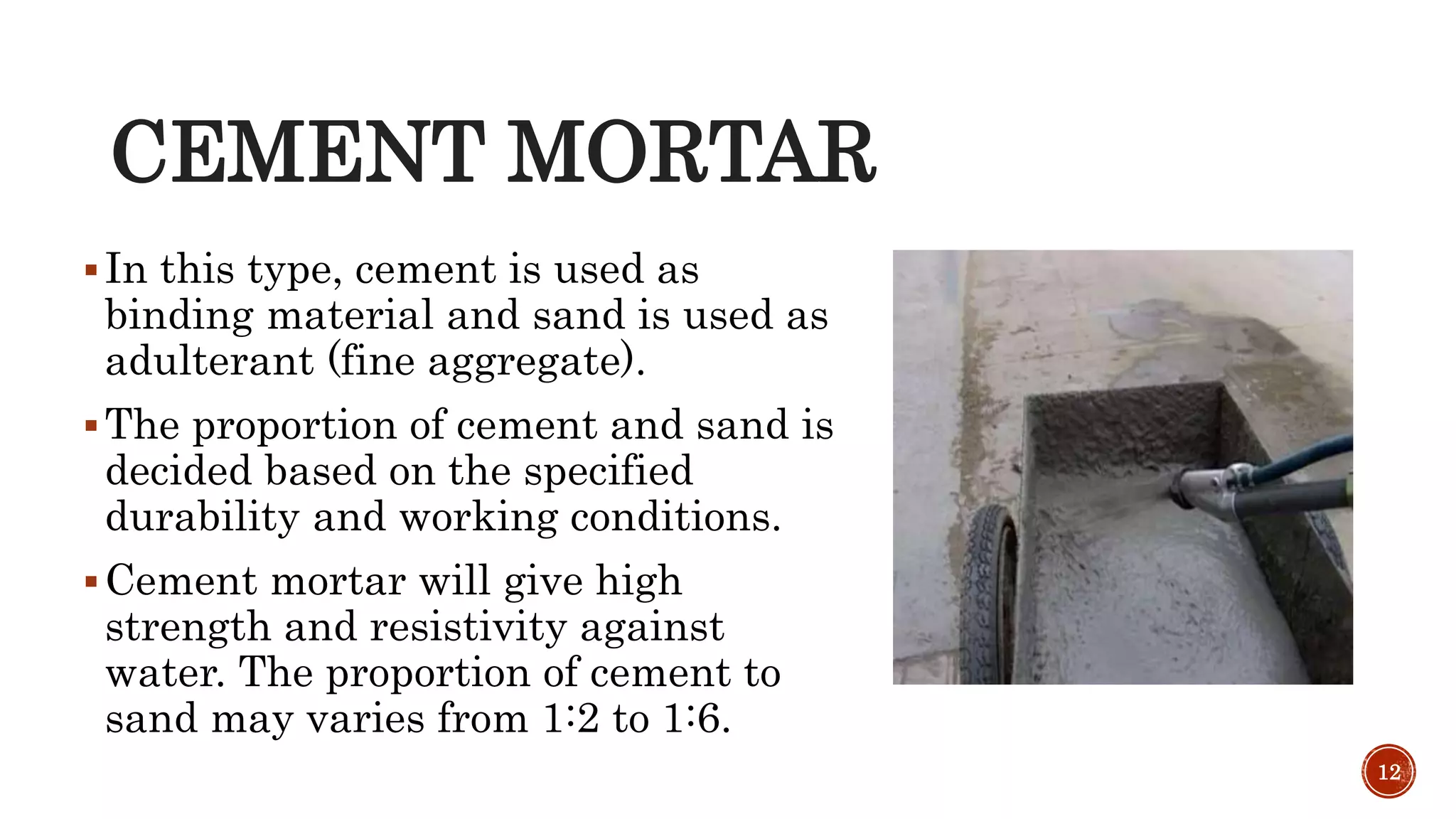
CEMENT MORTAR
In this type, cement is used as
binding material and sand is used as
adulterant (fine aggregate).
The proportion of cement and sand is
decided based on the specified
durability and working conditions.
Cement mortar will give high
strength and resistivity against
water. The proportion of cement to
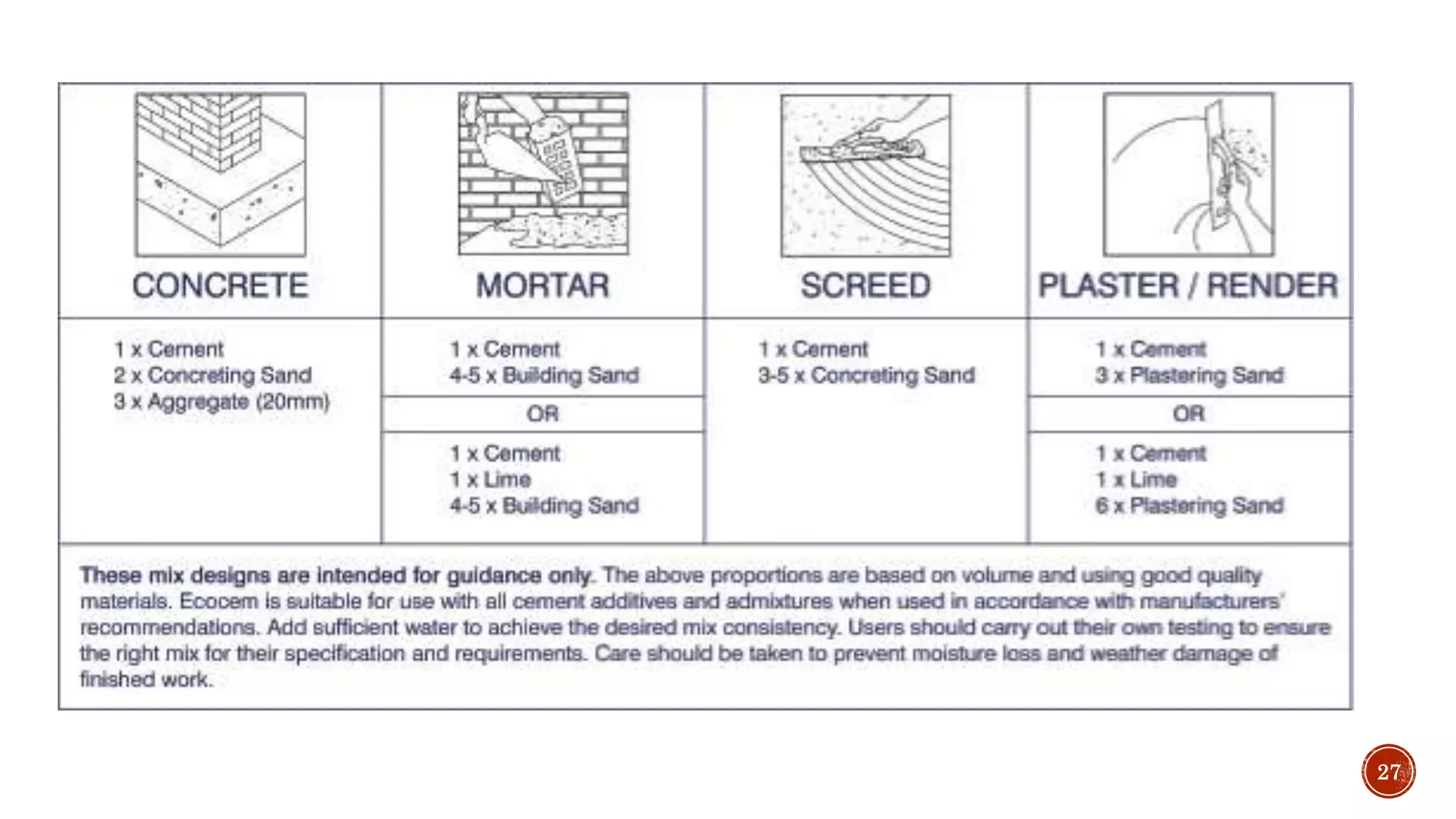
sand may varies from 1:2 to 1:6.
12
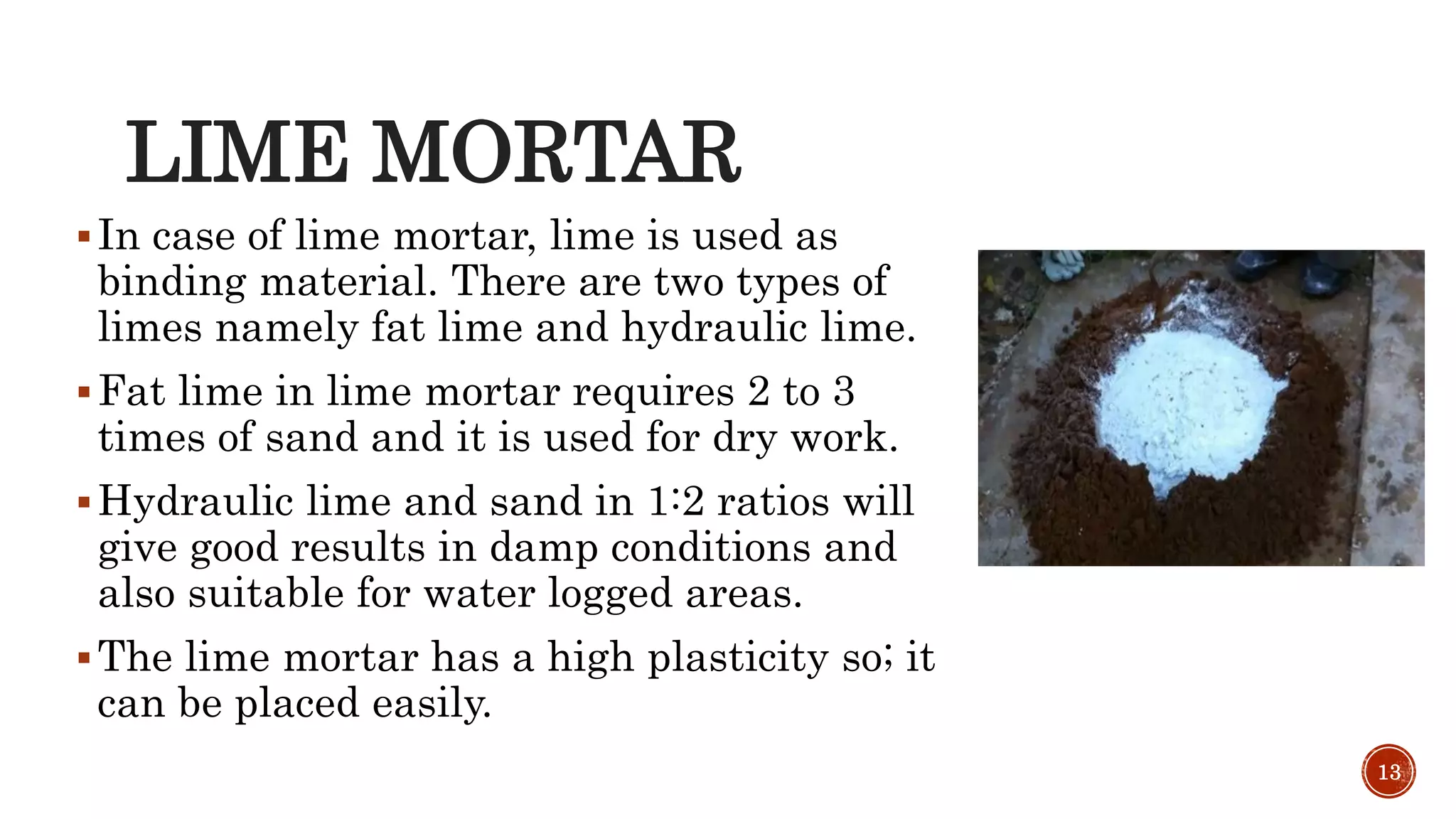
LIME MORTAR
In case of lime mortar, lime is used as
binding material. There are two types of
limes namely fat lime and hydraulic lime.
Fat lime in lime mortar requires 2 to 3
times of sand and it is used for dry work.
Hydraulic lime and sand in 1:2 ratios will
give good results in damp conditions and
also suitable for water logged areas.
The lime mortar has a high plasticity so; it
can be placed easily.
13
GYPSUM MORTAR
Gypsum mortar consists of
plaster and soft sand as binding
material and fine aggregate.
In the Egyptian ancient
structures called as pyramids,
gypsum mortar is used.
Gypsum mortar will have low
durability in damp conditions.
14
GAUGED MORTAR
Gauged mortar consists lime, cement and sand.
 We knew that lime mortar has high plasticity and cement
has high strength than lime so, whenever we mixed these
both in some proportions then the resultant will give two
properties in economical way.
So, this is also called as composite mortar or lime-cement
mortar. Usually 1:6 to 1:8 ratio of cement to lime will be
used to prepare gauged mortar
15
SURKHI MORTAR
Surkhi is finely powdered burnt
clay which is free from any
admixtures, impurities. It will give
more strength than sand and
cheaply available in the market.
Surkhi mortar consists lime,
surkhi and water.
Surkhi is used as adulterant or
fine aggregate. Sometimes half
amount of sand and half amount
of surkhi also used.
16
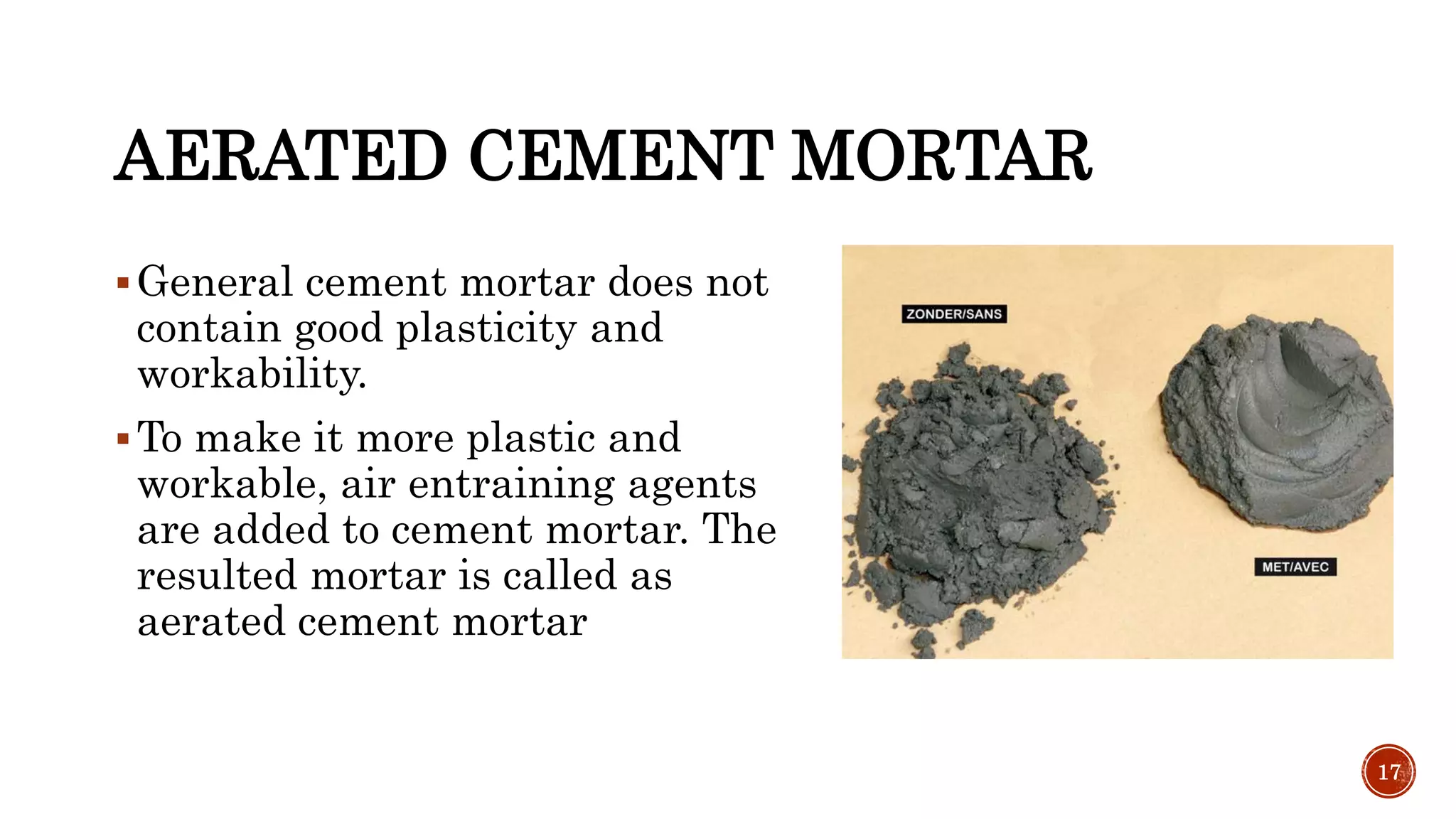
AERATED CEMENT MORTAR
General cement mortar does not
contain good plasticity and
workability.
To make it more plastic and
workable, air entraining agents
are added to cement mortar. The
resulted mortar is called as
aerated cement mortar
17
MORTARS BASED ON BULK
DENSITY
18
TYPES OF MORTARS BASED ON BULK
DENSITY
 Heavy mortar
 If the mortar having bulk density of 15 KN/𝑚3
or more then it
is called as heavy mortar. Generally heavy quartzes are used
as adulterants in this type of mortars.
 Lightweight mortar
 If the mortar having bulk density of less than 15 KN/𝑚3
then it
is called as light mortar. Generally light porous sands, soft
sands are used as adulterants in this type of mortars
19
SPECIAL PURPOSE MORTARS
20
SPECIAL PURPOSE MORTARS
 Other than the above described types there are some mortars with special
purposes. They are
• Fire resistant mortar
• Lightweight mortar
• Packing mortar
• Sound absorbing mortar
• X-ray shielding mortar
• Chemical resistant mortar
21
FIRE RESISTANT MORTAR
If there is any fire warnings to
the structures in a particular
zone, then we will go for fire
resistant mortar which acts as
fireproof shield.
By adding aluminous cement to
the fine powder of fire bricks
we will get fire resistant mortar.
22
LIGHTWEIGHT MORTAR
Lightweight mortar is generally used in the
soundproof and heat proof constructions.
It will be obtained by adding saw dust, wood powder
or, asbestos fibers, jute fibers coir etc. to the lime
mortar or cement mortar.
23
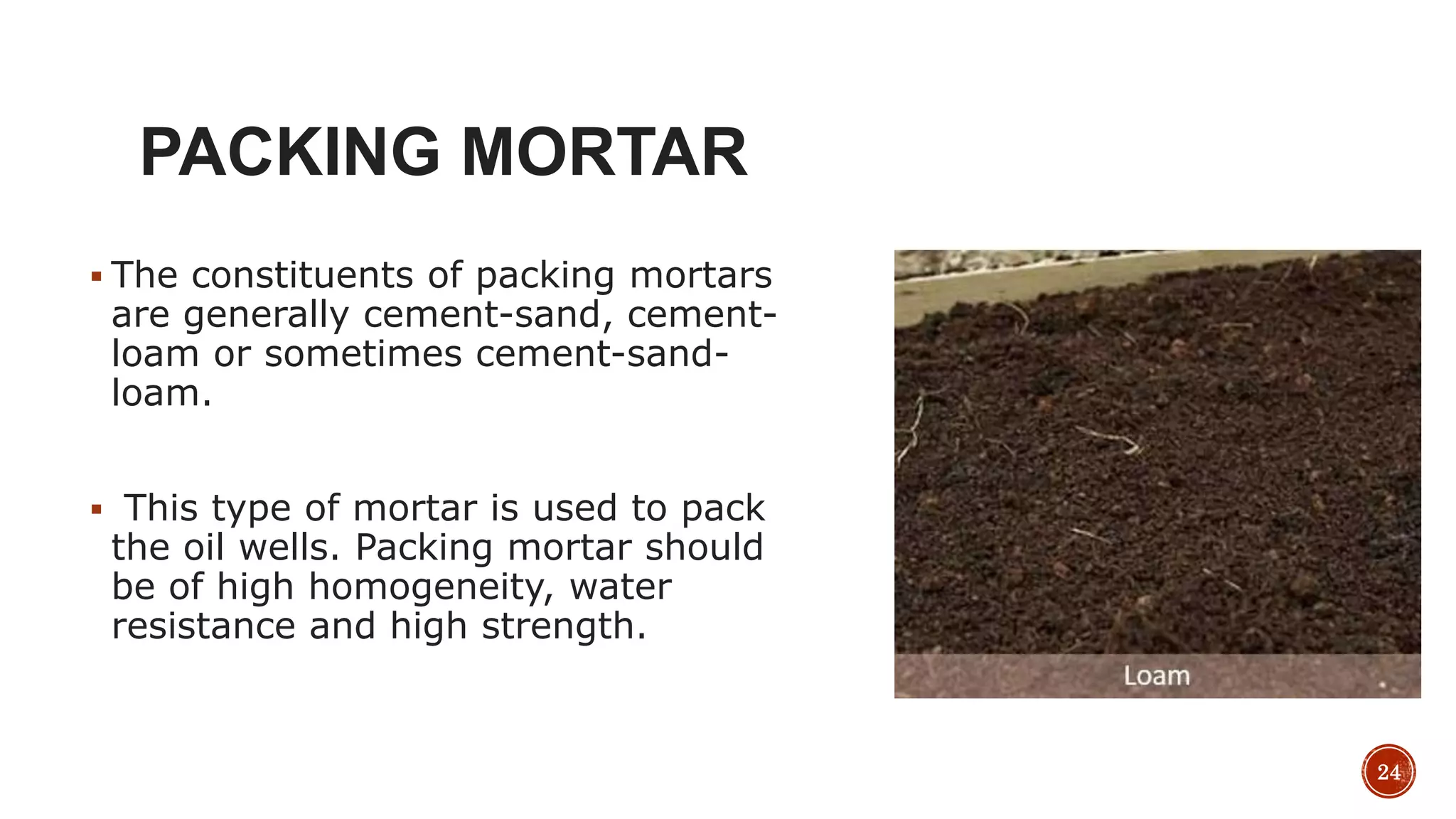
PACKING MORTAR
 The constituents of packing mortars
are generally cement-sand, cement-
loam or sometimes cement-sand-
loam.
 This type of mortar is used to pack
the oil wells. Packing mortar should
be of high homogeneity, water
resistance and high strength.
24
 Sound Absorbing Mortar
 It is used to reduce the noise level and acts as sound proof layer.
It consists cement, lime, gypsum, slag etc. as binding materials
and pumice, cinders as adulterants.
 X-ray Shielding Mortar
 To provide protection against ill effects of X-rays, the X-ray room
walls and ceilings are plastered by X-ray shielding mortar.
 This is heavy type mortar with bulk density around 22KN/m3.
Fine aggregates from heavy rock and suitable admixtures are
used to prepare this type of mortar.
25
 Chemical Resistant Mortar
 The additives added may not resist all the chemical attacks.
For example, silicate type chemical mortar resists nitric,
chromic, Sulphuric or any acidic damages but it cannot
prevent the structure against damage by alkalies of any
concentration.
26
27
28
29
30

Mortar (masonry)

  • 1.
  • 2.
    Mortar is amaterial used in masonry construction to fill the gaps between the bricks and blocks used in construction. Mortar binds bricks and blocks together to give strength and stability to a wall. 2
  • 3.
    •Strength The capacity ofthe individual elements, which together make up a structural system, to withstand the load that are applied to them. •Stability The capability of a structural system to transmit various loadings safely to the ground. 3
  • 4.
    Mortar is amixture of sand, a binder such as cement or lime, and water and is applied as a paste which then sets hard. or Mortar is a workable paste which is prepared by adding required amount of water to a mixture of binding material (also called matrix) and fine aggregate (also called adulterant). This plastic paste is useful to hold building materials such as stone or brick together. 4
  • 5.
    Nature of application Basedon binding material used Bulk density Special purpose mortars 5
  • 6.
  • 7.
    There are twotypes of mortars based on the nature of application. They are Brick or stone laying mortar Finishing mortar 7
  • 8.
    BRICKLAYING OR STONELAYING MORTAR Generally, in masonry walls the structural units such as stones or bricks are bonded together by using mortar. The proportions of ingredients for this purpose is decided with respect to the kind of binding material used 8
  • 9.
    FINISHING MORTAR The mortarused for ornamental finishing’s should have great strength, mobility and resistance against atmospheric action like rain, wind, etc. Finishing mortar is used for pointing and plastering works 9
  • 10.
  • 11.
     In mortar,Binding material play key role. The quality, durability and strength of the mortar will mainly depend on the quantity and quality of binding material used. Classification based on the binding material used is as follows.  Cement mortar  Lime mortar  Gypsum mortar  Gauged mortar  Surkhi mortar  Aerated cement mortar 11
  • 12.
    CEMENT MORTAR In thistype, cement is used as binding material and sand is used as adulterant (fine aggregate). The proportion of cement and sand is decided based on the specified durability and working conditions. Cement mortar will give high strength and resistivity against water. The proportion of cement to sand may varies from 1:2 to 1:6. 12
  • 13.
    LIME MORTAR In caseof lime mortar, lime is used as binding material. There are two types of limes namely fat lime and hydraulic lime. Fat lime in lime mortar requires 2 to 3 times of sand and it is used for dry work. Hydraulic lime and sand in 1:2 ratios will give good results in damp conditions and also suitable for water logged areas. The lime mortar has a high plasticity so; it can be placed easily. 13
  • 14.
    GYPSUM MORTAR Gypsum mortarconsists of plaster and soft sand as binding material and fine aggregate. In the Egyptian ancient structures called as pyramids, gypsum mortar is used. Gypsum mortar will have low durability in damp conditions. 14
  • 15.
    GAUGED MORTAR Gauged mortarconsists lime, cement and sand.  We knew that lime mortar has high plasticity and cement has high strength than lime so, whenever we mixed these both in some proportions then the resultant will give two properties in economical way. So, this is also called as composite mortar or lime-cement mortar. Usually 1:6 to 1:8 ratio of cement to lime will be used to prepare gauged mortar 15
  • 16.
    SURKHI MORTAR Surkhi isfinely powdered burnt clay which is free from any admixtures, impurities. It will give more strength than sand and cheaply available in the market. Surkhi mortar consists lime, surkhi and water. Surkhi is used as adulterant or fine aggregate. Sometimes half amount of sand and half amount of surkhi also used. 16
  • 17.
    AERATED CEMENT MORTAR Generalcement mortar does not contain good plasticity and workability. To make it more plastic and workable, air entraining agents are added to cement mortar. The resulted mortar is called as aerated cement mortar 17
  • 18.
    MORTARS BASED ONBULK DENSITY 18
  • 19.
    TYPES OF MORTARSBASED ON BULK DENSITY  Heavy mortar  If the mortar having bulk density of 15 KN/𝑚3 or more then it is called as heavy mortar. Generally heavy quartzes are used as adulterants in this type of mortars.  Lightweight mortar  If the mortar having bulk density of less than 15 KN/𝑚3 then it is called as light mortar. Generally light porous sands, soft sands are used as adulterants in this type of mortars 19
  • 20.
  • 21.
    SPECIAL PURPOSE MORTARS Other than the above described types there are some mortars with special purposes. They are • Fire resistant mortar • Lightweight mortar • Packing mortar • Sound absorbing mortar • X-ray shielding mortar • Chemical resistant mortar 21
  • 22.
    FIRE RESISTANT MORTAR Ifthere is any fire warnings to the structures in a particular zone, then we will go for fire resistant mortar which acts as fireproof shield. By adding aluminous cement to the fine powder of fire bricks we will get fire resistant mortar. 22
  • 23.
    LIGHTWEIGHT MORTAR Lightweight mortaris generally used in the soundproof and heat proof constructions. It will be obtained by adding saw dust, wood powder or, asbestos fibers, jute fibers coir etc. to the lime mortar or cement mortar. 23
  • 24.
    PACKING MORTAR  Theconstituents of packing mortars are generally cement-sand, cement- loam or sometimes cement-sand- loam.  This type of mortar is used to pack the oil wells. Packing mortar should be of high homogeneity, water resistance and high strength. 24
  • 25.
     Sound AbsorbingMortar  It is used to reduce the noise level and acts as sound proof layer. It consists cement, lime, gypsum, slag etc. as binding materials and pumice, cinders as adulterants.  X-ray Shielding Mortar  To provide protection against ill effects of X-rays, the X-ray room walls and ceilings are plastered by X-ray shielding mortar.  This is heavy type mortar with bulk density around 22KN/m3. Fine aggregates from heavy rock and suitable admixtures are used to prepare this type of mortar. 25
  • 26.
     Chemical ResistantMortar  The additives added may not resist all the chemical attacks. For example, silicate type chemical mortar resists nitric, chromic, Sulphuric or any acidic damages but it cannot prevent the structure against damage by alkalies of any concentration. 26
  • 27.
  • 28.
  • 29.
  • 30.