DEFINITION
A small hard block of backed clay that is used to build structure
such as houses and sometimes to make streets ,paths ,etc
Another definition
Molded rectangular block of clay backed by sun or in a kiln until hard
and use as a buildings and paving material.
Bricks are one of the oldest known building materials dating back to 7000bc
They were first found in southern turkey.
The first bricks were sun dried mud bricks.
Fired bricks were found to be more resistant to harsher weather conditions,
Thy made them a much more reliable brick for use in permanent buildings,
where mud bricks would not have been sufficient.
HISTORY
Bricks now
Bricks are more commonly used in the construction of buildings.
Brick architecture is dominant within its field
Manufacture of many different types of bricks of all shapes and colors.
Modern machinery, earth moving equipment, powerful electric motors
and modern tunnel kilns,making bricks has become much more
productive and efficient.
Bricks can be made from variety of materials the most common being
clay but also calcium silicate and concrete.
With clay bricks being the more popular, they are now manufactured
using three processes soft mud, dry press and extruded.
PREPARATION OF BRICK EARTH
MOULDING OF BRICKS
DRYING OF BRICKS
BURNING OF BRICKS
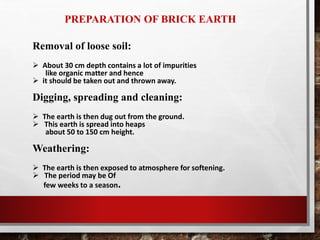
PREPARATION OF BRICK EARTH
Removal of loose soil:
 About 30 cm depth contains a lot of impurities
like organic matter and hence
 it should be taken out and thrown away.
Digging, spreading and cleaning:
 The earth is then dug out from the ground.
 This earth is spread into heaps
about 50 to 150 cm height.
Weathering:
 The earth is then exposed to atmosphere for softening.
 The period may be Of
few weeks to a season.
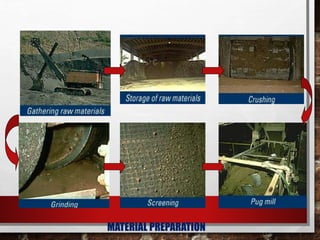
MATERIAL PREPARATION
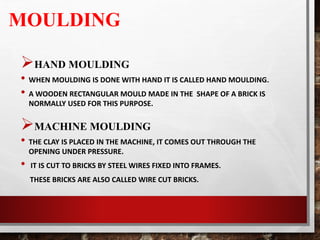
MOULDING
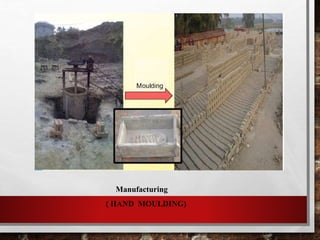
HAND MOULDING
• WHEN MOULDING IS DONE WITH HAND IT IS CALLED HAND MOULDING.
• A WOODEN RECTANGULAR MOULD MADE IN THE SHAPE OF A BRICK IS
NORMALLY USED FOR THIS PURPOSE.
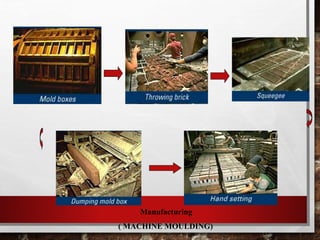
MACHINE MOULDING
• THE CLAY IS PLACED IN THE MACHINE, IT COMES OUT THROUGH THE
OPENING UNDER PRESSURE.
• IT IS CUT TO BRICKS BY STEEL WIRES FIXED INTO FRAMES.
THESE BRICKS ARE ALSO CALLED WIRE CUT BRICKS.
Manufacturing
( HAND MOULDING)
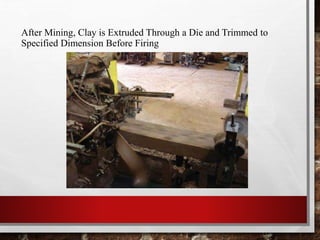
After Mining, Clay is Extruded Through a Die and Trimmed to
Specified Dimension Before Firing
Manufacturing
( MACHINE MOULDING)
DRYING OF BRICKS
CONTAIN 7 TO 30 PERCENT MOISTURE, DEPENDING UPON THE
FORMING METHOD.
MOST OF THIS WATER IS EVAPORATED IN DRYER CHAMBERS
TEMPERATURES ABOUT 100 ºF TO 400 ºF (38 ºC TO 204 ºC).
TIME, IS BETWEEN 24 TO 48 HOURS.
HEAT AND HUMIDITY MUST BE CAREFULLY REGULATED TO AVOID CRACKING
IN THE BRICK.
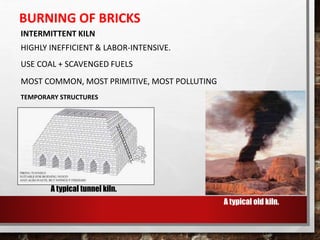
BURNING OF BRICKS
INTERMITTENT KILN
HIGHLY INEFFICIENT & LABOR-INTENSIVE.
USE COAL + SCAVENGED FUELS
MOST COMMON, MOST PRIMITIVE, MOST POLLUTING
TEMPORARY STRUCTURES
A typical old kiln.
A typical tunnel kiln.
CONCRETE BRICKS
• These bricks have either pale green or gray color.
• these are prepared from a small, dry aggregate concrete which is formed in
steel molds by using vibration and compaction.
High Alumina Bricks
High alumina bricks from 50% up to 90% alumina
• Various selected superior grade aggregates to meet the various service
conditions of various types of furnaces like laddie, blast furnace, cement
and sponge iron rotary kiln.
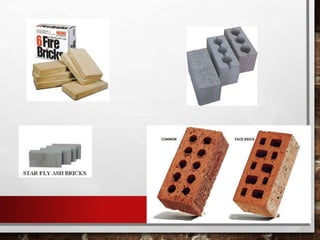
•FIRE BRICK
• A Fire brick is a block of ceramic material
• used in masonry construction and sized to be layer with one hand using mortar.
• bricks may be made from type of material .
• these are built primarily to withstand high heat and also find applications in extreme
mechanical, chemical, or thermal stresses.
• the brick is widely used as refractory insulating bricks for maintaining insistent
temperature.
•LIGHT WEIGHT HOLLOW BLOCKS
• This blocks are used in construction of houses in earthquake prone areas.
• These bricks are made of fly ash, cement, lime, gypsum, stone dust etc.
• available in different sizes.
• hollow concrete blocks is used as substitute for conventional bricks or stones used in
construction of buildings. and the blocks' importmant feature
•COLOR AND TEXTURE
BRICKS OFFER NATURAL AND A VARIETY OF COLORS, INCLUDING VARIOUS
TEXTURES.
•STRENGTH
BRICKS OFFER EXCELLENT HIGH COMPRESSIVE STRENGTH.
•POROSITY
THE ABILITY TO RELEASE AND ABSORB MOISTURE IS ONE OF THE MOST IMPORTANT
AND USEFUL PROPERTIES OF BRICKS, REGULATING TEMPERATURES AND HUMIDITY
INSIDE STRUCTURES.
• FIRE RESISTANCE
WHEN PREPARED PROPERLY A BRICK STRUCTURE CAN GIVE A FIRE
PROTECTION MAXIMUM RATING OF 6 HOURS.
• the format of brick is 90mm x 90mm x 90mm and 190mm x190mm x
190mm .
• with mortar joints ,the size of these bricks are taken as 200mm x
100mm x 100mm and 200 mm x 100 mm x 50 mm .
• the most common brick size is the ‘imperial brick’, which measures
222mm long x 106mm wide x 73mm high with a mass of between
3.0kg.
• there are also other sizes and formats available.
THE BRICKS USED IN CONSTRUCTION
ARE CLASSIFIED AS:
BRUNT BRICKS :
•FIRST CLASS BRICKS
•SECOND CLASS BRICKS
•THIRD CLASS BRICKS
•FOURTH CLASS BRICKS
UNBURNT OR SUN DRIED BRICKS
• THESE ARE DRIED UNDER SUNLIGHT.
• THESE ARE USED FOR TEMPORARY AND CHEAP CONSTRUCTION.
• IT IS ALSO USED FOR FILLING WORKS.
FIRST CLASS BRICKS
MADE OF GOOD EARTH WHICH IS FREE FROM SALINE DEPOSITS AND ARE
SAND MOLDED.
BURNT THOROUGHLY WITHOUT BEING VITRIFIED AND HAVE DEEP RED,
CHERRY AND COPPER COLOR.
SECOND CLASS BRICKS
 They shall be well burnt or slightly over burnt.
 They must give clear ringing sound when
struck.
 The may have slight irregularities in size, shape
and color.
 The minimum crushing strength of second class
brick should be 70 kg per sq cm
THIRD CLASS BRICKS
THESE BRICKS ARE SLIGHTLY UNDER BURNT OR OVER BURNT.
THEY ARE NOT UNIFORM IN SHAPE, SIZE AND EDGES.
THEY SHALL NOT OBSERVE WATER MORE THAN 25% OF THEIR OWN
DRY WEIGHT AFTER 24 HOURS, IMMERSION IN COLD WATER.
THEY HAVE SOME SIGNS OF EFFLORESCENCE
FOURTH CLASS BRICKS
 These are over burnt bricks which are dark in colour and are
irregular in size and shape.
 These are used as aggregate in concrete and for flooring.
 Over burnt bricks are not used for building construction
BURNING STAGES OF BRICKS
•THREE STAGES
1.WATER SMOKING STAGE
2.OXIDATION
3.VITRIFICATION
• structural uses: such as foundations walls and floors.
• decorative/ornamental uses: may be cast to from moldings and
other decorative features may be carved also may be used in
a variety of colors, textures, bonds and joints.
• may be concealed by other finish materials such as stucco,
plaster or paint, or may be exposed both on the interior and exterior.
• bricks are also used in the metallurgy and glass industries for lining furnaces.
• they have various uses, especially refractory bricks such as silica, magnesia,
chamotte andneutral (chromomagnesite) refractory
bricks. this type of brick must have good thermal shock resistance, under
load, high melting point, and satisfactory porosity.
• bricks are used for building and pavement . earlier brick pavement was
found incapable of withstanding heavy traffic,but it is coming back into use
as a method of traffic calming or as adecorative surface in pedestrian
precincts.
• the use of materials such as brick and stone can increase the thermal
mass of building, giving increased comfort in the heat of summer
and cold of winter and can be ideal for passive solar applications.
• brick typically will not require painting and so can provide a structure with
reduced life cycle costs, although sealing appropriately will reduce
potential spalling due to frost damage. concrete block of the non
decorative variety generally is painted or stuccoed if exposed.
• the appearance especially when well crafted, can impart an impression of
solidity and permanence.
• brick is very heat resistant material and thus will provide good
fire protection.
• being much more resistant to cold and moist weather conditions, brick
enabled the construction of permanent buildings in regions where the
harsher climate precluded the use of mud bricks.

properties,Manufacturing, types and features of bricks

  • 2.
    DEFINITION A small hardblock of backed clay that is used to build structure such as houses and sometimes to make streets ,paths ,etc Another definition Molded rectangular block of clay backed by sun or in a kiln until hard and use as a buildings and paving material.
  • 3.
    Bricks are oneof the oldest known building materials dating back to 7000bc They were first found in southern turkey. The first bricks were sun dried mud bricks. Fired bricks were found to be more resistant to harsher weather conditions, Thy made them a much more reliable brick for use in permanent buildings, where mud bricks would not have been sufficient. HISTORY
  • 4.
    Bricks now Bricks aremore commonly used in the construction of buildings. Brick architecture is dominant within its field Manufacture of many different types of bricks of all shapes and colors. Modern machinery, earth moving equipment, powerful electric motors and modern tunnel kilns,making bricks has become much more productive and efficient. Bricks can be made from variety of materials the most common being clay but also calcium silicate and concrete. With clay bricks being the more popular, they are now manufactured using three processes soft mud, dry press and extruded.
  • 7.
    PREPARATION OF BRICKEARTH MOULDING OF BRICKS DRYING OF BRICKS BURNING OF BRICKS
  • 8.
    PREPARATION OF BRICKEARTH Removal of loose soil:  About 30 cm depth contains a lot of impurities like organic matter and hence  it should be taken out and thrown away. Digging, spreading and cleaning:  The earth is then dug out from the ground.  This earth is spread into heaps about 50 to 150 cm height. Weathering:  The earth is then exposed to atmosphere for softening.  The period may be Of few weeks to a season.
  • 9.
  • 10.
    MOULDING HAND MOULDING • WHENMOULDING IS DONE WITH HAND IT IS CALLED HAND MOULDING. • A WOODEN RECTANGULAR MOULD MADE IN THE SHAPE OF A BRICK IS NORMALLY USED FOR THIS PURPOSE. MACHINE MOULDING • THE CLAY IS PLACED IN THE MACHINE, IT COMES OUT THROUGH THE OPENING UNDER PRESSURE. • IT IS CUT TO BRICKS BY STEEL WIRES FIXED INTO FRAMES. THESE BRICKS ARE ALSO CALLED WIRE CUT BRICKS.
  • 11.
  • 12.
    After Mining, Clayis Extruded Through a Die and Trimmed to Specified Dimension Before Firing
  • 13.
  • 14.
    DRYING OF BRICKS CONTAIN7 TO 30 PERCENT MOISTURE, DEPENDING UPON THE FORMING METHOD. MOST OF THIS WATER IS EVAPORATED IN DRYER CHAMBERS TEMPERATURES ABOUT 100 ºF TO 400 ºF (38 ºC TO 204 ºC). TIME, IS BETWEEN 24 TO 48 HOURS. HEAT AND HUMIDITY MUST BE CAREFULLY REGULATED TO AVOID CRACKING IN THE BRICK.
  • 15.
    BURNING OF BRICKS INTERMITTENTKILN HIGHLY INEFFICIENT & LABOR-INTENSIVE. USE COAL + SCAVENGED FUELS MOST COMMON, MOST PRIMITIVE, MOST POLLUTING TEMPORARY STRUCTURES A typical old kiln. A typical tunnel kiln.
  • 17.
    CONCRETE BRICKS • Thesebricks have either pale green or gray color. • these are prepared from a small, dry aggregate concrete which is formed in steel molds by using vibration and compaction. High Alumina Bricks High alumina bricks from 50% up to 90% alumina • Various selected superior grade aggregates to meet the various service conditions of various types of furnaces like laddie, blast furnace, cement and sponge iron rotary kiln.
  • 18.
    •FIRE BRICK • AFire brick is a block of ceramic material • used in masonry construction and sized to be layer with one hand using mortar. • bricks may be made from type of material . • these are built primarily to withstand high heat and also find applications in extreme mechanical, chemical, or thermal stresses. • the brick is widely used as refractory insulating bricks for maintaining insistent temperature. •LIGHT WEIGHT HOLLOW BLOCKS • This blocks are used in construction of houses in earthquake prone areas. • These bricks are made of fly ash, cement, lime, gypsum, stone dust etc. • available in different sizes. • hollow concrete blocks is used as substitute for conventional bricks or stones used in construction of buildings. and the blocks' importmant feature
  • 21.
    •COLOR AND TEXTURE BRICKSOFFER NATURAL AND A VARIETY OF COLORS, INCLUDING VARIOUS TEXTURES. •STRENGTH BRICKS OFFER EXCELLENT HIGH COMPRESSIVE STRENGTH. •POROSITY THE ABILITY TO RELEASE AND ABSORB MOISTURE IS ONE OF THE MOST IMPORTANT AND USEFUL PROPERTIES OF BRICKS, REGULATING TEMPERATURES AND HUMIDITY INSIDE STRUCTURES. • FIRE RESISTANCE WHEN PREPARED PROPERLY A BRICK STRUCTURE CAN GIVE A FIRE PROTECTION MAXIMUM RATING OF 6 HOURS.
  • 23.
    • the formatof brick is 90mm x 90mm x 90mm and 190mm x190mm x 190mm . • with mortar joints ,the size of these bricks are taken as 200mm x 100mm x 100mm and 200 mm x 100 mm x 50 mm . • the most common brick size is the ‘imperial brick’, which measures 222mm long x 106mm wide x 73mm high with a mass of between 3.0kg. • there are also other sizes and formats available.
  • 25.
    THE BRICKS USEDIN CONSTRUCTION ARE CLASSIFIED AS: BRUNT BRICKS : •FIRST CLASS BRICKS •SECOND CLASS BRICKS •THIRD CLASS BRICKS •FOURTH CLASS BRICKS
  • 26.
    UNBURNT OR SUNDRIED BRICKS • THESE ARE DRIED UNDER SUNLIGHT. • THESE ARE USED FOR TEMPORARY AND CHEAP CONSTRUCTION. • IT IS ALSO USED FOR FILLING WORKS.
  • 27.
    FIRST CLASS BRICKS MADEOF GOOD EARTH WHICH IS FREE FROM SALINE DEPOSITS AND ARE SAND MOLDED. BURNT THOROUGHLY WITHOUT BEING VITRIFIED AND HAVE DEEP RED, CHERRY AND COPPER COLOR. SECOND CLASS BRICKS  They shall be well burnt or slightly over burnt.  They must give clear ringing sound when struck.  The may have slight irregularities in size, shape and color.  The minimum crushing strength of second class brick should be 70 kg per sq cm
  • 28.
    THIRD CLASS BRICKS THESEBRICKS ARE SLIGHTLY UNDER BURNT OR OVER BURNT. THEY ARE NOT UNIFORM IN SHAPE, SIZE AND EDGES. THEY SHALL NOT OBSERVE WATER MORE THAN 25% OF THEIR OWN DRY WEIGHT AFTER 24 HOURS, IMMERSION IN COLD WATER. THEY HAVE SOME SIGNS OF EFFLORESCENCE FOURTH CLASS BRICKS  These are over burnt bricks which are dark in colour and are irregular in size and shape.  These are used as aggregate in concrete and for flooring.  Over burnt bricks are not used for building construction
  • 29.
    BURNING STAGES OFBRICKS •THREE STAGES 1.WATER SMOKING STAGE 2.OXIDATION 3.VITRIFICATION
  • 31.
    • structural uses:such as foundations walls and floors. • decorative/ornamental uses: may be cast to from moldings and other decorative features may be carved also may be used in a variety of colors, textures, bonds and joints. • may be concealed by other finish materials such as stucco, plaster or paint, or may be exposed both on the interior and exterior. • bricks are also used in the metallurgy and glass industries for lining furnaces. • they have various uses, especially refractory bricks such as silica, magnesia, chamotte andneutral (chromomagnesite) refractory bricks. this type of brick must have good thermal shock resistance, under load, high melting point, and satisfactory porosity. • bricks are used for building and pavement . earlier brick pavement was found incapable of withstanding heavy traffic,but it is coming back into use as a method of traffic calming or as adecorative surface in pedestrian precincts.
  • 33.
    • the useof materials such as brick and stone can increase the thermal mass of building, giving increased comfort in the heat of summer and cold of winter and can be ideal for passive solar applications. • brick typically will not require painting and so can provide a structure with reduced life cycle costs, although sealing appropriately will reduce potential spalling due to frost damage. concrete block of the non decorative variety generally is painted or stuccoed if exposed. • the appearance especially when well crafted, can impart an impression of solidity and permanence. • brick is very heat resistant material and thus will provide good fire protection. • being much more resistant to cold and moist weather conditions, brick enabled the construction of permanent buildings in regions where the harsher climate precluded the use of mud bricks.