Lesson ObjectivesLesson Objectives
o Determine falls for various drain runs
o Identify two types of drainage systems
o State how to work out gradients for
drainage
o Sketch two types of collars used for
drainage
o Visit www.hepworthdrainage.co.uk
COMBINED SYSTEM:COMBINED SYSTEM:
This is a system of drains by which foul and surface water is conveyed by oneThis is a system of drains by which foul and surface water is conveyed by one
set of pipes to the main sewerset of pipes to the main sewer
RE
RWP
RE
RWP
MH
MH
Public
Sewer
RWP BIG
SVP
SVP
BIG
RWP
COMBINED
SYSTEM
COMBINED SYSTEM
• Only one drain for both foul and surface water, reducing the overall cost
• There is no risk of making a wrong connection
• Foul water is flushed through the drain by the surface water
• The loss of a trap seal in a rainwater gulley allows the foul gas to pass into the
open air around the building
• The size of the sewage disposal plant is greater and therefore also the cost
• Possible greater pumping cost,due to both surface water and foul water
having to be lifted up to the treatment plant
• Risk of flooding
RE
RWP
RE
RWP
MH
MH
Public
Sewer
RWP BIG
SVP
SVP
BIG
RWP
COMBINED
SYSTEM
SEPARATE SYSTEM:SEPARATE SYSTEM:
This is a system of drains by which both foul and surface water are carried inThis is a system of drains by which both foul and surface water are carried in
two separate sets of drainstwo separate sets of drains
RE
RWP
RE
RWP
MH
MH
Surface
water
Sewer
RWP BIG
SVP
SVP
BIG
RWP
SEPARATE
SYSTEM
MH Manhole
RE Rodding eye
RWP Rainwater pipe
SVP Soil and vent pipe
BIG Back inlet gully
Good Drainage Systems
GOOD DRAINAGE PRACTISE
1. The drainage layout should be as simple and direct as possible.
 
 
2. Materials used should be hard, smooth non-corrosive and in true shape.
 
 
3. Pipes should be laid to falls to give a self-cleansing velocity. This is
generally considered to be - for a 100mm pipe to have a fall of 1 in 40 a
150mm pipe a fall of 1 in 60 and a 225mm pipe to have a fall of 1 in 90.
4. All joints must be airtight, watertight and free from internal
obstruction.


5. Lines of pipes between inspection chambers are to be as
straight as possible, both horizontally and longitudinally.
6. All inlets to drains must have a water seal of at
least 50mm except soil and ventilation pipes.
 
 
7. Branches should be kept as short as possible.
 
 
8. Where possible all junctions should be oblique and
in the direction of the flow. Contra flow junctions,
must be made using the appropriate angled standard
channel bend:
Flexible independent rubber 'O' ring joints provide the following advantages :-Flexible independent rubber 'O' ring joints provide the following advantages :-
  
can be assembled easily with a simple push fit jointing method in a two-can be assembled easily with a simple push fit jointing method in a two-
man operation.man operation.
• can be assembled during wet weather conditions.can be assembled during wet weather conditions.
• can be assembled without the use of lubricants.can be assembled without the use of lubricants.
• will not turn brittle in the sun, 'creep' under pressure or deteriote inwill not turn brittle in the sun, 'creep' under pressure or deteriote in
transit and storage. can prevent root penetration with root inhibitor.transit and storage. can prevent root penetration with root inhibitor.
• can accommodate ground movement.can accommodate ground movement.
is kept stable and durable by the roundness of the spigot/socketis kept stable and durable by the roundness of the spigot/socket
distributing the pressure evenly and the consistent thickness of thedistributing the pressure evenly and the consistent thickness of the
rings.rings.
• can be dismantled and rejoined easily for replacement of broken pipes.can be dismantled and rejoined easily for replacement of broken pipes.
No pipe wastage as the joints are independent.No pipe wastage as the joints are independent.
can be tested immediately after completion.can be tested immediately after completion.
Advantages of using flexible Joints
Drainage fittingsS
DRAINAGE FITTINGS
DRAINAGE FITTINGS
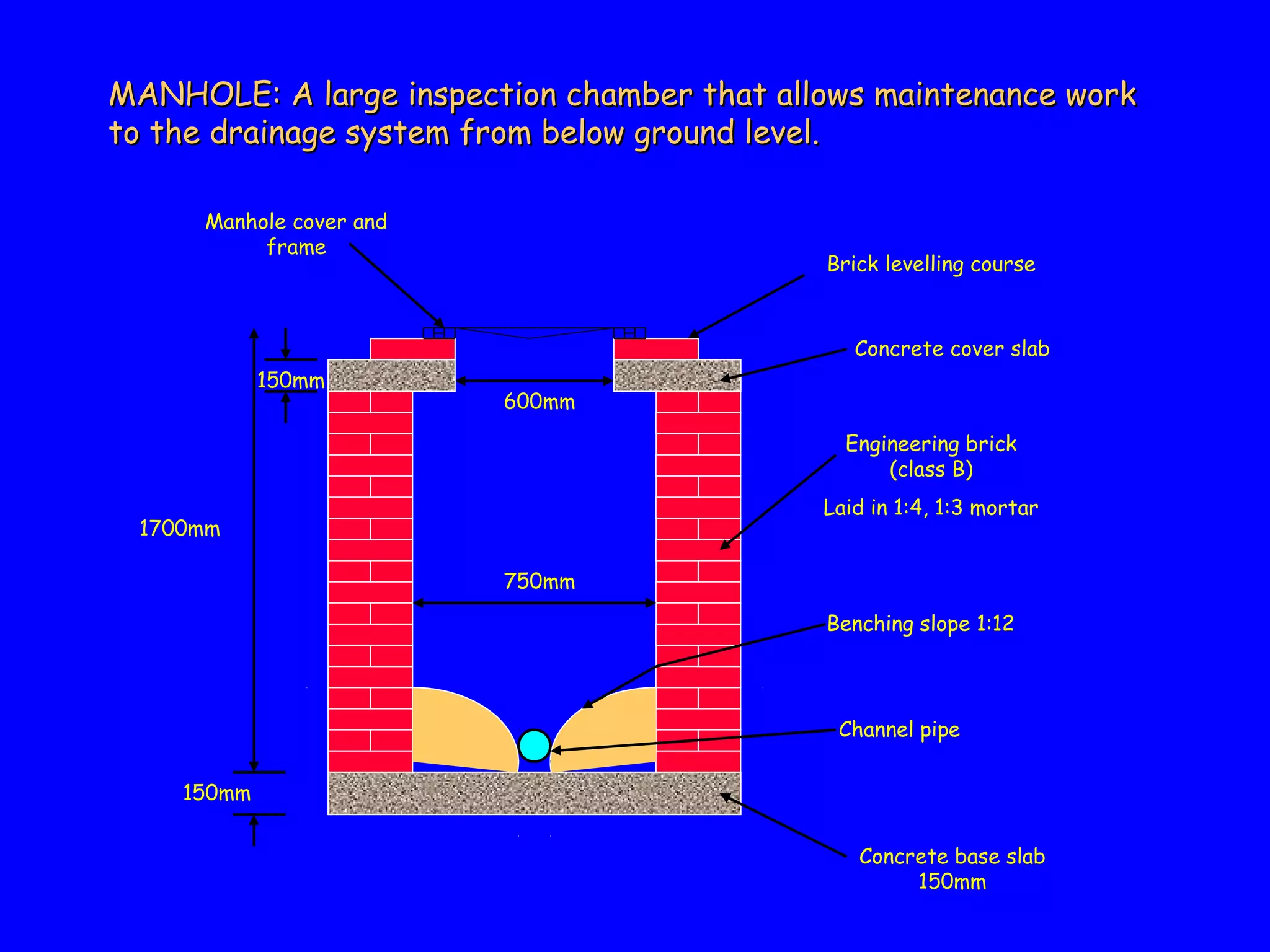
MANHOLE: A large inspection chamber that allows maintenance workMANHOLE: A large inspection chamber that allows maintenance work
to the drainage system from below ground level.to the drainage system from below ground level.
Brick levelling course
Concrete cover slab
Concrete base slab
150mm
Benching slope 1:12
150mm
750mm
Manhole cover and
frame
Channel pipe
600mm
Engineering brick
(class B)
Laid in 1:4, 1:3 mortar
150mm
1700mm
AIR TEST FOR DRAINS
WATER TEST FOR DRAINS
Expanding
stopper
Drainage

Drainage

  • 1.
    Lesson ObjectivesLesson Objectives oDetermine falls for various drain runs o Identify two types of drainage systems o State how to work out gradients for drainage o Sketch two types of collars used for drainage o Visit www.hepworthdrainage.co.uk
  • 2.
    COMBINED SYSTEM:COMBINED SYSTEM: Thisis a system of drains by which foul and surface water is conveyed by oneThis is a system of drains by which foul and surface water is conveyed by one set of pipes to the main sewerset of pipes to the main sewer RE RWP RE RWP MH MH Public Sewer RWP BIG SVP SVP BIG RWP COMBINED SYSTEM
  • 3.
    COMBINED SYSTEM • Onlyone drain for both foul and surface water, reducing the overall cost • There is no risk of making a wrong connection • Foul water is flushed through the drain by the surface water • The loss of a trap seal in a rainwater gulley allows the foul gas to pass into the open air around the building • The size of the sewage disposal plant is greater and therefore also the cost • Possible greater pumping cost,due to both surface water and foul water having to be lifted up to the treatment plant • Risk of flooding RE RWP RE RWP MH MH Public Sewer RWP BIG SVP SVP BIG RWP COMBINED SYSTEM
  • 4.
    SEPARATE SYSTEM:SEPARATE SYSTEM: Thisis a system of drains by which both foul and surface water are carried inThis is a system of drains by which both foul and surface water are carried in two separate sets of drainstwo separate sets of drains RE RWP RE RWP MH MH Surface water Sewer RWP BIG SVP SVP BIG RWP SEPARATE SYSTEM MH Manhole RE Rodding eye RWP Rainwater pipe SVP Soil and vent pipe BIG Back inlet gully
  • 5.
  • 6.
    GOOD DRAINAGE PRACTISE 1.The drainage layout should be as simple and direct as possible.     2. Materials used should be hard, smooth non-corrosive and in true shape.     3. Pipes should be laid to falls to give a self-cleansing velocity. This is generally considered to be - for a 100mm pipe to have a fall of 1 in 40 a 150mm pipe a fall of 1 in 60 and a 225mm pipe to have a fall of 1 in 90. 4. All joints must be airtight, watertight and free from internal obstruction.      
  • 7.
    5. Lines ofpipes between inspection chambers are to be as straight as possible, both horizontally and longitudinally. 6. All inlets to drains must have a water seal of at least 50mm except soil and ventilation pipes.     7. Branches should be kept as short as possible.     8. Where possible all junctions should be oblique and in the direction of the flow. Contra flow junctions, must be made using the appropriate angled standard channel bend:
  • 9.
    Flexible independent rubber'O' ring joints provide the following advantages :-Flexible independent rubber 'O' ring joints provide the following advantages :-    can be assembled easily with a simple push fit jointing method in a two-can be assembled easily with a simple push fit jointing method in a two- man operation.man operation. • can be assembled during wet weather conditions.can be assembled during wet weather conditions. • can be assembled without the use of lubricants.can be assembled without the use of lubricants. • will not turn brittle in the sun, 'creep' under pressure or deteriote inwill not turn brittle in the sun, 'creep' under pressure or deteriote in transit and storage. can prevent root penetration with root inhibitor.transit and storage. can prevent root penetration with root inhibitor. • can accommodate ground movement.can accommodate ground movement. is kept stable and durable by the roundness of the spigot/socketis kept stable and durable by the roundness of the spigot/socket distributing the pressure evenly and the consistent thickness of thedistributing the pressure evenly and the consistent thickness of the rings.rings. • can be dismantled and rejoined easily for replacement of broken pipes.can be dismantled and rejoined easily for replacement of broken pipes. No pipe wastage as the joints are independent.No pipe wastage as the joints are independent. can be tested immediately after completion.can be tested immediately after completion. Advantages of using flexible Joints
  • 11.
  • 12.
  • 13.
  • 14.
    MANHOLE: A largeinspection chamber that allows maintenance workMANHOLE: A large inspection chamber that allows maintenance work to the drainage system from below ground level.to the drainage system from below ground level. Brick levelling course Concrete cover slab Concrete base slab 150mm Benching slope 1:12 150mm 750mm Manhole cover and frame Channel pipe 600mm Engineering brick (class B) Laid in 1:4, 1:3 mortar 150mm 1700mm
  • 17.
  • 18.
    WATER TEST FORDRAINS Expanding stopper