DRAWING PRACTICE
LESSON OBJECTIVES
 Explain the concept of drawing to scale
 Use a scale rule to find a variety of
measurements
 State the commonly used scales for Block
and Site plans
 Explain the use of hatchings in drawings
THE CONCEPT OF DRAWING TO SCALE
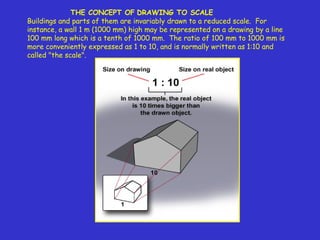
Buildings and parts of them are invariably drawn to a reduced scale. For
instance, a wall 1 m (1000 mm) high may be represented on a drawing by a line
100 mm long which is a tenth of 1000 mm. The ratio of 100 mm to 1000 mm is
more conveniently expressed as 1 to 10, and is normally written as 1:10 and
called "the scale".
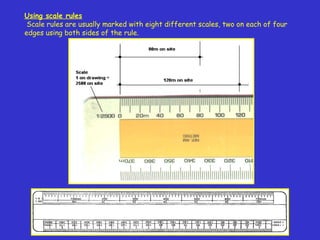
Using scale rules
Scale rules are usually marked with eight different scales, two on each of four
edges using both sides of the rule.
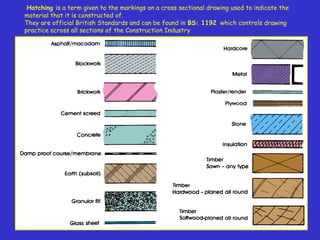
 Hatching is a term given to the markings on a cross sectional drawing used to indicate the
material that it is constructed of.
They are official British Standards and can be found in BS: 1192 which controls drawing
practice across all sections of the Construction Industry
 
Working Drawings
A working drawing and written specification should contain the total information
required for a building team to convert the architects proposed building into a
completed structure. To enable this to happen the following information should be
found in the following locations.
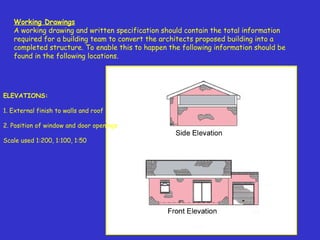
ELEVATIONS:
 
1. External finish to walls and roof
 
2. Position of window and door openings
 
Scale used 1:200, 1:100, 1:50
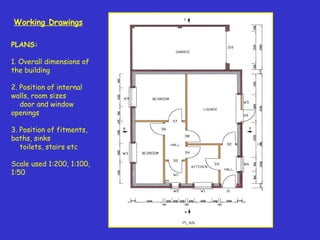
PLANS:
 
1. Overall dimensions of
the building
 
2. Position of internal
walls, room sizes
door and window
openings
 
3. Position of fitments,
baths, sinks
toilets, stairs etc
Scale used 1:200, 1:100,
1:50
Working Drawings
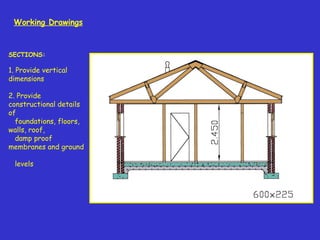
SECTIONS:
 
1. Provide vertical
dimensions
 
2. Provide
constructional details
of
foundations, floors,
walls, roof,
damp proof
membranes and ground
levels
Working Drawings
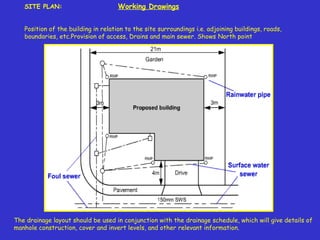
SITE PLAN:
 
Position of the building in relation to the site surroundings i.e. adjoining buildings, roads,
boundaries, etc.Provision of access, Drains and main sewer. Shows North point
Working Drawings
The drainage layout should be used in conjunction with the drainage schedule, which will give details of
manhole construction, cover and invert levels, and other relevant information.
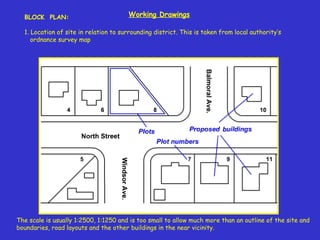
BLOCK PLAN:
 
1. Location of site in relation to surrounding district. This is taken from local authority’s
ordnance survey map
Working Drawings
The scale is usually 1:2500, 1:1250 and is too small to allow much more than an outline of the site and
boundaries, road layouts and the other buildings in the near vicinity.
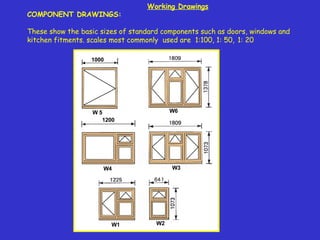
COMPONENT DRAWINGS:
 
These show the basic sizes of standard components such as doors, windows and
kitchen fitments. scales most commonly used are 1:100, 1: 50, 1: 20
Working Drawings
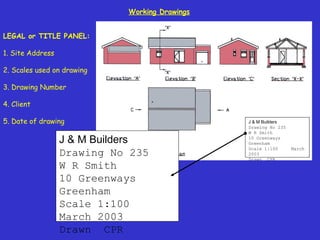
LEGAL or TITLE PANEL:
 
1. Site Address
 
2. Scales used on drawing
 
3. Drawing Number
 
4. Client
 
5. Date of drawing
 
J & M Builders
Drawing No 235
W R Smith
10 Greenways
Greenham
Scale 1:100 March
2003
Drawn CPR
J & M Builders
Drawing No 235
W R Smith
10 Greenways
Greenham
Scale 1:100
March 2003
Drawn CPR
Working Drawings
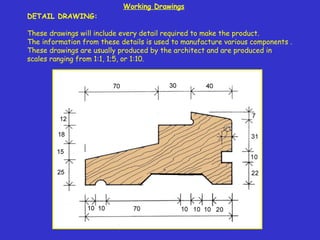
DETAIL DRAWING:
 
These drawings will include every detail required to make the product.
The information from these details is used to manufacture various components .
These drawings are usually produced by the architect and are produced in
scales ranging from 1:1, 1;5, or 1:10.
Working Drawings
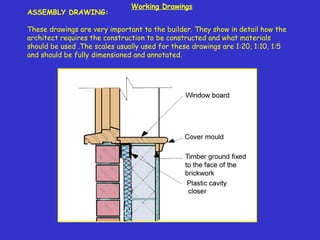
ASSEMBLY DRAWING:
 
These drawings are very important to the builder. They show in detail how the
architect requires the construction to be constructed and what materials
should be used .The scales usually used for these drawings are 1:20, 1:10, 1:5
and should be fully dimensioned and annotated.
Working Drawings
Key Points
• Select drawing required consulting Index if available
• Ensure it is the latest amended version
• First, get an overall picture before looking at details.
• Check the sum of intermediate dimensions equals the overall
dimension
• Do not scale from drawings
• Take every opportunity to compare drawings with the current
construction

Scale drawings

  • 1.
  • 2.
    LESSON OBJECTIVES  Explainthe concept of drawing to scale  Use a scale rule to find a variety of measurements  State the commonly used scales for Block and Site plans  Explain the use of hatchings in drawings
  • 3.
    THE CONCEPT OFDRAWING TO SCALE Buildings and parts of them are invariably drawn to a reduced scale. For instance, a wall 1 m (1000 mm) high may be represented on a drawing by a line 100 mm long which is a tenth of 1000 mm. The ratio of 100 mm to 1000 mm is more conveniently expressed as 1 to 10, and is normally written as 1:10 and called "the scale".
  • 4.
    Using scale rules Scalerules are usually marked with eight different scales, two on each of four edges using both sides of the rule.
  • 5.
     Hatching is aterm given to the markings on a cross sectional drawing used to indicate the material that it is constructed of. They are official British Standards and can be found in BS: 1192 which controls drawing practice across all sections of the Construction Industry  
  • 6.
    Working Drawings A workingdrawing and written specification should contain the total information required for a building team to convert the architects proposed building into a completed structure. To enable this to happen the following information should be found in the following locations. ELEVATIONS:   1. External finish to walls and roof   2. Position of window and door openings   Scale used 1:200, 1:100, 1:50
  • 7.
    PLANS:   1. Overall dimensionsof the building   2. Position of internal walls, room sizes door and window openings   3. Position of fitments, baths, sinks toilets, stairs etc Scale used 1:200, 1:100, 1:50 Working Drawings
  • 8.
    SECTIONS:   1. Provide vertical dimensions   2.Provide constructional details of foundations, floors, walls, roof, damp proof membranes and ground levels Working Drawings
  • 9.
    SITE PLAN:   Position ofthe building in relation to the site surroundings i.e. adjoining buildings, roads, boundaries, etc.Provision of access, Drains and main sewer. Shows North point Working Drawings The drainage layout should be used in conjunction with the drainage schedule, which will give details of manhole construction, cover and invert levels, and other relevant information.
  • 10.
    BLOCK PLAN:   1. Locationof site in relation to surrounding district. This is taken from local authority’s ordnance survey map Working Drawings The scale is usually 1:2500, 1:1250 and is too small to allow much more than an outline of the site and boundaries, road layouts and the other buildings in the near vicinity.
  • 11.
    COMPONENT DRAWINGS:   These showthe basic sizes of standard components such as doors, windows and kitchen fitments. scales most commonly used are 1:100, 1: 50, 1: 20 Working Drawings
  • 12.
    LEGAL or TITLEPANEL:   1. Site Address   2. Scales used on drawing   3. Drawing Number   4. Client   5. Date of drawing   J & M Builders Drawing No 235 W R Smith 10 Greenways Greenham Scale 1:100 March 2003 Drawn CPR J & M Builders Drawing No 235 W R Smith 10 Greenways Greenham Scale 1:100 March 2003 Drawn CPR Working Drawings
  • 13.
    DETAIL DRAWING:   These drawingswill include every detail required to make the product. The information from these details is used to manufacture various components . These drawings are usually produced by the architect and are produced in scales ranging from 1:1, 1;5, or 1:10. Working Drawings
  • 14.
    ASSEMBLY DRAWING:   These drawingsare very important to the builder. They show in detail how the architect requires the construction to be constructed and what materials should be used .The scales usually used for these drawings are 1:20, 1:10, 1:5 and should be fully dimensioned and annotated. Working Drawings
  • 15.
    Key Points • Selectdrawing required consulting Index if available • Ensure it is the latest amended version • First, get an overall picture before looking at details. • Check the sum of intermediate dimensions equals the overall dimension • Do not scale from drawings • Take every opportunity to compare drawings with the current construction