CEMENT TEST
Welcome to Civil Engineering
Introduction
 In general, cement is described as material used to
bind the mineral fragments called aggregates
 The cement paste acts as glue which makes a
cohesive mass with all the aggregates
 This bonding is important as the concrete fails not
because of less strength of aggregates but mainly due
to failure of bonding
Test Of Cement;
Normally two types of cement tests are conducted
Laboratory test of cement
Field test of Cement
Laboratory test of cement
For examining the suitability of cement in the laboratory, the
following tests are performed
 Fineness test
 Consistency test
 Specific gravity
 Initial and Final setting time test
 Soundness test
 Compressive strength test
 Loss of Ignition Test
Laboratory test of cement
FINENESS TEST
Fineness of cement affects hydration rate hence the rate
of strength gain. The smaller the particle size, the greater
the surface area-to-volume ratio, and thus, the more area
available for water-cement interaction per unit volume.
Therefore finer cement reacts faster with water and the
rate of development of strength and corresponding heat
of hydration is high.
Fineness test is used to check the proper grinding of
cement and measures the surface area of the cement
particles per unit mass.
Laboratory test of cement
There are two method of testing fineness of cement;
 Sieving method
 Air permeability method (Blaine)
Sieving method
In this method dry sieving is used, the principle of this is that we
determine the proportion of cement whose grain size is larger
then specified sieve size.
The apparatus used;
 90µm IS Sieve
 Balance capable of weighing 10g to the nearest 10mg
 A nylon or pure bristle brush, preferably with 25 to 40mm -for
cleaning the sieve.
Laboratory test of cement
Procedures;
(i) Weigh approximately 10g of cement to the nearest 0.01g and place it on the
sieve
(ii) Agitate the sieve by swirling, planetary and linear movements, until no more
fine material passes through it.
(iii) Weigh the residue and express its mass as a percentage of the quantity first
placed on the sieve to the nearest 0.1 percent.
Note: The weight of residue should not exceed 10% for Ordnally Portland Cement
(OPC).
Disadvantages of finenes cement
 Higher fineness requires higher grinding resulting in high cost
 Finer cements deteriorate faster upon exposure to atmosphere.
 Finer cements require more gypsum for proper hydration. ( unsoundness of
cement)
 Finer cements require more water hence high pores.
Laboratory test of cement
Air permeability method (Blaine)
The aim is to determine the fineness or surface area per gram of the cement.
Procedures;
 Put a filter paper into the cell then weight 2.84g of cement sample into it.
 Put another filter paper on it and compress with the plunger.
 Attach the cell on top of the U-tube manometer.
 Evacuate the air in the manometer through the side tube using the aspirator bulb
until the oil reaches level 1.
 Close the side valve and monitor the oil as it start to fall.
 Using a stop watch, measure the time taken for the oil to fall from level 2 to level 3
Blaine =k√t where k is 523.0547
Example: when t is obtained a 29sec
S=523.0547√29
S=2817cm2/gm
Laboratory test of cement
CONSISTENCY TEST
What is consistency?
Consistency refers to the relative mobility of a freshly mixed
cement paste or mortar or its ability to flow. The test aim to
measure the quantity of water required to produce a cement paste
of standard or normal consistency
Apparatus
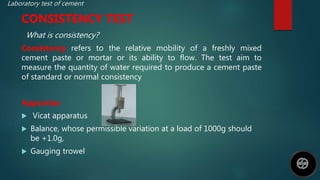
 Vicat apparatus
 Balance, whose permissible variation at a load of 1000g should
be +1.0g,
 Gauging trowel
Laboratory test of cement
Procedures;
(i) Weigh approximately 400g of cement and mix it with a weighed
quantity of water. Note: The time of gauging should be between 3
to 5 minutes.
(ii) Fill the Vicat mould with paste and level it with a trowel.
(iii) Lower the plunger gently till it touches the cement surface.
(iv) Release the plunger allowing it to sink into the paste.
It is defined as that percentage of water added to form the paste
which allows a penetration of 10  1 mm of the Vicat plunger. The
principle also is that standard consistency of cement at which the
Vicat plunger penetrates to a point 5-7mm from the bottom of
Vicat mould.
Laboratory test of cement
SPECIFIC GRAVITY TEST
To determine the specific gravity is normally defined as the
ratio between the weight of a given volume of material and
weight of an equal volume of water. To determine the specific
gravity of cement, kerosene which does not recent with
cement is used.
The mass of a unit volume of the solids or particles,
excluding air between particles. The particle density of
Portland cement ranges from 3.10 to 3.25 Mg/m3,
averaging 3.15 Mg/ m3.
For mixture proportioning, it may be more useful to
express the density as relative density (specific gravity).
On an average the specific gravity of cement is 3.15
Laboratory test of cement
Apparatus;
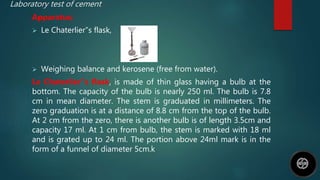
 Le Chaterlier”s flask,
 Weighing balance and kerosene (free from water).
Le Chaterlier”s flask, is made of thin glass having a bulb at the
bottom. The capacity of the bulb is nearly 250 ml. The bulb is 7.8
cm in mean diameter. The stem is graduated in millimeters. The
zero graduation is at a distance of 8.8 cm from the top of the bulb.
At 2 cm from the zero, there is another bulb is of length 3.5cm and
capacity 17 ml. At 1 cm from bulb, the stem is marked with 18 ml
and is grated up to 24 ml. The portion above 24ml mark is in the
form of a funnel of diameter 5cm.k
Laboratory test of cement
Procedures;
 Dry the flask carefully and fill with kerosene or naphtha to a point
on the stem between zero and 1 ml.
 Record the level of the liquid in the flask as initial reading.
 Put a weighted quantity of cement (about 60gm) into the flask so
that level of kerosene rise to about 22 ml mark, care being taken
to avoid splashing and to see that cement does not adhere to the
sides of the above the liquid.
 After putting all the cement to the flask, roll the flask gently in an
inclined position to expel air until no further air bubble rise3s to
the surface of the liquid.
 Note down the new liquid level as final reading.
Laboratory test of cement
Observation and calculations
 Weight of cement used =W gm
 Initial reading of flask =V1 ml
 Final reading of flask =V2 ml
 Volume of cement particle= V2-V1 ml
 Weight of equal of water= (V2-V1) x specific weight of water.
Specific gravity of cement = (Weight of cement/ Weight of equal volume of
water)
= W/(V2-V1)
NOTE:
(i) Duplicate determination of specific gravity should agree within 0.01.
(ii) To get more accurate result, the flask should be held in a constant temperature
before each reading is taken.
Laboratory test of cement
SETTING TIME
Setting refers to a change from liquid state to solid state. Although, during setting
cement paste acquires some strength, setting is different from hardening.
 Setting time is to determine if a cement sets according to the time limits specified
in the standards.
 Setting time is determined using either the Vicat apparatus or a Gillmore needle .
Vicat Needle Gillmore needle
Laboratory test of cement
SOUNDNESS TEST
Soundness is the volume stability of cement paste after setting. The cement paste
should not undergoes large changes in volume after it has set.The extra volume
change is due to free CaO and MgO. will result in cracking effect.
Note: Magnesium content in cement is limited to 6% and Gypsum content is
between 3-5%
Methods;
 Le-Chatelier method: which determines free CaO
 Autoclave method: which determines both free CaO and MgO
a. Le-Chatelier method
Apparatus;
Balance, whose permissible variation at a load of 1000g should be +1.0g and
Water bath.
Laboratory test of cement
Procedure:
(i) Place the mould on a glass sheet and fill it with the cement paste
formed by gauging cement with 0.78 times the water
required to give a paste of standard consistency.
(ii) Cover the mould with another piece of glass sheet, place a small
weight on this covering glass sheet and immediately submerge the
whole assembly in water at a temperature of 27 ± 2oC and keep it
there for 24hrs.
(iii) Measure the distance separating the indicator points to the
nearest 0.5mm (say d1).
(iv) Submerge the mould again in water at the temperature
prescribed above. Bring the water to boiling point in 25 to 30
minutes and keep it boiling for 3hrs.
Laboratory test of cement
COMPRESSIVE STRENGTH TEST
Compressive strength is the most important property physical
properties of cement. When cement is used for important
structures, compressive strength test is always carried out to
ascertain quality of cement. Strength test is not made on
plain cement due to excess shrinkage and cracking of plain
cement paste. Thus the strength of cement is measured using
either cement-sand mortar or concrete of prescribe proportions.
The British standard method for testing compressive strength of
cement BS EN 196-1: 2005 specifies a mortar prism test. The
cement-sand mix proportions of 1:3 is adopted with water cement
ratio of 0.5, the cubes are 50mm in dimensions.
Laboratory test of cement
Materials and apparatus used;
 Cement
 Standard sand
 Vibration Machine
 Poking Rod
 Cube Mould of size 70.6 mm X 70.6 mm X 70.6 mm
 Gauging Trowel
 Weigh Balance
 Graduated glass cylinders – 200 to 250 ml capacity
Laboratory test of cement
Preparation of specimen and test procedures;
 Mixing of material for each test cube shall be separately
prepared. The quantities of cement, standard sand and water
shall be as follows:
Cement – 200 gms, Standard sand – 600 gms, water – (p/4+3) %
of mass (cement +sand)
Where P = % of water required to make cement paste of
standard consistency.
 All ingredients shall be dry mixed for one minute. After that,
water is gradually added till paste is formed of uniform colour.
Mixing time shall be between 3-4 minutes. If uniform colour of
paste is not achieved after mixing more than 4 minutes, fresh
mortar shall be prepared.
 Apply mould oil on interior surface of mould and place the mould
on vibrating table. Immediately after preparing mortar as
describe in point 2,
Laboratory test of cement
 Place the mortar Inside cube moulds. Rod 20 times for approximate 8 sec to
ensure full compaction of mortar.
 Further compaction shall be done by using vibrating machine. The period of
vibration shall be two minutes at the specified speed of 12 000 ± 400
 After completion of vibration, remove moulds along with base plate and finish
the top surface by trowel.
 Keep moulds filled with specimen for 24 ± 1 hr in moist environment. Remove
samples from mould and immediately submerge in clean water.
 After curing period is over, remove cubes from water and immediately place in
testing machine with side facing upwards. Cubes shall be tested without
packing between steel plattens of the testing machine and cubes surface. Load
shall be steadily and uniformly applied, starting from zero at a rate of 35
N/mm2/min. till failure of sample.
Laboratory test of cement
 Calculate compressive strength of specimen by
using following formula
compressive strength = P / A where P = Maximum
load applied, A = cross-sectional area of test
specimen
 Compressive strength shall be calculated as average
value of three samples. If value of individual sample
is differing more than 10 % of average value, then
that value shall not be considered. In that case
average of other two samples shall be considered
for compressive strength calculation.
Laboratory test of cement
LOSS OF IGNITION TEST
 10 gm of cement is taken on platinum crucible and
heated up to a temperature of 900 to 10000C for 15
minutes
 The loss due to moisture and carbon dioxide causes
weight loss which should not be more than 5% for all
cements
Laboratory test of cement
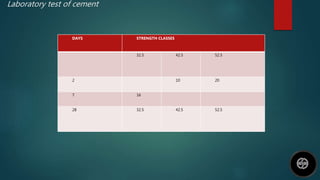
DAYS STRENGTH CLASSES
32.5 42.5 52.5
2 10 20
7 16
28 32.5 42.5 52.5

Cement test

  • 1.
  • 2.
    Welcome to CivilEngineering
  • 3.
    Introduction  In general,cement is described as material used to bind the mineral fragments called aggregates  The cement paste acts as glue which makes a cohesive mass with all the aggregates  This bonding is important as the concrete fails not because of less strength of aggregates but mainly due to failure of bonding
  • 4.
    Test Of Cement; Normallytwo types of cement tests are conducted Laboratory test of cement Field test of Cement
  • 5.
    Laboratory test ofcement For examining the suitability of cement in the laboratory, the following tests are performed  Fineness test  Consistency test  Specific gravity  Initial and Final setting time test  Soundness test  Compressive strength test  Loss of Ignition Test
  • 6.
    Laboratory test ofcement FINENESS TEST Fineness of cement affects hydration rate hence the rate of strength gain. The smaller the particle size, the greater the surface area-to-volume ratio, and thus, the more area available for water-cement interaction per unit volume. Therefore finer cement reacts faster with water and the rate of development of strength and corresponding heat of hydration is high. Fineness test is used to check the proper grinding of cement and measures the surface area of the cement particles per unit mass.
  • 7.
    Laboratory test ofcement There are two method of testing fineness of cement;  Sieving method  Air permeability method (Blaine) Sieving method In this method dry sieving is used, the principle of this is that we determine the proportion of cement whose grain size is larger then specified sieve size. The apparatus used;  90µm IS Sieve  Balance capable of weighing 10g to the nearest 10mg  A nylon or pure bristle brush, preferably with 25 to 40mm -for cleaning the sieve.
  • 8.
    Laboratory test ofcement Procedures; (i) Weigh approximately 10g of cement to the nearest 0.01g and place it on the sieve (ii) Agitate the sieve by swirling, planetary and linear movements, until no more fine material passes through it. (iii) Weigh the residue and express its mass as a percentage of the quantity first placed on the sieve to the nearest 0.1 percent. Note: The weight of residue should not exceed 10% for Ordnally Portland Cement (OPC). Disadvantages of finenes cement  Higher fineness requires higher grinding resulting in high cost  Finer cements deteriorate faster upon exposure to atmosphere.  Finer cements require more gypsum for proper hydration. ( unsoundness of cement)  Finer cements require more water hence high pores.
  • 9.
    Laboratory test ofcement Air permeability method (Blaine) The aim is to determine the fineness or surface area per gram of the cement. Procedures;  Put a filter paper into the cell then weight 2.84g of cement sample into it.  Put another filter paper on it and compress with the plunger.  Attach the cell on top of the U-tube manometer.  Evacuate the air in the manometer through the side tube using the aspirator bulb until the oil reaches level 1.  Close the side valve and monitor the oil as it start to fall.  Using a stop watch, measure the time taken for the oil to fall from level 2 to level 3 Blaine =k√t where k is 523.0547 Example: when t is obtained a 29sec S=523.0547√29 S=2817cm2/gm Laboratory test of cement
  • 10.
    Laboratory test ofcement CONSISTENCY TEST What is consistency? Consistency refers to the relative mobility of a freshly mixed cement paste or mortar or its ability to flow. The test aim to measure the quantity of water required to produce a cement paste of standard or normal consistency Apparatus  Vicat apparatus  Balance, whose permissible variation at a load of 1000g should be +1.0g,  Gauging trowel
  • 11.
    Laboratory test ofcement Procedures; (i) Weigh approximately 400g of cement and mix it with a weighed quantity of water. Note: The time of gauging should be between 3 to 5 minutes. (ii) Fill the Vicat mould with paste and level it with a trowel. (iii) Lower the plunger gently till it touches the cement surface. (iv) Release the plunger allowing it to sink into the paste. It is defined as that percentage of water added to form the paste which allows a penetration of 10  1 mm of the Vicat plunger. The principle also is that standard consistency of cement at which the Vicat plunger penetrates to a point 5-7mm from the bottom of Vicat mould.
  • 12.
    Laboratory test ofcement SPECIFIC GRAVITY TEST To determine the specific gravity is normally defined as the ratio between the weight of a given volume of material and weight of an equal volume of water. To determine the specific gravity of cement, kerosene which does not recent with cement is used. The mass of a unit volume of the solids or particles, excluding air between particles. The particle density of Portland cement ranges from 3.10 to 3.25 Mg/m3, averaging 3.15 Mg/ m3. For mixture proportioning, it may be more useful to express the density as relative density (specific gravity). On an average the specific gravity of cement is 3.15
  • 13.
    Laboratory test ofcement Apparatus;  Le Chaterlier”s flask,  Weighing balance and kerosene (free from water). Le Chaterlier”s flask, is made of thin glass having a bulb at the bottom. The capacity of the bulb is nearly 250 ml. The bulb is 7.8 cm in mean diameter. The stem is graduated in millimeters. The zero graduation is at a distance of 8.8 cm from the top of the bulb. At 2 cm from the zero, there is another bulb is of length 3.5cm and capacity 17 ml. At 1 cm from bulb, the stem is marked with 18 ml and is grated up to 24 ml. The portion above 24ml mark is in the form of a funnel of diameter 5cm.k
  • 14.
    Laboratory test ofcement Procedures;  Dry the flask carefully and fill with kerosene or naphtha to a point on the stem between zero and 1 ml.  Record the level of the liquid in the flask as initial reading.  Put a weighted quantity of cement (about 60gm) into the flask so that level of kerosene rise to about 22 ml mark, care being taken to avoid splashing and to see that cement does not adhere to the sides of the above the liquid.  After putting all the cement to the flask, roll the flask gently in an inclined position to expel air until no further air bubble rise3s to the surface of the liquid.  Note down the new liquid level as final reading.
  • 15.
    Laboratory test ofcement Observation and calculations  Weight of cement used =W gm  Initial reading of flask =V1 ml  Final reading of flask =V2 ml  Volume of cement particle= V2-V1 ml  Weight of equal of water= (V2-V1) x specific weight of water. Specific gravity of cement = (Weight of cement/ Weight of equal volume of water) = W/(V2-V1) NOTE: (i) Duplicate determination of specific gravity should agree within 0.01. (ii) To get more accurate result, the flask should be held in a constant temperature before each reading is taken.
  • 16.
    Laboratory test ofcement SETTING TIME Setting refers to a change from liquid state to solid state. Although, during setting cement paste acquires some strength, setting is different from hardening.  Setting time is to determine if a cement sets according to the time limits specified in the standards.  Setting time is determined using either the Vicat apparatus or a Gillmore needle . Vicat Needle Gillmore needle
  • 17.
    Laboratory test ofcement SOUNDNESS TEST Soundness is the volume stability of cement paste after setting. The cement paste should not undergoes large changes in volume after it has set.The extra volume change is due to free CaO and MgO. will result in cracking effect. Note: Magnesium content in cement is limited to 6% and Gypsum content is between 3-5% Methods;  Le-Chatelier method: which determines free CaO  Autoclave method: which determines both free CaO and MgO a. Le-Chatelier method Apparatus; Balance, whose permissible variation at a load of 1000g should be +1.0g and Water bath.
  • 18.
    Laboratory test ofcement Procedure: (i) Place the mould on a glass sheet and fill it with the cement paste formed by gauging cement with 0.78 times the water required to give a paste of standard consistency. (ii) Cover the mould with another piece of glass sheet, place a small weight on this covering glass sheet and immediately submerge the whole assembly in water at a temperature of 27 ± 2oC and keep it there for 24hrs. (iii) Measure the distance separating the indicator points to the nearest 0.5mm (say d1). (iv) Submerge the mould again in water at the temperature prescribed above. Bring the water to boiling point in 25 to 30 minutes and keep it boiling for 3hrs.
  • 19.
    Laboratory test ofcement COMPRESSIVE STRENGTH TEST Compressive strength is the most important property physical properties of cement. When cement is used for important structures, compressive strength test is always carried out to ascertain quality of cement. Strength test is not made on plain cement due to excess shrinkage and cracking of plain cement paste. Thus the strength of cement is measured using either cement-sand mortar or concrete of prescribe proportions. The British standard method for testing compressive strength of cement BS EN 196-1: 2005 specifies a mortar prism test. The cement-sand mix proportions of 1:3 is adopted with water cement ratio of 0.5, the cubes are 50mm in dimensions.
  • 20.
    Laboratory test ofcement Materials and apparatus used;  Cement  Standard sand  Vibration Machine  Poking Rod  Cube Mould of size 70.6 mm X 70.6 mm X 70.6 mm  Gauging Trowel  Weigh Balance  Graduated glass cylinders – 200 to 250 ml capacity
  • 21.
    Laboratory test ofcement Preparation of specimen and test procedures;  Mixing of material for each test cube shall be separately prepared. The quantities of cement, standard sand and water shall be as follows: Cement – 200 gms, Standard sand – 600 gms, water – (p/4+3) % of mass (cement +sand) Where P = % of water required to make cement paste of standard consistency.  All ingredients shall be dry mixed for one minute. After that, water is gradually added till paste is formed of uniform colour. Mixing time shall be between 3-4 minutes. If uniform colour of paste is not achieved after mixing more than 4 minutes, fresh mortar shall be prepared.  Apply mould oil on interior surface of mould and place the mould on vibrating table. Immediately after preparing mortar as describe in point 2,
  • 22.
    Laboratory test ofcement  Place the mortar Inside cube moulds. Rod 20 times for approximate 8 sec to ensure full compaction of mortar.  Further compaction shall be done by using vibrating machine. The period of vibration shall be two minutes at the specified speed of 12 000 ± 400  After completion of vibration, remove moulds along with base plate and finish the top surface by trowel.  Keep moulds filled with specimen for 24 ± 1 hr in moist environment. Remove samples from mould and immediately submerge in clean water.  After curing period is over, remove cubes from water and immediately place in testing machine with side facing upwards. Cubes shall be tested without packing between steel plattens of the testing machine and cubes surface. Load shall be steadily and uniformly applied, starting from zero at a rate of 35 N/mm2/min. till failure of sample.
  • 23.
    Laboratory test ofcement  Calculate compressive strength of specimen by using following formula compressive strength = P / A where P = Maximum load applied, A = cross-sectional area of test specimen  Compressive strength shall be calculated as average value of three samples. If value of individual sample is differing more than 10 % of average value, then that value shall not be considered. In that case average of other two samples shall be considered for compressive strength calculation.
  • 24.
    Laboratory test ofcement LOSS OF IGNITION TEST  10 gm of cement is taken on platinum crucible and heated up to a temperature of 900 to 10000C for 15 minutes  The loss due to moisture and carbon dioxide causes weight loss which should not be more than 5% for all cements
  • 25.
    Laboratory test ofcement DAYS STRENGTH CLASSES 32.5 42.5 52.5 2 10 20 7 16 28 32.5 42.5 52.5