Lintels and BeamsLintels and Beams
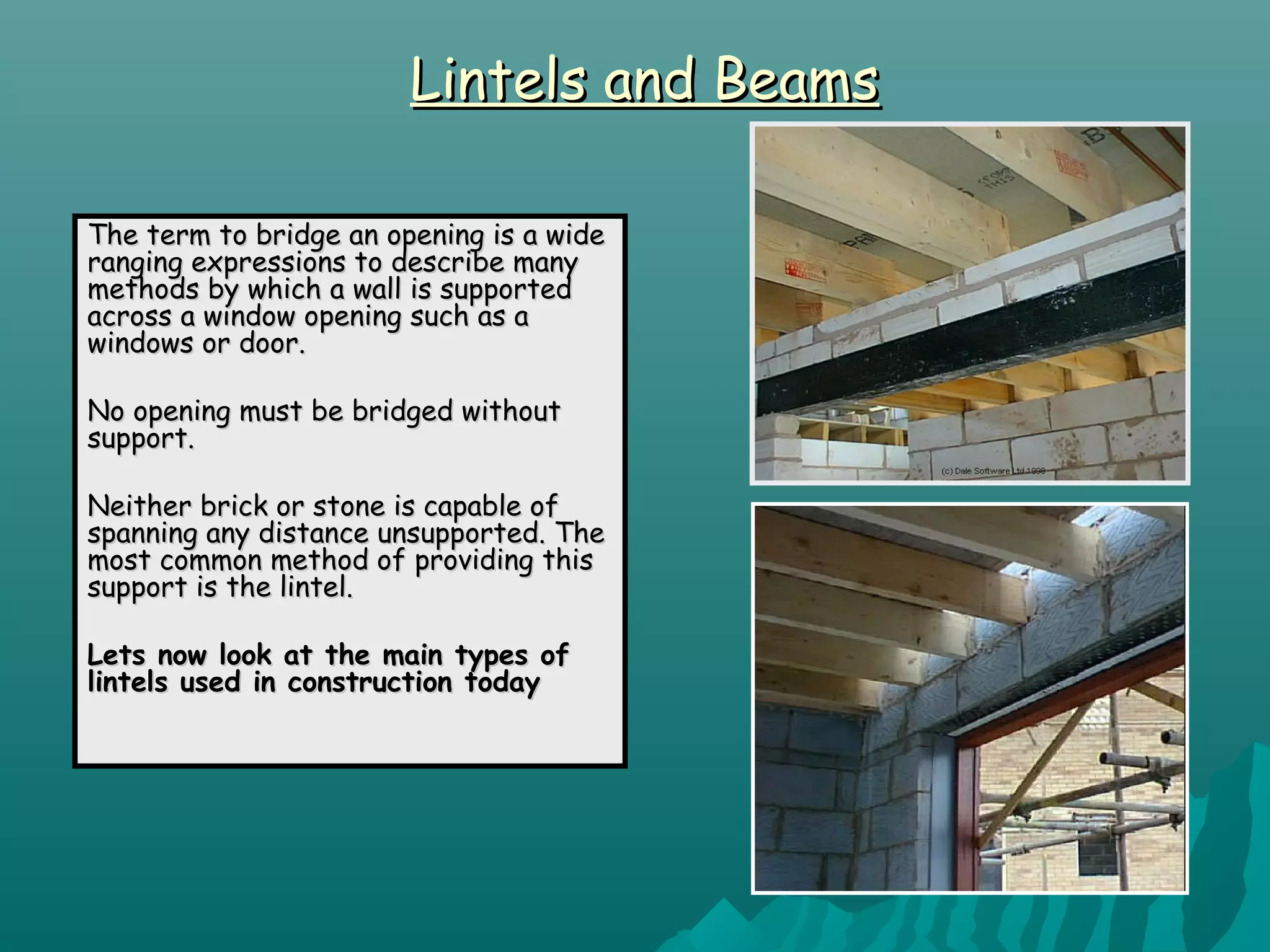
The term to bridge an opening is a wideThe term to bridge an opening is a wide
ranging expressions to describe manyranging expressions to describe many
methods by which a wall is supportedmethods by which a wall is supported
across a window opening such as aacross a window opening such as a
windows or door.windows or door.
No opening must be bridged withoutNo opening must be bridged without
support.support.
Neither brick or stone is capable ofNeither brick or stone is capable of
spanning any distance unsupported. Thespanning any distance unsupported. The
most common method of providing thismost common method of providing this
support is the lintel.support is the lintel.
Lets now look at the main types ofLets now look at the main types of
lintels used in construction todaylintels used in construction today
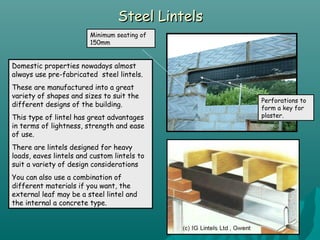
Steel LintelsSteel Lintels
Minimum seating of
150mm
Perforations to
form a key for
plaster.
Domestic properties nowadays almost
always use pre-fabricated steel lintels.
These are manufactured into a great
variety of shapes and sizes to suit the
different designs of the building.
This type of lintel has great advantages
in terms of lightness, strength and ease
of use.
There are lintels designed for heavy
loads, eaves lintels and custom lintels to
suit a variety of design considerations
You can also use a combination of
different materials if you want, the
external leaf may be a steel lintel and
the internal a concrete type.
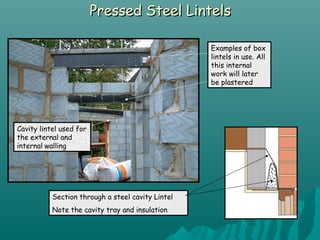
Pressed Steel LintelsPressed Steel Lintels
Examples of box
lintels in use. All
this internal
work will later
be plastered
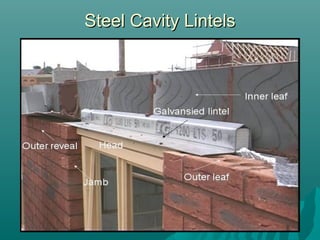
Cavity lintel used for
the external and
internal walling
Section through a steel cavity Lintel
Note the cavity tray and insulation
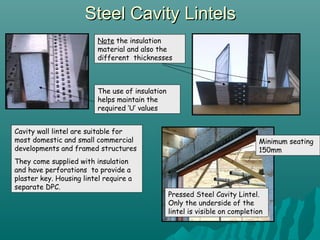
Steel Cavity LintelsSteel Cavity Lintels
Note the insulation
material and also the
different thicknesses
The use of insulation
helps maintain the
required ‘U’ values
Pressed Steel Cavity Lintel.
Only the underside of the
lintel is visible on completion
Minimum seating
150mm
Cavity wall lintel are suitable for
most domestic and small commercial
developments and framed structures
They come supplied with insulation
and have perforations to provide a
plaster key. Housing lintel require a
separate DPC.
Steel Cavity LintelsSteel Cavity Lintels
Reinforced Concrete LintelsReinforced Concrete Lintels
The use of reinforced concrete lintels
is very common. They have many
advantages over other forms of lintels,
the main one being the adaptability to
suit any size or shape.
Concrete though strong in compression,
is very weak in tension and for this
reason reinforcing rods are placed in
the lower part of the lintel in order to
absorb the tension and provide the
needed strength.
All concrete lintels are made by
placing wet concrete into a timber or
metal mould of the required size, the
sides are removed when the concrete
has set.
This process is known as casting, and
lintels can be either pre-cast which
means they are delivered to site ready
to use or cast- in situ where the lintel
is cast into the position they are to
take in the building.
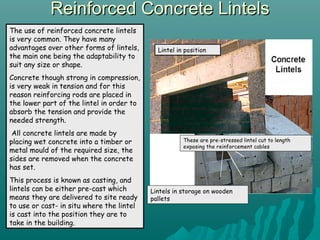
Lintels in storage on wooden
pallets
These are pre-stressed lintel cut to length
exposing the reinforcement cables
Lintel in position
Concrete LintelsConcrete Lintels
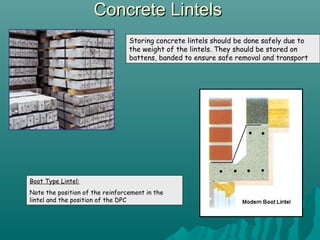
Storing concrete lintels should be done safely due to
the weight of the lintels. They should be stored on
battens, banded to ensure safe removal and transport
Boot Type Lintel:
Note the position of the reinforcement in the
lintel and the position of the DPC
Welsh ArchWelsh Arch
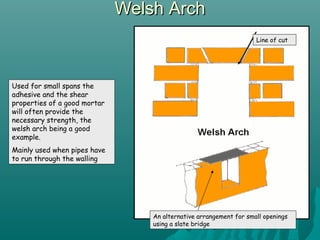
Used for small spans the
adhesive and the shear
properties of a good mortar
will often provide the
necessary strength, the
welsh arch being a good
example.
Mainly used when pipes have
to run through the walling
An alternative arrangement for small openings
using a slate bridge
Line of cut
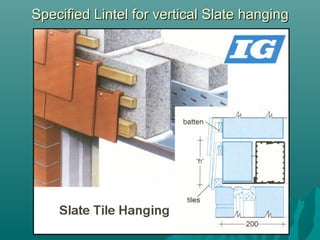
Specified Lintel for vertical Slate hangingSpecified Lintel for vertical Slate hanging
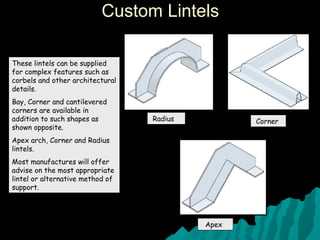
Custom LintelsCustom Lintels
These lintels can be supplied
for complex features such as
corbels and other architectural
details.
Bay, Corner and cantilevered
corners are available in
addition to such shapes as
shown opposite.
Apex arch, Corner and Radius
lintels.
Most manufactures will offer
advise on the most appropriate
lintel or alternative method of
support.
Radius Corner
Apex
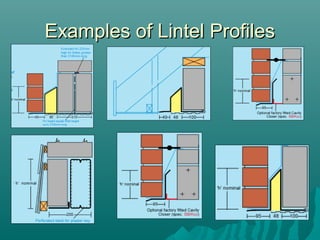
Examples of Lintel ProfilesExamples of Lintel Profiles
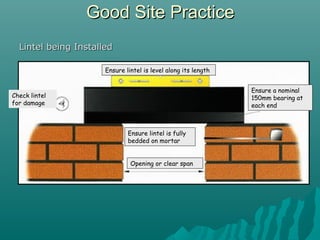
Good Site PracticeGood Site Practice
Lintel being InstalledLintel being Installed
Ensure lintel is level along its length
Ensure a nominal
150mm bearing at
each end
Check lintel
for damage
Ensure lintel is fully
bedded on mortar
Opening or clear span
Good Site PracticeGood Site Practice
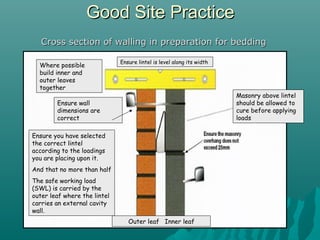
Cross section of walling in preparation for beddingCross section of walling in preparation for bedding
Ensure the blockwork
overhang does not
exceed 25mm.
Ensure lintel is level along its width
Masonry above lintel
should be allowed to
cure before applying
loads
Outer leaf Inner leaf
Ensure wall
dimensions are
correct
Where possible
build inner and
outer leaves
together
Ensure you have selected
the correct lintel
according to the loadings
you are placing upon it.
And that no more than half
The safe working load
(SWL) is carried by the
outer leaf where the lintel
carries an external cavity
wall.
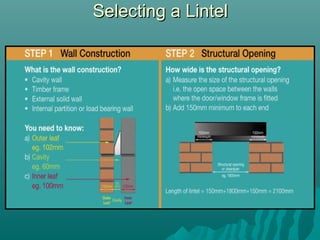
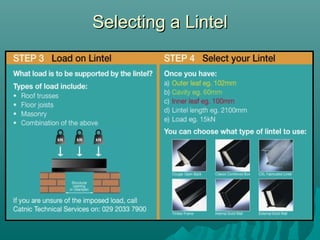
Selecting a LintelSelecting a Lintel

Lintels and Beams

  • 1.
    Lintels and BeamsLintelsand Beams The term to bridge an opening is a wideThe term to bridge an opening is a wide ranging expressions to describe manyranging expressions to describe many methods by which a wall is supportedmethods by which a wall is supported across a window opening such as aacross a window opening such as a windows or door.windows or door. No opening must be bridged withoutNo opening must be bridged without support.support. Neither brick or stone is capable ofNeither brick or stone is capable of spanning any distance unsupported. Thespanning any distance unsupported. The most common method of providing thismost common method of providing this support is the lintel.support is the lintel. Lets now look at the main types ofLets now look at the main types of lintels used in construction todaylintels used in construction today
  • 2.
    Steel LintelsSteel Lintels Minimumseating of 150mm Perforations to form a key for plaster. Domestic properties nowadays almost always use pre-fabricated steel lintels. These are manufactured into a great variety of shapes and sizes to suit the different designs of the building. This type of lintel has great advantages in terms of lightness, strength and ease of use. There are lintels designed for heavy loads, eaves lintels and custom lintels to suit a variety of design considerations You can also use a combination of different materials if you want, the external leaf may be a steel lintel and the internal a concrete type.
  • 3.
    Pressed Steel LintelsPressedSteel Lintels Examples of box lintels in use. All this internal work will later be plastered Cavity lintel used for the external and internal walling Section through a steel cavity Lintel Note the cavity tray and insulation
  • 4.
    Steel Cavity LintelsSteelCavity Lintels Note the insulation material and also the different thicknesses The use of insulation helps maintain the required ‘U’ values Pressed Steel Cavity Lintel. Only the underside of the lintel is visible on completion Minimum seating 150mm Cavity wall lintel are suitable for most domestic and small commercial developments and framed structures They come supplied with insulation and have perforations to provide a plaster key. Housing lintel require a separate DPC.
  • 5.
  • 6.
    Reinforced Concrete LintelsReinforcedConcrete Lintels The use of reinforced concrete lintels is very common. They have many advantages over other forms of lintels, the main one being the adaptability to suit any size or shape. Concrete though strong in compression, is very weak in tension and for this reason reinforcing rods are placed in the lower part of the lintel in order to absorb the tension and provide the needed strength. All concrete lintels are made by placing wet concrete into a timber or metal mould of the required size, the sides are removed when the concrete has set. This process is known as casting, and lintels can be either pre-cast which means they are delivered to site ready to use or cast- in situ where the lintel is cast into the position they are to take in the building. Lintels in storage on wooden pallets These are pre-stressed lintel cut to length exposing the reinforcement cables Lintel in position
  • 7.
    Concrete LintelsConcrete Lintels Storingconcrete lintels should be done safely due to the weight of the lintels. They should be stored on battens, banded to ensure safe removal and transport Boot Type Lintel: Note the position of the reinforcement in the lintel and the position of the DPC
  • 8.
    Welsh ArchWelsh Arch Usedfor small spans the adhesive and the shear properties of a good mortar will often provide the necessary strength, the welsh arch being a good example. Mainly used when pipes have to run through the walling An alternative arrangement for small openings using a slate bridge Line of cut
  • 9.
    Specified Lintel forvertical Slate hangingSpecified Lintel for vertical Slate hanging
  • 10.
    Custom LintelsCustom Lintels Theselintels can be supplied for complex features such as corbels and other architectural details. Bay, Corner and cantilevered corners are available in addition to such shapes as shown opposite. Apex arch, Corner and Radius lintels. Most manufactures will offer advise on the most appropriate lintel or alternative method of support. Radius Corner Apex
  • 11.
    Examples of LintelProfilesExamples of Lintel Profiles
  • 12.
    Good Site PracticeGoodSite Practice Lintel being InstalledLintel being Installed Ensure lintel is level along its length Ensure a nominal 150mm bearing at each end Check lintel for damage Ensure lintel is fully bedded on mortar Opening or clear span
  • 13.
    Good Site PracticeGoodSite Practice Cross section of walling in preparation for beddingCross section of walling in preparation for bedding Ensure the blockwork overhang does not exceed 25mm. Ensure lintel is level along its width Masonry above lintel should be allowed to cure before applying loads Outer leaf Inner leaf Ensure wall dimensions are correct Where possible build inner and outer leaves together Ensure you have selected the correct lintel according to the loadings you are placing upon it. And that no more than half The safe working load (SWL) is carried by the outer leaf where the lintel carries an external cavity wall.
  • 14.
  • 15.