ALLPPT.com _ Free PowerPoint Templates, Diagrams and Charts
BUILDING MATERIALS
& CONSTRUCTIONS
MORTAR, PLASTER &
POINTING
DIVYA VISHNOI
ASSISTANT PROFESSOR
Mortar
Mortar is the term which is used to describe the paste obtained by the
addition of water in the mixture of binding material like cement or
lime and aggregate like sand in definite proportion.
The binding material used may also be referred as matrix and the
aggregate used may also be referred as adulterant. Hence, mortar is a
mixture of matrix & adulterant.
1.It should be capable of developing good adhesion with
the building units such as bricks, stones etc.
2.It should be capable of developing the designed stresses.
3.It should be capable of resisting penetration of rain water.
4.It should be cheap.
5.It should be durable.
6.It should be easily workable.
7.It should not affect the durability of materials with which
it comes into contact.
Properties of good mortar
Uses
1. To bind the building units such as bricks, stones etc.
2. To carry out painting and plaster works on exposed
surfaces of masonry.
3. To form an even bedding layer for building units
4. To form joints of pipes
5. To improve the appearance of structure.
Types of Mortar
The mortar are classified on the bases of the foll
owing
1. Bulk density
2. Kinds of binding material
3. Nature of application
4. Special mortars
Bulk density:
According to bulk density of mortar in dry state, the mortars
are two types
a. Heavy mortars -bulk density is more than 1500kg/m3 and
prepared from heavy quartz
b. Lightweight mortars – bulk density is less than 1500kg/m3
and prepared from light porous sands.
Types of Mortar
Kinds of binding Material
According to the kinds of binding material, several factors such
as expected working conditions, hardening temperature,
moisture conditions, etc should be considered. The mortars are
classified into five categories.
a. Mud mortar
✓ The paste is prepared by mixing suitable clay, soil with water.
✓ The soil which is used for preparing mud mortar should be free
from grass, pebbles etc.
✓ These are the cheapest mortars but weakest in strength.
✓ These mortars are used for brickwork of ordinary buildings and
for plastering walls in rural areas.
Types of Mortar
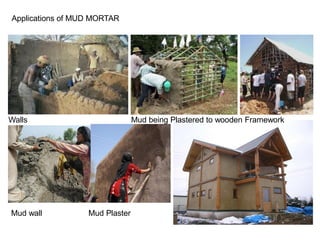
Applications of MUD MORTAR
Walls
Mud Plaster
Mud being Plastered to wooden Framework
Mud wall
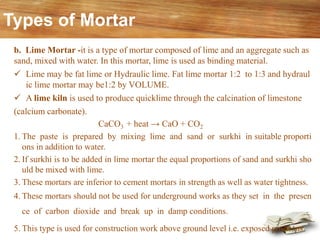
b. Lime Mortar -it is a type of mortar composed of lime and an aggregate such as
sand, mixed with water. In this mortar, lime is used as binding material.
✓ Lime may be fat lime or Hydraulic lime. Fat lime mortar 1:2 to 1:3 and hydraul
ic lime mortar may be1:2 by VOLUME.
✓ A lime kiln is used to produce quicklime through the calcination of limestone
(calcium carbonate).
CaCO3 + heat → CaO + CO2
1. The paste is prepared by mixing lime and sand or surkhi in suitable proporti
ons in addition to water.
2. If surkhi is to be added in lime mortar the equal proportions of sand and surkhi sho
uld be mixed with lime.
3. These mortars are inferior to cement mortars in strength as well as water tightness.
4. These mortars should not be used for underground works as they set in the presen
ce of carbon dioxide and break up in damp conditions.
5. This type is used for construction work above ground level i.e. exposed positions.
Types of Mortar
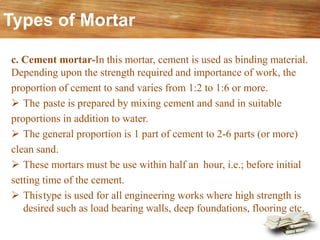
c. Cement mortar-In this mortar, cement is used as binding material.
Depending upon the strength required and importance of work, the
proportion of cement to sand varies from 1:2 to 1:6 or more.
➢ The paste is prepared by mixing cement and sand in suitable
proportions in addition to water.
➢ The general proportion is 1 part of cement to 2-6 parts (or more)
clean sand.
➢ These mortars must be use within half an hour, i.e.; before initial
setting time of the cement.
➢ Thistype is used for all engineering works where high strength is
desired such as load bearing walls, deep foundations, flooring etc.
Types of Mortar
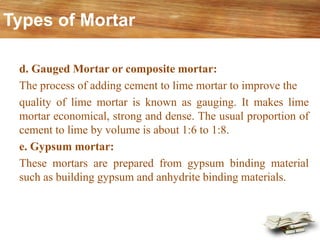
d. Gauged Mortar or composite mortar:
The process of adding cement to lime mortar to improve the
quality of lime mortar is known as gauging. It makes lime
mortar economical, strong and dense. The usual proportion of
cement to lime by volume is about 1:6 to 1:8.
e. Gypsum mortar:
These mortars are prepared from gypsum binding material
such as building gypsum and anhydrite binding materials.
Types of Mortar
Types of Mortar
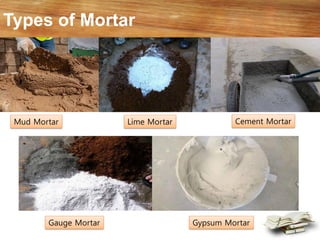
Mud Mortar Lime Mortar Cement Mortar
Gauge Mortar Gypsum Mortar
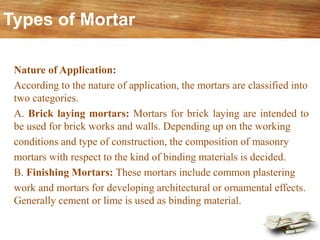
Nature of Application:
According to the nature of application, the mortars are classified into
two categories.
A. Brick laying mortars: Mortars for brick laying are intended to
be used for brick works and walls. Depending up on the working
conditions and type of construction, the composition of masonry
mortars with respect to the kind of binding materials is decided.
B. Finishing Mortars: These mortars include common plastering
work and mortars for developing architectural or ornamental effects.
Generally cement or lime is used as binding material.
Types of Mortar
Special Mortars:
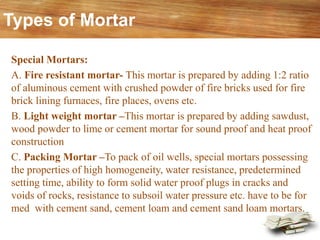
A. Fire resistant mortar- This mortar is prepared by adding 1:2 ratio
of aluminous cement with crushed powder of fire bricks used for fire
brick lining furnaces, fire places, ovens etc.
B. Light weight mortar –This mortar is prepared by adding sawdust,
wood powder to lime or cement mortar for sound proof and heat proof
construction
C. Packing Mortar –To pack of oil wells, special mortars possessing
the properties of high homogeneity, water resistance, predetermined
setting time, ability to form solid water proof plugs in cracks and
voids of rocks, resistance to subsoil water pressure etc. have to be for
med with cement sand, cement loam and cement sand loam mortars.
Types of Mortar
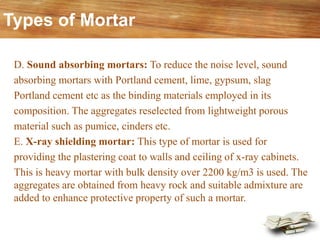
D. Sound absorbing mortars: To reduce the noise level, sound
absorbing mortars with Portland cement, lime, gypsum, slag
Portland cement etc as the binding materials employed in its
composition. The aggregates reselected from lightweight porous
material such as pumice, cinders etc.
E. X-ray shielding mortar: This type of mortar is used for
providing the plastering coat to walls and ceiling of x-ray cabinets.
This is heavy mortar with bulk density over 2200 kg/m3 is used. The
aggregates are obtained from heavy rock and suitable admixture are
added to enhance protective property of such a mortar.
Types of Mortar
Types of Mortar
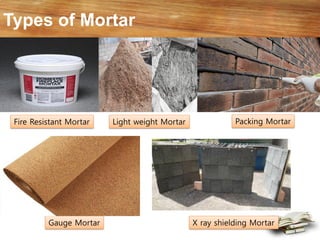
Fire Resistant Mortar Light weight Mortar Packing Mortar
Gauge Mortar X ray shielding Mortar
Preparation of cement mortar
Cement mortar may be prepared by manual mixing or by mechanical
mixing. Mechanical mixing is preferred when mortar is required in
large quantities to be used in continuous order.
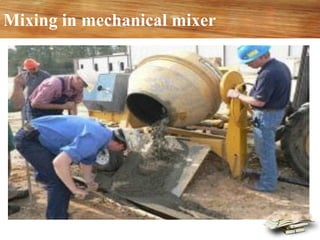
a. Mixing in mechanical mixer: In this case, cement and sand in
desired proportion are fed in the mixer and mixed dry. Water is then
added gradually and the wet mixing a continued for at least one
minute to obtain the mortar of desired consistency. It is necessary to
ensure that only the quantity of mortar which can be used within half
an hour of its mixing should be prepared at a time. This is essential as
after 30 minutes the mortar begins to set.
Mixing in mechanical mixer
b. Manual mixing: In this case, specified quantity of sand is spread
and levelled on clean dry masonry platform. Required quantity of
cement bags are emptied over the sand layer. The ingredients are then
mixed thoroughly by turning them over the sand layer. The ingredient
s are then mixed thoroughly by turning them over and over. Backward
and forward several times with the help of spade. Dry mixing is
continued till the mix have attains a uniform colour. A batch of dry
mix is then put in the shallow masonry tank and just sufficient
quantity of water is added to bring the mortar to the consistency of a
paste. The quantity of dry mix taken in each batch should be such the
mortar formed each time is consumed within half an hour.
Preparation of cement mortar
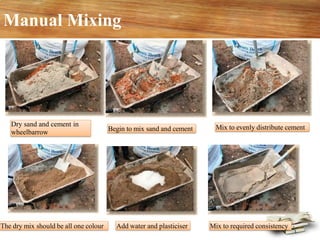
Manual Mixing
Dry sand and cement in
wheelbarrow Begin to mix sand and cement Mix to evenly distribute cement
The dry mix should be all one colour Add water and plasticiser Mix to required consistency
Precautions in using mortar
1. Consumption of mortar – the consumption of mortar should be as
early as possible
Lime mortar – with in 36 hours after its preparation
Cement mortar – within 30 minutes
Gauged mortar – within 2 hours.
2. Frost action - Setting action of mortar is affected by the presence
of frost and not advisable in frosty weather.
3. Soaking of building units: Building units should not be soaked
before application of mortar. If this precaution is not taken, water of
mortar will be absorbed by the building units and mortar will become
weak.
4. Sprinkling of water: The construction work carried out by
mortar should be kept dam or wet by sprinkling water for about 7
to 10 days to avoid rapid drying of mortar.
5. Workability: Mortar should not contain excess water and it
should be stiff as can be conveniently used. Joints should be well
formed and excess mortar from joints should be neatly taken off
by a trowel. Surface formed by mortar for building units to rest
should be even.
Precautions in using mortar
Objective of plastering
1) Plastering is done to achieve the following objects.
2) To protect the external surfaces against penetration of rain
water and other atmospheric agencies
3) To give smooth surface in which dust and dirt cannot lodge.
4) To give decorative effect.
5) To protect surfaces against vermin.
6) To conceal inferior materials or defective workmanship
Requirements of good plaster
1. It should adhere to the background and should remain adhere
d during all variations of the climatic changes.
2. It should be cheap and economical
3. It should be hard and durable.
4. It should be possible to apply it during all weather conditions
5. It should be effectively check the entry or penetration of
moisture from the surface.
6. It should possess good workability
Mortar for plaster
1) Cement mortar
2) Lime mortar
3) Gypsum mortar
4) Gauged mortar
5) Surkhi mortar
6) Aerated cement mortar
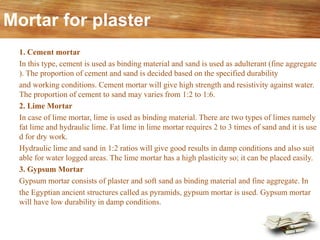
Mortar for plaster
1. Cement mortar
In this type, cement is used as binding material and sand is used as adulterant (fine aggregate
). The proportion of cement and sand is decided based on the specified durability
and working conditions. Cement mortar will give high strength and resistivity against water.
The proportion of cement to sand may varies from 1:2 to 1:6.
2. Lime Mortar
In case of lime mortar, lime is used as binding material. There are two types of limes namely
fat lime and hydraulic lime. Fat lime in lime mortar requires 2 to 3 times of sand and it is use
d for dry work.
Hydraulic lime and sand in 1:2 ratios will give good results in damp conditions and also suit
able for water logged areas. The lime mortar has a high plasticity so; it can be placed easily.
3. Gypsum Mortar
Gypsum mortar consists of plaster and soft sand as binding material and fine aggregate. In
the Egyptian ancient structures called as pyramids, gypsum mortar is used. Gypsum mortar
will have low durability in damp conditions.
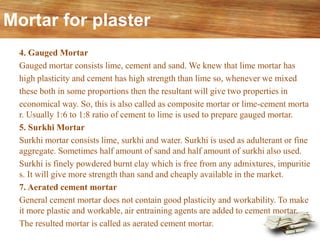
Mortar for plaster
4. Gauged Mortar
Gauged mortar consists lime, cement and sand. We knew that lime mortar has
high plasticity and cement has high strength than lime so, whenever we mixed
these both in some proportions then the resultant will give two properties in
economical way. So, this is also called as composite mortar or lime-cement morta
r. Usually 1:6 to 1:8 ratio of cement to lime is used to prepare gauged mortar.
5. Surkhi Mortar
Surkhi mortar consists lime, surkhi and water. Surkhi is used as adulterant or fine
aggregate. Sometimes half amount of sand and half amount of surkhi also used.
Surkhi is finely powdered burnt clay which is free from any admixtures, impuritie
s. It will give more strength than sand and cheaply available in the market.
7. Aerated cement mortar
General cement mortar does not contain good plasticity and workability. To make
it more plastic and workable, air entraining agents are added to cement mortar.
The resulted mortar is called as aerated cement mortar.
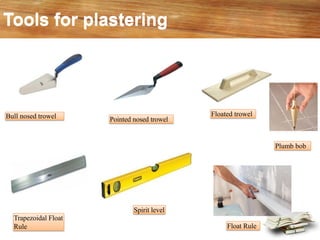
Bull nosed trowel Pointed nosed trowel
Floated trowel
Trapezoidal Float
Rule
Plumb bob
Float Rule
Tools for plasteringTools for plastering
Spirit level
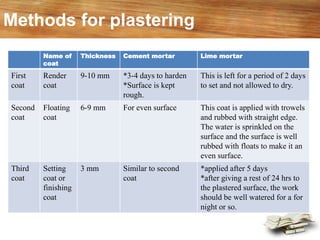
Methods for plastering
Name of
coat
Thickness Cement mortar Lime mortar
First
coat
Render
coat
9-10 mm *3-4 days to harden
*Surface is kept
rough.
This is left for a period of 2 days
to set and not allowed to dry.
Second
coat
Floating
coat
6-9 mm For even surface This coat is applied with trowels
and rubbed with straight edge.
The water is sprinkled on the
surface and the surface is well
rubbed with floats to make it an
even surface.
Third
coat
Setting
coat or
finishing
coat
3 mm Similar to second
coat
*applied after 5 days
*after giving a rest of 24 hrs to
the plastered surface, the work
should be well watered for a for
night or so.
Types of External plaster
Sand faced finish
➢ The first coat of sand faced cement plaster is done with cement mort
ar in 1:4 with coarse sand after curing the plaster for seven days the
second coat of cement plaster 1:3 ratio will be done on the first coat
.
➢ Sponge is used in the second coat and it is applied when the secon
d coat is wet, it is thus worked that the density of sand grain appear
on surface is equal and uniform.
➢ The surface is kept well watered at least for 15 days.
Rough cast finish or spatter dash finish
➢ This plaster is a mixture of sand and gravel in specified proportion d
ashed over a freshly plastered surface.
➢ The plaster base consists of two
➢ coats, under layer 12 mm thick and top layer 10 mm thick having the
cement mortar ratio 1:3.
➢ In order to make the base more plastic, about 10% of hydrated lime
by volume of cement shall be added while prepare mortar.
Depeter finish
➢ This is just another form of rough cast finish.
➢ The rendering coat of 12 mm thick is prepared as in case of pebble
dash finish.
➢ While this coat is wet, pieces of gravel are pressed with hand on the
surface.
➢ Thus it is possible to have beautiful patterns and ornamental designs
on the surface by selecting materials of different colors.
Pebble dash or dry dash finish
➢ It is similar to rough cast finish except clean pebble of size from 6 m
m to 12.5 mm are dashed against the surface so that there are laid in
position by mortar applied only
Smooth cast finish
➢ This finish is just similar to sand faced finish except fine grained sand is used
instead of coarse sand.
➢ No sponging is done to expose the sand grain .
➢ It is normally done on internal walls.
Types of External plaster
Pointing
The term pointing is used to denote the finishing of mortar joint of
either stone masonry or brick masonry. The joints are raked out a
depth of about 20 mm and then , these spaces are filled up by
suitable mortar in desired shape.
It is desirable to avoid the pointing as far as possible. This is due
to the fact that pointing involves raking out of joints which are
constructed with good mortar and filling the joints with mortar
which, in many cases is not sufficiently watered. For this reason,
the pointing work of new structure should follow the masonry
work in progress. The joints are thus raked out when the mortar
has not set.
Method of pointing
1. The mortar of the masonry joints to be covered by pointing is raked
out least to a depth of 20 mm.
2. The dust from the masonry joints is removed by the brushes.
3. The surface is then washed with clean water and it is kept wet for a
few hours.
4. The mortar is then carefully placed in desired shape in these prepared
joints. The mortar is placed by a small trowel and it is slightly pressed
to bring it into close contact with the old interior mortar of the joint.
5. The finished surface is well watered for a period of at least 3 days, if
lime mortar is used and 10 days, if cement mortar is used.
Types of pointing
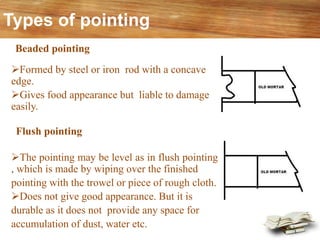
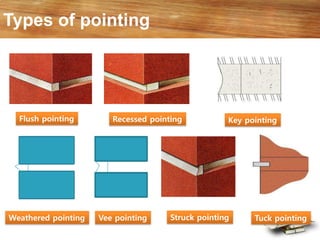
➢The pointing may be level as in flush pointing
, which is made by wiping over the finished
pointing with the trowel or piece of rough cloth.
➢Does not give good appearance. But it is
durable as it does not provide any space for
accumulation of dust, water etc.
Flush pointing
Beaded pointing
➢Formed by steel or iron rod with a concave
edge.
➢Gives food appearance but liable to damage
easily.
Types of pointing
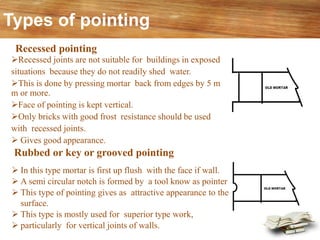
➢ In this type mortar is first up flush with the face if wall.
➢ A semi circular notch is formed by a tool know as pointer
➢ This type of pointing gives as attractive appearance to the
surface.
➢ This type is mostly used for superior type work,
➢ particularly for vertical joints of walls.
Rubbed or key or grooved pointing
Recessed pointing
➢Recessed joints are not suitable for buildings in exposed
situations because they do not readily shed water.
➢This is done by pressing mortar back from edges by 5 m
m or more.
➢Face of pointing is kept vertical.
➢Only bricks with good frost resistance should be used
with recessed joints.
➢ Gives good appearance.
Types of pointing
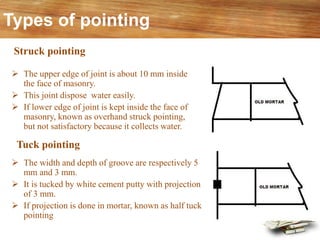
➢ The upper edge of joint is about 10 mm inside
the face of masonry.
➢ This joint dispose water easily.
➢ If lower edge of joint is kept inside the face of
masonry, known as overhand struck pointing,
but not satisfactory because it collects water.
Struck pointing
Tuck pointing
➢ The width and depth of groove are respectively 5
mm and 3 mm.
➢ It is tucked by white cement putty with projection
of 3 mm.
➢ If projection is done in mortar, known as half tuck
pointing
Types of pointing
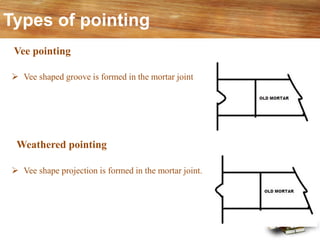
➢ Vee shaped groove is formed in the mortar joint
Vee pointing
Weathered pointing
➢ Vee shape projection is formed in the mortar joint.
Types of pointing
Flush pointing Recessed pointing Key pointing
Weathered pointing Vee pointing Struck pointing Tuck pointing
Defects in plaster
➢ Blistering of plaster surface
This is the formation of small patches of plaster swelling out beyond the plastered
surface, arising out of late slaking of lime particles in the plaster.
➢ Cracking
✓Imperfect preparation of background
✓Structural defects in building
✓Discontinuity of surface
✓Movements in the background due to its thermal expansion or
✓rapid drying
✓Movements in the plaster surface itself, either due to expansion or
✓shrinkage.
✓Excessive shrinkage due to application of thick coat
✓Faulty workmanship.
Defects in plaster
➢ Efflorescence
✓ It is the whitish crystalline substance which appears on the surface due to
presence of salts in plaster making materials as well as building materials like
bricks, sand, cement etc and even water.
✓ This gives a very bad appearance. It affects the adhesion of paint with
wall surface.
✓ Efflorescence can be removed to some extent by dry bushing and washin
g the surface repeatedly.
➢ Flaking
It is the formation of very loose mass of plastered surface, due to poor bond
between successive coats.
➢ Peeling
It is the complete dislocation of some portion of plastered surface, resulting in the
formation of a patch. This also results from imperfect bond.
Defects in plaster
➢ Popping
It is the formation of conical hole in the plastered surface due to presence of
some particles which expand on setting.
➢ Rust stains
These are sometimes formed when plaster is applied on metal laths
➢ Uneven surface
This is obtained purely due to poor workman ship.
References
1) “Building Construction” authored by S.C. Rangwala, Char
otar publishing house Pvt. Ltd.
2) “Building Construction” authored by Bindra and Arora,.
3) “Building Construction” authored by M.L. Gambhir, Tata
Meghraw Hills publication.
4) IS 2250:1981 – “Code of practice for preparation and use
of masonry mortar”
Mortar plaster pointing

Mortar plaster pointing

  • 1.
    ALLPPT.com _ FreePowerPoint Templates, Diagrams and Charts BUILDING MATERIALS & CONSTRUCTIONS MORTAR, PLASTER & POINTING DIVYA VISHNOI ASSISTANT PROFESSOR
  • 2.
    Mortar Mortar is theterm which is used to describe the paste obtained by the addition of water in the mixture of binding material like cement or lime and aggregate like sand in definite proportion. The binding material used may also be referred as matrix and the aggregate used may also be referred as adulterant. Hence, mortar is a mixture of matrix & adulterant.
  • 3.
    1.It should becapable of developing good adhesion with the building units such as bricks, stones etc. 2.It should be capable of developing the designed stresses. 3.It should be capable of resisting penetration of rain water. 4.It should be cheap. 5.It should be durable. 6.It should be easily workable. 7.It should not affect the durability of materials with which it comes into contact. Properties of good mortar
  • 4.
    Uses 1. To bindthe building units such as bricks, stones etc. 2. To carry out painting and plaster works on exposed surfaces of masonry. 3. To form an even bedding layer for building units 4. To form joints of pipes 5. To improve the appearance of structure.
  • 5.
    Types of Mortar Themortar are classified on the bases of the foll owing 1. Bulk density 2. Kinds of binding material 3. Nature of application 4. Special mortars
  • 6.
    Bulk density: According tobulk density of mortar in dry state, the mortars are two types a. Heavy mortars -bulk density is more than 1500kg/m3 and prepared from heavy quartz b. Lightweight mortars – bulk density is less than 1500kg/m3 and prepared from light porous sands. Types of Mortar
  • 7.
    Kinds of bindingMaterial According to the kinds of binding material, several factors such as expected working conditions, hardening temperature, moisture conditions, etc should be considered. The mortars are classified into five categories. a. Mud mortar ✓ The paste is prepared by mixing suitable clay, soil with water. ✓ The soil which is used for preparing mud mortar should be free from grass, pebbles etc. ✓ These are the cheapest mortars but weakest in strength. ✓ These mortars are used for brickwork of ordinary buildings and for plastering walls in rural areas. Types of Mortar
  • 8.
    Applications of MUDMORTAR Walls Mud Plaster Mud being Plastered to wooden Framework Mud wall
  • 9.
    b. Lime Mortar-it is a type of mortar composed of lime and an aggregate such as sand, mixed with water. In this mortar, lime is used as binding material. ✓ Lime may be fat lime or Hydraulic lime. Fat lime mortar 1:2 to 1:3 and hydraul ic lime mortar may be1:2 by VOLUME. ✓ A lime kiln is used to produce quicklime through the calcination of limestone (calcium carbonate). CaCO3 + heat → CaO + CO2 1. The paste is prepared by mixing lime and sand or surkhi in suitable proporti ons in addition to water. 2. If surkhi is to be added in lime mortar the equal proportions of sand and surkhi sho uld be mixed with lime. 3. These mortars are inferior to cement mortars in strength as well as water tightness. 4. These mortars should not be used for underground works as they set in the presen ce of carbon dioxide and break up in damp conditions. 5. This type is used for construction work above ground level i.e. exposed positions. Types of Mortar
  • 10.
    c. Cement mortar-Inthis mortar, cement is used as binding material. Depending upon the strength required and importance of work, the proportion of cement to sand varies from 1:2 to 1:6 or more. ➢ The paste is prepared by mixing cement and sand in suitable proportions in addition to water. ➢ The general proportion is 1 part of cement to 2-6 parts (or more) clean sand. ➢ These mortars must be use within half an hour, i.e.; before initial setting time of the cement. ➢ Thistype is used for all engineering works where high strength is desired such as load bearing walls, deep foundations, flooring etc. Types of Mortar
  • 11.
    d. Gauged Mortaror composite mortar: The process of adding cement to lime mortar to improve the quality of lime mortar is known as gauging. It makes lime mortar economical, strong and dense. The usual proportion of cement to lime by volume is about 1:6 to 1:8. e. Gypsum mortar: These mortars are prepared from gypsum binding material such as building gypsum and anhydrite binding materials. Types of Mortar
  • 12.
    Types of Mortar MudMortar Lime Mortar Cement Mortar Gauge Mortar Gypsum Mortar
  • 13.
    Nature of Application: Accordingto the nature of application, the mortars are classified into two categories. A. Brick laying mortars: Mortars for brick laying are intended to be used for brick works and walls. Depending up on the working conditions and type of construction, the composition of masonry mortars with respect to the kind of binding materials is decided. B. Finishing Mortars: These mortars include common plastering work and mortars for developing architectural or ornamental effects. Generally cement or lime is used as binding material. Types of Mortar
  • 14.
    Special Mortars: A. Fireresistant mortar- This mortar is prepared by adding 1:2 ratio of aluminous cement with crushed powder of fire bricks used for fire brick lining furnaces, fire places, ovens etc. B. Light weight mortar –This mortar is prepared by adding sawdust, wood powder to lime or cement mortar for sound proof and heat proof construction C. Packing Mortar –To pack of oil wells, special mortars possessing the properties of high homogeneity, water resistance, predetermined setting time, ability to form solid water proof plugs in cracks and voids of rocks, resistance to subsoil water pressure etc. have to be for med with cement sand, cement loam and cement sand loam mortars. Types of Mortar
  • 15.
    D. Sound absorbingmortars: To reduce the noise level, sound absorbing mortars with Portland cement, lime, gypsum, slag Portland cement etc as the binding materials employed in its composition. The aggregates reselected from lightweight porous material such as pumice, cinders etc. E. X-ray shielding mortar: This type of mortar is used for providing the plastering coat to walls and ceiling of x-ray cabinets. This is heavy mortar with bulk density over 2200 kg/m3 is used. The aggregates are obtained from heavy rock and suitable admixture are added to enhance protective property of such a mortar. Types of Mortar
  • 16.
    Types of Mortar FireResistant Mortar Light weight Mortar Packing Mortar Gauge Mortar X ray shielding Mortar
  • 17.
    Preparation of cementmortar Cement mortar may be prepared by manual mixing or by mechanical mixing. Mechanical mixing is preferred when mortar is required in large quantities to be used in continuous order. a. Mixing in mechanical mixer: In this case, cement and sand in desired proportion are fed in the mixer and mixed dry. Water is then added gradually and the wet mixing a continued for at least one minute to obtain the mortar of desired consistency. It is necessary to ensure that only the quantity of mortar which can be used within half an hour of its mixing should be prepared at a time. This is essential as after 30 minutes the mortar begins to set.
  • 18.
  • 19.
    b. Manual mixing:In this case, specified quantity of sand is spread and levelled on clean dry masonry platform. Required quantity of cement bags are emptied over the sand layer. The ingredients are then mixed thoroughly by turning them over the sand layer. The ingredient s are then mixed thoroughly by turning them over and over. Backward and forward several times with the help of spade. Dry mixing is continued till the mix have attains a uniform colour. A batch of dry mix is then put in the shallow masonry tank and just sufficient quantity of water is added to bring the mortar to the consistency of a paste. The quantity of dry mix taken in each batch should be such the mortar formed each time is consumed within half an hour. Preparation of cement mortar
  • 20.
    Manual Mixing Dry sandand cement in wheelbarrow Begin to mix sand and cement Mix to evenly distribute cement The dry mix should be all one colour Add water and plasticiser Mix to required consistency
  • 21.
    Precautions in usingmortar 1. Consumption of mortar – the consumption of mortar should be as early as possible Lime mortar – with in 36 hours after its preparation Cement mortar – within 30 minutes Gauged mortar – within 2 hours. 2. Frost action - Setting action of mortar is affected by the presence of frost and not advisable in frosty weather. 3. Soaking of building units: Building units should not be soaked before application of mortar. If this precaution is not taken, water of mortar will be absorbed by the building units and mortar will become weak.
  • 22.
    4. Sprinkling ofwater: The construction work carried out by mortar should be kept dam or wet by sprinkling water for about 7 to 10 days to avoid rapid drying of mortar. 5. Workability: Mortar should not contain excess water and it should be stiff as can be conveniently used. Joints should be well formed and excess mortar from joints should be neatly taken off by a trowel. Surface formed by mortar for building units to rest should be even. Precautions in using mortar
  • 23.
    Objective of plastering 1)Plastering is done to achieve the following objects. 2) To protect the external surfaces against penetration of rain water and other atmospheric agencies 3) To give smooth surface in which dust and dirt cannot lodge. 4) To give decorative effect. 5) To protect surfaces against vermin. 6) To conceal inferior materials or defective workmanship
  • 24.
    Requirements of goodplaster 1. It should adhere to the background and should remain adhere d during all variations of the climatic changes. 2. It should be cheap and economical 3. It should be hard and durable. 4. It should be possible to apply it during all weather conditions 5. It should be effectively check the entry or penetration of moisture from the surface. 6. It should possess good workability
  • 25.
    Mortar for plaster 1)Cement mortar 2) Lime mortar 3) Gypsum mortar 4) Gauged mortar 5) Surkhi mortar 6) Aerated cement mortar
  • 26.
    Mortar for plaster 1.Cement mortar In this type, cement is used as binding material and sand is used as adulterant (fine aggregate ). The proportion of cement and sand is decided based on the specified durability and working conditions. Cement mortar will give high strength and resistivity against water. The proportion of cement to sand may varies from 1:2 to 1:6. 2. Lime Mortar In case of lime mortar, lime is used as binding material. There are two types of limes namely fat lime and hydraulic lime. Fat lime in lime mortar requires 2 to 3 times of sand and it is use d for dry work. Hydraulic lime and sand in 1:2 ratios will give good results in damp conditions and also suit able for water logged areas. The lime mortar has a high plasticity so; it can be placed easily. 3. Gypsum Mortar Gypsum mortar consists of plaster and soft sand as binding material and fine aggregate. In the Egyptian ancient structures called as pyramids, gypsum mortar is used. Gypsum mortar will have low durability in damp conditions.
  • 27.
    Mortar for plaster 4.Gauged Mortar Gauged mortar consists lime, cement and sand. We knew that lime mortar has high plasticity and cement has high strength than lime so, whenever we mixed these both in some proportions then the resultant will give two properties in economical way. So, this is also called as composite mortar or lime-cement morta r. Usually 1:6 to 1:8 ratio of cement to lime is used to prepare gauged mortar. 5. Surkhi Mortar Surkhi mortar consists lime, surkhi and water. Surkhi is used as adulterant or fine aggregate. Sometimes half amount of sand and half amount of surkhi also used. Surkhi is finely powdered burnt clay which is free from any admixtures, impuritie s. It will give more strength than sand and cheaply available in the market. 7. Aerated cement mortar General cement mortar does not contain good plasticity and workability. To make it more plastic and workable, air entraining agents are added to cement mortar. The resulted mortar is called as aerated cement mortar.
  • 28.
    Bull nosed trowelPointed nosed trowel Floated trowel Trapezoidal Float Rule Plumb bob Float Rule Tools for plasteringTools for plastering Spirit level
  • 29.
    Methods for plastering Nameof coat Thickness Cement mortar Lime mortar First coat Render coat 9-10 mm *3-4 days to harden *Surface is kept rough. This is left for a period of 2 days to set and not allowed to dry. Second coat Floating coat 6-9 mm For even surface This coat is applied with trowels and rubbed with straight edge. The water is sprinkled on the surface and the surface is well rubbed with floats to make it an even surface. Third coat Setting coat or finishing coat 3 mm Similar to second coat *applied after 5 days *after giving a rest of 24 hrs to the plastered surface, the work should be well watered for a for night or so.
  • 30.
    Types of Externalplaster Sand faced finish ➢ The first coat of sand faced cement plaster is done with cement mort ar in 1:4 with coarse sand after curing the plaster for seven days the second coat of cement plaster 1:3 ratio will be done on the first coat . ➢ Sponge is used in the second coat and it is applied when the secon d coat is wet, it is thus worked that the density of sand grain appear on surface is equal and uniform. ➢ The surface is kept well watered at least for 15 days. Rough cast finish or spatter dash finish ➢ This plaster is a mixture of sand and gravel in specified proportion d ashed over a freshly plastered surface. ➢ The plaster base consists of two ➢ coats, under layer 12 mm thick and top layer 10 mm thick having the cement mortar ratio 1:3. ➢ In order to make the base more plastic, about 10% of hydrated lime by volume of cement shall be added while prepare mortar.
  • 31.
    Depeter finish ➢ Thisis just another form of rough cast finish. ➢ The rendering coat of 12 mm thick is prepared as in case of pebble dash finish. ➢ While this coat is wet, pieces of gravel are pressed with hand on the surface. ➢ Thus it is possible to have beautiful patterns and ornamental designs on the surface by selecting materials of different colors. Pebble dash or dry dash finish ➢ It is similar to rough cast finish except clean pebble of size from 6 m m to 12.5 mm are dashed against the surface so that there are laid in position by mortar applied only Smooth cast finish ➢ This finish is just similar to sand faced finish except fine grained sand is used instead of coarse sand. ➢ No sponging is done to expose the sand grain . ➢ It is normally done on internal walls. Types of External plaster
  • 32.
    Pointing The term pointingis used to denote the finishing of mortar joint of either stone masonry or brick masonry. The joints are raked out a depth of about 20 mm and then , these spaces are filled up by suitable mortar in desired shape. It is desirable to avoid the pointing as far as possible. This is due to the fact that pointing involves raking out of joints which are constructed with good mortar and filling the joints with mortar which, in many cases is not sufficiently watered. For this reason, the pointing work of new structure should follow the masonry work in progress. The joints are thus raked out when the mortar has not set.
  • 33.
    Method of pointing 1.The mortar of the masonry joints to be covered by pointing is raked out least to a depth of 20 mm. 2. The dust from the masonry joints is removed by the brushes. 3. The surface is then washed with clean water and it is kept wet for a few hours. 4. The mortar is then carefully placed in desired shape in these prepared joints. The mortar is placed by a small trowel and it is slightly pressed to bring it into close contact with the old interior mortar of the joint. 5. The finished surface is well watered for a period of at least 3 days, if lime mortar is used and 10 days, if cement mortar is used.
  • 34.
    Types of pointing ➢Thepointing may be level as in flush pointing , which is made by wiping over the finished pointing with the trowel or piece of rough cloth. ➢Does not give good appearance. But it is durable as it does not provide any space for accumulation of dust, water etc. Flush pointing Beaded pointing ➢Formed by steel or iron rod with a concave edge. ➢Gives food appearance but liable to damage easily.
  • 35.
    Types of pointing ➢In this type mortar is first up flush with the face if wall. ➢ A semi circular notch is formed by a tool know as pointer ➢ This type of pointing gives as attractive appearance to the surface. ➢ This type is mostly used for superior type work, ➢ particularly for vertical joints of walls. Rubbed or key or grooved pointing Recessed pointing ➢Recessed joints are not suitable for buildings in exposed situations because they do not readily shed water. ➢This is done by pressing mortar back from edges by 5 m m or more. ➢Face of pointing is kept vertical. ➢Only bricks with good frost resistance should be used with recessed joints. ➢ Gives good appearance.
  • 36.
    Types of pointing ➢The upper edge of joint is about 10 mm inside the face of masonry. ➢ This joint dispose water easily. ➢ If lower edge of joint is kept inside the face of masonry, known as overhand struck pointing, but not satisfactory because it collects water. Struck pointing Tuck pointing ➢ The width and depth of groove are respectively 5 mm and 3 mm. ➢ It is tucked by white cement putty with projection of 3 mm. ➢ If projection is done in mortar, known as half tuck pointing
  • 37.
    Types of pointing ➢Vee shaped groove is formed in the mortar joint Vee pointing Weathered pointing ➢ Vee shape projection is formed in the mortar joint.
  • 38.
    Types of pointing Flushpointing Recessed pointing Key pointing Weathered pointing Vee pointing Struck pointing Tuck pointing
  • 39.
    Defects in plaster ➢Blistering of plaster surface This is the formation of small patches of plaster swelling out beyond the plastered surface, arising out of late slaking of lime particles in the plaster. ➢ Cracking ✓Imperfect preparation of background ✓Structural defects in building ✓Discontinuity of surface ✓Movements in the background due to its thermal expansion or ✓rapid drying ✓Movements in the plaster surface itself, either due to expansion or ✓shrinkage. ✓Excessive shrinkage due to application of thick coat ✓Faulty workmanship.
  • 40.
    Defects in plaster ➢Efflorescence ✓ It is the whitish crystalline substance which appears on the surface due to presence of salts in plaster making materials as well as building materials like bricks, sand, cement etc and even water. ✓ This gives a very bad appearance. It affects the adhesion of paint with wall surface. ✓ Efflorescence can be removed to some extent by dry bushing and washin g the surface repeatedly. ➢ Flaking It is the formation of very loose mass of plastered surface, due to poor bond between successive coats. ➢ Peeling It is the complete dislocation of some portion of plastered surface, resulting in the formation of a patch. This also results from imperfect bond.
  • 41.
    Defects in plaster ➢Popping It is the formation of conical hole in the plastered surface due to presence of some particles which expand on setting. ➢ Rust stains These are sometimes formed when plaster is applied on metal laths ➢ Uneven surface This is obtained purely due to poor workman ship.
  • 42.
    References 1) “Building Construction”authored by S.C. Rangwala, Char otar publishing house Pvt. Ltd. 2) “Building Construction” authored by Bindra and Arora,. 3) “Building Construction” authored by M.L. Gambhir, Tata Meghraw Hills publication. 4) IS 2250:1981 – “Code of practice for preparation and use of masonry mortar”