BLOCKWORK
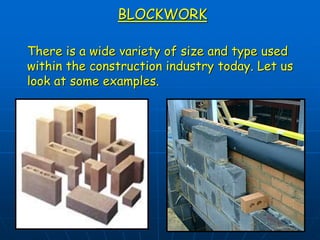
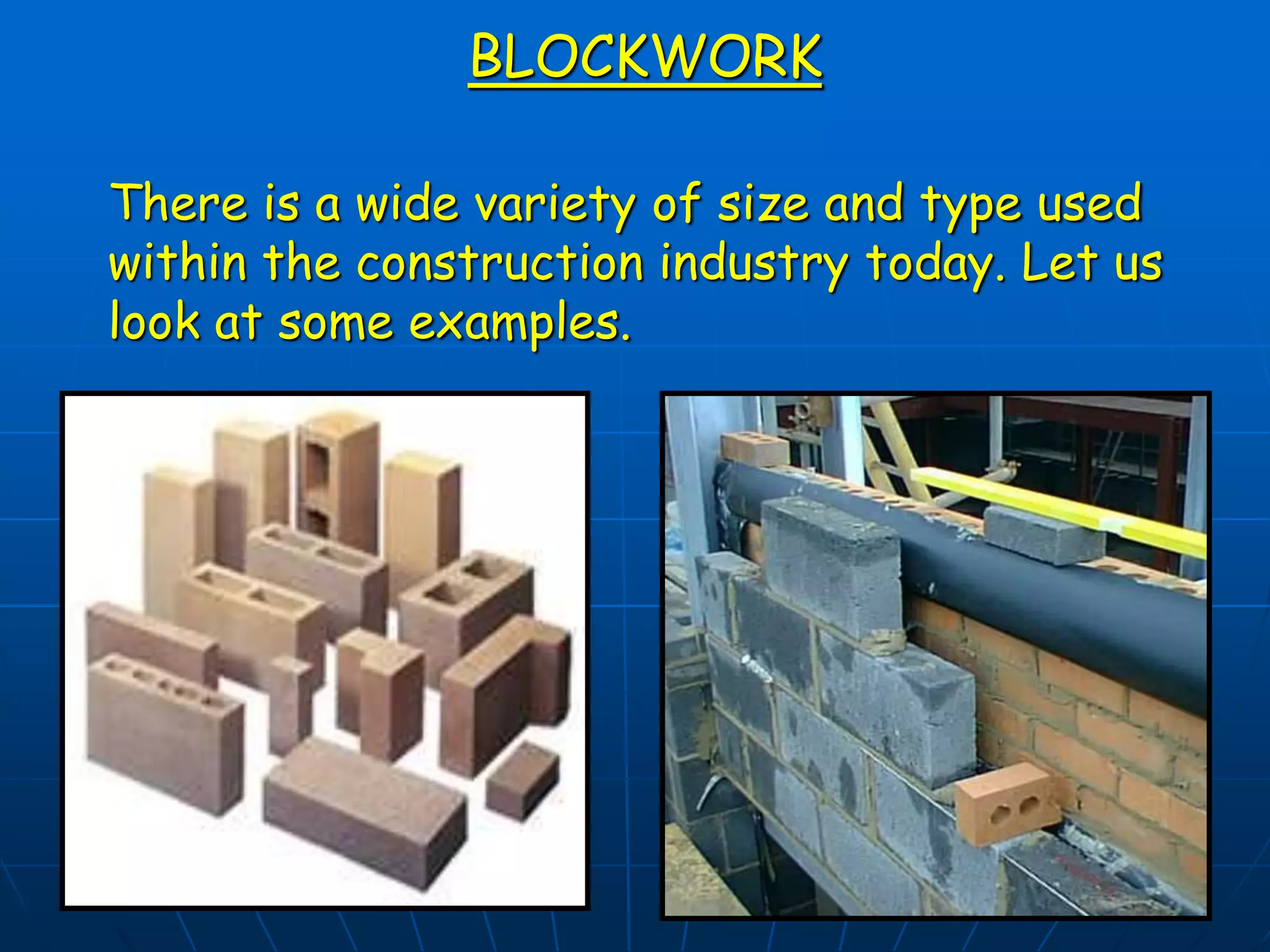
There is a wide variety of size and type used
within the construction industry today. Let us
look at some examples.
Blockwork
Block manufacture:
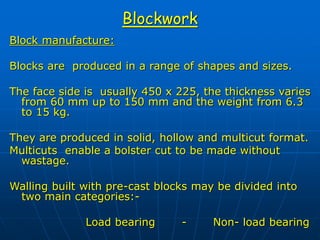
Blocks are produced in a range of shapes and sizes.
The face side is usually 450 x 225, the thickness varies
from 60 mm up to 150 mm and the weight from 6.3
to 15 kg.
They are produced in solid, hollow and multicut format.
Multicuts enable a bolster cut to be made without
wastage.
Walling built with pre-cast blocks may be divided into
two main categories:-
Load bearing - Non- load bearing
Load Bearing Blockwork
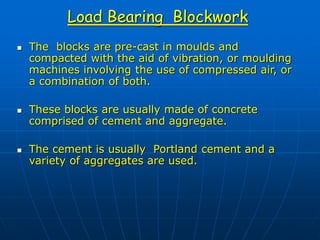
 The blocks are pre-cast in moulds and
compacted with the aid of vibration, or moulding
machines involving the use of compressed air, or
a combination of both.
 These blocks are usually made of concrete
comprised of cement and aggregate.
 The cement is usually Portland cement and a
variety of aggregates are used.
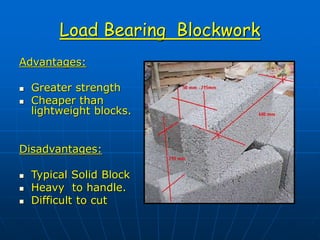
Load Bearing Blockwork
Advantages:
 Greater strength
 Cheaper than
lightweight blocks.
Disadvantages:
 Typical Solid Block
 Heavy to handle.
 Difficult to cut
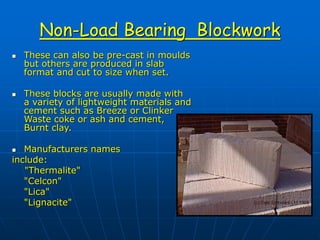
Non-Load Bearing Blockwork
 These can also be pre-cast in moulds
but others are produced in slab
format and cut to size when set.
 These blocks are usually made with
a variety of lightweight materials and
cement such as Breeze or Clinker
Waste coke or ash and cement,
Burnt clay.
 Manufacturers names
include:
"Thermalite"
"Celcon"
"Lica"
"Lignacite"
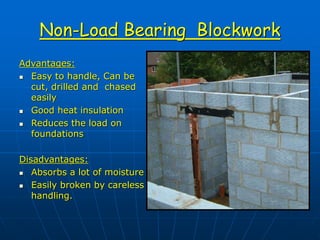
Non-Load Bearing Blockwork
Advantages:
 Easy to handle, Can be
cut, drilled and chased
easily
 Good heat insulation
 Reduces the load on
foundations
Disadvantages:
 Absorbs a lot of moisture
 Easily broken by careless
handling.
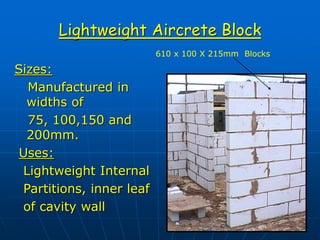
Lightweight Aircrete Block
Sizes:
Manufactured in
widths of
75, 100,150 and
200mm.
Uses:
Lightweight Internal
Partitions, inner leaf
of cavity wall
610 x 100 X 215mm Blocks
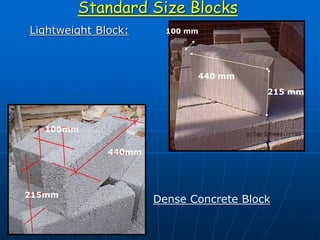
Standard Size Blocks
Lightweight Block: 100 mm
440 mm
215 mm
440mm
100mm
215mm
Dense Concrete Block
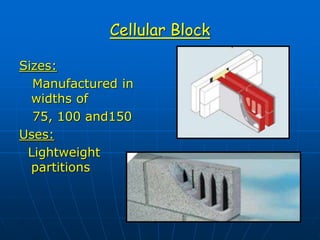
Cellular Block
Sizes:
Manufactured in
widths of
75, 100 and150
Uses:
Lightweight
partitions
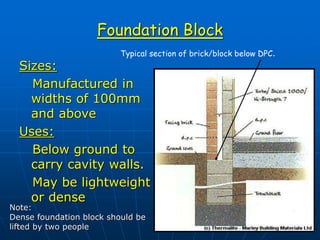
Foundation Block
Sizes:
Manufactured in
widths of 100mm
and above
Uses:
Below ground to
carry cavity walls.
May be lightweight
or dense
Typical section of brick/block below DPC.
Note:
Dense foundation block should be
lifted by two people
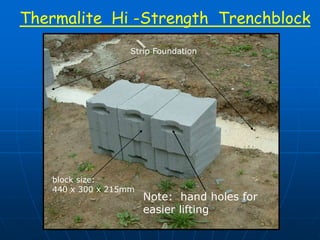
Thermalite Hi -Strength Trenchblock
Note: hand holes for
easier lifting
Strip Foundation
block size:
440 x 300 x 215mm
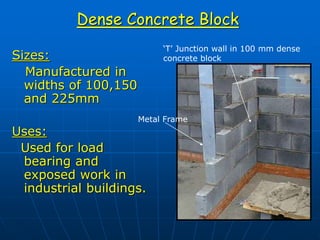
Dense Concrete Block
Sizes:
Manufactured in
widths of 100,150
and 225mm
Uses:
Used for load
bearing and
exposed work in
industrial buildings.
‘T’ Junction wall in 100 mm dense
concrete block
Metal Frame
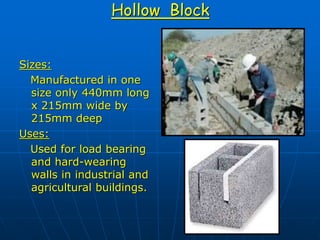
Hollow Block
Sizes:
Manufactured in one
size only 440mm long
x 215mm wide by
215mm deep
Uses:
Used for load bearing
and hard-wearing
walls in industrial and
agricultural buildings.
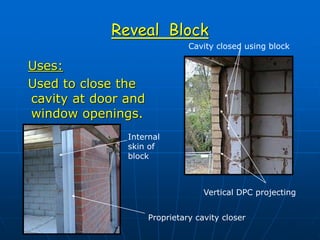
Reveal Block
Uses:
Used to close the
cavity at door and
window openings.
Vertical DPC projecting
Cavity closed using block
Internal
skin of
block
Proprietary cavity closer
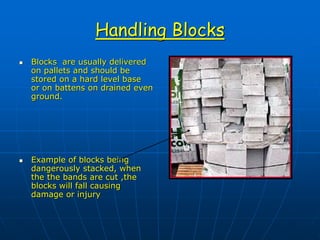
Handling Blocks
 Blocks are usually delivered
on pallets and should be
stored on a hard level base
or on battens on drained even
ground.
 Example of blocks being
dangerously stacked, when
the the bands are cut ,the
blocks will fall causing
damage or injury
Handling Blocks
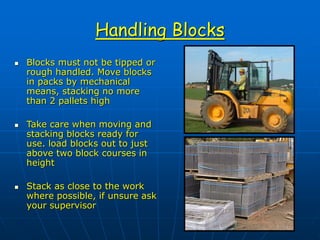
 Blocks must not be tipped or
rough handled. Move blocks
in packs by mechanical
means, stacking no more
than 2 pallets high
 Take care when moving and
stacking blocks ready for
use. load blocks out to just
above two block courses in
height
 Stack as close to the work
where possible, if unsure ask
your supervisor
Preparing the work area
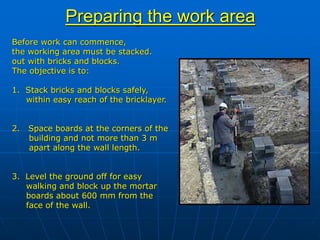
Before work can commence,
the working area must be stacked.
out with bricks and blocks.
The objective is to:
1. Stack bricks and blocks safely,
within easy reach of the bricklayer.
2. Space boards at the corners of the
building and not more than 3 m
apart along the wall length.
3. Level the ground off for easy
walking and block up the mortar
boards about 600 mm from the
face of the wall.
Cold weather conditions
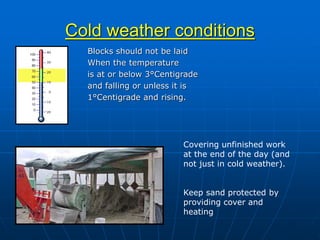
Blocks should not be laid
When the temperature
is at or below 3°Centigrade
and falling or unless it is
1°Centigrade and rising.
Covering unfinished work
at the end of the day (and
not just in cold weather).
Keep sand protected by
providing cover and
heating

Introduction to Blockwork

  • 1.
    BLOCKWORK There is awide variety of size and type used within the construction industry today. Let us look at some examples.
  • 2.
    Blockwork Block manufacture: Blocks areproduced in a range of shapes and sizes. The face side is usually 450 x 225, the thickness varies from 60 mm up to 150 mm and the weight from 6.3 to 15 kg. They are produced in solid, hollow and multicut format. Multicuts enable a bolster cut to be made without wastage. Walling built with pre-cast blocks may be divided into two main categories:- Load bearing - Non- load bearing
  • 3.
    Load Bearing Blockwork The blocks are pre-cast in moulds and compacted with the aid of vibration, or moulding machines involving the use of compressed air, or a combination of both.  These blocks are usually made of concrete comprised of cement and aggregate.  The cement is usually Portland cement and a variety of aggregates are used.
  • 4.
    Load Bearing Blockwork Advantages: Greater strength  Cheaper than lightweight blocks. Disadvantages:  Typical Solid Block  Heavy to handle.  Difficult to cut
  • 5.
    Non-Load Bearing Blockwork These can also be pre-cast in moulds but others are produced in slab format and cut to size when set.  These blocks are usually made with a variety of lightweight materials and cement such as Breeze or Clinker Waste coke or ash and cement, Burnt clay.  Manufacturers names include: "Thermalite" "Celcon" "Lica" "Lignacite"
  • 6.
    Non-Load Bearing Blockwork Advantages: Easy to handle, Can be cut, drilled and chased easily  Good heat insulation  Reduces the load on foundations Disadvantages:  Absorbs a lot of moisture  Easily broken by careless handling.
  • 7.
    Lightweight Aircrete Block Sizes: Manufacturedin widths of 75, 100,150 and 200mm. Uses: Lightweight Internal Partitions, inner leaf of cavity wall 610 x 100 X 215mm Blocks
  • 8.
    Standard Size Blocks LightweightBlock: 100 mm 440 mm 215 mm 440mm 100mm 215mm Dense Concrete Block
  • 9.
    Cellular Block Sizes: Manufactured in widthsof 75, 100 and150 Uses: Lightweight partitions
  • 10.
    Foundation Block Sizes: Manufactured in widthsof 100mm and above Uses: Below ground to carry cavity walls. May be lightweight or dense Typical section of brick/block below DPC. Note: Dense foundation block should be lifted by two people
  • 11.
    Thermalite Hi -StrengthTrenchblock Note: hand holes for easier lifting Strip Foundation block size: 440 x 300 x 215mm
  • 12.
    Dense Concrete Block Sizes: Manufacturedin widths of 100,150 and 225mm Uses: Used for load bearing and exposed work in industrial buildings. ‘T’ Junction wall in 100 mm dense concrete block Metal Frame
  • 13.
    Hollow Block Sizes: Manufactured inone size only 440mm long x 215mm wide by 215mm deep Uses: Used for load bearing and hard-wearing walls in industrial and agricultural buildings.
  • 14.
    Reveal Block Uses: Used toclose the cavity at door and window openings. Vertical DPC projecting Cavity closed using block Internal skin of block Proprietary cavity closer
  • 15.
    Handling Blocks  Blocksare usually delivered on pallets and should be stored on a hard level base or on battens on drained even ground.  Example of blocks being dangerously stacked, when the the bands are cut ,the blocks will fall causing damage or injury
  • 16.
    Handling Blocks  Blocksmust not be tipped or rough handled. Move blocks in packs by mechanical means, stacking no more than 2 pallets high  Take care when moving and stacking blocks ready for use. load blocks out to just above two block courses in height  Stack as close to the work where possible, if unsure ask your supervisor
  • 17.
    Preparing the workarea Before work can commence, the working area must be stacked. out with bricks and blocks. The objective is to: 1. Stack bricks and blocks safely, within easy reach of the bricklayer. 2. Space boards at the corners of the building and not more than 3 m apart along the wall length. 3. Level the ground off for easy walking and block up the mortar boards about 600 mm from the face of the wall.
  • 18.
    Cold weather conditions Blocksshould not be laid When the temperature is at or below 3°Centigrade and falling or unless it is 1°Centigrade and rising. Covering unfinished work at the end of the day (and not just in cold weather). Keep sand protected by providing cover and heating