Presented By:Presented By:
Engineer LATIF HYDER WADHOEngineer LATIF HYDER WADHO
Mehran University of Engg: & Technology KhairpurMehran University of Engg: & Technology Khairpur
Civil Engineering MaterialsCivil Engineering Materials
11stst
Term 1Term 1stst
Year B.E.CivilYear B.E.Civil
3
AGGREGATES
4
Aggregates are inert materials
which are mixed with binding
material such as cement or lime
for manufacturing of mortar or
concrete. Aggregates are used
as filler in mortar and concrete
and also to reduce their cost.
CLASSIFICATION
OF
AGGREGATES
Depending upon the size of
their particles aggregates are
classified as:
(1) Fine aggregates
(2) Coarse aggregates
7
(1) Fine Aggregates:
Aggregates whose particles pass
through 4.75 mm IS sieve are termed
as fine aggregates. Most commonly
used fine aggregates are sand (pit or
quarry sand, river sand and sea sand)
and crushed stone in powdered form,
how ever some times sukhi and ash or
cinder are also used.
8
(a) Sand:
It consists of small angular or
rounded grains of silica depending
upon the source from which it is
obtained. It is classified as:
9
It is found as deposited in soil and is to be
excavated out. Its grains are generally
sharp or angular. It should be free from
organic matter and clay. It is usually
considered to be the best fine aggregate
for use in mortar and concrete.
(i) Pit or quarry sand:
10
(ii) River Sand:
It is obtained from the banks and
beds of rivers. It may be fine or
coarse. Fine sand obtained from
beds and banks of rivers is often
found mixed with silt and clay so it
should be washed before use. But
coarse sand is generally clean and
excellent for use especially for
plastering.
11
(iii) Sea Sand:
It consists of fine rounded grains of
brown colour and it is collected from
sea shores or sea beaches. Sea sand
usually contains salts and while using
that in mortar, etc, causes
disintegration of the work in which it is
used. In R.C.C work these salts will
attack reinforcement if salt content is
high. These salts may cause
efflorescence. It should be used
locally after thorough washing.
12
(b) Crushed stone:
It is obtained by crushing the waste
stones of quarries to the particular
size of sand. Sand obtained from by
crushing a good quality stone is
excellent fine aggregate.
Mortar made with this sand is usually
used in ashlar work (good quality of
work).
13
Aggregates whose particles do
not pass through 4.75 mm IS are
termed as coarse aggregates.
Most commonly used coarse
aggregates are crushed stone,
gravel; broken pieces of burnt
bricks,etc.
(2) Coarse Aggregates:
14
It is an excellent coarse aggregate
and is obtained by crushing granite,
sand stone or grained lime stone
and all types of stones. Crushed
stones are used for the construction
of roads and railway tracks, etc.
(a) Crushed stone:
15
(b) Gravel:
It is an other very good coarse
aggregate. It is obtained from
river beds, quarries and sea
shores. The gravel obtained from
sea shores should be well
washed with fresh water before
use in order to remove the
impurities which may be clay,
salts ,silt,etc. It is commonly used
in the preparation of concrete.
16
(c) Broken pieces of bricks:
It is also a good artificial source of coarse
aggregates. It is obtained by breaking well
burnt bricks. It is generally used in lime
concrete at places where aggregates from
natural sources are either not available or
are expensive. It can be used at places
where low strength is required. It should be
watered well before using it in the
preparation of concrete. It is commonly
used for mass concrete in foundations and
under floors.
17
GOOD QUALITYIES OF AN IDEAL
AGGREGATE:
An ideal aggregate used for the
manufacturing of concrete and
mortar, should meet the following
requirements.
(1) It should consist of natural stones,
gravels and sand or in various
combinations of these materials.
(2) It should be hard, strong and
durable.
18
(3) It should be dense, clear and
free from any coating.
(4) It should be free from injurious
vegetable matters.
(5) It should not contain flaky
(angular) and elongated pieces.
(6) It should not contain any
material liable to attack steel
reinforcement in case of reinforced
concrete.
19
Important characteristics of
aggregates which influence the
properties of resulting concrete mix
are discussed as under:
CHARACTERISTICS OF
AGGREGATES:
20
Aggregate containing the
constituents which generally react
with alkalies in cement cause
excessive expansion, cracking of
concrete mix, should never be used.
Suitability of aggregates should be
judged either by studying its service
history or by laboratory tests.
1.Composition:
21
The size and shape of the
aggregate particles mainly influence
the quantity of cement required in a
concrete mix and ultimately
economy of the concrete. For the
preparation of economical concrete,
one should use largest coarse
aggregates feasible for the
structure.
2. Size and shape:
22
Type of structure Max. size of aggregate
1. Mass concrete work 40 mm
i.e. dams, retaining walls,
piers and abutments, etc.
2. R.C.C work 20 mm
i.e. beams, columns, etc
3. Flooring 10 mm
It may be clearly noted that the size and
shape of the aggregate particles influence the
properties of freshly mixed concrete more as
compared to those of hardened concrete.
23
There are so many tests which are
to be performed to check the quality
of aggregates but some important
tests are discussed below.
QUALITY TESTS OF
AGGREGATES:
24
The aggregate crushing value gives
a relative measure of resistance of
an aggregate to crushing under a
gradually applied compressive load.
The aggregate crushing strength
value is useful factor to know the
behaviour of aggregates when
subjected to wear.
1. Crushing Test of Aggregate:
25
The aggregate impact value gives a
relative measure of the resistance
of an aggregate to sudden shock or
impact. The impact value is some
times used as an alternative to its
crushing value.
2. Impact Value Test:
26
The aggregate abrasion
value gives a relative
measure of resistance of an
aggregate to wear when it is
rotated in a cylinder along
with some abrasive charge.
3. Abrasion Value:
27
In determination of the proportions
of the particles with in certain
ranges in an aggregate by
separation on various sieves of
different size openings, may be
defined as sieve analysis.
SIEVE ANALYSIS:
28
FINENESS MODULUS (F.M):
The sum of cumulative percentage of
residues retained on each of the Indian
standard sieves
(80mm,40mm,20mm,10mm,4.75mm,2.36m
m,1.18mm,600 microns,300microns and
150 microns each succeeding sieve has
half the aperture of the previous one),
divided by the 100,is known as “Fineness
modulus” of the aggregates. The fineness
modulus of an aggregate is roughly
proportional to the average size of particles
of the aggregates.
29
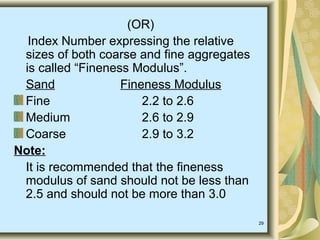
(OR)
Index Number expressing the relative
sizes of both coarse and fine aggregates
is called “Fineness Modulus”.
Sand Fineness Modulus
Fine 2.2 to 2.6
Medium 2.6 to 2.9
Coarse 2.9 to 3.2
Note:
It is recommended that the fineness
modulus of sand should not be less than
2.5 and should not be more than 3.0
Developed by:Nadeem Asghar 30
Thank
You

Aggregates ppt

  • 2.
    Presented By:Presented By: EngineerLATIF HYDER WADHOEngineer LATIF HYDER WADHO Mehran University of Engg: & Technology KhairpurMehran University of Engg: & Technology Khairpur Civil Engineering MaterialsCivil Engineering Materials 11stst Term 1Term 1stst Year B.E.CivilYear B.E.Civil
  • 3.
  • 4.
    4 Aggregates are inertmaterials which are mixed with binding material such as cement or lime for manufacturing of mortar or concrete. Aggregates are used as filler in mortar and concrete and also to reduce their cost.
  • 5.
  • 6.
    Depending upon thesize of their particles aggregates are classified as: (1) Fine aggregates (2) Coarse aggregates
  • 7.
    7 (1) Fine Aggregates: Aggregateswhose particles pass through 4.75 mm IS sieve are termed as fine aggregates. Most commonly used fine aggregates are sand (pit or quarry sand, river sand and sea sand) and crushed stone in powdered form, how ever some times sukhi and ash or cinder are also used.
  • 8.
    8 (a) Sand: It consistsof small angular or rounded grains of silica depending upon the source from which it is obtained. It is classified as:
  • 9.
    9 It is foundas deposited in soil and is to be excavated out. Its grains are generally sharp or angular. It should be free from organic matter and clay. It is usually considered to be the best fine aggregate for use in mortar and concrete. (i) Pit or quarry sand:
  • 10.
    10 (ii) River Sand: Itis obtained from the banks and beds of rivers. It may be fine or coarse. Fine sand obtained from beds and banks of rivers is often found mixed with silt and clay so it should be washed before use. But coarse sand is generally clean and excellent for use especially for plastering.
  • 11.
    11 (iii) Sea Sand: Itconsists of fine rounded grains of brown colour and it is collected from sea shores or sea beaches. Sea sand usually contains salts and while using that in mortar, etc, causes disintegration of the work in which it is used. In R.C.C work these salts will attack reinforcement if salt content is high. These salts may cause efflorescence. It should be used locally after thorough washing.
  • 12.
    12 (b) Crushed stone: Itis obtained by crushing the waste stones of quarries to the particular size of sand. Sand obtained from by crushing a good quality stone is excellent fine aggregate. Mortar made with this sand is usually used in ashlar work (good quality of work).
  • 13.
    13 Aggregates whose particlesdo not pass through 4.75 mm IS are termed as coarse aggregates. Most commonly used coarse aggregates are crushed stone, gravel; broken pieces of burnt bricks,etc. (2) Coarse Aggregates:
  • 14.
    14 It is anexcellent coarse aggregate and is obtained by crushing granite, sand stone or grained lime stone and all types of stones. Crushed stones are used for the construction of roads and railway tracks, etc. (a) Crushed stone:
  • 15.
    15 (b) Gravel: It isan other very good coarse aggregate. It is obtained from river beds, quarries and sea shores. The gravel obtained from sea shores should be well washed with fresh water before use in order to remove the impurities which may be clay, salts ,silt,etc. It is commonly used in the preparation of concrete.
  • 16.
    16 (c) Broken piecesof bricks: It is also a good artificial source of coarse aggregates. It is obtained by breaking well burnt bricks. It is generally used in lime concrete at places where aggregates from natural sources are either not available or are expensive. It can be used at places where low strength is required. It should be watered well before using it in the preparation of concrete. It is commonly used for mass concrete in foundations and under floors.
  • 17.
    17 GOOD QUALITYIES OFAN IDEAL AGGREGATE: An ideal aggregate used for the manufacturing of concrete and mortar, should meet the following requirements. (1) It should consist of natural stones, gravels and sand or in various combinations of these materials. (2) It should be hard, strong and durable.
  • 18.
    18 (3) It shouldbe dense, clear and free from any coating. (4) It should be free from injurious vegetable matters. (5) It should not contain flaky (angular) and elongated pieces. (6) It should not contain any material liable to attack steel reinforcement in case of reinforced concrete.
  • 19.
    19 Important characteristics of aggregateswhich influence the properties of resulting concrete mix are discussed as under: CHARACTERISTICS OF AGGREGATES:
  • 20.
    20 Aggregate containing the constituentswhich generally react with alkalies in cement cause excessive expansion, cracking of concrete mix, should never be used. Suitability of aggregates should be judged either by studying its service history or by laboratory tests. 1.Composition:
  • 21.
    21 The size andshape of the aggregate particles mainly influence the quantity of cement required in a concrete mix and ultimately economy of the concrete. For the preparation of economical concrete, one should use largest coarse aggregates feasible for the structure. 2. Size and shape:
  • 22.
    22 Type of structureMax. size of aggregate 1. Mass concrete work 40 mm i.e. dams, retaining walls, piers and abutments, etc. 2. R.C.C work 20 mm i.e. beams, columns, etc 3. Flooring 10 mm It may be clearly noted that the size and shape of the aggregate particles influence the properties of freshly mixed concrete more as compared to those of hardened concrete.
  • 23.
    23 There are somany tests which are to be performed to check the quality of aggregates but some important tests are discussed below. QUALITY TESTS OF AGGREGATES:
  • 24.
    24 The aggregate crushingvalue gives a relative measure of resistance of an aggregate to crushing under a gradually applied compressive load. The aggregate crushing strength value is useful factor to know the behaviour of aggregates when subjected to wear. 1. Crushing Test of Aggregate:
  • 25.
    25 The aggregate impactvalue gives a relative measure of the resistance of an aggregate to sudden shock or impact. The impact value is some times used as an alternative to its crushing value. 2. Impact Value Test:
  • 26.
    26 The aggregate abrasion valuegives a relative measure of resistance of an aggregate to wear when it is rotated in a cylinder along with some abrasive charge. 3. Abrasion Value:
  • 27.
    27 In determination ofthe proportions of the particles with in certain ranges in an aggregate by separation on various sieves of different size openings, may be defined as sieve analysis. SIEVE ANALYSIS:
  • 28.
    28 FINENESS MODULUS (F.M): Thesum of cumulative percentage of residues retained on each of the Indian standard sieves (80mm,40mm,20mm,10mm,4.75mm,2.36m m,1.18mm,600 microns,300microns and 150 microns each succeeding sieve has half the aperture of the previous one), divided by the 100,is known as “Fineness modulus” of the aggregates. The fineness modulus of an aggregate is roughly proportional to the average size of particles of the aggregates.
  • 29.
    29 (OR) Index Number expressingthe relative sizes of both coarse and fine aggregates is called “Fineness Modulus”. Sand Fineness Modulus Fine 2.2 to 2.6 Medium 2.6 to 2.9 Coarse 2.9 to 3.2 Note: It is recommended that the fineness modulus of sand should not be less than 2.5 and should not be more than 3.0
  • 30.