MORTAR
Content :-
• Introduction
• Constituents
• Properties
• Types of mortar
• Selection of mortar
• Tests
• Grouting
• Guniting
• Application
• Site visit
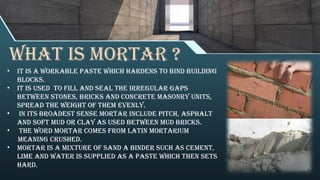
What is mortar ?
• It is a workable paste which hardens to bind building
blocks.
• It is used to fill and seal the irregular gaps
between stones, bricks and concrete masonry units,
spread the weight of them evenly.
• In its broadest sense mortar include pitch, asphalt
and soft mud or clay as used between mud bricks.
• The word Mortar comes from Latin mortarium
meaning crushed.
• mortar is a mixture of sand a Binder such as cement,
lime and water is supplied as a paste which then sets
hard.
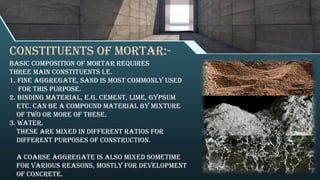
Constituents of mortar:-
Basic composition of mortar requires
three main constituents i.e.
1. Fine aggregate, Sand is most commonly used
for this purpose.
2. Binding material, e.g. Cement, Lime, Gypsum
etc. Can be a compound material by mixture
of two or more of these.
3. Water.
These are mixed in different ratios for
different purposes of construction.
A coarse aggregate is also mixed sometime
for various reasons, mostly for development
of concrete.
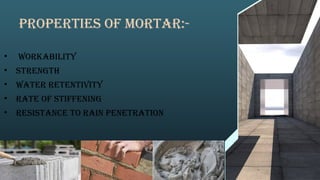
PROPERTIES OF MORTAR:-
• workability
• Strength
• water retentivity
• rate of stiffening
• resistance to rain penetration
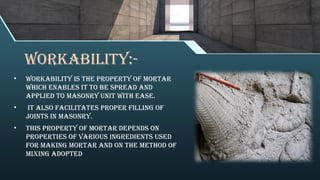
WORKABILITY:-
• Workability is the property of mortar
which enables it to be spread and
applied to masonry unit with ease.
• It also facilitates proper filling of
joints in masonry.
• This property of mortar depends on
properties of various ingredients used
for making mortar and on the method of
mixing adopted
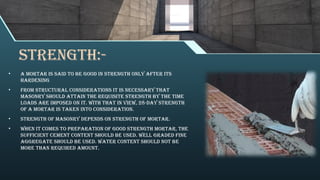
STRENGTH:-
• A mortar is said to be good in strength only after its
hardening
• From structural considerations it is necessary that
masonry should attain the requisite strength by the time
loads are imposed on it. With that in view, 28-day strength
of a mortar is taken into consideration.
• Strength of masonry depends on strength of mortar.
• When it comes to preparation of good strength mortar, the
sufficient cement content should be used. Well graded fine
aggregate should be used. Water content should not be
more than required amount.
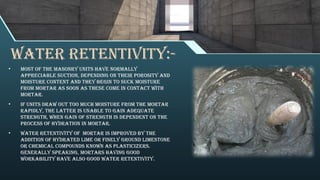
WATER RETENTIVITY:-
• Most of the masonry units have normally
appreciable suction, depending on their porosity and
moisture content and they begin to suck moisture
from mortar as soon as these come in contact with
mortar.
• If units draw out too much moisture from the mortar
rapidly, the latter is unable to gain adequate
strength, when gain of strength is dependent on the
process of hydration in mortar.
• Water retentivity of mortar is improved by the
addition of hydrated lime or finely ground limestone
or chemical compounds known as plasticizers.
Generally speaking, mortars having good
workability have also good water retentivity.
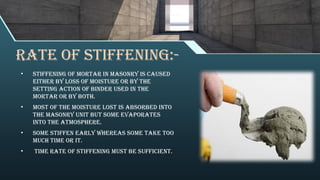
RATE OF STIFFENING:-
• Stiffening of mortar in masonry is caused
either by loss of moisture or by the
setting action of binder used in the
mortar or by both.
• Most of the moisture lost is absorbed into
the masonry unit but some evaporates
into the atmosphere.
• Some stiffen early whereas some take too
much time or it.
• time rate of stiffening must be sufficient.
RESISTANCE TO RAIN PENETRATION:-
• Rain water penetrates a masonry wall
through
- pores of masonry units
- pores of mortar
- cracks between units and mortar
• main source of rain penetration is
through cracks in masonry.
• from the point of rain penetration,
bonding property of mortar is of great
importance.
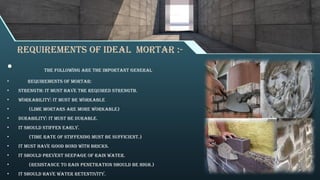
REQUIREMENTS OF ideal MORTAR :-
• The following are the important general
• requirements of mortar:
• Strength: It must have the required strength.
• Workability: It must be workable
• (lime mortars are more workable)
• Durability: It must be durable.
• It should stiffen early.
• (Time rate of stiffening must be sufficient.)
• It must have good bond with bricks.
• It should prevent seepage of rain water.
• (Resistance to rain penetration should be high.)
• It should have water retentivity.
Types of mortar :-
• Based on bulk density
• Based on Nature of
application
• Based on strength
• Based on binding material used
• Special purpose mortars
Bulk density :-
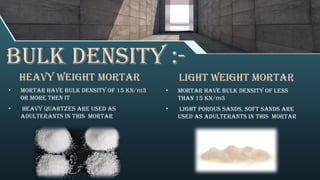
heavy weight mortar
• mortar have bulk density of 15 KN/ 3
𝑚
or more then it
• heavy quartzes are used as
adulterants in this mortar
Light weight mortar
• mortar have bulk density of less
than 15 KN/ 3
𝑚
• light porous sands, soft sands are
used as adulterants in this mortar
Based on nature of
applications:-
• Brick laying or stone
laying mortar
• Finishing mortar
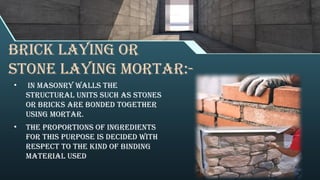
BRICK LAYING OR
STONE LAYING MORTAR:-
• In masonry walls the
structural units such as stones
or bricks are bonded together
using mortar.
• The proportions of ingredients
for this purpose is decided with
respect to the kind of binding
material used
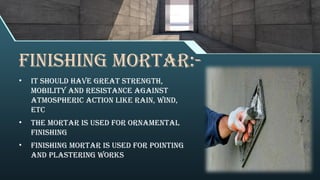
FINISHING MORTAR:-
• It should have great strength,
mobility and resistance against
atmospheric action like rain, wind,
etc
• The mortar is used for ornamental
finishing
• Finishing mortar is used for pointing
and plastering works
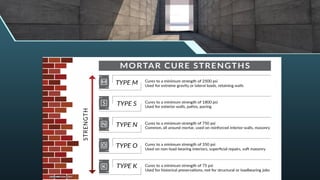
Based on strength
• Type m
• Type s
• Type n
• Type o
• Type k
Based on binding material
used:-
• Cement mortar
• Lime mortar
• Surkhi mortar
• Mud mortar
• Gypsum mortar
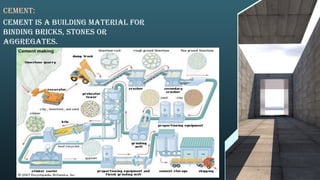
Cement is a building material for
binding bricks, stones or
aggregates.
CEMENT:
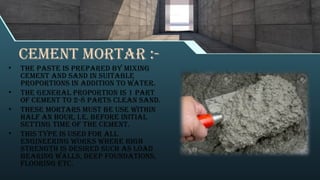
Cement mortar :-
• The paste is prepared by mixing
cement and sand in suitable
proportions in addition to water.
• The general proportion is 1 part
of cement to 2-8 parts clean sand.
• These mortars must be use within
half an hour, i.e. before initial
setting time of the cement.
• This type is used for all
engineering works where high
strength is desired such as load
bearing walls, deep foundations,
flooring etc.
PREPARATION OF cement MORTAR
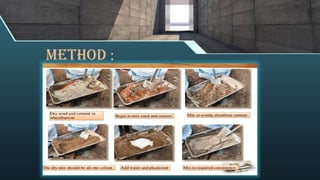
• When mixing by hand, the sand cement are helped up on a mixing board or in a wheel
barrow and repeatedly turned over and over until thoroughly mixed.
• The colour of the dry mix will change as the cement is distributed throughout - there
should be no ‘streaking’ of cement, and no clumps of pure sand or pure cement.
• Once the dry ingredient are mixed, the water can be added.
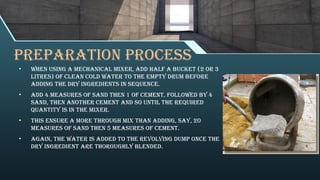
PREPARATION PROCESS
• When using a mechanical mixer, add half a bucket (2 or 3
litres) of clean cold water to the empty drum before
adding the dry ingredients in sequence.
• Add 4 measures of sand then 1 of cement, followed by 4
sand, then another cement and so until the required
quantity is in the mixer.
• This ensure a more through mix than adding, say, 20
measures of sand then 5 measures of cement.
• Again, the water is added to the revolving dump once the
dry ingredient are thoroughly blended.
METHOD :
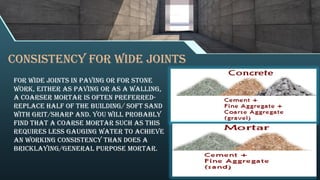
CONSISTENCY FOR WIDE JOINTS
For wide joints in paving or for stone
work, either as paving or as a walling,
a coarser mortar is often preferred-
replace half of the building/ soft sand
with grit/sharp and. You will probably
find that a coarse mortar such as this
requires less gauging water to achieve
an working consistency than does a
bricklaying/general purpose mortar.
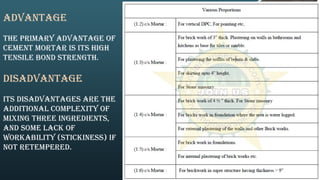
advantage
The primary advantage of
cement mortar is its high
tensile bond strength.
disadvantage
its disadvantages are the
additional complexity of
mixing three ingredients,
and some lack of
workability (stickiness) if
not retempered.
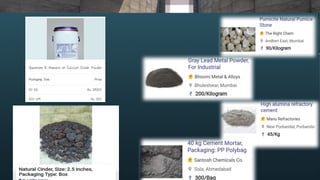
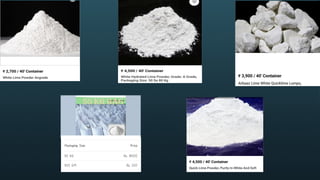
prices of cement :
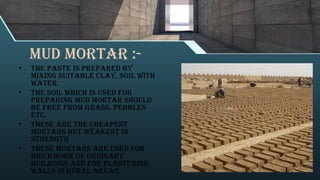
Mud mortar :-
• The paste is prepared by
mixing suitable clay, soil with
water.
• The soil which is used for
preparing mud mortar should
be free from grass, pebbles
etc.
• These are the cheapest
mortars but weakest in
strength
• These mortars are used for
brickwork of ordinary
buildings and for plastering
walls in rural areas.
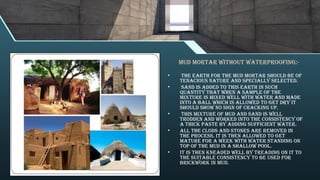
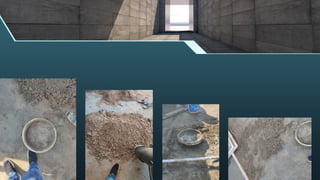
Mud mortar without waterproofing:-
• The earth for the mud mortar should be of
tenacious nature and specially selected.
• Sand is added to this earth in such
quantity that when a sample of the
mixture is mixed well with water and made
into a ball which is allowed to get dry it
should show no sign of cracking up.
• This mixture of mud and sand is well
trodden and worked into the consistency of
a thick paste by adding sufficient water.
• All the clods and stones are removed in
the process. It is then allowed to get
mature for a week with water standing on
top of the mud in a shallow pool.
• It is then kneaded well by treading on it to
the suitable consistency to be used for
brickwork in mud.
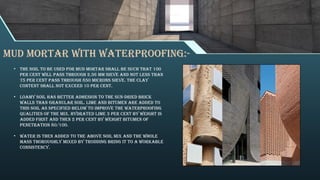
Mud mortar with waterproofing:-
• The soil to be used for mud mortar shall be such that 100
per cent will pass through 2.36 mm sieve and not less than
75 per cent pass through 850 microns sieve. The clay
content shall not exceed 10 per cent.
• Loamy soil has better adhesion to the sun-dried brick
walls than granular soil. Lime and bitumen are added to
this soil as specified below to improve the waterproofing
qualities of the mix. Hydrated lime 3 per cent by weight is
added first and then 2 per cent by weight bitumen of
penetration 80/100.
• Water is then added to the above soil mix and the whole
mass thoroughly mixed by trodding bring it to a workable
consistency.
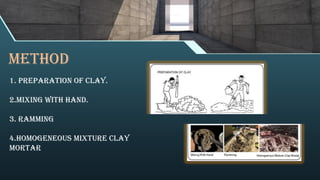
METHOD
1. PREPARATION OF CLAY.
2.MIXING WITH HAND.
3. RAMMING
4.HOMOGENEOUS MIXTURE CLAY
MORTAR
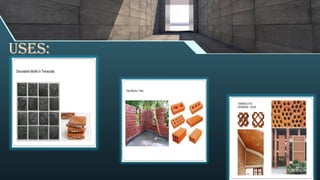
USES:
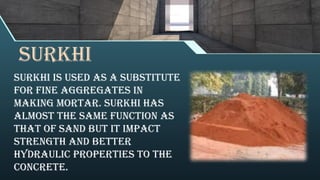
surkhi
Surkhi is used as a substitute
for fine aggregates in
making mortar. Surkhi has
almost the same function as
that of sand but it impact
strength and better
hydraulic properties to the
concrete.
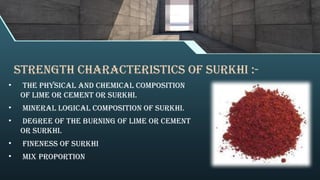
Strength characteristics of surkhi :-
• The physical and chemical composition
of lime or cement or surkhi.
• Mineral logical composition of surkhi.
• Degree of the burning of lime or cement
or surkhi.
• Fineness of surkhi
• Mix proportion
Types of surkhi mortar:-
1. Surkhi-Lime Mortar
• The mixture of lime, surkhi and
water is said to be the surkhi-
lime mortar.
• This mortar has a low heat of
hydration. It sets very
slowly.
2. Surkhi-Cement Mortar
• It is the mixture of cement,
surkhi and water in definite
proportion.
• This mortar is commonly used.
It also has a high heat of
hydration and high setting
time.
Advantage of surkhi Mortar
• There is a global sand storage. So surkhi mortar can be used as an alternative.
• Its has a low heat of hydration.
• It is more resistive to alkalis and salt solutions.
• It is slow in setting and therefore it can be used for work up to a period of six
hours of its preparation without disturbing the efficiency of mortar.
Disadvantages of surkhi Mortar
• Compared to ordinary mortar it is more subjected to shrinkage.
• It has low compressive strength as compared to ordinary cement mortar.
• It set slowly
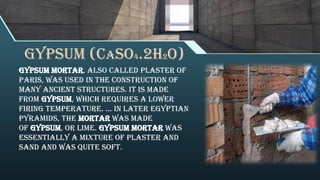
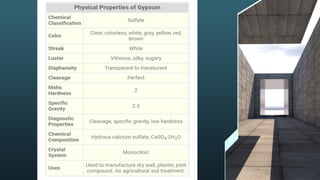
GYPsum (CaSO4.2h2o)
Gypsum mortar, also called plaster of
Paris, was used in the construction of
many ancient structures. It is made
from gypsum, which requires a lower
firing temperature. ... In later Egyptian
pyramids, the mortar was made
of gypsum, or lime. Gypsum mortar was
essentially a mixture of plaster and
sand and was quite soft.
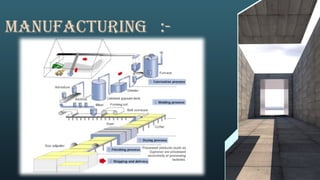
Manufacturing :-
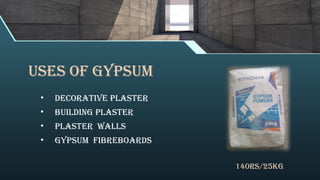
Uses of gypsum
• Decorative Plaster
• Building plaster
• Plaster Walls
• Gypsum fibreboards
140rs/25kg
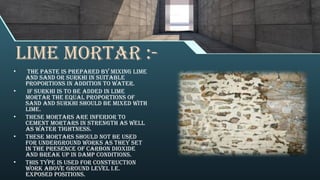
Lime mortar :-
• The paste is prepared by mixing lime
and sand or surkhi in suitable
proportions in addition to water.
• If surkhi is to be added in lime
mortar the equal proportions of
sand and surkhi should be mixed with
lime.
• These mortars are inferior to
cement mortars in strength as well
as water tightness.
• These mortars should not be used
for underground works as they set
in the presence of carbon dioxide
and break up in damp conditions.
• This type is used for construction
work above ground level i.e.
exposed positions.
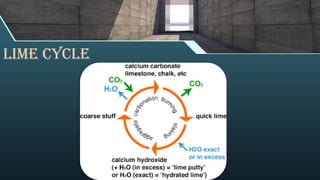
Lime cycle
Types of lime :-
NON – HYDRAULIC LIME
• It does not require water in order to harden.
• It can be produced in two different forms , i.e.
lime putty and hydrated lime.
• Sometimes called ‘fat lime’ .
• When it is set in mason unit , it takes quite a
long time to harden.
HYDRAULIC LIME
• These Mortars are designed to harden when they
come in contact with water
• There are three strength grades for natural
hydraulic lime
• NHL2 (Feebly Hydraulic Lime)
• NHL3.5 (Moderately Hydraulic Lime )
• NHL5 ( Eminently Hydraulic Lime )
HOT MIXED LIME MORTAR
• This process combines slaking and mixing of the
aggregate in one operation.
• Unsuitable for plastering as it may contain
unslaked particles
Special purpose
mortars:-
• Fire resistance mortar
• Packing mortar
• Sound absorbing mortar
• Chemical resistant mortar
• Lightweight mortar
• X-ray shielding mortar
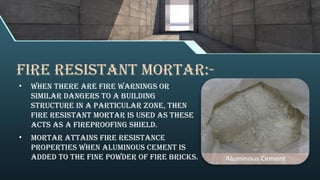
Fire Resistant Mortar:-
• When there are fire warnings or
similar dangers to a building
structure in a particular zone, then
fire resistant mortar is used as these
acts as a fireproofing shield.
• Mortar attains fire resistance
properties when aluminous cement is
added to the fine powder of fire bricks.
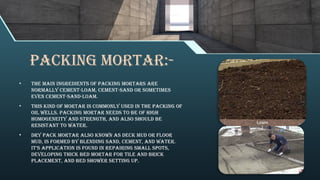
Packing Mortar:-
• The main ingredients of packing mortars are
normally cement-loam, cement-sand or sometimes
even cement-sand-loam.
• This kind of mortar is commonly used in the packing of
oil wells. Packing mortar needs to be of high
homogeneity and strength, and also should be
resistant to water.
• Dry pack mortar also known as deck mud or floor
mud, is formed by blending sand, cement, and water.
It’s application is found in repairing small spots,
developing thick bed mortar for tile and brick
placement, and bed shower setting up.
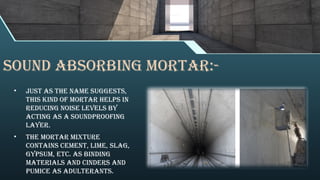
Sound Absorbing Mortar:-
• Just as the name suggests,
this kind of mortar helps in
reducing noise levels by
acting as a soundproofing
layer.
• The mortar mixture
contains cement, lime, slag,
gypsum, etc. as binding
materials and cinders and
pumice as adulterants.
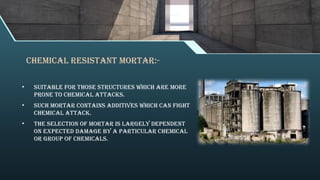
Chemical Resistant Mortar:-
• suitable for those structures which are more
prone to chemical attacks.
• Such mortar contains additives which can fight
chemical attack.
• The selection of mortar is largely dependent
on expected damage by a particular chemical
or group of chemicals.
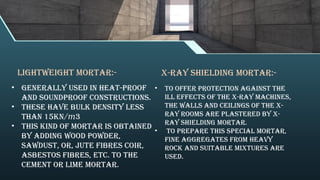
• To offer protection against the
ill effects of the X-ray machines,
the walls and ceilings of the X-
ray rooms are plastered by X-
ray shielding mortar.
• To prepare this special mortar,
fine aggregates from heavy
rock and suitable mixtures are
used.
X-ray Shielding Mortar:-
Lightweight Mortar:-
• Generally used in heat-proof
and soundproof constructions.
• these Have bulk density less
than 15KN/ 3
𝑚
• This kind of mortar is obtained
by adding wood powder,
sawdust, or, jute fibres coir,
asbestos fibres, etc. to the
cement or lime mortar.
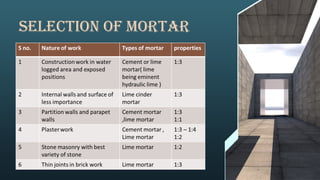
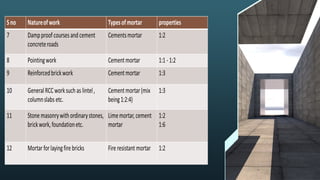
Selection of mortar
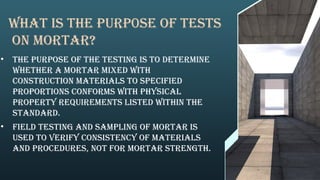
What is the purp0se of tests
on mortar?
• The purpose of the testing is to determine
whether a mortar mixed with
construction materials to specified
proportions conforms with physical
property requirements listed within the
standard.
• Field testing and sampling of mortar is
used to verify consistency of materials
and procedures, not for mortar strength.
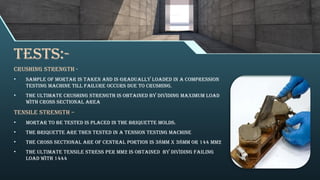
Tests:-
Crushing strength -
• Sample of mortar is taken and is gradually loaded in a compression
testing machine till failure occurs due to crushing.
• The ultimate crushing strength is obtained by dividing maximum load
with cross sectional area
Tensile strength –
• Mortar to be tested is placed in the briquette molds.
• The briquette are then tested in a tension testing machine
• The cross sectional are of central portion is 38mm x 38mm or 144 mm2
• The ultimate tensile stress per mm2 is obtained by dividing failing
load with 1444
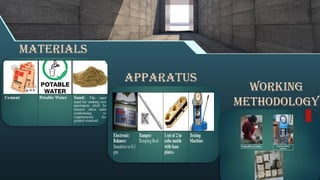
apparatus
Materials
Working
methodology
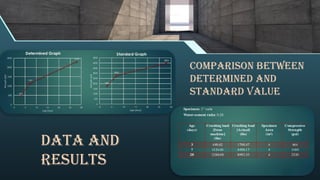
data and
results
Comparison between
determined and
standard value
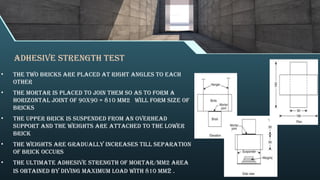
adhesive strength test
• The two bricks are placed at right angles to each
other
• The mortar is placed to join them so as to form a
horizontal joint of 90x90 = 810 mm2 will form size of
bricks
• The upper brick is suspended from an overhead
support and the weights are attached to the lower
brick
• The weights are gradually increases till separation
of brick occurs
• The ultimate adhesive strength of mortar/mm2 area
is obtained by diving maximum load with 810 mm2 .
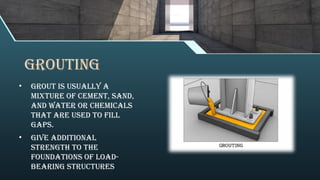
grouting
• Grout is usually a
mixture of cement, sand,
and water or chemicals
that are used to fill
gaps.
• Give additional
strength to the
foundations of load-
bearing structures
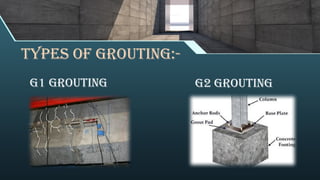
Types of grouting:-
G1 GROUTING G2 Grouting
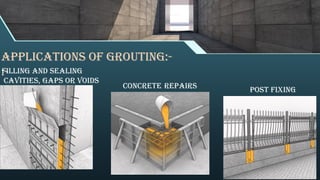
Applications of grouting:-
:-
Filling and sealing
cavities, gaps or voids
Post fixing
Concrete repairs
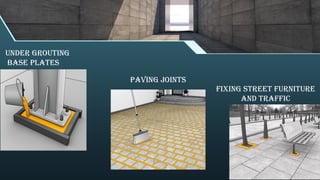
Under grouting
base plates
Paving joints
Fixing street furniture
and traffic
Guniting:-
Application of mortar or concrete under pneumatic
pressure through a cement gun is
known as guniting, concrete becomes extremely strong & a
high bond is achieved.
Composed of cement & sand conveyed
through gun.
Water is added at high velocity & the mix
strikes the surface.
Brick Masonry Construction Preparation-
• Check the level of the ground using level, theodolite or
transparent hose level.
• Set the layout of the structure.
• Trace of building axis and wall alignment using gypsum
powder, chalk, or similar, marking the trenches for
foundation.
• After that, install foundation wall, cure foundation for
minimum two days before beginning of brick masonry
construction.
• Distribute bricks in several stacks along project site to cut
time and effort later.
• Wet bricks few hours prior to the work. Not only does
this avoid absorbing too much water from mortar but also
improve adherence of bricks and mortar.
Brick Masonry Construction Procedure
• Initially, mix the mortar with water and blend it until a smooth
and plastic mortar is produced.
• After that, place the mortar on foundation line evenly using
trowel (25mm thickness and one brick wide is recommended for
laid mortar).
• Then, lay the first course of stretcher bricks in the mortar.
Start with second brick, apply mortar to the head joint end of
each brick, After that shove the bricks into place firmly so
that the mortar is squeezed out of all side of the joints.
• Utilize a level to examine the course for correct height. ensure
that bricks are plumb and level.
• Place another mortar line alongside the first course, then
begin laying the second course.
• Use the two half bricks to begin the second to ensure that the first two courses
are staggered for structural purposes.
• To finish the second course of the lead, lay three header bricks and make sure
that they are plumb and level.
• The third and fifth courses consists of stretchers similar to the first course.
The fourth course begins with single header,
• followed by stretchers. Use the level to make sure that the lead is true on each
course. Lastly, this pattern of brick laying is used till the target height is
reached.
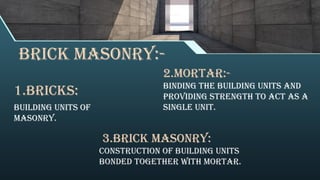
BRICK MASONRY:-
1.BRICKS:
Building units of
masonry.
2.MORTAR:-
Binding the building units and
providing strength to act as a
single unit.
3.BRICK MASONRY:
Construction of building units
bonded together with mortar.
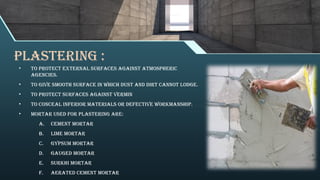
PLASTERING :
• To protect external surfaces against atmospheric
agencies.
• To give smooth surface in which dust and dirt cannot lodge.
• To protect surfaces against vermin
• To conceal inferior materials or defective workmanship.
• Mortar used for plastering are:
a. Cement Mortar
b. Lime Mortar
c. Gypsum Mortar
d. Gauged Mortar
e. Surkhi Mortar
f. Aerated Cement Mortar
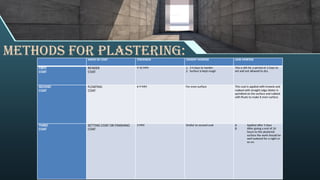
METHODS FOR PLASTERING:
NAME OF COAT THICKNESS CEMENT MORTAR LIME MORTAR
FIRST
COAT
RENDER
COAT
9-10 MM 1. 3-4 days to harden
2. Surface is kept rough
This is left for a period of 2 Days to
set and not allowed to dry.
SECOND
COAT
FLOATING
COAT
6-9 MM For even surface This coat is applied with trowels and
rubbed with straight edge.Water is
sprinkled on the surface and rubbed
with floats to make it even surface.
THIRD
COAT
SETTING COAT OR FINISHING
COAT
3 MM Similar to second coat A. Applied after 5 days
B. After giving a rest of 24
hours to the plastered
surface the work should be
well watered for a night or
so on.
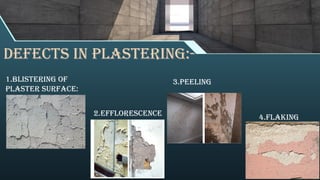
Defects in plastering:-
3.PEELING
4.FLAKING
1.BLISTERING OF
PLASTER SURFACE:
2.EFFLORESCENCE
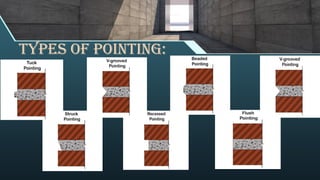
POINTING:
The term pointing is used to denote the finishing of mortar
in either stone masonry or brick masonry. Pointing involves
raking out of joints which are constructed with good
mortar and filling the joints with mortar which, in many
cases is not sufficiently watered.
Types of pointing:
Market
survey
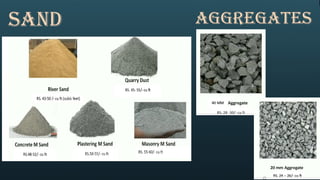
SAND aggregates
cement
50 KG bag
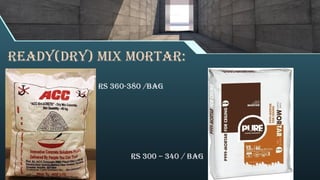
READY(DRY) MIX MORTAR:
RS 360-380 /bag
RS 300 – 340 / bag
50 KG bag
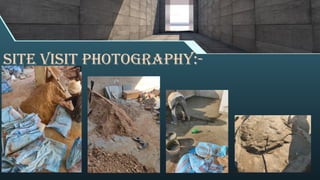
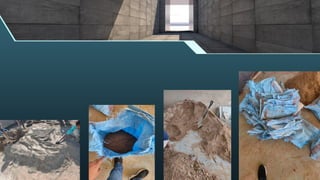
Site visit photography:-
Shivangini singh
Saumya singh
Shambhavi Srivastava
Shailesh Kunwar
Shivam srivastava
A presentation by:
Shreya singh
Shreya Chandra
Saurabh rana
Shivam keshari
thankyou

Introduction to construction mortar.pptx

  • 1.
  • 2.
    Content :- • Introduction •Constituents • Properties • Types of mortar • Selection of mortar • Tests • Grouting • Guniting • Application • Site visit
  • 3.
    What is mortar? • It is a workable paste which hardens to bind building blocks. • It is used to fill and seal the irregular gaps between stones, bricks and concrete masonry units, spread the weight of them evenly. • In its broadest sense mortar include pitch, asphalt and soft mud or clay as used between mud bricks. • The word Mortar comes from Latin mortarium meaning crushed. • mortar is a mixture of sand a Binder such as cement, lime and water is supplied as a paste which then sets hard.
  • 4.
    Constituents of mortar:- Basiccomposition of mortar requires three main constituents i.e. 1. Fine aggregate, Sand is most commonly used for this purpose. 2. Binding material, e.g. Cement, Lime, Gypsum etc. Can be a compound material by mixture of two or more of these. 3. Water. These are mixed in different ratios for different purposes of construction. A coarse aggregate is also mixed sometime for various reasons, mostly for development of concrete.
  • 5.
    PROPERTIES OF MORTAR:- •workability • Strength • water retentivity • rate of stiffening • resistance to rain penetration
  • 6.
    WORKABILITY:- • Workability isthe property of mortar which enables it to be spread and applied to masonry unit with ease. • It also facilitates proper filling of joints in masonry. • This property of mortar depends on properties of various ingredients used for making mortar and on the method of mixing adopted
  • 7.
    STRENGTH:- • A mortaris said to be good in strength only after its hardening • From structural considerations it is necessary that masonry should attain the requisite strength by the time loads are imposed on it. With that in view, 28-day strength of a mortar is taken into consideration. • Strength of masonry depends on strength of mortar. • When it comes to preparation of good strength mortar, the sufficient cement content should be used. Well graded fine aggregate should be used. Water content should not be more than required amount.
  • 8.
    WATER RETENTIVITY:- • Mostof the masonry units have normally appreciable suction, depending on their porosity and moisture content and they begin to suck moisture from mortar as soon as these come in contact with mortar. • If units draw out too much moisture from the mortar rapidly, the latter is unable to gain adequate strength, when gain of strength is dependent on the process of hydration in mortar. • Water retentivity of mortar is improved by the addition of hydrated lime or finely ground limestone or chemical compounds known as plasticizers. Generally speaking, mortars having good workability have also good water retentivity.
  • 9.
    RATE OF STIFFENING:- •Stiffening of mortar in masonry is caused either by loss of moisture or by the setting action of binder used in the mortar or by both. • Most of the moisture lost is absorbed into the masonry unit but some evaporates into the atmosphere. • Some stiffen early whereas some take too much time or it. • time rate of stiffening must be sufficient.
  • 10.
    RESISTANCE TO RAINPENETRATION:- • Rain water penetrates a masonry wall through - pores of masonry units - pores of mortar - cracks between units and mortar • main source of rain penetration is through cracks in masonry. • from the point of rain penetration, bonding property of mortar is of great importance.
  • 11.
    REQUIREMENTS OF idealMORTAR :- • The following are the important general • requirements of mortar: • Strength: It must have the required strength. • Workability: It must be workable • (lime mortars are more workable) • Durability: It must be durable. • It should stiffen early. • (Time rate of stiffening must be sufficient.) • It must have good bond with bricks. • It should prevent seepage of rain water. • (Resistance to rain penetration should be high.) • It should have water retentivity.
  • 12.
    Types of mortar:- • Based on bulk density • Based on Nature of application • Based on strength • Based on binding material used • Special purpose mortars
  • 13.
    Bulk density :- heavyweight mortar • mortar have bulk density of 15 KN/ 3 𝑚 or more then it • heavy quartzes are used as adulterants in this mortar Light weight mortar • mortar have bulk density of less than 15 KN/ 3 𝑚 • light porous sands, soft sands are used as adulterants in this mortar
  • 14.
    Based on natureof applications:- • Brick laying or stone laying mortar • Finishing mortar
  • 15.
    BRICK LAYING OR STONELAYING MORTAR:- • In masonry walls the structural units such as stones or bricks are bonded together using mortar. • The proportions of ingredients for this purpose is decided with respect to the kind of binding material used
  • 16.
    FINISHING MORTAR:- • Itshould have great strength, mobility and resistance against atmospheric action like rain, wind, etc • The mortar is used for ornamental finishing • Finishing mortar is used for pointing and plastering works
  • 17.
    Based on strength •Type m • Type s • Type n • Type o • Type k
  • 19.
    Based on bindingmaterial used:- • Cement mortar • Lime mortar • Surkhi mortar • Mud mortar • Gypsum mortar
  • 20.
    Cement is abuilding material for binding bricks, stones or aggregates. CEMENT:
  • 21.
    Cement mortar :- •The paste is prepared by mixing cement and sand in suitable proportions in addition to water. • The general proportion is 1 part of cement to 2-8 parts clean sand. • These mortars must be use within half an hour, i.e. before initial setting time of the cement. • This type is used for all engineering works where high strength is desired such as load bearing walls, deep foundations, flooring etc.
  • 22.
    PREPARATION OF cementMORTAR • When mixing by hand, the sand cement are helped up on a mixing board or in a wheel barrow and repeatedly turned over and over until thoroughly mixed. • The colour of the dry mix will change as the cement is distributed throughout - there should be no ‘streaking’ of cement, and no clumps of pure sand or pure cement. • Once the dry ingredient are mixed, the water can be added.
  • 23.
    PREPARATION PROCESS • Whenusing a mechanical mixer, add half a bucket (2 or 3 litres) of clean cold water to the empty drum before adding the dry ingredients in sequence. • Add 4 measures of sand then 1 of cement, followed by 4 sand, then another cement and so until the required quantity is in the mixer. • This ensure a more through mix than adding, say, 20 measures of sand then 5 measures of cement. • Again, the water is added to the revolving dump once the dry ingredient are thoroughly blended.
  • 24.
  • 25.
    CONSISTENCY FOR WIDEJOINTS For wide joints in paving or for stone work, either as paving or as a walling, a coarser mortar is often preferred- replace half of the building/ soft sand with grit/sharp and. You will probably find that a coarse mortar such as this requires less gauging water to achieve an working consistency than does a bricklaying/general purpose mortar.
  • 26.
    advantage The primary advantageof cement mortar is its high tensile bond strength. disadvantage its disadvantages are the additional complexity of mixing three ingredients, and some lack of workability (stickiness) if not retempered.
  • 27.
  • 28.
    Mud mortar :- •The paste is prepared by mixing suitable clay, soil with water. • The soil which is used for preparing mud mortar should be free from grass, pebbles etc. • These are the cheapest mortars but weakest in strength • These mortars are used for brickwork of ordinary buildings and for plastering walls in rural areas.
  • 29.
    Mud mortar withoutwaterproofing:- • The earth for the mud mortar should be of tenacious nature and specially selected. • Sand is added to this earth in such quantity that when a sample of the mixture is mixed well with water and made into a ball which is allowed to get dry it should show no sign of cracking up. • This mixture of mud and sand is well trodden and worked into the consistency of a thick paste by adding sufficient water. • All the clods and stones are removed in the process. It is then allowed to get mature for a week with water standing on top of the mud in a shallow pool. • It is then kneaded well by treading on it to the suitable consistency to be used for brickwork in mud.
  • 30.
    Mud mortar withwaterproofing:- • The soil to be used for mud mortar shall be such that 100 per cent will pass through 2.36 mm sieve and not less than 75 per cent pass through 850 microns sieve. The clay content shall not exceed 10 per cent. • Loamy soil has better adhesion to the sun-dried brick walls than granular soil. Lime and bitumen are added to this soil as specified below to improve the waterproofing qualities of the mix. Hydrated lime 3 per cent by weight is added first and then 2 per cent by weight bitumen of penetration 80/100. • Water is then added to the above soil mix and the whole mass thoroughly mixed by trodding bring it to a workable consistency.
  • 31.
    METHOD 1. PREPARATION OFCLAY. 2.MIXING WITH HAND. 3. RAMMING 4.HOMOGENEOUS MIXTURE CLAY MORTAR
  • 32.
  • 33.
    surkhi Surkhi is usedas a substitute for fine aggregates in making mortar. Surkhi has almost the same function as that of sand but it impact strength and better hydraulic properties to the concrete.
  • 34.
    Strength characteristics ofsurkhi :- • The physical and chemical composition of lime or cement or surkhi. • Mineral logical composition of surkhi. • Degree of the burning of lime or cement or surkhi. • Fineness of surkhi • Mix proportion
  • 35.
    Types of surkhimortar:- 1. Surkhi-Lime Mortar • The mixture of lime, surkhi and water is said to be the surkhi- lime mortar. • This mortar has a low heat of hydration. It sets very slowly. 2. Surkhi-Cement Mortar • It is the mixture of cement, surkhi and water in definite proportion. • This mortar is commonly used. It also has a high heat of hydration and high setting time.
  • 36.
    Advantage of surkhiMortar • There is a global sand storage. So surkhi mortar can be used as an alternative. • Its has a low heat of hydration. • It is more resistive to alkalis and salt solutions. • It is slow in setting and therefore it can be used for work up to a period of six hours of its preparation without disturbing the efficiency of mortar. Disadvantages of surkhi Mortar • Compared to ordinary mortar it is more subjected to shrinkage. • It has low compressive strength as compared to ordinary cement mortar. • It set slowly
  • 37.
    GYPsum (CaSO4.2h2o) Gypsum mortar,also called plaster of Paris, was used in the construction of many ancient structures. It is made from gypsum, which requires a lower firing temperature. ... In later Egyptian pyramids, the mortar was made of gypsum, or lime. Gypsum mortar was essentially a mixture of plaster and sand and was quite soft.
  • 39.
  • 40.
    Uses of gypsum •Decorative Plaster • Building plaster • Plaster Walls • Gypsum fibreboards 140rs/25kg
  • 41.
    Lime mortar :- •The paste is prepared by mixing lime and sand or surkhi in suitable proportions in addition to water. • If surkhi is to be added in lime mortar the equal proportions of sand and surkhi should be mixed with lime. • These mortars are inferior to cement mortars in strength as well as water tightness. • These mortars should not be used for underground works as they set in the presence of carbon dioxide and break up in damp conditions. • This type is used for construction work above ground level i.e. exposed positions.
  • 42.
  • 43.
    Types of lime:- NON – HYDRAULIC LIME • It does not require water in order to harden. • It can be produced in two different forms , i.e. lime putty and hydrated lime. • Sometimes called ‘fat lime’ . • When it is set in mason unit , it takes quite a long time to harden. HYDRAULIC LIME • These Mortars are designed to harden when they come in contact with water • There are three strength grades for natural hydraulic lime • NHL2 (Feebly Hydraulic Lime) • NHL3.5 (Moderately Hydraulic Lime ) • NHL5 ( Eminently Hydraulic Lime ) HOT MIXED LIME MORTAR • This process combines slaking and mixing of the aggregate in one operation. • Unsuitable for plastering as it may contain unslaked particles
  • 44.
    Special purpose mortars:- • Fireresistance mortar • Packing mortar • Sound absorbing mortar • Chemical resistant mortar • Lightweight mortar • X-ray shielding mortar
  • 45.
    Fire Resistant Mortar:- •When there are fire warnings or similar dangers to a building structure in a particular zone, then fire resistant mortar is used as these acts as a fireproofing shield. • Mortar attains fire resistance properties when aluminous cement is added to the fine powder of fire bricks.
  • 46.
    Packing Mortar:- • Themain ingredients of packing mortars are normally cement-loam, cement-sand or sometimes even cement-sand-loam. • This kind of mortar is commonly used in the packing of oil wells. Packing mortar needs to be of high homogeneity and strength, and also should be resistant to water. • Dry pack mortar also known as deck mud or floor mud, is formed by blending sand, cement, and water. It’s application is found in repairing small spots, developing thick bed mortar for tile and brick placement, and bed shower setting up.
  • 47.
    Sound Absorbing Mortar:- •Just as the name suggests, this kind of mortar helps in reducing noise levels by acting as a soundproofing layer. • The mortar mixture contains cement, lime, slag, gypsum, etc. as binding materials and cinders and pumice as adulterants.
  • 48.
    Chemical Resistant Mortar:- •suitable for those structures which are more prone to chemical attacks. • Such mortar contains additives which can fight chemical attack. • The selection of mortar is largely dependent on expected damage by a particular chemical or group of chemicals.
  • 49.
    • To offerprotection against the ill effects of the X-ray machines, the walls and ceilings of the X- ray rooms are plastered by X- ray shielding mortar. • To prepare this special mortar, fine aggregates from heavy rock and suitable mixtures are used. X-ray Shielding Mortar:- Lightweight Mortar:- • Generally used in heat-proof and soundproof constructions. • these Have bulk density less than 15KN/ 3 𝑚 • This kind of mortar is obtained by adding wood powder, sawdust, or, jute fibres coir, asbestos fibres, etc. to the cement or lime mortar.
  • 50.
  • 52.
    What is thepurp0se of tests on mortar? • The purpose of the testing is to determine whether a mortar mixed with construction materials to specified proportions conforms with physical property requirements listed within the standard. • Field testing and sampling of mortar is used to verify consistency of materials and procedures, not for mortar strength.
  • 53.
    Tests:- Crushing strength - •Sample of mortar is taken and is gradually loaded in a compression testing machine till failure occurs due to crushing. • The ultimate crushing strength is obtained by dividing maximum load with cross sectional area Tensile strength – • Mortar to be tested is placed in the briquette molds. • The briquette are then tested in a tension testing machine • The cross sectional are of central portion is 38mm x 38mm or 144 mm2 • The ultimate tensile stress per mm2 is obtained by dividing failing load with 1444
  • 54.
  • 55.
  • 56.
    adhesive strength test •The two bricks are placed at right angles to each other • The mortar is placed to join them so as to form a horizontal joint of 90x90 = 810 mm2 will form size of bricks • The upper brick is suspended from an overhead support and the weights are attached to the lower brick • The weights are gradually increases till separation of brick occurs • The ultimate adhesive strength of mortar/mm2 area is obtained by diving maximum load with 810 mm2 .
  • 57.
    grouting • Grout isusually a mixture of cement, sand, and water or chemicals that are used to fill gaps. • Give additional strength to the foundations of load- bearing structures
  • 58.
    Types of grouting:- G1GROUTING G2 Grouting
  • 59.
    Applications of grouting:- :- Fillingand sealing cavities, gaps or voids Post fixing Concrete repairs
  • 60.
    Under grouting base plates Pavingjoints Fixing street furniture and traffic
  • 61.
    Guniting:- Application of mortaror concrete under pneumatic pressure through a cement gun is known as guniting, concrete becomes extremely strong & a high bond is achieved. Composed of cement & sand conveyed through gun. Water is added at high velocity & the mix strikes the surface.
  • 62.
    Brick Masonry ConstructionPreparation- • Check the level of the ground using level, theodolite or transparent hose level. • Set the layout of the structure. • Trace of building axis and wall alignment using gypsum powder, chalk, or similar, marking the trenches for foundation. • After that, install foundation wall, cure foundation for minimum two days before beginning of brick masonry construction. • Distribute bricks in several stacks along project site to cut time and effort later. • Wet bricks few hours prior to the work. Not only does this avoid absorbing too much water from mortar but also improve adherence of bricks and mortar.
  • 63.
    Brick Masonry ConstructionProcedure • Initially, mix the mortar with water and blend it until a smooth and plastic mortar is produced. • After that, place the mortar on foundation line evenly using trowel (25mm thickness and one brick wide is recommended for laid mortar). • Then, lay the first course of stretcher bricks in the mortar. Start with second brick, apply mortar to the head joint end of each brick, After that shove the bricks into place firmly so that the mortar is squeezed out of all side of the joints. • Utilize a level to examine the course for correct height. ensure that bricks are plumb and level. • Place another mortar line alongside the first course, then begin laying the second course.
  • 64.
    • Use thetwo half bricks to begin the second to ensure that the first two courses are staggered for structural purposes. • To finish the second course of the lead, lay three header bricks and make sure that they are plumb and level. • The third and fifth courses consists of stretchers similar to the first course. The fourth course begins with single header, • followed by stretchers. Use the level to make sure that the lead is true on each course. Lastly, this pattern of brick laying is used till the target height is reached.
  • 65.
    BRICK MASONRY:- 1.BRICKS: Building unitsof masonry. 2.MORTAR:- Binding the building units and providing strength to act as a single unit. 3.BRICK MASONRY: Construction of building units bonded together with mortar.
  • 66.
    PLASTERING : • Toprotect external surfaces against atmospheric agencies. • To give smooth surface in which dust and dirt cannot lodge. • To protect surfaces against vermin • To conceal inferior materials or defective workmanship. • Mortar used for plastering are: a. Cement Mortar b. Lime Mortar c. Gypsum Mortar d. Gauged Mortar e. Surkhi Mortar f. Aerated Cement Mortar
  • 67.
    METHODS FOR PLASTERING: NAMEOF COAT THICKNESS CEMENT MORTAR LIME MORTAR FIRST COAT RENDER COAT 9-10 MM 1. 3-4 days to harden 2. Surface is kept rough This is left for a period of 2 Days to set and not allowed to dry. SECOND COAT FLOATING COAT 6-9 MM For even surface This coat is applied with trowels and rubbed with straight edge.Water is sprinkled on the surface and rubbed with floats to make it even surface. THIRD COAT SETTING COAT OR FINISHING COAT 3 MM Similar to second coat A. Applied after 5 days B. After giving a rest of 24 hours to the plastered surface the work should be well watered for a night or so on.
  • 68.
  • 69.
    POINTING: The term pointingis used to denote the finishing of mortar in either stone masonry or brick masonry. Pointing involves raking out of joints which are constructed with good mortar and filling the joints with mortar which, in many cases is not sufficiently watered.
  • 70.
  • 71.
  • 72.
  • 73.
  • 74.
    READY(DRY) MIX MORTAR: RS360-380 /bag RS 300 – 340 / bag
  • 76.
  • 77.
  • 80.
    Shivangini singh Saumya singh ShambhaviSrivastava Shailesh Kunwar Shivam srivastava A presentation by: Shreya singh Shreya Chandra Saurabh rana Shivam keshari thankyou