1. Field Testing
2. Standard Consistency Test
3. Fineness Test
4. Soundness Test
5. Strength Test
Testing of Cement
Field Testing
 Open the bag and take a good look at the cement,
then it should not contain any visible lumps.
 Colour of cement should be greenish grey.
 Should get cool feeling when thrusted.
 When we touch the cement, it should give a smooth
&not a gritty feeling.
 When we throw the cement on a bucket full of water
before it sinks the particles should flow.
 When we make a stiff paste of cement & cut it with
sharp edges & kept on a glass plate under water
there wont be any disturbance to the shape& should
get strength after 24hours.
Standard Consistency Test
The standard consistency of a cement
paste is defined as that consistency
which will permit a Vicat plunger
having 10 mm diameter and 50 mm
length to penetrate to a depth of 33-35
mm from the top of the mould.
Used to find out the percentage of
water required to produce a
cement paste of standard
consistency.
This is also called normal
consistency (CPNC).
PROCEDUR
E:
•For first trial, take about 500gms of cement & water of 24%by weight
of cement.
•Fill it in Vicat’s mould with in 3-5min.
•After filling, shake the mould to expel air.
•A standard plunger, 10 mm diameter, 50 mm long is attached and
brought down to touch the surface of the paste and quickly released.
•Note the reading according to depth of penetration of the plunger.
PROCEDUR
E:
• Conduct trials continuously by taking different
water cement ratios till the plunger penetrates for
a depth of 33-35mm from top.
 This particular percentage is known as
percentage of water required to produce cement
paste of standard consistency.
 This is usually denoted as ‘P’.
 SUITABLE CONDITIONS:
 Conducted in a constant temperature of 270+20C.
 Constant Humidity 90%.
Setting Time Test:
 An arbitraty division has been made for the
setting time of cement.
 Initial setting time &
 Final setting time.
INITIAL SETTING TIME
 The time elapsed between the moment that
the water is added to the cement, to the time
that the paste starts losing its plasticity.
 Normally a minimum of 30min has maintained
for mixing & handling operations.
 It should not be less than 30min.
FINAL SETTING TIME
 The time elapsed between the moment the
water is added to the cement, and the time
when the paste has completely lost its
plasticity and has attained sufficient firmness
to resist certain definite pressure.
 It should not exceed 10 hours.
 So that it is avoided from least vulnerable to
damages from external activities.
FINENESS TEST
• The fineness of cement
has an important bearing
on the rate of hydration,
rate of gain of strength,
evolution of heat.
• Finer cement offers
greater surface area.
• Disadvantage of fine
grinding is that it is
susceptible to air set &
early deterioration.
• Maximum no. of particles in a sample of
cement<100microns.
• The smallest particle should have a size of 1.5microns
• Large particle should have a size of 10microns.
• Fineness of cement is tested in two ways.
• By sieving.
• By determination specific surface by air permeability
method.
FINENESS TEST
SIEVE TEST
PROCEDURE:
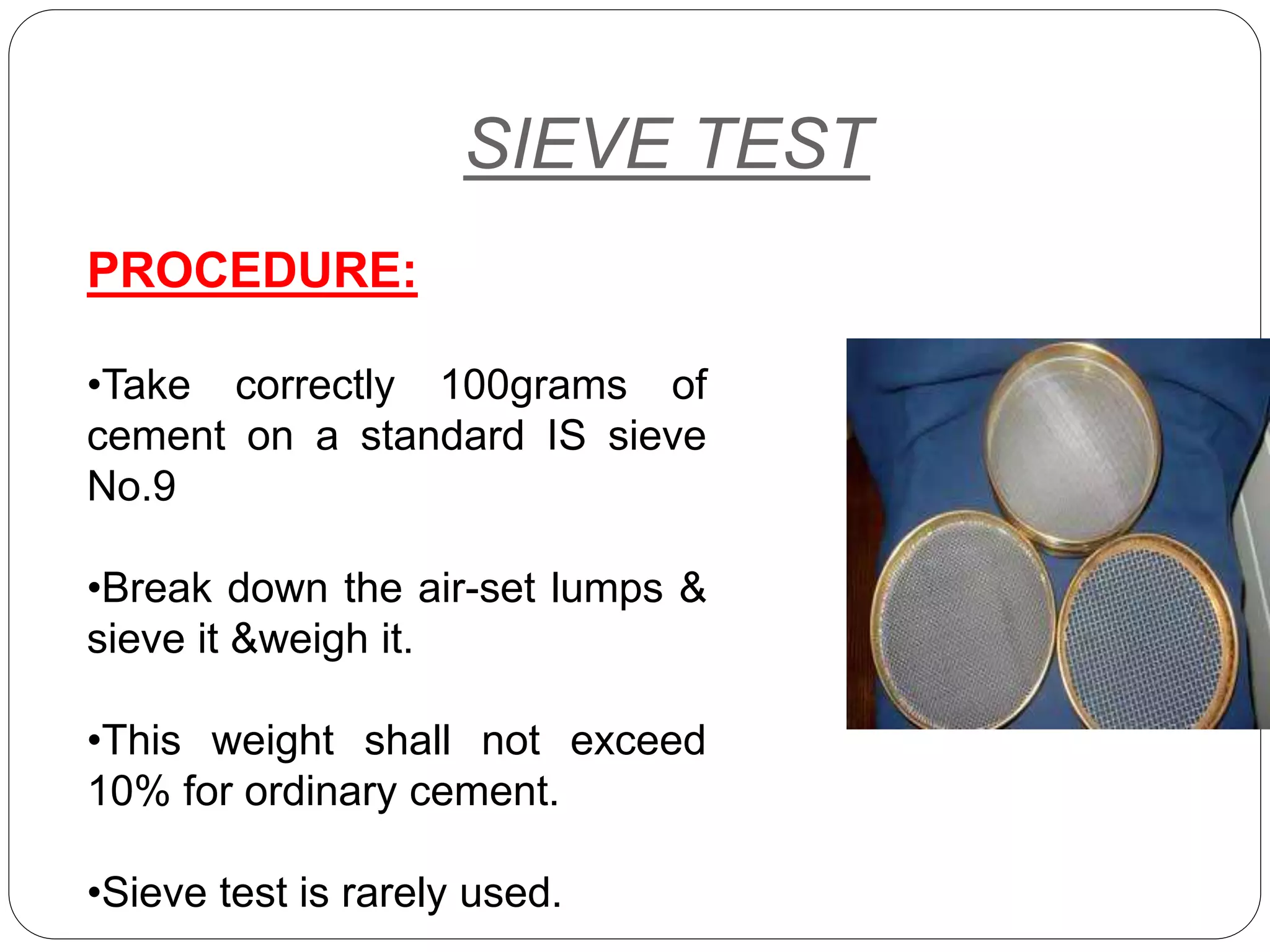
•Take correctly 100grams of
cement on a standard IS sieve
No.9
•Break down the air-set lumps &
sieve it &weigh it.
•This weight shall not exceed
10% for ordinary cement.
•Sieve test is rarely used.
SOUNDNESS TEST
 It is very important that the cement after
setting shall not undergo any appreciable
change of volume.
 This test is to ensure that the cement does
not show any subsequent expansions.
 The unsoundness in cement is due to the
presence of excess of lime combined with
acidic oxide at the kiln.
 This is due to high proportion of magnesia &
calcium sulphate.
 Therefore magnesia content in cement is
limited to 6%.
 Gypsum 3-5.
APPARATUS FOR SOUDNESS TEST
 It consists of a small split cylinder of spring brass.
 It is 30mm diameter & 30mm high.
 Cement is gauged with 0.78 times & filled into the
mould & kept on a glass plate & covered with another
glass plate.
 This is immersed in water at a temperature 270c-320c
for 24 hours.
 Measure the distance between indicators.
 Heat the water & bring to boiling point of about 25-
30min.
 Remove the mould from the water after 3 hours.
 Measure the distance between the indicators.
 This must not exceed 10min for ordinary, rapid
hardening, low heat Portland cements.
APPARATUS OF SOUNDNESS TEST
STRENGTH TEST
 This is the most important of all
properties of hardened cement.
 Due to excessive shrinkage and
cracking the strength tests are not made
on heat cement paste.
 Standard sand is used for finding the
strength of cement.
STRENGTH OF CEMENT
 Strength tests are not carried out on neat cement
pastes, because it is very difficult to form these
pastes due to cohesive property of cement.
 Strength tests are carried out on cement mortar
prepared by standard gradation (1 part cement+3
parts sand+1/2 part water)
PROCEDURE
 Take 555gms of standard sand. 185gms of cement
(i.e., 1:3 ratio of cement and sand)
 Mix them for 1min, then add water of
quantity(P/4)+3.0%.
 Mix three ingredients thoroughly until the mixture
is of uniform colour.
 The time of mixing should not be<3min and
>4min.
 Then the mortar is filled into a cube mould of
7.06cm.
 Compact the mortar.
 Keep the compacted cube in the mould at a
temperature of 27°C ± 2°C and at least 90 per cent
relative humidity for 24 hours.
1) Direct Tension (Tensile Strength):
 σt=P/1in2
 Difficult test procedure
PP
1”
1”
3) Compression Test:
i) Cubic Sample ii)Flexural Sample after it
is broken
P
P
σc=P/A
4cm
4cm4cm
σc=P/A
A=4x4
THANK YOU………..

Tests on cement

  • 1.
    1. Field Testing 2.Standard Consistency Test 3. Fineness Test 4. Soundness Test 5. Strength Test Testing of Cement
  • 2.
    Field Testing  Openthe bag and take a good look at the cement, then it should not contain any visible lumps.  Colour of cement should be greenish grey.  Should get cool feeling when thrusted.  When we touch the cement, it should give a smooth &not a gritty feeling.  When we throw the cement on a bucket full of water before it sinks the particles should flow.  When we make a stiff paste of cement & cut it with sharp edges & kept on a glass plate under water there wont be any disturbance to the shape& should get strength after 24hours.
  • 3.
    Standard Consistency Test Thestandard consistency of a cement paste is defined as that consistency which will permit a Vicat plunger having 10 mm diameter and 50 mm length to penetrate to a depth of 33-35 mm from the top of the mould. Used to find out the percentage of water required to produce a cement paste of standard consistency. This is also called normal consistency (CPNC).
  • 4.
    PROCEDUR E: •For first trial,take about 500gms of cement & water of 24%by weight of cement. •Fill it in Vicat’s mould with in 3-5min. •After filling, shake the mould to expel air. •A standard plunger, 10 mm diameter, 50 mm long is attached and brought down to touch the surface of the paste and quickly released. •Note the reading according to depth of penetration of the plunger.
  • 5.
    PROCEDUR E: • Conduct trialscontinuously by taking different water cement ratios till the plunger penetrates for a depth of 33-35mm from top.  This particular percentage is known as percentage of water required to produce cement paste of standard consistency.  This is usually denoted as ‘P’.  SUITABLE CONDITIONS:  Conducted in a constant temperature of 270+20C.  Constant Humidity 90%.
  • 6.
    Setting Time Test: An arbitraty division has been made for the setting time of cement.  Initial setting time &  Final setting time.
  • 7.
    INITIAL SETTING TIME The time elapsed between the moment that the water is added to the cement, to the time that the paste starts losing its plasticity.  Normally a minimum of 30min has maintained for mixing & handling operations.  It should not be less than 30min.
  • 8.
    FINAL SETTING TIME The time elapsed between the moment the water is added to the cement, and the time when the paste has completely lost its plasticity and has attained sufficient firmness to resist certain definite pressure.  It should not exceed 10 hours.  So that it is avoided from least vulnerable to damages from external activities.
  • 9.
    FINENESS TEST • Thefineness of cement has an important bearing on the rate of hydration, rate of gain of strength, evolution of heat. • Finer cement offers greater surface area. • Disadvantage of fine grinding is that it is susceptible to air set & early deterioration.
  • 10.
    • Maximum no.of particles in a sample of cement<100microns. • The smallest particle should have a size of 1.5microns • Large particle should have a size of 10microns. • Fineness of cement is tested in two ways. • By sieving. • By determination specific surface by air permeability method. FINENESS TEST
  • 11.
    SIEVE TEST PROCEDURE: •Take correctly100grams of cement on a standard IS sieve No.9 •Break down the air-set lumps & sieve it &weigh it. •This weight shall not exceed 10% for ordinary cement. •Sieve test is rarely used.
  • 12.
    SOUNDNESS TEST  Itis very important that the cement after setting shall not undergo any appreciable change of volume.  This test is to ensure that the cement does not show any subsequent expansions.  The unsoundness in cement is due to the presence of excess of lime combined with acidic oxide at the kiln.  This is due to high proportion of magnesia & calcium sulphate.  Therefore magnesia content in cement is limited to 6%.  Gypsum 3-5.
  • 13.
    APPARATUS FOR SOUDNESSTEST  It consists of a small split cylinder of spring brass.  It is 30mm diameter & 30mm high.  Cement is gauged with 0.78 times & filled into the mould & kept on a glass plate & covered with another glass plate.  This is immersed in water at a temperature 270c-320c for 24 hours.  Measure the distance between indicators.  Heat the water & bring to boiling point of about 25- 30min.  Remove the mould from the water after 3 hours.  Measure the distance between the indicators.  This must not exceed 10min for ordinary, rapid hardening, low heat Portland cements.
  • 14.
  • 15.
    STRENGTH TEST  Thisis the most important of all properties of hardened cement.  Due to excessive shrinkage and cracking the strength tests are not made on heat cement paste.  Standard sand is used for finding the strength of cement.
  • 16.
    STRENGTH OF CEMENT Strength tests are not carried out on neat cement pastes, because it is very difficult to form these pastes due to cohesive property of cement.  Strength tests are carried out on cement mortar prepared by standard gradation (1 part cement+3 parts sand+1/2 part water)
  • 17.
    PROCEDURE  Take 555gmsof standard sand. 185gms of cement (i.e., 1:3 ratio of cement and sand)  Mix them for 1min, then add water of quantity(P/4)+3.0%.  Mix three ingredients thoroughly until the mixture is of uniform colour.  The time of mixing should not be<3min and >4min.  Then the mortar is filled into a cube mould of 7.06cm.  Compact the mortar.  Keep the compacted cube in the mould at a temperature of 27°C ± 2°C and at least 90 per cent relative humidity for 24 hours.
  • 18.
    1) Direct Tension(Tensile Strength):  σt=P/1in2  Difficult test procedure PP 1” 1”
  • 21.
    3) Compression Test: i)Cubic Sample ii)Flexural Sample after it is broken P P σc=P/A 4cm 4cm4cm σc=P/A A=4x4
  • 23.