DR. VIBHA KHANNA
Asso. Prof. (Botany)
SPC GOVERNMENT COLLEGE
AJMER (Rajasthan)
PLANT BIOCHEMISTRY
• BLOCK 1. : Lipid metabolism
– PRESENTATION 2: Structure and Functions of
membrane lipids
MEMBRANE LIPIDS: Structure
Glycerophospholipids
• Most membrane lipids
are amphipathic, having a
non-polar end and a
polar end.
• Glycerophospholipids
(phosphoglycerides), are
common constituents of
cellular membranes. They
have a glycerol backbone.
The hydroxyls at C1 & C2
are esterified to fatty
acids.
MEMBRANE LIPIDS : Structure
Glycerophospholipids
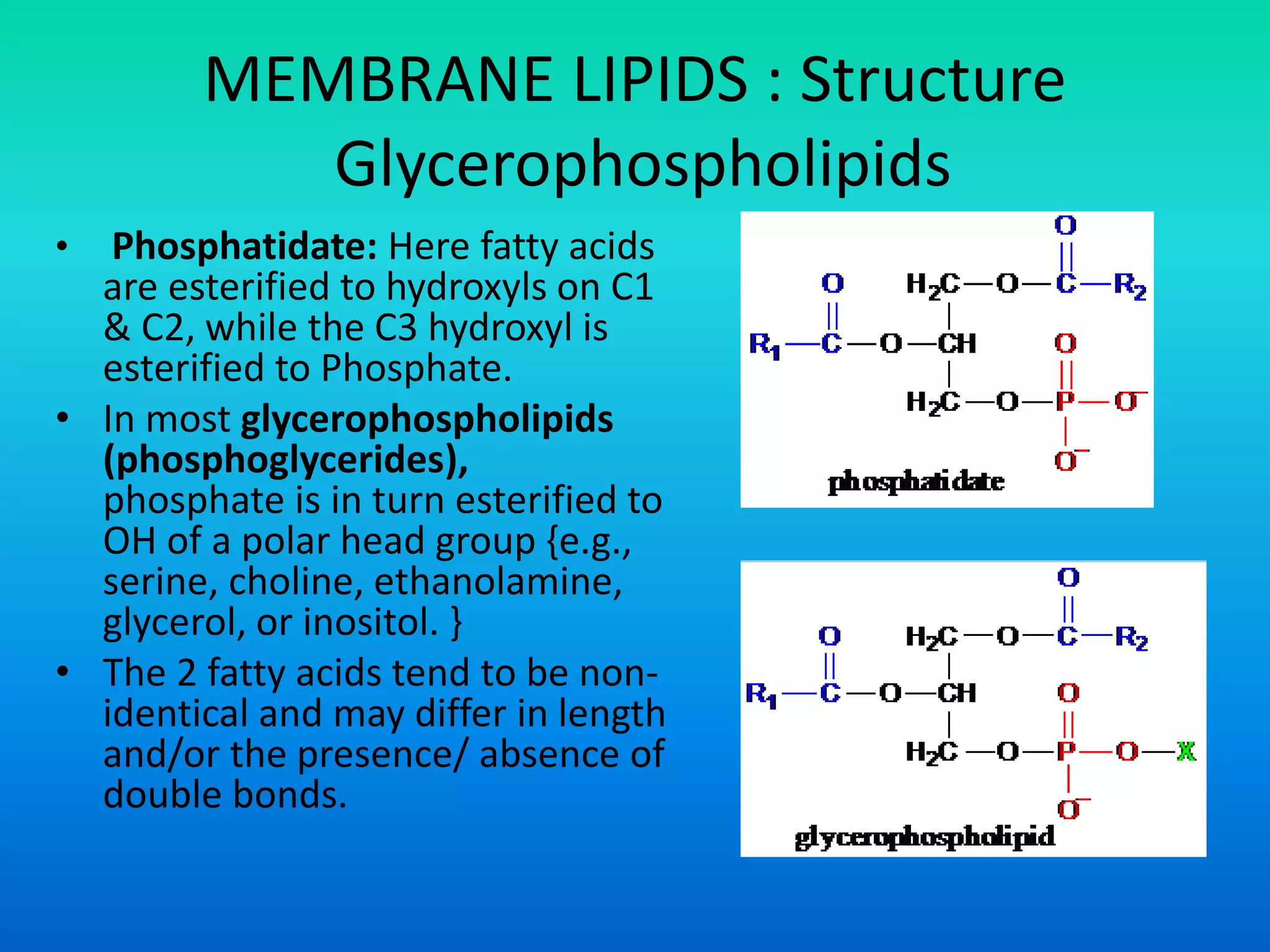
• Phosphatidate: Here fatty acids
are esterified to hydroxyls on C1
& C2, while the C3 hydroxyl is
esterified to Phosphate.
• In most glycerophospholipids
(phosphoglycerides),
phosphate is in turn esterified to
OH of a polar head group {e.g.,
serine, choline, ethanolamine,
glycerol, or inositol. }
• The 2 fatty acids tend to be non-
identical and may differ in length
and/or the presence/ absence of
double bonds.
MEMBRANE LIPIDS : Structure
Glycerophospholipids
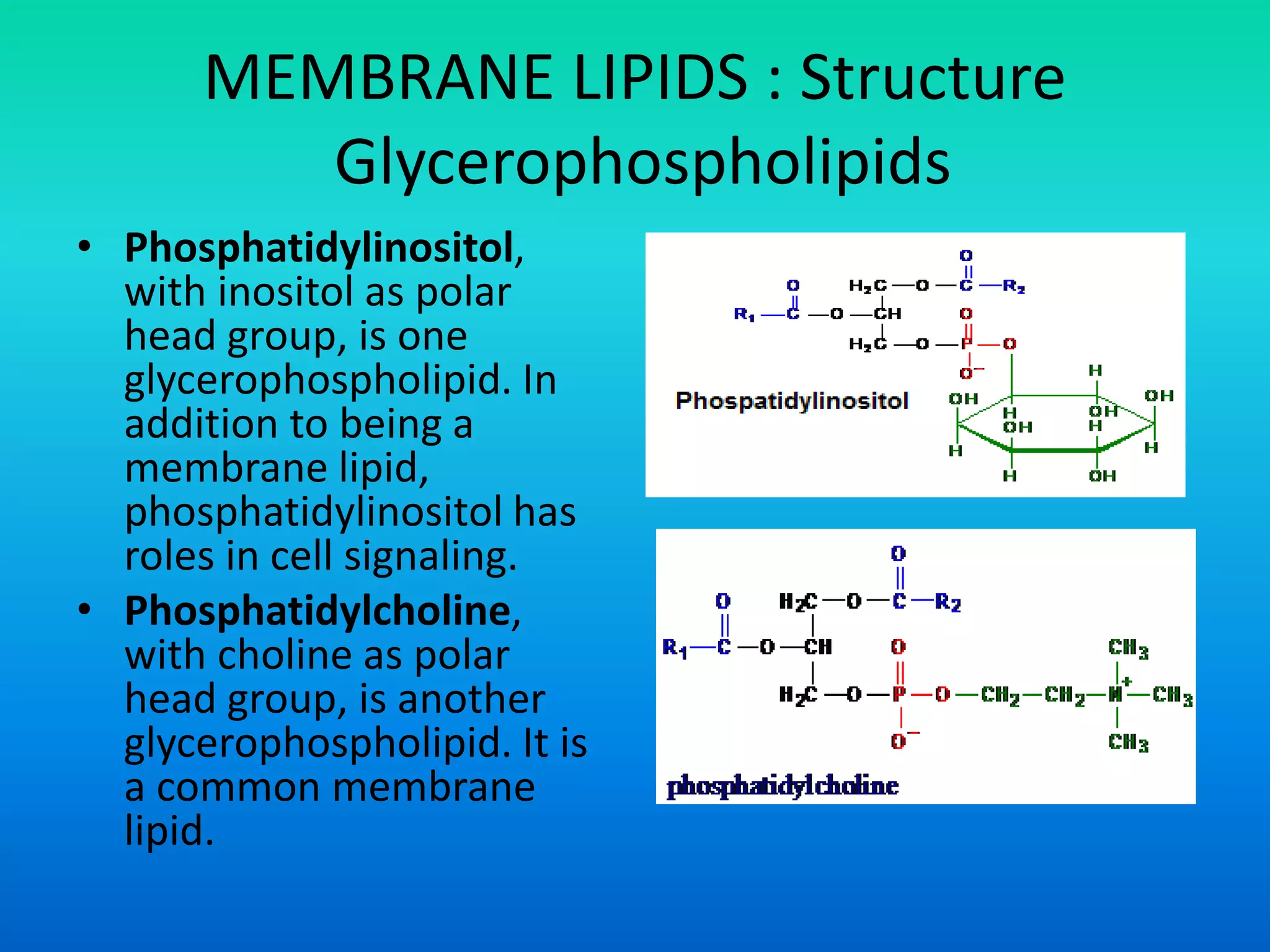
• Phosphatidylinositol,
with inositol as polar
head group, is one
glycerophospholipid. In
addition to being a
membrane lipid,
phosphatidylinositol has
roles in cell signaling.
• Phosphatidylcholine,
with choline as polar
head group, is another
glycerophospholipid. It is
a common membrane
lipid.
MEMBRANE LIPIDS : Structure
Glycerophospholipids
• Each glycerophospholipid
includes
– a polar region: glycerol,
carbonyl O of fatty acids,
Phosphate & the polar
head group (X)and
– non-polar hydrocarbon
tails of fatty acids (R1, R2).
MEMBRANE LIPIDS : Structure
Sphingolipids
• Sphingolipids are derivatives
of the lipid sphingosine, which
has a long hydrocarbon tail,
and a polar domain that
includes an amino group.
• Sphingosine may be reversibly
phosphorylated to produce
the signal molecule
sphingosine-1-phosphate.
Other derivatives of
sphingosine are commonly
found as constituents of
biological membranes.
• The amino group of
sphingosine can form an
amide bond with a fatty acid
carboxyl, to yield a ceramide.
MEMBRANE LIPIDS : Structure
Sphingolipids
• In the more complex
sphingolipids, a polar “head
group" is esterified to the
terminal hydroxyl of the
sphingosine moiety of the
ceramide.
• Sphingomyelin has a
phosphocholine or
phosphethanolamine head
group.
– Sphingomyelins are common
constituent of plasma
membranes. Sphingomyelin,
with a phosphocholine head
group, is similar in size and
shape to the
glycerophospholipid
phosphatidyl choline.
MEMBRANE LIPIDS : Structure
Glycosphingolipids
• Cerebrosides and gangliosides,
collectively called
glycosphingolipids, are
commonly found in the outer
leaflet of the plasma membrane
bilayer, with their sugar chains
extending out from the cell
surface.
• A cerebroside is a sphingolipid
(ceramide) with a
monosaccharide such as
glucose or galactose as polar
head group.
• A ganglioside is a ceramide with
a polar head group that is a
complex oligosaccharide,
including the acidic sugar
derivative sialic acid.
MEMBRANE LIPIDS : Structure
Cholesterol
• Cholesterol, is an
important constituent
of cell membranes.
• It has a rigid ring system
and a short branched
hydrocarbon tail.
• Cholesterol is largely
hydrophobic, but it has
one polar group, a
hydroxyl, making it
amphipathic.
MEMBRANE LIPIDS : Function
Membrane fluidity• Amphipathic lipids in association
with water form complexes in which
polar regions are in contact with
water and hydrophobic regions away
from water.
• A bilayer is the most stable
configuration for amphipathic lipids,
such as phospholipids.
• The interior of a lipid bilayer is
normally highly fluid.
• In the liquid crystal state,
hydrocarbon chains of phospholipids
are disordered and in constant
motion.
• At lower temperature, a membrane
containing only a single type of
phospholipid, undergoes transition to
a crystalline state .
MEMBRANE LIPIDS : Function
Membrane fluidity
• In crystalline state the fatty acid tails are fully extended, packing is
highly ordered, and Van der Waals interactions between adjacent
chains are maximal.
• The cis double bonds of unsaturated fatty acids, results in kinks in fatty
acid chains, which interfere with packing in the crystalline state and
lower the phase transition temperature.
• Furthermore, cholesterol inserts into bilayer membranes with its
hydroxyl group oriented toward the aqueous phase and its hydrophobic
ring system adjacent to fatty acid chains of phospholipids.
• The OH group of cholesterol forms hydrogen bonds with polar
phospholipid head groups. Interaction with the relatively rigid
cholesterol decreases the mobility of hydrocarbon tails of
phospholipids.
• However, the presence of cholesterol in a phospholipid membrane
interferes with close packing of fatty acid tails in the crystalline state,
and thus inhibits transition to the crystal state.
• Phospholipid membranes with a high concentration of cholesterol have
a fluidity intermediate between the liquid crystal and crystal states.
MEMBRANE LIPIDS : Function
Membrane fluidity
• Two strategies by which the phase changes of
membrane lipids are avoided:
– Cholesterol is abundant in membranes, such as
plasma membranes, that include many lipids with
long-chain saturated fatty acids. In the absence of
cholesterol, such membranes would crystallize at
physiological temperatures.
– The inner mitochondrial membrane lacks
cholesterol, but includes many phospholipids
whose fatty acids have one or more double
bonds, which lower the melting point to below
physiological temperature.
MEMBRANE LIPIDS : Function
Membrane fluidity
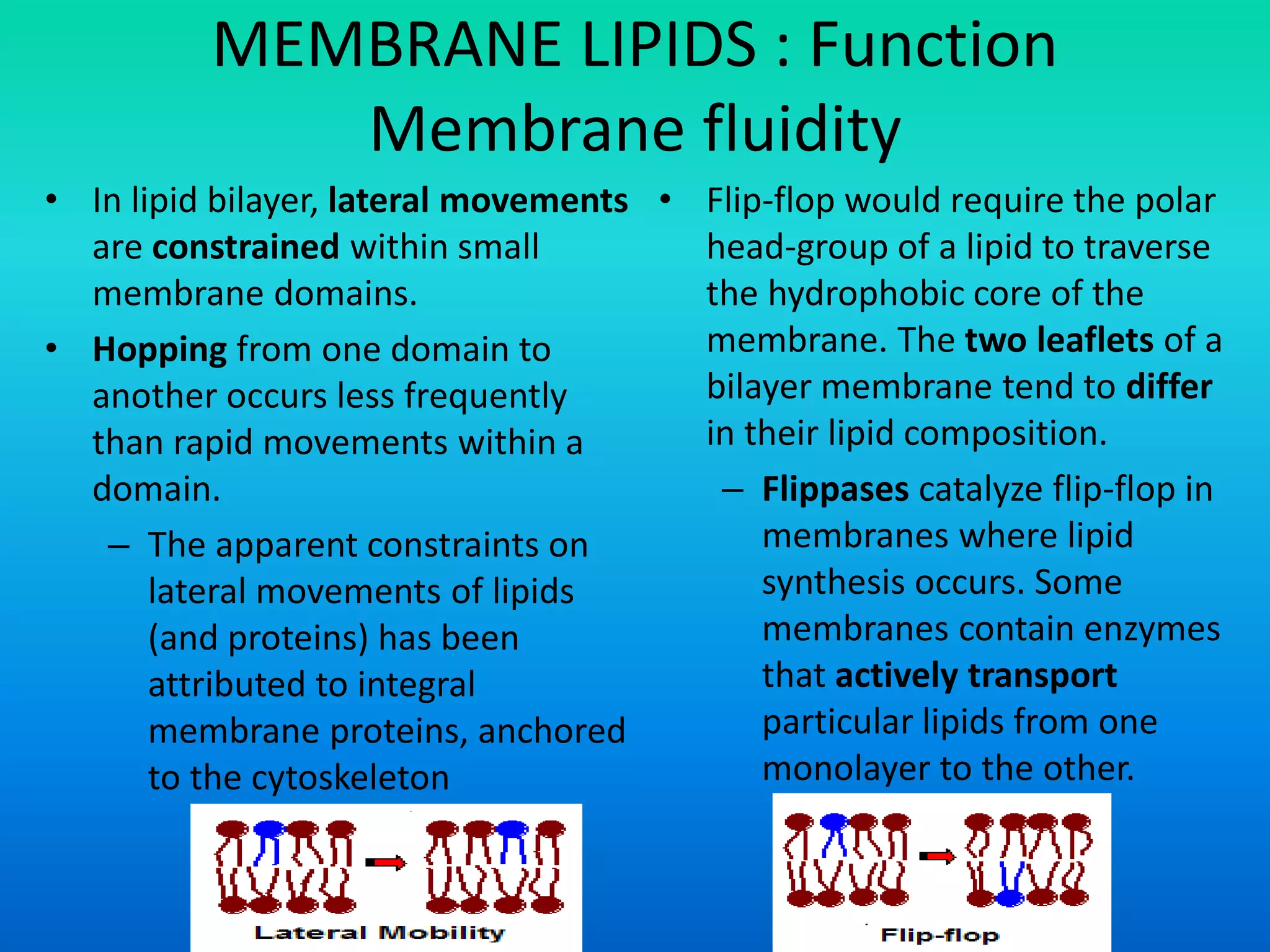
• In lipid bilayer, lateral movements
are constrained within small
membrane domains.
• Hopping from one domain to
another occurs less frequently
than rapid movements within a
domain.
– The apparent constraints on
lateral movements of lipids
(and proteins) has been
attributed to integral
membrane proteins, anchored
to the cytoskeleton
• Flip-flop would require the polar
head-group of a lipid to traverse
the hydrophobic core of the
membrane. The two leaflets of a
bilayer membrane tend to differ
in their lipid composition.
– Flippases catalyze flip-flop in
membranes where lipid
synthesis occurs. Some
membranes contain enzymes
that actively transport
particular lipids from one
monolayer to the other.

Membrane lipids contd

  • 1.
    DR. VIBHA KHANNA Asso.Prof. (Botany) SPC GOVERNMENT COLLEGE AJMER (Rajasthan)
  • 2.
    PLANT BIOCHEMISTRY • BLOCK1. : Lipid metabolism – PRESENTATION 2: Structure and Functions of membrane lipids
  • 3.
    MEMBRANE LIPIDS: Structure Glycerophospholipids •Most membrane lipids are amphipathic, having a non-polar end and a polar end. • Glycerophospholipids (phosphoglycerides), are common constituents of cellular membranes. They have a glycerol backbone. The hydroxyls at C1 & C2 are esterified to fatty acids.
  • 4.
    MEMBRANE LIPIDS :Structure Glycerophospholipids • Phosphatidate: Here fatty acids are esterified to hydroxyls on C1 & C2, while the C3 hydroxyl is esterified to Phosphate. • In most glycerophospholipids (phosphoglycerides), phosphate is in turn esterified to OH of a polar head group {e.g., serine, choline, ethanolamine, glycerol, or inositol. } • The 2 fatty acids tend to be non- identical and may differ in length and/or the presence/ absence of double bonds.
  • 5.
    MEMBRANE LIPIDS :Structure Glycerophospholipids • Phosphatidylinositol, with inositol as polar head group, is one glycerophospholipid. In addition to being a membrane lipid, phosphatidylinositol has roles in cell signaling. • Phosphatidylcholine, with choline as polar head group, is another glycerophospholipid. It is a common membrane lipid.
  • 6.
    MEMBRANE LIPIDS :Structure Glycerophospholipids • Each glycerophospholipid includes – a polar region: glycerol, carbonyl O of fatty acids, Phosphate & the polar head group (X)and – non-polar hydrocarbon tails of fatty acids (R1, R2).
  • 7.
    MEMBRANE LIPIDS :Structure Sphingolipids • Sphingolipids are derivatives of the lipid sphingosine, which has a long hydrocarbon tail, and a polar domain that includes an amino group. • Sphingosine may be reversibly phosphorylated to produce the signal molecule sphingosine-1-phosphate. Other derivatives of sphingosine are commonly found as constituents of biological membranes. • The amino group of sphingosine can form an amide bond with a fatty acid carboxyl, to yield a ceramide.
  • 8.
    MEMBRANE LIPIDS :Structure Sphingolipids • In the more complex sphingolipids, a polar “head group" is esterified to the terminal hydroxyl of the sphingosine moiety of the ceramide. • Sphingomyelin has a phosphocholine or phosphethanolamine head group. – Sphingomyelins are common constituent of plasma membranes. Sphingomyelin, with a phosphocholine head group, is similar in size and shape to the glycerophospholipid phosphatidyl choline.
  • 9.
    MEMBRANE LIPIDS :Structure Glycosphingolipids • Cerebrosides and gangliosides, collectively called glycosphingolipids, are commonly found in the outer leaflet of the plasma membrane bilayer, with their sugar chains extending out from the cell surface. • A cerebroside is a sphingolipid (ceramide) with a monosaccharide such as glucose or galactose as polar head group. • A ganglioside is a ceramide with a polar head group that is a complex oligosaccharide, including the acidic sugar derivative sialic acid.
  • 10.
    MEMBRANE LIPIDS :Structure Cholesterol • Cholesterol, is an important constituent of cell membranes. • It has a rigid ring system and a short branched hydrocarbon tail. • Cholesterol is largely hydrophobic, but it has one polar group, a hydroxyl, making it amphipathic.
  • 11.
    MEMBRANE LIPIDS :Function Membrane fluidity• Amphipathic lipids in association with water form complexes in which polar regions are in contact with water and hydrophobic regions away from water. • A bilayer is the most stable configuration for amphipathic lipids, such as phospholipids. • The interior of a lipid bilayer is normally highly fluid. • In the liquid crystal state, hydrocarbon chains of phospholipids are disordered and in constant motion. • At lower temperature, a membrane containing only a single type of phospholipid, undergoes transition to a crystalline state .
  • 12.
    MEMBRANE LIPIDS :Function Membrane fluidity • In crystalline state the fatty acid tails are fully extended, packing is highly ordered, and Van der Waals interactions between adjacent chains are maximal. • The cis double bonds of unsaturated fatty acids, results in kinks in fatty acid chains, which interfere with packing in the crystalline state and lower the phase transition temperature. • Furthermore, cholesterol inserts into bilayer membranes with its hydroxyl group oriented toward the aqueous phase and its hydrophobic ring system adjacent to fatty acid chains of phospholipids. • The OH group of cholesterol forms hydrogen bonds with polar phospholipid head groups. Interaction with the relatively rigid cholesterol decreases the mobility of hydrocarbon tails of phospholipids. • However, the presence of cholesterol in a phospholipid membrane interferes with close packing of fatty acid tails in the crystalline state, and thus inhibits transition to the crystal state. • Phospholipid membranes with a high concentration of cholesterol have a fluidity intermediate between the liquid crystal and crystal states.
  • 13.
    MEMBRANE LIPIDS :Function Membrane fluidity • Two strategies by which the phase changes of membrane lipids are avoided: – Cholesterol is abundant in membranes, such as plasma membranes, that include many lipids with long-chain saturated fatty acids. In the absence of cholesterol, such membranes would crystallize at physiological temperatures. – The inner mitochondrial membrane lacks cholesterol, but includes many phospholipids whose fatty acids have one or more double bonds, which lower the melting point to below physiological temperature.
  • 14.
    MEMBRANE LIPIDS :Function Membrane fluidity • In lipid bilayer, lateral movements are constrained within small membrane domains. • Hopping from one domain to another occurs less frequently than rapid movements within a domain. – The apparent constraints on lateral movements of lipids (and proteins) has been attributed to integral membrane proteins, anchored to the cytoskeleton • Flip-flop would require the polar head-group of a lipid to traverse the hydrophobic core of the membrane. The two leaflets of a bilayer membrane tend to differ in their lipid composition. – Flippases catalyze flip-flop in membranes where lipid synthesis occurs. Some membranes contain enzymes that actively transport particular lipids from one monolayer to the other.