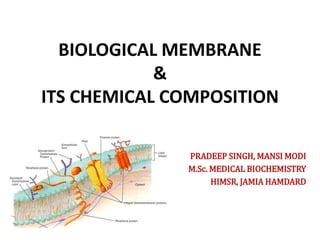
BIOLOGICAL MEMBRANE
&
ITS CHEMICAL COMPOSITION
PRADEEP SINGH, MANSI MODI
M.Sc. MEDICAL BIOCHEMISTRY
HIMSR, JAMIA HAMDARD
INTRODUCTION
Fundamental unit of life.
Self replicating structure.
The first cells were observed and named by Robert
Hooke in 1665 from slice of cork.
Cell membrane is a protective sheath, also known as
plasma membrane.
The region of cell lying between the plasma
membrane and the nucleus is the cytoplasm.
CONTENTS
• Plasma Membrane and its Functions
• Chemical Composition Of Membranes
• Lipids Bilayer and Micelles
• Mobility of Lipid Components In Membrane
• Fluid Mosaic Model
• Asymmetry Of Lipid Bilayer
• Membrane Proteins
• Fluidity Of Lipid Bilayer
• Lipid Rafts
• Dynamic Nature Of Membranes
Plasma Membrane
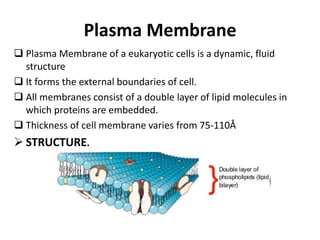
 Plasma Membrane of a eukaryotic cells is a dynamic, fluid
structure
 It forms the external boundaries of cell.
 All membranes consist of a double layer of lipid molecules in
which proteins are embedded.
 Thickness of cell membrane varies from 75-110Å
 STRUCTURE.
 FUNCTION’S
• Protective:-Forms outermost boundary of the cell organelles.
• Digestive:-Takes in food and excretes waste products.
• Selective Permeability:-
a)Non-Polar Molecules( gases like O2,CO2,N2,lipids, steroid hormones,
alcohol) can dissolve in the polar region of the membrane and move rapidly
across the membrane.
b) Polar molecules(Water soluble substances: ions, glucose, urea etc) have
much lower solubility , Therefore, penetrate the membrane much more slowly.
• Chemical and Physical Properties of membrane control the free
passage of ions in and out of cell. This property helps in maintaining components
in intracellular fluid and extracellular fluid.
• Insulating Properties:- It acts as dielectric material of a charged
condenser, thus cell membrane has a very high insulating value.
Chemical Composition Of Plasma
Membrane
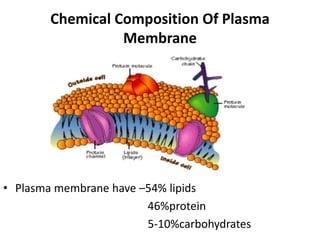
• Plasma membrane have –54% lipids
46%protein
5-10%carbohydrates
Chemical Composition Of Plasma
Membrane
• Lipids and proteins are the two major components of
all membrane.
• Carbohydrates are present in outer leaflets.
• But in inner leaflets, do not have a significant role.
• Carbohydrates bound either to proteins as constituents
of glycoproteins , Or bound to lipids as constituents of
glycolipids.
Lipids Are The Major Components:-
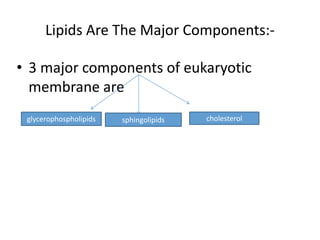
• 3 major components of eukaryotic
membrane are
glycerophospholipids sphingolipids cholesterol
Glycerophospholipids
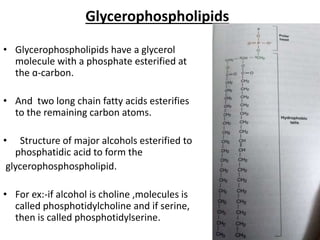
• Glycerophospholipids have a glycerol
molecule with a phosphate esterified at
the ɑ-carbon.
• And two long chain fatty acids esterifies
to the remaining carbon atoms.
• Structure of major alcohols esterified to
phosphatidic acid to form the
glycerophosphospholipid.
• For ex:-if alcohol is choline ,molecules is
called phosphotidylcholine and if serine,
then is called phosphotidylserine.
Glycerophospholipids
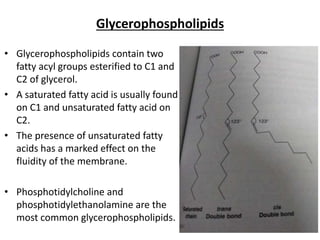
• Glycerophospholipids contain two
fatty acyl groups esterified to C1 and
C2 of glycerol.
• A saturated fatty acid is usually found
on C1 and unsaturated fatty acid on
C2.
• The presence of unsaturated fatty
acids has a marked effect on the
fluidity of the membrane.
• Phosphotidylcholine and
phosphotidylethanolamine are the
most common glycerophospholipids.
Glycerophospholipids
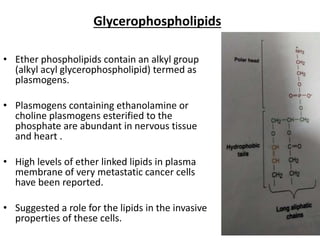
• Ether phospholipids contain an alkyl group
(alkyl acyl glycerophospholipid) termed as
plasmogens.
• Plasmogens containing ethanolamine or
choline plasmogens esterified to the
phosphate are abundant in nervous tissue
and heart .
• High levels of ether linked lipids in plasma
membrane of very metastatic cancer cells
have been reported.
• Suggested a role for the lipids in the invasive
properties of these cells.
Glycerophospholipids Are Amphipathic
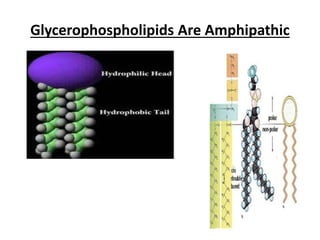
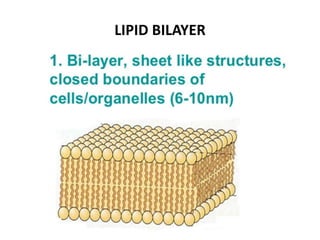
• The basic structure of the plasma membrane is the lipid
bilayer.
• Glycerophospholipids contain both a polar and non
polar end.
• Polar head group are in contact with intra or
extracellular aquous phase.
• Whereas non polar tails face each other.
Sphingolipids
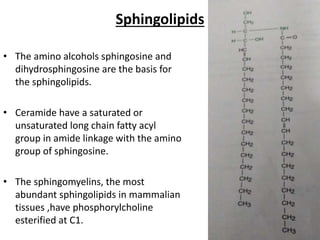
• The amino alcohols sphingosine and
dihydrosphingosine are the basis for
the sphingolipids.
• Ceramide have a saturated or
unsaturated long chain fatty acyl
group in amide linkage with the amino
group of sphingosine.
• The sphingomyelins, the most
abundant sphingolipids in mammalian
tissues ,have phosphorylcholine
esterified at C1.
• Glycosphingolipids contain a sugar linked by a
ẞ-glycosidic bond to C1OH group of a ceramide.
• A subgroup of cerebroside which contain either
glucose or galactose.
• Galactocerebroside predominate in brain and
nervous tissue, whereas glucocerebroside
occur in small quantities of non neuronal
tissues.
• The plasma membrane of animal cells contains 4 major
phospholipids, such as –phosphotidylcholine,
phosphotidylserine, phosphotidylethanolamine and
sphingomyelin.
• At neutral pH, the polar head group may have no net charge,
Or it may have net negative charge.
Cholesterol
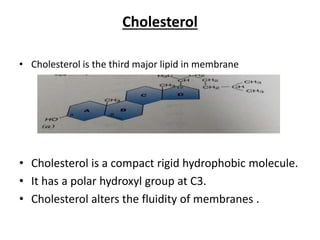
• Cholesterol is the third major lipid in membrane
• Cholesterol is a compact rigid hydrophobic molecule.
• It has a polar hydroxyl group at C3.
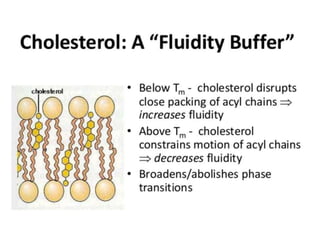
• Cholesterol alters the fluidity of membranes .
The major lipid components of plasma
membranes:-PC-21%
PE+PS-29%
SM-21%
CHOLESTEROL-26%
Glycoproteins or Glycolipids
• Carbohydrates are present in membranes as
oligosaccharides.
• They are covalently attached to the lipids or proteins.
• The carbohydrate is on the extracellular surface of
plasma membrane and the luminal surface of
endoplasmic reticulum.
Role of carbohydrates
• Carbohydrates mainly serve as cell to cell recognition
molecules, membrane receptor.
LIPID BILAYER
Lipid bilayer and Micelles
• The amphipathic compound with a
hydrophilic head and a hydrophobic
tail interact with aqueous systems
in vitro to form a sphere.
• Micelles have only one polar
surface, which is side presented to
the aqueous phase..
• The structure of a micelles is very stable .
• Because of hydrophobic interactions between
hydrocarbon chains and attraction of polar head
group to water.
• Micelles are important in intestinal digestion and
absorption of lipids
Mobility of lipid components in membrane
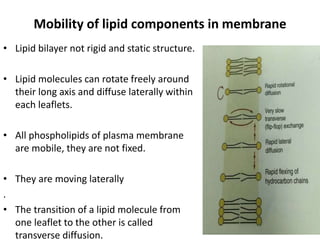
• Lipid bilayer not rigid and static structure.
• Lipid molecules can rotate freely around
their long axis and diffuse laterally within
each leaflets.
• All phospholipids of plasma membrane
are mobile, they are not fixed.
• They are moving laterally
.
• The transition of a lipid molecule from
one leaflet to the other is called
transverse diffusion.
FLUID MOSAIC MODEL
 In 1972 SJ Singer and GL Nicolson proposed fluid
mosaic model.
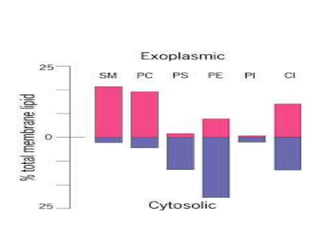
Asymmetry Of Lipid Bilayer
Outer leaflets
• Lots of carbohydrates.
• Sphingomyelin and
phosphotidylcholine.
• Cho moities are present.
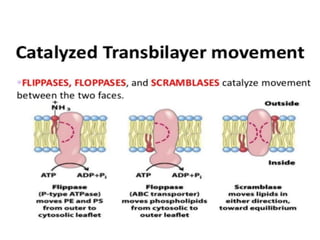
• Floppase is an outward-
directed ATP-dependent
transporter.
Inner leaflets
• Carbohydrates does not have
significant role.
• Phosphotidylserine and
phosphotidylethanolamine.
• Absent
• Flippase is an inward-directed
ATP-dependent lipid class of
transporters.
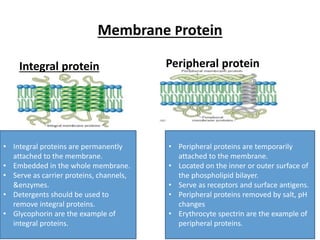
Membrane Protein
Integral protein Peripheral protein
• Integral proteins are permanently
attached to the membrane.
• Embedded in the whole membrane.
• Serve as carrier proteins, channels,
&enzymes.
• Detergents should be used to
remove integral proteins.
• Glycophorin are the example of
integral proteins.
• Peripheral proteins are temporarily
attached to the membrane.
• Located on the inner or outer surface of
the phospholipid bilayer.
• Serve as receptors and surface antigens.
• Peripheral proteins removed by salt, pH
changes
• Erythrocyte spectrin are the example of
peripheral proteins.
Integral proteins
 Integral membrane proteins are embedded are asymmetric in the membrane
 Integral proteins are mostly transmembrane proteins.
 All transmembrane proteins are amphipathic
 Protein that are held in lipid bilayer very tightly .
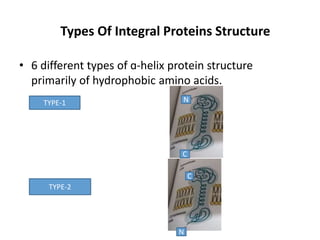
Types Of Integral Proteins Structure
• 6 different types of ɑ-helix protein structure
primarily of hydrophobic amino acids.
TYPE-1
TYPE-2
C
N
N
C
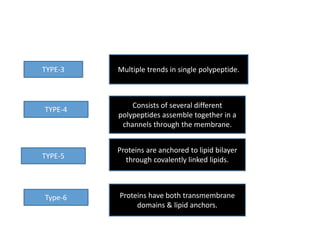
TYPE-3 Multiple trends in single polypeptide.
TYPE-4
Consists of several different
polypeptides assemble together in a
channels through the membrane.
TYPE-5
Proteins are anchored to lipid bilayer
through covalently linked lipids.
Type-6 Proteins have both transmembrane
domains & lipid anchors.
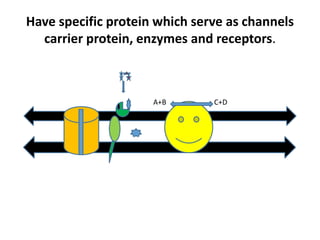
Have specific protein which serve as channels
carrier protein, enzymes and receptors.
A+B C+D
Fluidity of a lipid bilayer
• Although the lipid bilayer structure is quite stable
its individual phospholipid & sterol molecules have much
freedom of motion which is main reason of fluidity property of
lipid bilayer.
• Membrane fluidity is influenced by:
-Temperature
-Fatty acid composition
-sterol content
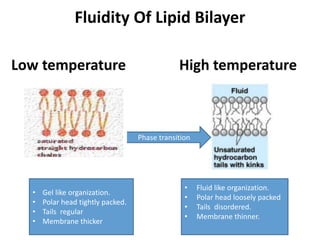
Fluidity Of Lipid Bilayer
Low temperature
• Fluid like organization
• Polar head loosely packed
• Tailed disordered
• Membrane thinner
• Fatty acid unsaturated
High temperature
Phase transition
• Fluid like organization.
• Polar head loosely packed
• Tails disordered.
• Membrane thinner.
• Gel like organization.
• Polar head tightly packed.
• Tails regular
• Membrane thicker
Abnormalities of Cell Membrane Fluidity in Disease
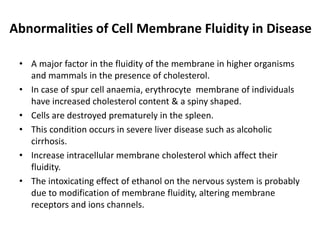
• A major factor in the fluidity of the membrane in higher organisms
and mammals in the presence of cholesterol.
• In case of spur cell anaemia, erythrocyte membrane of individuals
have increased cholesterol content & a spiny shaped.
• Cells are destroyed prematurely in the spleen.
• This condition occurs in severe liver disease such as alcoholic
cirrhosis.
• Increase intracellular membrane cholesterol which affect their
fluidity.
• The intoxicating effect of ethanol on the nervous system is probably
due to modification of membrane fluidity, altering membrane
receptors and ions channels.
Lipid Rafts
• Lipid rafts are membrane microdomains enriched in
sphingolipids,cholesterol and certain lipid-linkedproteins.
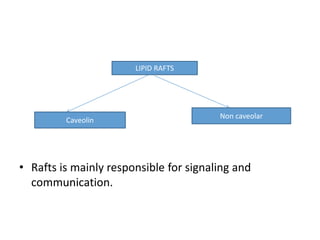
• Rafts is mainly responsible for signaling and
communication.
LIPID RAFTS
Caveolin
Non caveolar
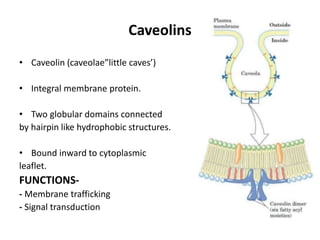
Caveolins
• Caveolin (caveolae”little caves’)
• Integral membrane protein.
• Two globular domains connected
by hairpin like hydrophobic structures.
• Bound inward to cytoplasmic
leaflet.
FUNCTIONS-
- Membrane trafficking
- Signal transduction
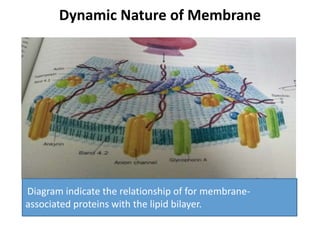
Dynamic Nature of Membrane
Diagram indicate the relationship of for membrane-
associated proteins with the lipid bilayer.
• Some membrane protein movement is restricted.
• Cellular membrane are in a constantly changing
state, with movement of proteins and lipids laterally,
changes in association of lipid anchored proteins and
molecules into and out of the membrane.
“THANK YOU”

Biological membrane & its chemical composition

  • 1.
    BIOLOGICAL MEMBRANE & ITS CHEMICALCOMPOSITION PRADEEP SINGH, MANSI MODI M.Sc. MEDICAL BIOCHEMISTRY HIMSR, JAMIA HAMDARD
  • 2.
    INTRODUCTION Fundamental unit oflife. Self replicating structure. The first cells were observed and named by Robert Hooke in 1665 from slice of cork. Cell membrane is a protective sheath, also known as plasma membrane. The region of cell lying between the plasma membrane and the nucleus is the cytoplasm.
  • 3.
    CONTENTS • Plasma Membraneand its Functions • Chemical Composition Of Membranes • Lipids Bilayer and Micelles • Mobility of Lipid Components In Membrane • Fluid Mosaic Model • Asymmetry Of Lipid Bilayer • Membrane Proteins • Fluidity Of Lipid Bilayer • Lipid Rafts • Dynamic Nature Of Membranes
  • 4.
    Plasma Membrane  PlasmaMembrane of a eukaryotic cells is a dynamic, fluid structure  It forms the external boundaries of cell.  All membranes consist of a double layer of lipid molecules in which proteins are embedded.  Thickness of cell membrane varies from 75-110Å  STRUCTURE.
  • 5.
     FUNCTION’S • Protective:-Formsoutermost boundary of the cell organelles. • Digestive:-Takes in food and excretes waste products. • Selective Permeability:- a)Non-Polar Molecules( gases like O2,CO2,N2,lipids, steroid hormones, alcohol) can dissolve in the polar region of the membrane and move rapidly across the membrane. b) Polar molecules(Water soluble substances: ions, glucose, urea etc) have much lower solubility , Therefore, penetrate the membrane much more slowly. • Chemical and Physical Properties of membrane control the free passage of ions in and out of cell. This property helps in maintaining components in intracellular fluid and extracellular fluid. • Insulating Properties:- It acts as dielectric material of a charged condenser, thus cell membrane has a very high insulating value.
  • 6.
    Chemical Composition OfPlasma Membrane • Plasma membrane have –54% lipids 46%protein 5-10%carbohydrates
  • 7.
    Chemical Composition OfPlasma Membrane • Lipids and proteins are the two major components of all membrane. • Carbohydrates are present in outer leaflets. • But in inner leaflets, do not have a significant role. • Carbohydrates bound either to proteins as constituents of glycoproteins , Or bound to lipids as constituents of glycolipids.
  • 8.
    Lipids Are TheMajor Components:- • 3 major components of eukaryotic membrane are glycerophospholipids sphingolipids cholesterol
  • 9.
    Glycerophospholipids • Glycerophospholipids havea glycerol molecule with a phosphate esterified at the ɑ-carbon. • And two long chain fatty acids esterifies to the remaining carbon atoms. • Structure of major alcohols esterified to phosphatidic acid to form the glycerophosphospholipid. • For ex:-if alcohol is choline ,molecules is called phosphotidylcholine and if serine, then is called phosphotidylserine.
  • 10.
    Glycerophospholipids • Glycerophospholipids containtwo fatty acyl groups esterified to C1 and C2 of glycerol. • A saturated fatty acid is usually found on C1 and unsaturated fatty acid on C2. • The presence of unsaturated fatty acids has a marked effect on the fluidity of the membrane. • Phosphotidylcholine and phosphotidylethanolamine are the most common glycerophospholipids.
  • 11.
    Glycerophospholipids • Ether phospholipidscontain an alkyl group (alkyl acyl glycerophospholipid) termed as plasmogens. • Plasmogens containing ethanolamine or choline plasmogens esterified to the phosphate are abundant in nervous tissue and heart . • High levels of ether linked lipids in plasma membrane of very metastatic cancer cells have been reported. • Suggested a role for the lipids in the invasive properties of these cells.
  • 12.
  • 13.
    Glycerophospholipids Are Amphipathic •The basic structure of the plasma membrane is the lipid bilayer. • Glycerophospholipids contain both a polar and non polar end. • Polar head group are in contact with intra or extracellular aquous phase. • Whereas non polar tails face each other.
  • 14.
    Sphingolipids • The aminoalcohols sphingosine and dihydrosphingosine are the basis for the sphingolipids. • Ceramide have a saturated or unsaturated long chain fatty acyl group in amide linkage with the amino group of sphingosine. • The sphingomyelins, the most abundant sphingolipids in mammalian tissues ,have phosphorylcholine esterified at C1.
  • 15.
    • Glycosphingolipids containa sugar linked by a ẞ-glycosidic bond to C1OH group of a ceramide. • A subgroup of cerebroside which contain either glucose or galactose. • Galactocerebroside predominate in brain and nervous tissue, whereas glucocerebroside occur in small quantities of non neuronal tissues.
  • 16.
    • The plasmamembrane of animal cells contains 4 major phospholipids, such as –phosphotidylcholine, phosphotidylserine, phosphotidylethanolamine and sphingomyelin. • At neutral pH, the polar head group may have no net charge, Or it may have net negative charge.
  • 17.
    Cholesterol • Cholesterol isthe third major lipid in membrane • Cholesterol is a compact rigid hydrophobic molecule. • It has a polar hydroxyl group at C3. • Cholesterol alters the fluidity of membranes .
  • 18.
    The major lipidcomponents of plasma membranes:-PC-21% PE+PS-29% SM-21% CHOLESTEROL-26%
  • 19.
    Glycoproteins or Glycolipids •Carbohydrates are present in membranes as oligosaccharides. • They are covalently attached to the lipids or proteins. • The carbohydrate is on the extracellular surface of plasma membrane and the luminal surface of endoplasmic reticulum.
  • 20.
    Role of carbohydrates •Carbohydrates mainly serve as cell to cell recognition molecules, membrane receptor.
  • 22.
  • 23.
    Lipid bilayer andMicelles • The amphipathic compound with a hydrophilic head and a hydrophobic tail interact with aqueous systems in vitro to form a sphere. • Micelles have only one polar surface, which is side presented to the aqueous phase..
  • 24.
    • The structureof a micelles is very stable . • Because of hydrophobic interactions between hydrocarbon chains and attraction of polar head group to water. • Micelles are important in intestinal digestion and absorption of lipids
  • 25.
    Mobility of lipidcomponents in membrane • Lipid bilayer not rigid and static structure. • Lipid molecules can rotate freely around their long axis and diffuse laterally within each leaflets. • All phospholipids of plasma membrane are mobile, they are not fixed. • They are moving laterally . • The transition of a lipid molecule from one leaflet to the other is called transverse diffusion.
  • 27.
    FLUID MOSAIC MODEL In 1972 SJ Singer and GL Nicolson proposed fluid mosaic model.
  • 28.
    Asymmetry Of LipidBilayer Outer leaflets • Lots of carbohydrates. • Sphingomyelin and phosphotidylcholine. • Cho moities are present. • Floppase is an outward- directed ATP-dependent transporter. Inner leaflets • Carbohydrates does not have significant role. • Phosphotidylserine and phosphotidylethanolamine. • Absent • Flippase is an inward-directed ATP-dependent lipid class of transporters.
  • 30.
    Membrane Protein Integral proteinPeripheral protein • Integral proteins are permanently attached to the membrane. • Embedded in the whole membrane. • Serve as carrier proteins, channels, &enzymes. • Detergents should be used to remove integral proteins. • Glycophorin are the example of integral proteins. • Peripheral proteins are temporarily attached to the membrane. • Located on the inner or outer surface of the phospholipid bilayer. • Serve as receptors and surface antigens. • Peripheral proteins removed by salt, pH changes • Erythrocyte spectrin are the example of peripheral proteins.
  • 31.
    Integral proteins  Integralmembrane proteins are embedded are asymmetric in the membrane  Integral proteins are mostly transmembrane proteins.  All transmembrane proteins are amphipathic  Protein that are held in lipid bilayer very tightly .
  • 32.
    Types Of IntegralProteins Structure • 6 different types of ɑ-helix protein structure primarily of hydrophobic amino acids. TYPE-1 TYPE-2 C N N C
  • 33.
    TYPE-3 Multiple trendsin single polypeptide. TYPE-4 Consists of several different polypeptides assemble together in a channels through the membrane. TYPE-5 Proteins are anchored to lipid bilayer through covalently linked lipids. Type-6 Proteins have both transmembrane domains & lipid anchors.
  • 34.
    Have specific proteinwhich serve as channels carrier protein, enzymes and receptors. A+B C+D
  • 35.
    Fluidity of alipid bilayer • Although the lipid bilayer structure is quite stable its individual phospholipid & sterol molecules have much freedom of motion which is main reason of fluidity property of lipid bilayer. • Membrane fluidity is influenced by: -Temperature -Fatty acid composition -sterol content
  • 36.
    Fluidity Of LipidBilayer Low temperature • Fluid like organization • Polar head loosely packed • Tailed disordered • Membrane thinner • Fatty acid unsaturated High temperature Phase transition • Fluid like organization. • Polar head loosely packed • Tails disordered. • Membrane thinner. • Gel like organization. • Polar head tightly packed. • Tails regular • Membrane thicker
  • 38.
    Abnormalities of CellMembrane Fluidity in Disease • A major factor in the fluidity of the membrane in higher organisms and mammals in the presence of cholesterol. • In case of spur cell anaemia, erythrocyte membrane of individuals have increased cholesterol content & a spiny shaped. • Cells are destroyed prematurely in the spleen. • This condition occurs in severe liver disease such as alcoholic cirrhosis. • Increase intracellular membrane cholesterol which affect their fluidity. • The intoxicating effect of ethanol on the nervous system is probably due to modification of membrane fluidity, altering membrane receptors and ions channels.
  • 39.
    Lipid Rafts • Lipidrafts are membrane microdomains enriched in sphingolipids,cholesterol and certain lipid-linkedproteins.
  • 40.
    • Rafts ismainly responsible for signaling and communication. LIPID RAFTS Caveolin Non caveolar
  • 41.
    Caveolins • Caveolin (caveolae”littlecaves’) • Integral membrane protein. • Two globular domains connected by hairpin like hydrophobic structures. • Bound inward to cytoplasmic leaflet. FUNCTIONS- - Membrane trafficking - Signal transduction
  • 42.
    Dynamic Nature ofMembrane Diagram indicate the relationship of for membrane- associated proteins with the lipid bilayer.
  • 43.
    • Some membraneprotein movement is restricted. • Cellular membrane are in a constantly changing state, with movement of proteins and lipids laterally, changes in association of lipid anchored proteins and molecules into and out of the membrane.
  • 44.