DR. VIBHA KHANNA
ASSO. PROF. (BOTANY)
S.P.C. GOVERNMENT COLLEGE
AJMER (RAJASTHAN)
CYTOGENETICS
• BLOCK 2: HORIZONTAL GENE TRANSFER IN BACTERIA
• PRESENTATION 4:
TRANSDUCTION IN BACTERIA;
Bacteriophage: An Introduction
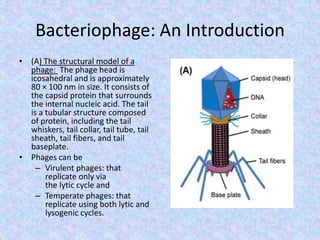
• (A) The structural model of a
phage: The phage head is
icosahedral and is approximately
80 × 100 nm in size. It consists of
the capsid protein that surrounds
the internal nucleic acid. The tail
is a tubular structure composed
of protein, including the tail
whiskers, tail collar, tail tube, tail
sheath, tail fibers, and tail
baseplate.
• Phages can be
– Virulent phages: that
replicate only via
the lytic cycle and
– Temperate phages: that
replicate using both lytic and
lysogenic cycles.
Bacteriophage: An Introduction
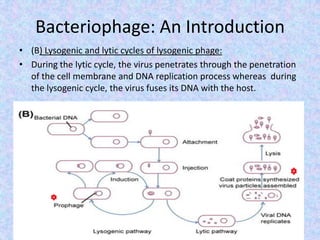
• (B) Lysogenic and lytic cycles of lysogenic phage:
• During the lytic cycle, the virus penetrates through the penetration
of the cell membrane and DNA replication process whereas during
the lysogenic cycle, the virus fuses its DNA with the host.
Discovery of Transduction
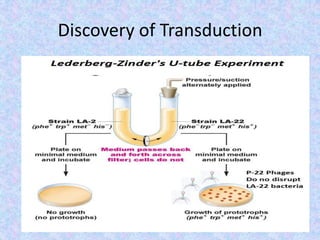
• In 1951, Joshua Lederberg and Norton Zinder were testing for
recombination in the bacterium Salmonella typhimurium by using the
techniques that had been successful with E. coli.
• The researchers used two different strains: one was phe− trp− tyr−, and
the other was met− his−. (the mutant alleles confer nutritional
requirements.)
• When either strain was plated on a minimal medium, no wild-type cells
were observed.
• However, after the two strains were mixed, wild-type cells appeared at
a frequency of about 1 in 105. These were the “recombinants”
• By preventing cell contact with filters of varying sizes, the researchers
found the one responsible for the rise of the recombinants–a
temperate bacteriophage of Salmonella.
• So instead of confirming the conjugation in the bacterium, the
researchers discovered a new process of gene transfer in organisms,
and this time, mediated by a virus
Discovery of Transduction
• Lederberg and Zinder, instead of confirming conjugation
in Salmonella, had discovered a new type of gene transfer mediated
by a virus.
• They called this process ’tranduction’.
• Some phages are able to “mobilize” bacterial genes and carry them
from one bacterial cell to another, where the virus inserts its
contents. . Thus, transduction is one of modes of genetic transfer in
bacteria—along with conjugation and transformation.
• Transduction has subsequently been shown to be quite common
among both temperate and virulent phages.
• There are two kinds of transduction: generalized and specialized.
– Generalized transducing phages can carry any part of
the chromosome, whereas
– specialized transducing phages carry only restricted parts of the
bacterial chromosome.
Discovery of Transduction
Transduction: A mode of Horizontal
Gene Transfer
Transduction: A mode of Horizontal
Gene Transfer
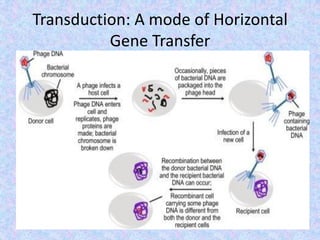
• Bacterial transduction, or simply transduction, is a type of gene
transfer where a bacterium transfers its DNA (or a portion of it) to
another bacterium by using a virus as a vector.
• During the replication of lytic bacteriophages and temperate
bacteriophages, occasionally the phage capsid accidently
assembles around a small fragment of bacterial DNA.
• When this bacteriophage, called a ‘transducing particle’,
infects another bacterium, it injects the fragment of donor
bacterial DNA it is carrying into the recipient where it can
subsequently be exchanged for a piece of the recipient's DNA
by homologous recombination.
• Transduction can transfer larger fragments of DNA than
transformation.
Transduction: A mode of Horizontal
Gene Transfer
• Transduction uses a temperate phage as the vehicle by which
DNA from a donor cell is transferred into a recipient cell. It
does not require the physical contact between the two.
• According to the genes involved in transduction, the process
can be of two types:
– (A) generalized transduction and
– (B) restricted transduction
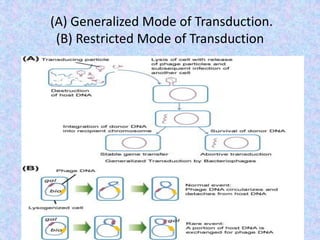
(A) Generalized Mode of Transduction.
• In generalized transduction, the packaged DNA can be from any
part of the donor strain chromosome.
• When phages exit the lysogenic phase, the prophage will excise
itself from the bacterial chromosome and enter into the lytic phase.
• The copies of bacteriophage DNA are packaged into virions, which
have been newly synthesized. The packaging of bacteriophage DNA
is subject to error, with frequent occurrences of mispackaging of
small pieces of bacterial DNA into the virions instead of the
bacteriophage genome. Such virions can then be spread to new
bacteria upon subsequent infection. .
• Approximately one in 105–107 phages will contain bacterial DNA
fragments that have been mistakenly packaged into the phage
head, which results in the formation of a transducting phage.
• Transducting phages can infect another host bacterium and inject
the DNA fragment they are carrying into the recipient cell, thereby
transferring DNA from one bacterial cell to another.
(B) Restricted Mode of Transduction
• Restricted transduction, or specific
transduction, describes the process in which
transduction is restricted to specific genes
from the chromosome of the donor strain.
• If phage λ is transferred into E. coli K12 while
it is in the lysogenic phase, the phage DNA is
integrated into a specific site in the E.
coli chromosome, between the galactose (gal)
and biotin (bio) genes.
(A) Generalized Mode of Transduction.
(B) Restricted Mode of Transduction
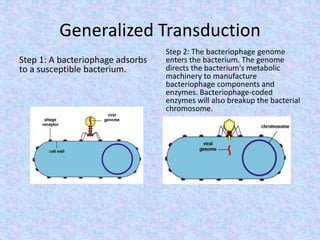
Generalized Transduction
Step 1: A bacteriophage adsorbs
to a susceptible bacterium.
Step 2: The bacteriophage genome
enters the bacterium. The genome
directs the bacterium's metabolic
machinery to manufacture
bacteriophage components and
enzymes. Bacteriophage-coded
enzymes will also breakup the bacterial
chromosome.
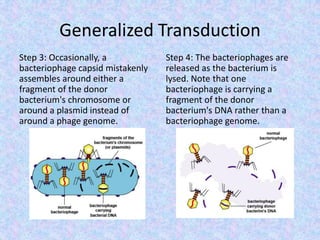
Generalized Transduction
Step 3: Occasionally, a
bacteriophage capsid mistakenly
assembles around either a
fragment of the donor
bacterium's chromosome or
around a plasmid instead of
around a phage genome.
Step 4: The bacteriophages are
released as the bacterium is
lysed. Note that one
bacteriophage is carrying a
fragment of the donor
bacterium's DNA rather than a
bacteriophage genome.
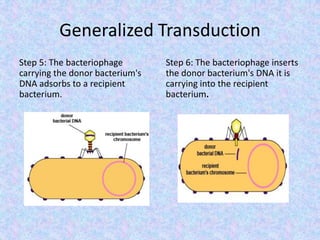
Generalized Transduction
Step 5: The bacteriophage
carrying the donor bacterium's
DNA adsorbs to a recipient
bacterium.
Step 6: The bacteriophage inserts
the donor bacterium's DNA it is
carrying into the recipient
bacterium.
Generalized Transduction
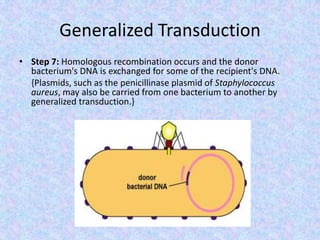
• Step 7: Homologous recombination occurs and the donor
bacterium's DNA is exchanged for some of the recipient's DNA.
{Plasmids, such as the penicillinase plasmid of Staphylococcus
aureus, may also be carried from one bacterium to another by
generalized transduction.}
Specialized Transduction
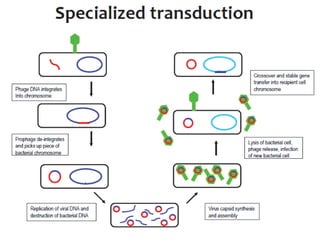
• Specialized transduction, may occur occasionally during the lysogenic life cycle of a
temperate bacteriophage.
• Step 1: A temperate bacteriophage adsorbs to a susceptible bacterium and injects its
genome.
• Step 2: The bacteriophage inserts its genome into the bacterium's chromosome to
become a ‘prophage’.
• Step 3: Occasionally during spontaneous induction, the DNA is excised incorrectly and a
small piece of the donor bacterium's DNA is picked up as part of the bacteriophage's
genome in place of some of the bacteriophage DNA that remains in the bacterium's
chromosome.
• Step 4: As the bacteriophage replicates, the segment of bacterial DNA replicates as part
of the bacteriophage's genome. Every bacteriophage now carries that segment of
bacterial DNA.
• Step 5: The bacteriophage adsorbs to a recipient bacterium and injects its genome.
• Step 6: The bacteriophage genome carrying the donor bacterial DNA inserts into the
recipient bacterium's chromosome.
Homologous Recombination
https://www.slideshare.net/vibhakhanna1/biology-of-homologous-recombination-in-bacteria
• RecBCD of Escherichia coli is a multi-subunit enzyme with DNA
helicase and nuclease activities. It is also called exonuclease V or
exoV.
• It is required for homologous recombination of linear DNAs, such as
those that occur during bacterial conjugation and phage-mediated
transduction, and also for DNA double-strand-break repair, which,
in E. coli, is accomplished almost exclusively via homologous
recombination.
• RecBCD activity is controlled by 8-bp Chi sequences in the E.
coli genome.
• In vivo, Chi modulates the enzyme, diminishing its destructive
exonuclease activity while leaving its recombination-promoting
helicase activity intact.
• The Chi/RecBCD system almost certainly functions in promoting
recombinational repair of DNA ends that form at broken replication
forks.
• This allows reestablishment of replication forks by recombinational
joining of a broken end to a sister molecule.

Transduction in bacteria

  • 1.
    DR. VIBHA KHANNA ASSO.PROF. (BOTANY) S.P.C. GOVERNMENT COLLEGE AJMER (RAJASTHAN)
  • 2.
    CYTOGENETICS • BLOCK 2:HORIZONTAL GENE TRANSFER IN BACTERIA • PRESENTATION 4: TRANSDUCTION IN BACTERIA;
  • 3.
    Bacteriophage: An Introduction •(A) The structural model of a phage: The phage head is icosahedral and is approximately 80 × 100 nm in size. It consists of the capsid protein that surrounds the internal nucleic acid. The tail is a tubular structure composed of protein, including the tail whiskers, tail collar, tail tube, tail sheath, tail fibers, and tail baseplate. • Phages can be – Virulent phages: that replicate only via the lytic cycle and – Temperate phages: that replicate using both lytic and lysogenic cycles.
  • 4.
    Bacteriophage: An Introduction •(B) Lysogenic and lytic cycles of lysogenic phage: • During the lytic cycle, the virus penetrates through the penetration of the cell membrane and DNA replication process whereas during the lysogenic cycle, the virus fuses its DNA with the host.
  • 5.
    Discovery of Transduction •In 1951, Joshua Lederberg and Norton Zinder were testing for recombination in the bacterium Salmonella typhimurium by using the techniques that had been successful with E. coli. • The researchers used two different strains: one was phe− trp− tyr−, and the other was met− his−. (the mutant alleles confer nutritional requirements.) • When either strain was plated on a minimal medium, no wild-type cells were observed. • However, after the two strains were mixed, wild-type cells appeared at a frequency of about 1 in 105. These were the “recombinants” • By preventing cell contact with filters of varying sizes, the researchers found the one responsible for the rise of the recombinants–a temperate bacteriophage of Salmonella. • So instead of confirming the conjugation in the bacterium, the researchers discovered a new process of gene transfer in organisms, and this time, mediated by a virus
  • 6.
    Discovery of Transduction •Lederberg and Zinder, instead of confirming conjugation in Salmonella, had discovered a new type of gene transfer mediated by a virus. • They called this process ’tranduction’. • Some phages are able to “mobilize” bacterial genes and carry them from one bacterial cell to another, where the virus inserts its contents. . Thus, transduction is one of modes of genetic transfer in bacteria—along with conjugation and transformation. • Transduction has subsequently been shown to be quite common among both temperate and virulent phages. • There are two kinds of transduction: generalized and specialized. – Generalized transducing phages can carry any part of the chromosome, whereas – specialized transducing phages carry only restricted parts of the bacterial chromosome.
  • 7.
  • 8.
    Transduction: A modeof Horizontal Gene Transfer
  • 9.
    Transduction: A modeof Horizontal Gene Transfer • Bacterial transduction, or simply transduction, is a type of gene transfer where a bacterium transfers its DNA (or a portion of it) to another bacterium by using a virus as a vector. • During the replication of lytic bacteriophages and temperate bacteriophages, occasionally the phage capsid accidently assembles around a small fragment of bacterial DNA. • When this bacteriophage, called a ‘transducing particle’, infects another bacterium, it injects the fragment of donor bacterial DNA it is carrying into the recipient where it can subsequently be exchanged for a piece of the recipient's DNA by homologous recombination. • Transduction can transfer larger fragments of DNA than transformation.
  • 10.
    Transduction: A modeof Horizontal Gene Transfer • Transduction uses a temperate phage as the vehicle by which DNA from a donor cell is transferred into a recipient cell. It does not require the physical contact between the two. • According to the genes involved in transduction, the process can be of two types: – (A) generalized transduction and – (B) restricted transduction
  • 11.
    (A) Generalized Modeof Transduction. • In generalized transduction, the packaged DNA can be from any part of the donor strain chromosome. • When phages exit the lysogenic phase, the prophage will excise itself from the bacterial chromosome and enter into the lytic phase. • The copies of bacteriophage DNA are packaged into virions, which have been newly synthesized. The packaging of bacteriophage DNA is subject to error, with frequent occurrences of mispackaging of small pieces of bacterial DNA into the virions instead of the bacteriophage genome. Such virions can then be spread to new bacteria upon subsequent infection. . • Approximately one in 105–107 phages will contain bacterial DNA fragments that have been mistakenly packaged into the phage head, which results in the formation of a transducting phage. • Transducting phages can infect another host bacterium and inject the DNA fragment they are carrying into the recipient cell, thereby transferring DNA from one bacterial cell to another.
  • 12.
    (B) Restricted Modeof Transduction • Restricted transduction, or specific transduction, describes the process in which transduction is restricted to specific genes from the chromosome of the donor strain. • If phage λ is transferred into E. coli K12 while it is in the lysogenic phase, the phage DNA is integrated into a specific site in the E. coli chromosome, between the galactose (gal) and biotin (bio) genes.
  • 13.
    (A) Generalized Modeof Transduction. (B) Restricted Mode of Transduction
  • 14.
    Generalized Transduction Step 1:A bacteriophage adsorbs to a susceptible bacterium. Step 2: The bacteriophage genome enters the bacterium. The genome directs the bacterium's metabolic machinery to manufacture bacteriophage components and enzymes. Bacteriophage-coded enzymes will also breakup the bacterial chromosome.
  • 15.
    Generalized Transduction Step 3:Occasionally, a bacteriophage capsid mistakenly assembles around either a fragment of the donor bacterium's chromosome or around a plasmid instead of around a phage genome. Step 4: The bacteriophages are released as the bacterium is lysed. Note that one bacteriophage is carrying a fragment of the donor bacterium's DNA rather than a bacteriophage genome.
  • 16.
    Generalized Transduction Step 5:The bacteriophage carrying the donor bacterium's DNA adsorbs to a recipient bacterium. Step 6: The bacteriophage inserts the donor bacterium's DNA it is carrying into the recipient bacterium.
  • 17.
    Generalized Transduction • Step7: Homologous recombination occurs and the donor bacterium's DNA is exchanged for some of the recipient's DNA. {Plasmids, such as the penicillinase plasmid of Staphylococcus aureus, may also be carried from one bacterium to another by generalized transduction.}
  • 18.
    Specialized Transduction • Specializedtransduction, may occur occasionally during the lysogenic life cycle of a temperate bacteriophage. • Step 1: A temperate bacteriophage adsorbs to a susceptible bacterium and injects its genome. • Step 2: The bacteriophage inserts its genome into the bacterium's chromosome to become a ‘prophage’. • Step 3: Occasionally during spontaneous induction, the DNA is excised incorrectly and a small piece of the donor bacterium's DNA is picked up as part of the bacteriophage's genome in place of some of the bacteriophage DNA that remains in the bacterium's chromosome. • Step 4: As the bacteriophage replicates, the segment of bacterial DNA replicates as part of the bacteriophage's genome. Every bacteriophage now carries that segment of bacterial DNA. • Step 5: The bacteriophage adsorbs to a recipient bacterium and injects its genome. • Step 6: The bacteriophage genome carrying the donor bacterial DNA inserts into the recipient bacterium's chromosome.
  • 20.
    Homologous Recombination https://www.slideshare.net/vibhakhanna1/biology-of-homologous-recombination-in-bacteria • RecBCDof Escherichia coli is a multi-subunit enzyme with DNA helicase and nuclease activities. It is also called exonuclease V or exoV. • It is required for homologous recombination of linear DNAs, such as those that occur during bacterial conjugation and phage-mediated transduction, and also for DNA double-strand-break repair, which, in E. coli, is accomplished almost exclusively via homologous recombination. • RecBCD activity is controlled by 8-bp Chi sequences in the E. coli genome. • In vivo, Chi modulates the enzyme, diminishing its destructive exonuclease activity while leaving its recombination-promoting helicase activity intact. • The Chi/RecBCD system almost certainly functions in promoting recombinational repair of DNA ends that form at broken replication forks. • This allows reestablishment of replication forks by recombinational joining of a broken end to a sister molecule.