INTRODUCTION
Many proteins and enzymes like regulatory
enzymes can be regulated via covalent
modification.
Covalent Modification involves the addition of
some sort of functional group onto the enzyme by
another molecule.
Over 500 different types of covalent modification
have been found in proteins.
Common modifying groups include
phosphoryl,acety,adenylyl,methyl,amide,carboxyl,h
yd-roxyl,sulphate etc. There are even entire
proteins that are used as specialized modifying
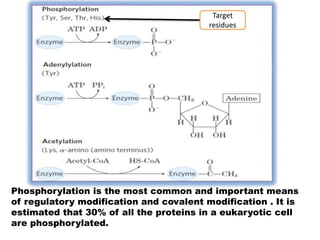
Phosphorylation is the most common and important means
of regulatory modification and covalent modification . It is
estimated that 30% of all the proteins in a eukaryotic cell
are phosphorylated.
Target
residues
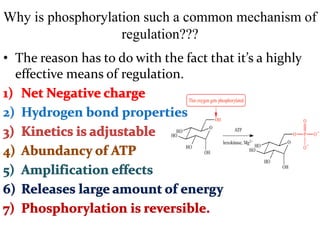
Why is phosphorylation such a common mechanism of
regulation???
• The reason has to do with the fact that it’s a highly
effective means of regulation.
Phosphoryl groups affect the structure and
catalytic activity of enzymes
Protein kinases
• The attachment of
phosphoryl groups to
specific amino acid
residues of a protein is
catalyzed by protein
kinases.
Protein phosphatases
• Removal of phosphoryl
group from specific amino
acid is catalyzed by protein
phosphatases.
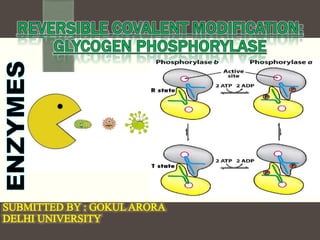
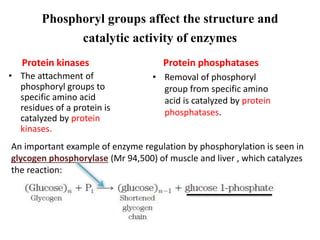
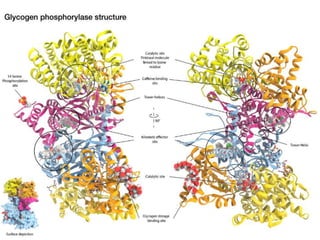
An important example of enzyme regulation by phosphorylation is seen in
glycogen phosphorylase (Mr 94,500) of muscle and liver , which catalyzes
the reaction:
 The glucose-1-phosphate so formed can be used for
the synthesis of ATP in muscle or converted to free
glucose in the liver.
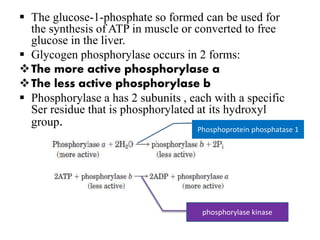
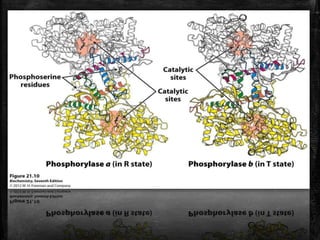
 Glycogen phosphorylase occurs in 2 forms:
The more active phosphorylase a
The less active phosphorylase b
 Phosphorylase a has 2 subunits , each with a specific
Ser residue that is phosphorylated at its hydroxyl
group. Phosphoprotein phosphatase 1
phosphorylase kinase
SOME IMPORTANTPOINTS
• Glycogen phosphorylase contains pyridoxal phosphate as a prosthetic
group.
• The breakdown of glycogen in skeletal muscles and the liver is
regulated by variations in the ratio of the 2 forms of glycogen
phosphorylase.
• The a and b forms differ in their secondary , tertiary and quaternary
structures; the active site undergoes changes in structure and
consequently , changes in catalytic activity as the 2 forms are
interconverted.
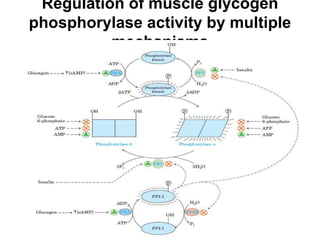
• The activity of glycogen phosphorylase in muscle is subjected to a
multilevel system of regulation , involving covalent
modification(phosphorylation), allosteric regulation and a regulatory
cascade sensitive to hormonal status that acts on the enzymes
involved in phosphorylation and dephosphorylation.
Regulation of muscle glycogen
phosphorylase activity by multiple
mechanisms
• Terms expansion:
• PPI-1 = Phosphoprotein phosphatase inhibitor 1
• PKA = Protein kinase A
• PP2B = Phosphoprotein phosphatase 2 B
• PP1 = phosphoprotein phosphatase 1
Thanks for your kind patience……

Reversible covalent modification

  • 2.
    INTRODUCTION Many proteins andenzymes like regulatory enzymes can be regulated via covalent modification. Covalent Modification involves the addition of some sort of functional group onto the enzyme by another molecule. Over 500 different types of covalent modification have been found in proteins. Common modifying groups include phosphoryl,acety,adenylyl,methyl,amide,carboxyl,h yd-roxyl,sulphate etc. There are even entire proteins that are used as specialized modifying
  • 3.
    Phosphorylation is themost common and important means of regulatory modification and covalent modification . It is estimated that 30% of all the proteins in a eukaryotic cell are phosphorylated. Target residues
  • 4.
    Why is phosphorylationsuch a common mechanism of regulation??? • The reason has to do with the fact that it’s a highly effective means of regulation.
  • 5.
    Phosphoryl groups affectthe structure and catalytic activity of enzymes Protein kinases • The attachment of phosphoryl groups to specific amino acid residues of a protein is catalyzed by protein kinases. Protein phosphatases • Removal of phosphoryl group from specific amino acid is catalyzed by protein phosphatases. An important example of enzyme regulation by phosphorylation is seen in glycogen phosphorylase (Mr 94,500) of muscle and liver , which catalyzes the reaction:
  • 7.
     The glucose-1-phosphateso formed can be used for the synthesis of ATP in muscle or converted to free glucose in the liver.  Glycogen phosphorylase occurs in 2 forms: The more active phosphorylase a The less active phosphorylase b  Phosphorylase a has 2 subunits , each with a specific Ser residue that is phosphorylated at its hydroxyl group. Phosphoprotein phosphatase 1 phosphorylase kinase
  • 9.
    SOME IMPORTANTPOINTS • Glycogenphosphorylase contains pyridoxal phosphate as a prosthetic group. • The breakdown of glycogen in skeletal muscles and the liver is regulated by variations in the ratio of the 2 forms of glycogen phosphorylase. • The a and b forms differ in their secondary , tertiary and quaternary structures; the active site undergoes changes in structure and consequently , changes in catalytic activity as the 2 forms are interconverted. • The activity of glycogen phosphorylase in muscle is subjected to a multilevel system of regulation , involving covalent modification(phosphorylation), allosteric regulation and a regulatory cascade sensitive to hormonal status that acts on the enzymes involved in phosphorylation and dephosphorylation.
  • 10.
    Regulation of muscleglycogen phosphorylase activity by multiple mechanisms
  • 11.
    • Terms expansion: •PPI-1 = Phosphoprotein phosphatase inhibitor 1 • PKA = Protein kinase A • PP2B = Phosphoprotein phosphatase 2 B • PP1 = phosphoprotein phosphatase 1
  • 12.
    Thanks for yourkind patience……