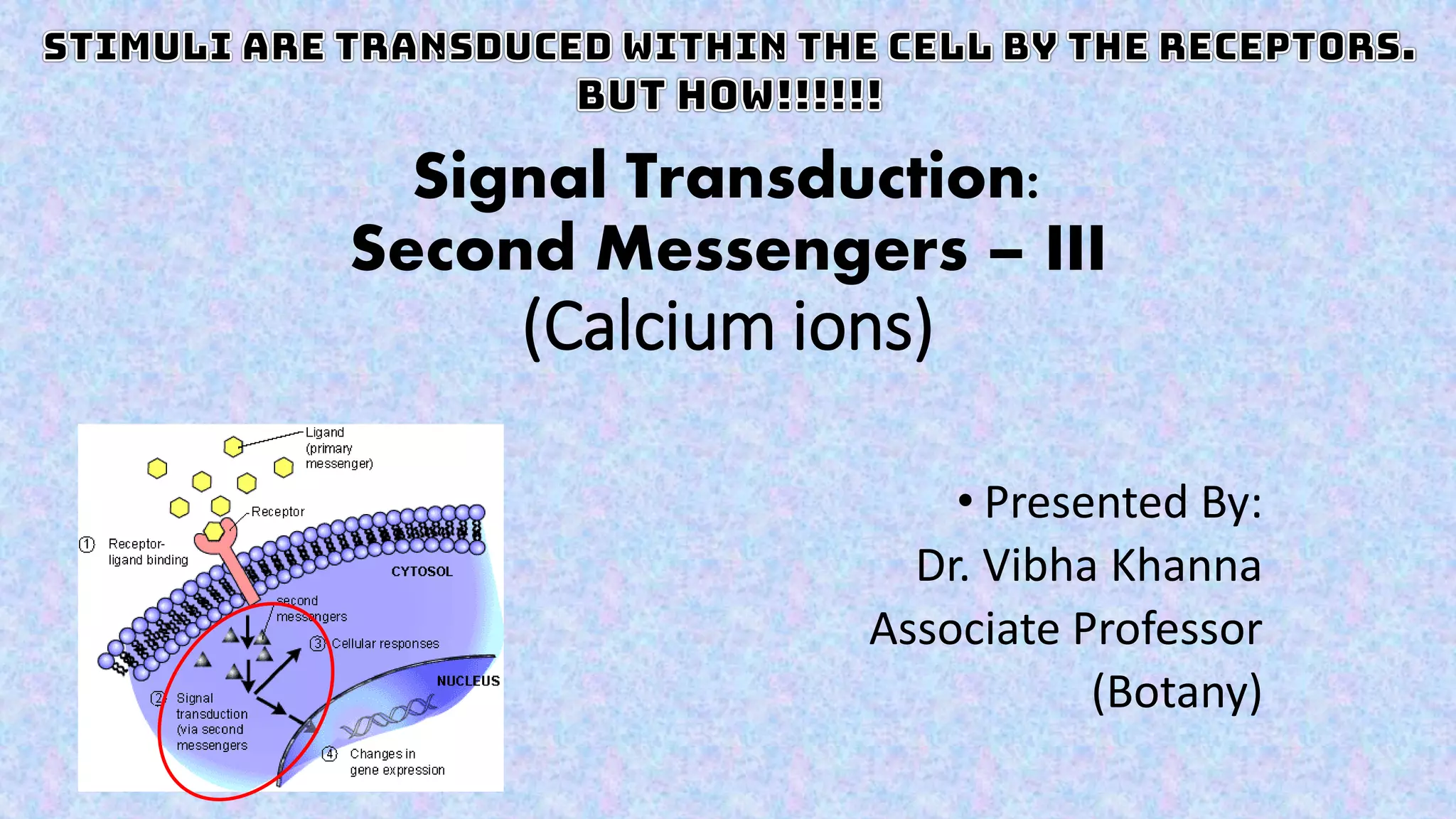
Signal Transduction:
Second Messengers – III
(Calcium ions)
• Presented By:
Dr. Vibha Khanna
Associate Professor
(Botany)
Second Messenger : Calcium ions
• Calcium (Ca2+) is an important cellular second messenger for diverse
developmental processes and environmental responses.
• cytosolic Ca2+ is the only second messenger to be involved in diverse pathways and
respond to numerous stimuli.
• Various environmental and developmental processes induces transient
increases in cytosolic Ca2+ {the cellular calcium levels, termed as calcium
signatures},
• developmental processes including root growth, stomatal movement, pollen growth,
• environmental cues including light, abiotic stress responses, and plant-microbe
interactions.
• The concentration of Ca2+ is delicately balanced by the presence of
‘Ca2+ stores’ like vacuoles, endoplasmic reticulum, mitochondria and cell
wall.
Why is Ca2+ are excluded from the cytosol?
• One reason is that Ca2+ binds water much less tightly and precipitates
phosphate.
• Hence, cells have evolved ways to isolate this dangerous divalent,
• to simply reduce its cytosolic levels
• to use its binding energy for signal transduction.
• Unlike complex molecules, Ca2+ cannot be chemically altered. Thus, to
exert control over Ca2+, cells must chelate, compartmentalize, or extrude it.
• Hundreds of cellular proteins have been adapted to bind Ca2+
• in some cases simply to buffer or lower Ca2+ levels, and
• in others to trigger cellular processes.
• The local nature of Ca2+ signaling is intimately tied to this large range of
affinities.
Mechanisms of intracellular calcium ion
concentration changes
• The mechanisms of intracellular concentration changes include
• calcium-induced calcium release and
• calcium dependent inactivation of calcium release.
• The removal of Ca2+ from the cytosol against its electrochemical
gradient to either the apoplast or to intracellular organelles requires
energized ‘active’ transport.
• Ca2+-ATPases and
• H+/Ca2+ antiporters
are the key proteins catalyzing this movement.
Calcium signatures are generated by the coordinated action of various
Ca2+ influx and efflux systems including channels, pumps, and exchangers
located at different cellular membranes.
• The cytoplasmic Ca2+ level is low in
resting cells.
• Low cytoplasmic [Ca2+] is maintained by
extrusion via
• plasma membrane Ca2+ ATPase (PMCA) and
• smooth endoplasmic reticular Ca2+ ATPase
(SERCA) transporters.
• The Na/Ca exchanger (NCX), a major
secondary regulator of [Ca2+], is
electrogenic,
• exchanging three Na ions for one Ca2+.
• Intracellular Ca2+ hyperpolarizes many
cells by activating K+ channels, and in
some cells, Cl− channels.
• This decreases CaV channel activity but
increases the driving force across active
Ca2+-permeant channels.
The Ca2+ signaling network: An Overview
• In excitatory Ca2+ signaling, plasma membrane
ion channels are triggered to open by changes
in voltage, or extra- or intracellular ligand
binding.
• Initial increases in [Ca2+] trigger more release,
primarily from ER via Ca2+-sensitive ryanodine
receptors (RyR).
• G protein-coupled receptor (GPCR) or receptor
tyrosine kinase-mediated activation of PLC
cleaves PIP2 into inositol (1,4,5) trisphosphate
(IP3) and diacylglycerol (DAG).
• IP3 is a ligand for the intracellular IP3R channel
spanning the membrane of the ER.
• GPCRs catalyze the exchange of guanosine
diphosphate (GDP) for GTP on Gα subunits,
releasing active Gα and Gβγ subunits that in
turn activate PLCβ.
• RTKs dimerize upon ligand binding, auto-
phosphorylate, and interact with other signaling
proteins to activate PLCγ.

Second messengers in Signal transduction (Calcium ions)

  • 1.
    Signal Transduction: Second Messengers– III (Calcium ions) • Presented By: Dr. Vibha Khanna Associate Professor (Botany)
  • 2.
    Second Messenger :Calcium ions • Calcium (Ca2+) is an important cellular second messenger for diverse developmental processes and environmental responses. • cytosolic Ca2+ is the only second messenger to be involved in diverse pathways and respond to numerous stimuli. • Various environmental and developmental processes induces transient increases in cytosolic Ca2+ {the cellular calcium levels, termed as calcium signatures}, • developmental processes including root growth, stomatal movement, pollen growth, • environmental cues including light, abiotic stress responses, and plant-microbe interactions. • The concentration of Ca2+ is delicately balanced by the presence of ‘Ca2+ stores’ like vacuoles, endoplasmic reticulum, mitochondria and cell wall.
  • 3.
    Why is Ca2+are excluded from the cytosol? • One reason is that Ca2+ binds water much less tightly and precipitates phosphate. • Hence, cells have evolved ways to isolate this dangerous divalent, • to simply reduce its cytosolic levels • to use its binding energy for signal transduction. • Unlike complex molecules, Ca2+ cannot be chemically altered. Thus, to exert control over Ca2+, cells must chelate, compartmentalize, or extrude it. • Hundreds of cellular proteins have been adapted to bind Ca2+ • in some cases simply to buffer or lower Ca2+ levels, and • in others to trigger cellular processes. • The local nature of Ca2+ signaling is intimately tied to this large range of affinities.
  • 4.
    Mechanisms of intracellularcalcium ion concentration changes • The mechanisms of intracellular concentration changes include • calcium-induced calcium release and • calcium dependent inactivation of calcium release. • The removal of Ca2+ from the cytosol against its electrochemical gradient to either the apoplast or to intracellular organelles requires energized ‘active’ transport. • Ca2+-ATPases and • H+/Ca2+ antiporters are the key proteins catalyzing this movement.
  • 5.
    Calcium signatures aregenerated by the coordinated action of various Ca2+ influx and efflux systems including channels, pumps, and exchangers located at different cellular membranes. • The cytoplasmic Ca2+ level is low in resting cells. • Low cytoplasmic [Ca2+] is maintained by extrusion via • plasma membrane Ca2+ ATPase (PMCA) and • smooth endoplasmic reticular Ca2+ ATPase (SERCA) transporters. • The Na/Ca exchanger (NCX), a major secondary regulator of [Ca2+], is electrogenic, • exchanging three Na ions for one Ca2+. • Intracellular Ca2+ hyperpolarizes many cells by activating K+ channels, and in some cells, Cl− channels. • This decreases CaV channel activity but increases the driving force across active Ca2+-permeant channels.
  • 6.
    The Ca2+ signalingnetwork: An Overview • In excitatory Ca2+ signaling, plasma membrane ion channels are triggered to open by changes in voltage, or extra- or intracellular ligand binding. • Initial increases in [Ca2+] trigger more release, primarily from ER via Ca2+-sensitive ryanodine receptors (RyR). • G protein-coupled receptor (GPCR) or receptor tyrosine kinase-mediated activation of PLC cleaves PIP2 into inositol (1,4,5) trisphosphate (IP3) and diacylglycerol (DAG). • IP3 is a ligand for the intracellular IP3R channel spanning the membrane of the ER. • GPCRs catalyze the exchange of guanosine diphosphate (GDP) for GTP on Gα subunits, releasing active Gα and Gβγ subunits that in turn activate PLCβ. • RTKs dimerize upon ligand binding, auto- phosphorylate, and interact with other signaling proteins to activate PLCγ.