Downloaded 216 times



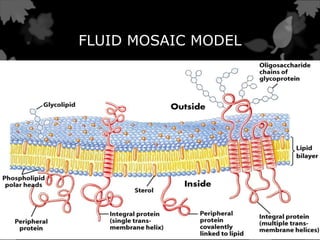


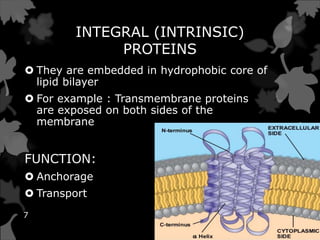


Biological membranes are thin, flexible surfaces that separate cells and organelles from their environments. They are made up of proteins, lipids like phospholipids and glycolipids, and carbohydrates. Phospholipids are the major lipid component, consisting of a hydrophilic head and two hydrophobic tails, allowing them to form the fluid lipid bilayer structure of the membrane. Membrane proteins can be integral and span the membrane or peripheral and attach to its surface. They perform many functions including transport, cell signaling, and anchoring the cytoskeleton. Together, the components of the membrane give it key properties such as selective permeability and fluidity to control what enters and exits the cell while protecting it.


