STRUCTURAL LIPID
By
KAUSHAL KUMAR SAHU
Assistant Professor (Ad Hoc)
Department of Biotechnology
Govt. Digvijay Autonomous P. G. College
Raj-Nandgaon ( C. G. )
Introduction
Definition
History
Structural lipid in membrane
 Types of membrane lipids
 Phospholipids-
 Glycolipid -
 Cholestrol -
Membranes – Lipid Bilayers
Lipid vesicles
 Archea versus bacteria
Conclusion
References
Synopsis
Introduction
 Biological lipid are a chemically diverse group of
compound, the common and defining feature of which
is their insolubility in water.
 Fats and oils are the principle stored from of energy in
many organism.
 Phospholipids and sterol are major structural element of
Biological membrane .
Definition-
 The lipid are heterogenes group of compounds.
 Although lipid are amphiphatic molecule.
(Containing both components of hydrophilic and
hydrophobic regions within the molecule)
History
 1758 First study by Poulletier de la Salle FP of a lipid
(cholesterol) isolated from bile stones.
 1783 Fourcroy AF introduced alcohol to extract brain lipids.
 1862 Isolation by Beneke GM for the first time in a plant extract
(pea seeds) of a compound he believed to be cholesterol.
 1899 Altman R et al. introduced acetone in the preparation of
phospholipids (separation from fats and cholesterol).
Structural lipid in membrane
Types of membrane lipids-
 Phospholipids
 Glycolipid
 Cholestrol
Phospholipids
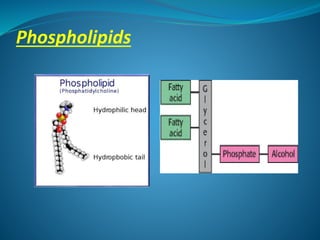
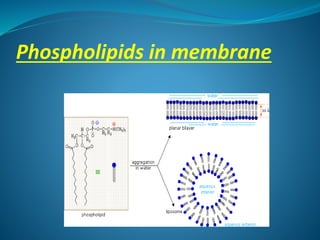
 A phospholipids molecule consists of two main parts-
 a hydrophilic polar head group and
 a hydrophobic tail.
 The polar head group has one or more phosphate
groups while the hydrophobic tail has two fatty acyl
chains.
 Phospholipids are important as a structural
constitution of lipid bilayer of biological membranes
 for example, the plasma membrane of cells
Phospholipids
Phospholipids in membrane
Phospholipids exist in two forms:
1. Phosphoglycerides and
2. Sphingomyelin.
1. Phosphoglycerides
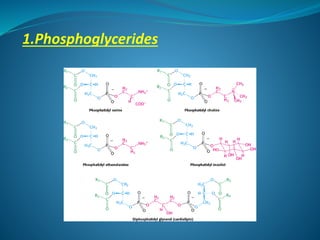
 Phosphoglycerides are lipids of glycerol groups bonded to
two fat-soluble fatty acids and one charged, water-soluble
phosphate group; the compound is known as phosphatidic acid.
 The phosphate group can be bonded by other chemical
group to form different structures for different functions.
1.Phosphoglycerides
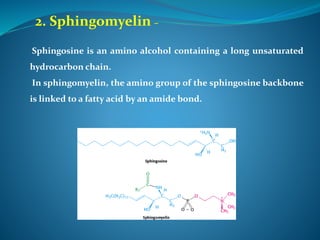
2. Sphingomyelin –
Sphingosine is an amino alcohol containing a long unsaturated
hydrocarbon chain.
In sphingomyelin, the amino group of the sphingosine backbone
is linked to a fatty acid by an amide bond.
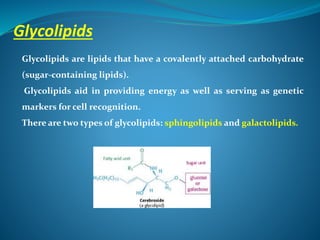
Glycolipids
Glycolipids are lipids that have a covalently attached carbohydrate
(sugar-containing lipids).
Glycolipids aid in providing energy as well as serving as genetic
markers for cell recognition.
There are two types of glycolipids: sphingolipids and galactolipids.
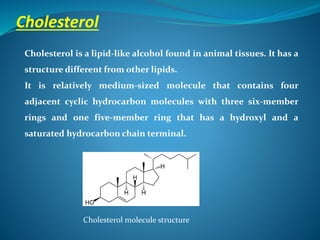
Cholesterol
Cholesterol molecule structure
Cholesterol is a lipid-like alcohol found in animal tissues. It has a
structure different from other lipids.
It is relatively medium-sized molecule that contains four
adjacent cyclic hydrocarbon molecules with three six-member
rings and one five-member ring that has a hydroxyl and a
saturated hydrocarbon chain terminal.
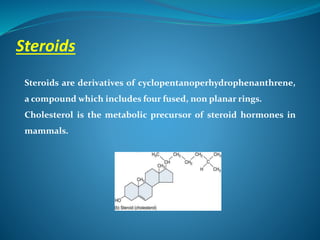
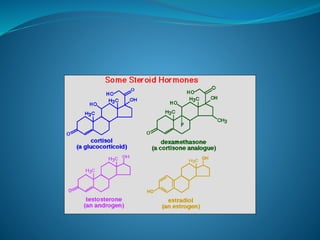
Steroids
Steroids are derivatives of cyclopentanoperhydrophenanthrene,
a compound which includes four fused, non planar rings.
Cholesterol is the metabolic precursor of steroid hormones in
mammals.
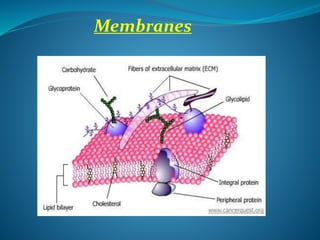
Membranes
Lipid Bilayers
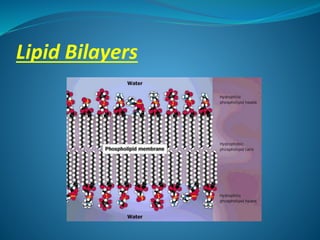
The central architectural feature of biological
membranes is a double layer of lipids, which acts as a
barrier to the passage of polar molecules and ions.
 Membrane Lipids are amphipathic : one end of the
molecule is hydrophobic, the other hydrophilic.
Their hydrophobic interactions with each other and
their hydrophilic interactions with water direct their
packing into sheets called membrane bilayers.
Lipid Bilayers
Lipid Vesicles
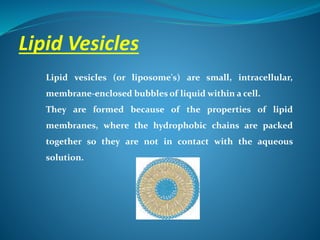
Lipid vesicles (or liposome's) are small, intracellular,
membrane-enclosed bubbles of liquid within a cell.
They are formed because of the properties of lipid
membranes, where the hydrophobic chains are packed
together so they are not in contact with the aqueous
solution.
Archea versus Bacteria
•Two major factor that separates Archea (bacteria) from Bacteria is
the Archea's cell membranes phospholipids consists of ether
linkages and the fatty acid hydrocarbon chains are completely
saturated and branched with a methyl group every 5 carbons.
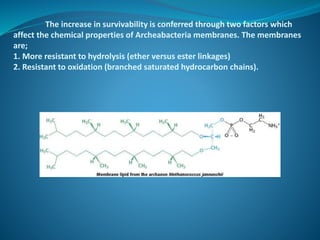
The increase in survivability is conferred through two factors which
affect the chemical properties of Archeabacteria membranes. The membranes
are;
1. More resistant to hydrolysis (ether versus ester linkages)
2. Resistant to oxidation (branched saturated hydrocarbon chains).
Conclusion-
 Lipid provide to amphipathic nature of the cell membrane.
 The structure of the bilayer provides a permeability barrier between
exterior and interior compartments.
 The lipids in the membrane undergo complex phases to facilitate
processes that are a function of concentration, composition, and
temperature.
 The presence of cholesterol also reduces membrane fluidity.
LEHNINGER-PRINCIPLES OF BIOCHEMISTRY-fifth edition
LEHNINGER,NELSON & COX -5th edition
BICHEMISTRY-J.L.JAIN
LABERT STRYER –BIOCHEMISTRY-5th edition
BIOCHEMISTRY-4th edition DONALD VOET & JUDITH VOET
http;//lipid library.org.aose.org/
http;//www.agriinfo.in/
http;//en.wikibooks.org/
References-

Structural lipid by KK Sahu sir

  • 1.
    STRUCTURAL LIPID By KAUSHAL KUMARSAHU Assistant Professor (Ad Hoc) Department of Biotechnology Govt. Digvijay Autonomous P. G. College Raj-Nandgaon ( C. G. )
  • 2.
    Introduction Definition History Structural lipid inmembrane  Types of membrane lipids  Phospholipids-  Glycolipid -  Cholestrol - Membranes – Lipid Bilayers Lipid vesicles  Archea versus bacteria Conclusion References Synopsis
  • 3.
    Introduction  Biological lipidare a chemically diverse group of compound, the common and defining feature of which is their insolubility in water.  Fats and oils are the principle stored from of energy in many organism.  Phospholipids and sterol are major structural element of Biological membrane .
  • 4.
    Definition-  The lipidare heterogenes group of compounds.  Although lipid are amphiphatic molecule. (Containing both components of hydrophilic and hydrophobic regions within the molecule)
  • 5.
    History  1758 Firststudy by Poulletier de la Salle FP of a lipid (cholesterol) isolated from bile stones.  1783 Fourcroy AF introduced alcohol to extract brain lipids.  1862 Isolation by Beneke GM for the first time in a plant extract (pea seeds) of a compound he believed to be cholesterol.  1899 Altman R et al. introduced acetone in the preparation of phospholipids (separation from fats and cholesterol).
  • 6.
    Structural lipid inmembrane Types of membrane lipids-  Phospholipids  Glycolipid  Cholestrol
  • 7.
    Phospholipids  A phospholipidsmolecule consists of two main parts-  a hydrophilic polar head group and  a hydrophobic tail.  The polar head group has one or more phosphate groups while the hydrophobic tail has two fatty acyl chains.  Phospholipids are important as a structural constitution of lipid bilayer of biological membranes  for example, the plasma membrane of cells
  • 8.
  • 9.
  • 10.
    Phospholipids exist intwo forms: 1. Phosphoglycerides and 2. Sphingomyelin.
  • 11.
    1. Phosphoglycerides  Phosphoglyceridesare lipids of glycerol groups bonded to two fat-soluble fatty acids and one charged, water-soluble phosphate group; the compound is known as phosphatidic acid.  The phosphate group can be bonded by other chemical group to form different structures for different functions.
  • 12.
  • 13.
    2. Sphingomyelin – Sphingosineis an amino alcohol containing a long unsaturated hydrocarbon chain. In sphingomyelin, the amino group of the sphingosine backbone is linked to a fatty acid by an amide bond.
  • 14.
    Glycolipids Glycolipids are lipidsthat have a covalently attached carbohydrate (sugar-containing lipids). Glycolipids aid in providing energy as well as serving as genetic markers for cell recognition. There are two types of glycolipids: sphingolipids and galactolipids.
  • 15.
    Cholesterol Cholesterol molecule structure Cholesterolis a lipid-like alcohol found in animal tissues. It has a structure different from other lipids. It is relatively medium-sized molecule that contains four adjacent cyclic hydrocarbon molecules with three six-member rings and one five-member ring that has a hydroxyl and a saturated hydrocarbon chain terminal.
  • 16.
    Steroids Steroids are derivativesof cyclopentanoperhydrophenanthrene, a compound which includes four fused, non planar rings. Cholesterol is the metabolic precursor of steroid hormones in mammals.
  • 18.
  • 19.
    Lipid Bilayers The centralarchitectural feature of biological membranes is a double layer of lipids, which acts as a barrier to the passage of polar molecules and ions.  Membrane Lipids are amphipathic : one end of the molecule is hydrophobic, the other hydrophilic. Their hydrophobic interactions with each other and their hydrophilic interactions with water direct their packing into sheets called membrane bilayers.
  • 20.
  • 21.
    Lipid Vesicles Lipid vesicles(or liposome's) are small, intracellular, membrane-enclosed bubbles of liquid within a cell. They are formed because of the properties of lipid membranes, where the hydrophobic chains are packed together so they are not in contact with the aqueous solution.
  • 22.
    Archea versus Bacteria •Twomajor factor that separates Archea (bacteria) from Bacteria is the Archea's cell membranes phospholipids consists of ether linkages and the fatty acid hydrocarbon chains are completely saturated and branched with a methyl group every 5 carbons.
  • 23.
    The increase insurvivability is conferred through two factors which affect the chemical properties of Archeabacteria membranes. The membranes are; 1. More resistant to hydrolysis (ether versus ester linkages) 2. Resistant to oxidation (branched saturated hydrocarbon chains).
  • 24.
    Conclusion-  Lipid provideto amphipathic nature of the cell membrane.  The structure of the bilayer provides a permeability barrier between exterior and interior compartments.  The lipids in the membrane undergo complex phases to facilitate processes that are a function of concentration, composition, and temperature.  The presence of cholesterol also reduces membrane fluidity.
  • 25.
    LEHNINGER-PRINCIPLES OF BIOCHEMISTRY-fifthedition LEHNINGER,NELSON & COX -5th edition BICHEMISTRY-J.L.JAIN LABERT STRYER –BIOCHEMISTRY-5th edition BIOCHEMISTRY-4th edition DONALD VOET & JUDITH VOET http;//lipid library.org.aose.org/ http;//www.agriinfo.in/ http;//en.wikibooks.org/ References-