This document discusses the physiological processes involved in the transition from vegetative to reproductive growth in plants, known as the flowering process. It covers two broad phases: floral induction, where stimuli cause flower primordia to form, and floral development. Floral induction is regulated by endogenous and environmental signals that program shoot meristems to produce flowers at appropriate times. Floral development then occurs in four steps as flowering time, meristem identity, and organ identity genes are activated to specify the formation of floral organs. The document explores various floral inductive pathways and genes that integrate environmental and internal signals to control the timing of flowering.


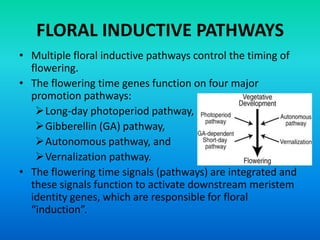
![FLORAL INDUCTIVE PATHWAYS
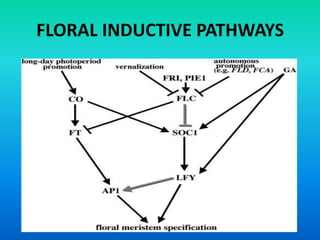
• Signals from the four major floral inductive pathways
are integrated by FLC, SOC1, FT, and LFY [FLOWERING
LOCUS C (FLC), SUPPRESSOR OF OVEREXPRESSION OF
CONSTANS (SOC1), and FLOWERING LOCUS T (FT)]
• Many of these interactions are demonstrated to be
direct.
• Ultimately, the flowering time genes function to
control the activity of a much smaller group of
‘meristem identity’ genes.
• The meristem identity genes can be divided into two
subclasses:
the shoot meristem identity genes and
the floral meristem identity genes.](https://image.slidesharecdn.com/floweringprocess-200503185016/85/Flowering-process-13-320.jpg)