DR. VIBHA KHANNA
Asso. Prof. (Botany)
SPC GOVERNMENT COLLEGE
AJMER (Rajasthan)
PLANT BIOCHEMISTRY
‱ BLOCK 1. : Lipid metabolism
– PRESENTATION 1: Structure and function of lipids,
LIPIDS
‱ Term first used by German biochemist Bloor in 1943.
‱ The word lipid is derived from a Greek word “lipos” which means Fat.
‱ They are:
1. Insoluble in water.
2. Soluble in non-polar organic solvents e.g. ether, acetone.
3. Contain carbon, hydrogen and oxygen sometimes contain nitrogen and phosphorous.
4. Neutral lipids upon hydrolysis yield glycerol and fatty acids*.
5. Take part in plant and animal metabolism.
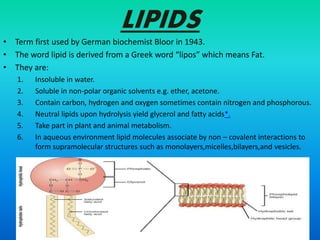
6. In aqueous environment lipid molecules associate by non – covalent interactions to
form supramolecular structures such as monolayers,micelles,bilayers,and vesicles.
‱ FATTY ACIDS*
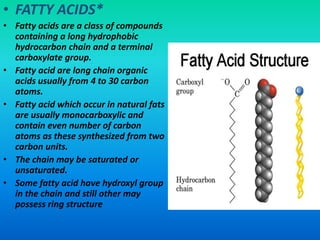
‱ Fatty acids are a class of compounds
containing a long hydrophobic
hydrocarbon chain and a terminal
carboxylate group.
‱ Fatty acid are long chain organic
acids usually from 4 to 30 carbon
atoms.
‱ Fatty acid which occur in natural fats
are usually monocarboxylic and
contain even number of carbon
atoms as these synthesized from two
carbon units.
‱ The chain may be saturated or
unsaturated.
‱ Some fatty acid have hydroxyl group
in the chain and still other may
possess ring structure
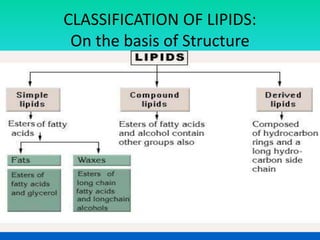
CLASSIFICATION OF LIPIDS:
On the basis of Structure
CLASSIFICATION OF LIPIDS :
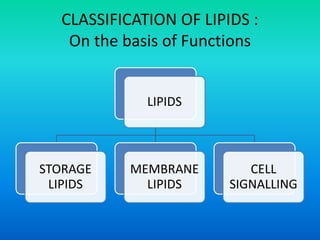
On the basis of Functions
LIPIDS
STORAGE
LIPIDS
MEMBRANE
LIPIDS
CELL
SIGNALLING
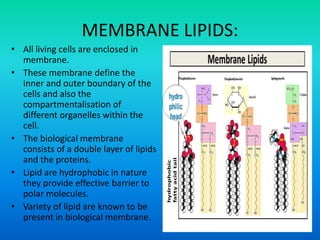
MEMBRANE LIPIDS:
‱ All living cells are enclosed in
membrane.
‱ These membrane define the
inner and outer boundary of the
cells and also the
compartmentalisation of
different organelles within the
cell.
‱ The biological membrane
consists of a double layer of lipids
and the proteins.
‱ Lipid are hydrophobic in nature
they provide effective barrier to
polar molecules.
‱ Variety of lipid are known to be
present in biological membrane.
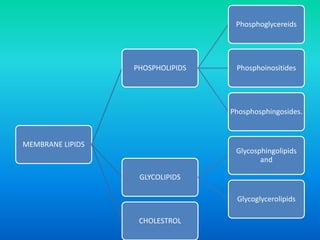
MEMBRANE LIPIDS
PHOSPHOLIPIDS
Phosphoglycereids
Phosphoinositides
Phosphosphingosides.
GLYCOLIPIDS
Glycosphingolipids
and
Glycoglycerolipids
CHOLESTROL
PHOSPHOLIPID:
‱ Phospholipid are the most abundant
membrane lipid.
‱ They serve primarily as structural
components of membrane and are never
stored in large quantities.
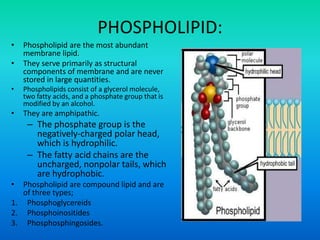
‱ Phospholipids consist of a glycerol molecule,
two fatty acids, and a phosphate group that is
modified by an alcohol.
‱ They are amphipathic.
– The phosphate group is the
negatively-charged polar head,
which is hydrophilic.
– The fatty acid chains are the
uncharged, nonpolar tails, which
are hydrophobic.
‱ Phospholipid are compound lipid and are
of three types;
1. Phosphoglycereids
2. Phosphoinositides
3. Phosphosphingosides.
PHOSPHOLIPID: Phosphoglycereids
‱ Phosphoglycerides have three parts:
– a three-carbon backbone of glycerol,
– two long-chain fatty acids esterified (or attached via an ether link in
Archaea) to hydroxyl groups on carbons 1 and 2 (C1 and C2) of the
glycerol and
– a highly polar or charged group ( like phosphoric acid) esterified to
the C3 hydroxyl group of glycerol.
‱ Lecithin is a phospholipid which consists of glycerol, two fatty acids, a
phosphate group and choline. (Lecithins are widely distributed in
nature, including various oil seeds like soybean and the yeasts .)
‱ Cephalins contain the amino alcohols serine or ethanolamine(in place
of choline). (Cephalins are found in most cell membranes, in animal
world. They have been identified from soybean oil.)
PHOSPHOLIPID: Phosphoinositides
‱ Phosphatidylinositol is an acidic (anionic) phospholipid that basically,
consists of a phosphatidic acid backbone, linked via the phosphate
group to inositol (hexahydroxycyclohexane).
‱ Phosphoinositides are the phosphorylated derivatives of
phosphatidylinositol.
‱ They have three parts:
– a three-carbon backbone of glycerol,
– two long-chain fatty acids esterified to hydroxyl groups on carbons 1 and 2
(C1 and C2) of the glycerol and
– attached to a polar head group (the cyclic hexahydroxy alcohol called
inositol) that extends into the cytoplasm. [The inositol is present as the
stereoisomer, myo-inositol.]
‱ Examples: phosphatidylinositol 3,4,5-trisphosphate, often called PIP3 ;
phosphatidylinositol 4,5-bisphosphate, often called PIP2
‱ *Phosphosphingosides: apparently lack in plants and the
microorganisms.
GLYCOLIPID
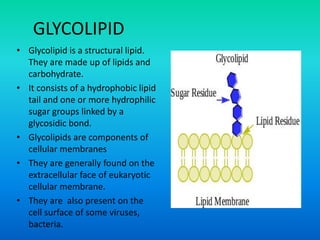
‱ Glycolipid is a structural lipid.
They are made up of lipids and
carbohydrate.
‱ It consists of a hydrophobic lipid
tail and one or more hydrophilic
sugar groups linked by a
glycosidic bond.
‱ Glycolipids are components of
cellular membranes
‱ They are generally found on the
extracellular face of eukaryotic
cellular membrane.
‱ They are also present on the
cell surface of some viruses,
bacteria.
GLYCOLIPIDS
‱ The basic structure of a
glycolipid consists of a mono- or
oligosaccharide group attached
to a sphingolipid or a glycerol
group, which can be acetylated
or alkylated, with one or two
fatty acids.
‱ These make up the two classes
– Glycosphingolipids and
– Glycoglycerolipids
‱ Glycolipids interact and bind to
the lipid-bilayer through the
hydrophobic nature of the lipid
tail which anchors it to the
surface of the plasma
membrane.
Cholesterol
‱ Cholesterol is a steroid derivative
and is present as membrane lipid in
almost all animal membranes.
‱ Derivatives of steroids, however, are
also found in plants, fungi, and
some bacteria.
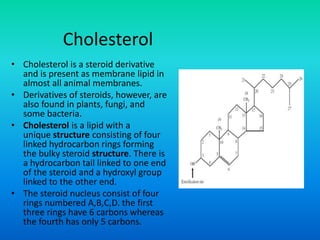
‱ Cholesterol is a lipid with a
unique structure consisting of four
linked hydrocarbon rings forming
the bulky steroid structure. There is
a hydrocarbon tail linked to one end
of the steroid and a hydroxyl group
linked to the other end.
‱ The steroid nucleus consist of four
rings numbered A,B,C,D. the first
three rings have 6 carbons whereas
the fourth has only 5 carbons.
REFERENCES:
Biochemistry And Molecular Biology Of Plants
: Buchanan, Gruissem, Jones
Plant Physiology : Mohr

Lipids: Structure and Functions

  • 1.
    DR. VIBHA KHANNA Asso.Prof. (Botany) SPC GOVERNMENT COLLEGE AJMER (Rajasthan)
  • 2.
    PLANT BIOCHEMISTRY ‱ BLOCK1. : Lipid metabolism – PRESENTATION 1: Structure and function of lipids,
  • 3.
    LIPIDS ‱ Term firstused by German biochemist Bloor in 1943. ‱ The word lipid is derived from a Greek word “lipos” which means Fat. ‱ They are: 1. Insoluble in water. 2. Soluble in non-polar organic solvents e.g. ether, acetone. 3. Contain carbon, hydrogen and oxygen sometimes contain nitrogen and phosphorous. 4. Neutral lipids upon hydrolysis yield glycerol and fatty acids*. 5. Take part in plant and animal metabolism. 6. In aqueous environment lipid molecules associate by non – covalent interactions to form supramolecular structures such as monolayers,micelles,bilayers,and vesicles.
  • 4.
    ‱ FATTY ACIDS* ‱Fatty acids are a class of compounds containing a long hydrophobic hydrocarbon chain and a terminal carboxylate group. ‱ Fatty acid are long chain organic acids usually from 4 to 30 carbon atoms. ‱ Fatty acid which occur in natural fats are usually monocarboxylic and contain even number of carbon atoms as these synthesized from two carbon units. ‱ The chain may be saturated or unsaturated. ‱ Some fatty acid have hydroxyl group in the chain and still other may possess ring structure
  • 5.
    CLASSIFICATION OF LIPIDS: Onthe basis of Structure
  • 6.
    CLASSIFICATION OF LIPIDS: On the basis of Functions LIPIDS STORAGE LIPIDS MEMBRANE LIPIDS CELL SIGNALLING
  • 7.
    MEMBRANE LIPIDS: ‱ Allliving cells are enclosed in membrane. ‱ These membrane define the inner and outer boundary of the cells and also the compartmentalisation of different organelles within the cell. ‱ The biological membrane consists of a double layer of lipids and the proteins. ‱ Lipid are hydrophobic in nature they provide effective barrier to polar molecules. ‱ Variety of lipid are known to be present in biological membrane.
  • 8.
  • 9.
    PHOSPHOLIPID: ‱ Phospholipid arethe most abundant membrane lipid. ‱ They serve primarily as structural components of membrane and are never stored in large quantities. ‱ Phospholipids consist of a glycerol molecule, two fatty acids, and a phosphate group that is modified by an alcohol. ‱ They are amphipathic. – The phosphate group is the negatively-charged polar head, which is hydrophilic. – The fatty acid chains are the uncharged, nonpolar tails, which are hydrophobic. ‱ Phospholipid are compound lipid and are of three types; 1. Phosphoglycereids 2. Phosphoinositides 3. Phosphosphingosides.
  • 10.
    PHOSPHOLIPID: Phosphoglycereids ‱ Phosphoglycerideshave three parts: – a three-carbon backbone of glycerol, – two long-chain fatty acids esterified (or attached via an ether link in Archaea) to hydroxyl groups on carbons 1 and 2 (C1 and C2) of the glycerol and – a highly polar or charged group ( like phosphoric acid) esterified to the C3 hydroxyl group of glycerol. ‱ Lecithin is a phospholipid which consists of glycerol, two fatty acids, a phosphate group and choline. (Lecithins are widely distributed in nature, including various oil seeds like soybean and the yeasts .) ‱ Cephalins contain the amino alcohols serine or ethanolamine(in place of choline). (Cephalins are found in most cell membranes, in animal world. They have been identified from soybean oil.)
  • 11.
    PHOSPHOLIPID: Phosphoinositides ‱ Phosphatidylinositolis an acidic (anionic) phospholipid that basically, consists of a phosphatidic acid backbone, linked via the phosphate group to inositol (hexahydroxycyclohexane). ‱ Phosphoinositides are the phosphorylated derivatives of phosphatidylinositol. ‱ They have three parts: – a three-carbon backbone of glycerol, – two long-chain fatty acids esterified to hydroxyl groups on carbons 1 and 2 (C1 and C2) of the glycerol and – attached to a polar head group (the cyclic hexahydroxy alcohol called inositol) that extends into the cytoplasm. [The inositol is present as the stereoisomer, myo-inositol.] ‱ Examples: phosphatidylinositol 3,4,5-trisphosphate, often called PIP3 ; phosphatidylinositol 4,5-bisphosphate, often called PIP2 ‱ *Phosphosphingosides: apparently lack in plants and the microorganisms.
  • 12.
    GLYCOLIPID ‱ Glycolipid isa structural lipid. They are made up of lipids and carbohydrate. ‱ It consists of a hydrophobic lipid tail and one or more hydrophilic sugar groups linked by a glycosidic bond. ‱ Glycolipids are components of cellular membranes ‱ They are generally found on the extracellular face of eukaryotic cellular membrane. ‱ They are also present on the cell surface of some viruses, bacteria.
  • 13.
    GLYCOLIPIDS ‱ The basicstructure of a glycolipid consists of a mono- or oligosaccharide group attached to a sphingolipid or a glycerol group, which can be acetylated or alkylated, with one or two fatty acids. ‱ These make up the two classes – Glycosphingolipids and – Glycoglycerolipids ‱ Glycolipids interact and bind to the lipid-bilayer through the hydrophobic nature of the lipid tail which anchors it to the surface of the plasma membrane.
  • 14.
    Cholesterol ‱ Cholesterol isa steroid derivative and is present as membrane lipid in almost all animal membranes. ‱ Derivatives of steroids, however, are also found in plants, fungi, and some bacteria. ‱ Cholesterol is a lipid with a unique structure consisting of four linked hydrocarbon rings forming the bulky steroid structure. There is a hydrocarbon tail linked to one end of the steroid and a hydroxyl group linked to the other end. ‱ The steroid nucleus consist of four rings numbered A,B,C,D. the first three rings have 6 carbons whereas the fourth has only 5 carbons.
  • 15.
    REFERENCES: Biochemistry And MolecularBiology Of Plants : Buchanan, Gruissem, Jones Plant Physiology : Mohr