DR. VIBHA KHANNA
Asso. Prof. (Botany)
SPC GOVERNMENT COLLEGE
AJMER (Rajasthan)
PLANT PHYSIOLOGY
THE FLOWERING PROCESS
PRESENTATION 6:
Role Of Vernalization
Vernalisation
• Lysenko (1928), a Russian worker, found that by
providing low temperature treatment to young
plants or moistened seeds, the cold requiring
annual and biennial plants can be made to flower
in one growing season.
• He called the effect of this chilling treatment as
vernalization (from Latin vernus, "of the spring").
• Vernalization prepares the plant to flower.
• Vernalization is a process of shortening of the
juvenile or vegetative phase and hastening
flowering by a previous cold treatment.
Definition
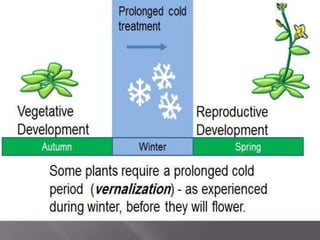
• Vernalization, can be defined as the induction of
a plant's flowering process by exposure to the
prolonged cold of winter, or by an artificial
equivalent.
• It is the process whereby flowering is promoted
by a cold treatment given to a fully hydrated seed
(i.e., a seed that has imbibed water) or to a
growing plant.
• This may be reversed if the period of low
temperature is interrupted, an effect known as
‘devernalization’.
Significance
• Vernalization ensures that reproductive development
and seed production occurs in spring and winters,
rather than in autumn.
• It has been interpreted as an adaptation of plants from
temperate climates to seasonal changes.
• Vernalization is an important adaptation of plants
growing at high latitudes or altitudes to ensure that
flowering occurs in the warmer days of spring or
summer, allowing sufficient time for seed development
before the onset of winter.
• Vernalization is important in agriculture as various crop
plants, including the winter cereals, must experience a
prolonged period at low temperatures to initiate
flowering in the spring.
Mechanism
• Vernalization effects are directly perceived by the
imbibed embryo and communicated to all
meristematic tissues originating at the embryo
apex.
• Vernalization illustrates the epigenetic memory of
plant cells that lasts over months and is
transmitted via the mitosis of meristematic cells
• The plant apex may sense vernalizing
temperatures from seed imbibition, throughout
the vegetative phase.
• Epigenetics is defined as the study of hereditary and
reversible mitotic as well as meiotic changes, which
affect gene expression without any modifications of DNA
sequence
Mechanism
• The vernalization process can be viewed as the
conversion of digital epigenetic information
stored at the cellular level into a quantitative
response of the whole organism.
• Plants mainly sense environmental conditions
through organs such as leaves, but the
developmental decision: to flower, occurs in
the meristem at the apex.
• This implies that the epigenetic silencing of FLC is
relayed by a signal promoting flowering at the
level of the organism and over a distance.
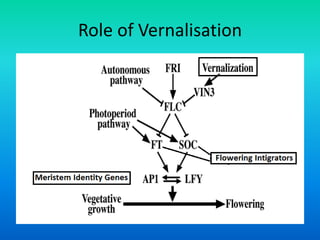
Role of Vernalisation
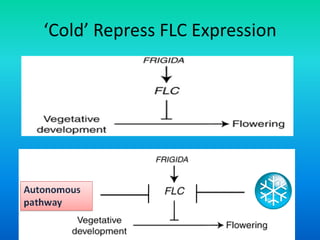
‘Cold’ Repress FLC Expression
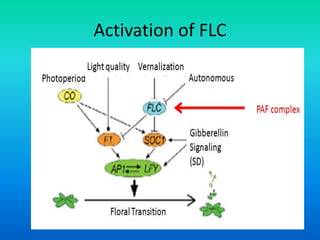
Activation of FLC
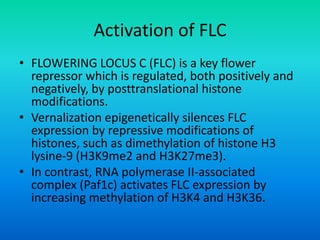
• FLOWERING LOCUS C (FLC) is a key flower
repressor which is regulated, both positively and
negatively, by posttranslational histone
modifications.
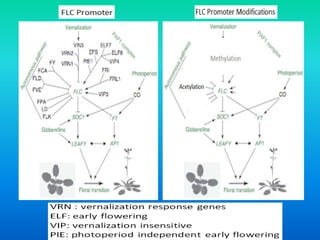
• Vernalization epigenetically silences FLC
expression by repressive modifications of
histones, such as dimethylation of histone H3
lysine-9 (H3K9me2 and H3K27me3).
• In contrast, RNA polymerase II-associated
complex (Paf1c) activates FLC expression by
increasing methylation of H3K4 and H3K36.
Activation of FLC
FT the immediate target of FLC
• FT is an immediate downstream target of FLC
repression and encodes a small globular protein that
translocates from the leaves to the shoot apex, thus
representing a key component of this mobile flowering
signal (probably the ‘vernalin’).
• The decision of ‘when to flower’ largely depends on
the level of FT expression, which is strongly influenced
by seasonal cues such as the length of
the photoperiod and warm temperatures
• Modulation of the chromatin state at the FT locus thus
illustrates as to how chromatin contributes to precise
transcriptional regulation by sensing environmental
signals.

Vernalisation

  • 1.
    DR. VIBHA KHANNA Asso.Prof. (Botany) SPC GOVERNMENT COLLEGE AJMER (Rajasthan)
  • 2.
    PLANT PHYSIOLOGY THE FLOWERINGPROCESS PRESENTATION 6: Role Of Vernalization
  • 3.
    Vernalisation • Lysenko (1928),a Russian worker, found that by providing low temperature treatment to young plants or moistened seeds, the cold requiring annual and biennial plants can be made to flower in one growing season. • He called the effect of this chilling treatment as vernalization (from Latin vernus, "of the spring"). • Vernalization prepares the plant to flower. • Vernalization is a process of shortening of the juvenile or vegetative phase and hastening flowering by a previous cold treatment.
  • 5.
    Definition • Vernalization, canbe defined as the induction of a plant's flowering process by exposure to the prolonged cold of winter, or by an artificial equivalent. • It is the process whereby flowering is promoted by a cold treatment given to a fully hydrated seed (i.e., a seed that has imbibed water) or to a growing plant. • This may be reversed if the period of low temperature is interrupted, an effect known as ‘devernalization’.
  • 6.
    Significance • Vernalization ensuresthat reproductive development and seed production occurs in spring and winters, rather than in autumn. • It has been interpreted as an adaptation of plants from temperate climates to seasonal changes. • Vernalization is an important adaptation of plants growing at high latitudes or altitudes to ensure that flowering occurs in the warmer days of spring or summer, allowing sufficient time for seed development before the onset of winter. • Vernalization is important in agriculture as various crop plants, including the winter cereals, must experience a prolonged period at low temperatures to initiate flowering in the spring.
  • 7.
    Mechanism • Vernalization effectsare directly perceived by the imbibed embryo and communicated to all meristematic tissues originating at the embryo apex. • Vernalization illustrates the epigenetic memory of plant cells that lasts over months and is transmitted via the mitosis of meristematic cells • The plant apex may sense vernalizing temperatures from seed imbibition, throughout the vegetative phase. • Epigenetics is defined as the study of hereditary and reversible mitotic as well as meiotic changes, which affect gene expression without any modifications of DNA sequence
  • 8.
    Mechanism • The vernalizationprocess can be viewed as the conversion of digital epigenetic information stored at the cellular level into a quantitative response of the whole organism. • Plants mainly sense environmental conditions through organs such as leaves, but the developmental decision: to flower, occurs in the meristem at the apex. • This implies that the epigenetic silencing of FLC is relayed by a signal promoting flowering at the level of the organism and over a distance.
  • 9.
  • 10.
  • 11.
    Activation of FLC •FLOWERING LOCUS C (FLC) is a key flower repressor which is regulated, both positively and negatively, by posttranslational histone modifications. • Vernalization epigenetically silences FLC expression by repressive modifications of histones, such as dimethylation of histone H3 lysine-9 (H3K9me2 and H3K27me3). • In contrast, RNA polymerase II-associated complex (Paf1c) activates FLC expression by increasing methylation of H3K4 and H3K36.
  • 12.
  • 14.
    FT the immediatetarget of FLC • FT is an immediate downstream target of FLC repression and encodes a small globular protein that translocates from the leaves to the shoot apex, thus representing a key component of this mobile flowering signal (probably the ‘vernalin’). • The decision of ‘when to flower’ largely depends on the level of FT expression, which is strongly influenced by seasonal cues such as the length of the photoperiod and warm temperatures • Modulation of the chromatin state at the FT locus thus illustrates as to how chromatin contributes to precise transcriptional regulation by sensing environmental signals.