DR. VIBHA KHANNA
ASSO. PROF. (BOTANY)
S.P.C. GOVERNMENT COLLEGE
AJMER (RAJASTHAN)
CYTOGENETICS
• BLOCK 2
• PRESENTATION 1:
HORIZONTAL GENE TRANSFER IN BACTERIA
Horizontal Vs. Vertical Gene Transfer
• Horizontal gene transfer, also called lateral gene
transfer, is the transmission of DNA (deoxyribonucleic
acid) between different genomes.
• It is a process in which an organism transfers genetic
material to another organism that is not its offspring.
• Horizontal gene transfer is known to occur between
different species, such as between prokaryotes and
eukaryotes and between the three DNA-containing
organelles of eukaryotes—the nucleus, the
mitochondrion and the chloroplast.
• Acquisition of DNA through horizontal gene transfer is
distinguished from the transmission of genetic material
from parents to offspring during reproduction, which is
known as vertical gene transfer.
Horizontal Vs. Vertical Gene Transfer
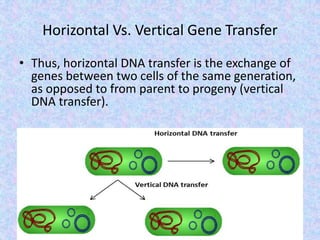
• Thus, horizontal DNA transfer is the exchange of
genes between two cells of the same generation,
as opposed to from parent to progeny (vertical
DNA transfer).
Horizontal Gene Transfer In Bacteria
• Horizontal gene transfer is made possible mainly by the
existence of genetic elements which are mobile, such as
– plasmids (extrachromosomal genetic material),
– transposons (“jumping genes”), and
– bacteriophages (bacteria-infecting viruses).
• These elements are transferred between organisms through
different mechanisms, which in prokaryotes include
– transformation,
– conjugation and
– transduction.
Types of Horizontal Gene Transfer
• In transformation, prokaryotes take up free
fragments of DNA, often in the form of
plasmids, found in their environment.
• In conjugation, genetic material is exchanged
during a temporary union between two cells,
which may entail the transfer of a plasmid or
transposon.
• In transduction, DNA is transmitted from one
cell to another via a bacteriophage.
Horizontal Gene Transfer
• Natural bacterial transformation and conjugation
have been found in bacteria and archaea.
• Two different membrane protein complexes
consisting of conserved proteins are responsible
for ‘taking in’ and ‘giving out’ DNA during natural
bacterial transformation and conjugation,
respectively
• These DNA transport systems deliver single-
stranded DNA (ssDNA) either from the donor cell
(for conjugation) or into the recipient cell (for
transformation)
General Mechanisms of Horizontal
gene transfer
• In horizontal gene transfer, newly acquired DNA is
incorporated into the genome of the recipient
through either recombination or insertion.
– Recombination essentially is the regrouping of genes,
such that native and foreign (new) DNA segments that
are homologous are edited and combined.
– Insertion occurs when the foreign DNA introduced
into a cell shares no homology with existing DNA. In
this case, the new genetic material is embedded
between existing genes in the recipient’s genome.
Significance of Horizontal Gene
Transfer
• Bacteria are able to respond to selective pressures and adapt to new
environments by acquiring new genetic traits as a result of
– mutation,
– a modification of gene function within a bacterium, and
– as a result of horizontal gene transfer, the acquisition of new genes from
other bacteria.
• Mutation occurs relatively slowly. Furthermore, most mutations are
harmful to the bacterium. Horizontal gene transfer, on the other hand,
enables bacteria to respond and adapt to their environment much
more rapidly by acquiring large DNA sequences from another
bacterium in a single transfer.
• The ability of Bacteria and Archaea to adapt to new environments as a
part of bacterial evolution most frequently results from the acquisition
of new genes through horizontal gene transfer rather than by the
alteration of gene functions through mutations.
Significance of Horizontal Gene
Transfer
• Although the three “classical" methods of DNA transfer in
nature: bacterial conjugation, natural transformation, and
transduction, are mechanistically quite different, they aim
to achieve the main objective of all cells, i.e., the ability to
survive and adapt to new environments.
• Transformation, transduction, and “conjugation”
implement DNA recombination, creating genetic diversity
and hence, allowing bacteria to acquire new capabilities
and evolve, resulting in additional, improved,
environmental adaptations that enhance bacterial survival.
• Horizontal gene transfer (HGT) plays an important role in
bacterial evolution.
Significance of Horizontal Gene
Transfer
• Horizontal gene transfer is able to cause rather
large-scale changes in a bacterial genome. For
example, certain bacteria contain multiple
virulence genes called pathogenicity islands that
are located on large, unstable regions of the
bacterial genome.
• These pathogenicity islands can be transmitted to
other bacteria by horizontal gene transfer.
• However, if these transferred genes provide no
selective advantage to the bacteria that acquire
them, they are usually lost by deletion. In this
way the size of the bacterium's genome can
remain approximately the same size over time.
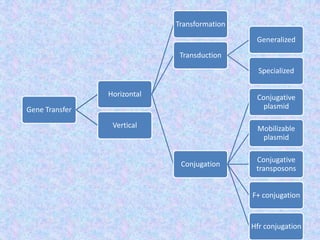
Gene Transfer
Horizontal
Transformation
Transduction
Generalized
Specialized
Conjugation
Conjugative
plasmid
Mobilizable
plasmid
Conjugative
transposons
F+ conjugation
Hfr conjugation
Vertical
Mobile Genetic Elements
• Plasmids: Circular or linear extrachromosomal replicons; self-transferable or
mobilizable plasmids are vehicles for the transmission of genetic information
between a broad or narrow range of species
• Bacteriophages: Viruses that infect prokaryotes; can integrate into the host
genome and then be vehicles for horizontal gene transfer
• Integrative Conjugative Elements (ICEs): Self-transferable conjugative
elements that integrate into the genome of new hosts like temperate
bacteriophages; may promote the mobilization of genomic islands by utilizing
conserved integration sites
• Genomic islands: Large chromosomal regions acquired by horizontal transfer
that are flanked by repeat structures and contain genes for chromosomal
integration and excision
• Transposable elements: Genetic elements that can move within or between
elements replicons by action of their transposase; flanked by inverted repeats,
transposons typically carry genes for antibiotic resistance or other phenotypes,
while IS-elements code only for the transposase; multiple copies of the same
IS-element promote genome plasticity by homologous recombination.
• Integrons: Genetic elements that capture promoterless gene cassettes at an
attachment site downstream of a promoter, by action of the integrase encoded
on the integron; frequently associated with transposons and conjugative
plasmids

Horizontal gene transfer in bacteria

  • 1.
    DR. VIBHA KHANNA ASSO.PROF. (BOTANY) S.P.C. GOVERNMENT COLLEGE AJMER (RAJASTHAN)
  • 2.
    CYTOGENETICS • BLOCK 2 •PRESENTATION 1: HORIZONTAL GENE TRANSFER IN BACTERIA
  • 3.
    Horizontal Vs. VerticalGene Transfer • Horizontal gene transfer, also called lateral gene transfer, is the transmission of DNA (deoxyribonucleic acid) between different genomes. • It is a process in which an organism transfers genetic material to another organism that is not its offspring. • Horizontal gene transfer is known to occur between different species, such as between prokaryotes and eukaryotes and between the three DNA-containing organelles of eukaryotes—the nucleus, the mitochondrion and the chloroplast. • Acquisition of DNA through horizontal gene transfer is distinguished from the transmission of genetic material from parents to offspring during reproduction, which is known as vertical gene transfer.
  • 4.
    Horizontal Vs. VerticalGene Transfer • Thus, horizontal DNA transfer is the exchange of genes between two cells of the same generation, as opposed to from parent to progeny (vertical DNA transfer).
  • 5.
    Horizontal Gene TransferIn Bacteria • Horizontal gene transfer is made possible mainly by the existence of genetic elements which are mobile, such as – plasmids (extrachromosomal genetic material), – transposons (“jumping genes”), and – bacteriophages (bacteria-infecting viruses). • These elements are transferred between organisms through different mechanisms, which in prokaryotes include – transformation, – conjugation and – transduction.
  • 6.
    Types of HorizontalGene Transfer • In transformation, prokaryotes take up free fragments of DNA, often in the form of plasmids, found in their environment. • In conjugation, genetic material is exchanged during a temporary union between two cells, which may entail the transfer of a plasmid or transposon. • In transduction, DNA is transmitted from one cell to another via a bacteriophage.
  • 7.
    Horizontal Gene Transfer •Natural bacterial transformation and conjugation have been found in bacteria and archaea. • Two different membrane protein complexes consisting of conserved proteins are responsible for ‘taking in’ and ‘giving out’ DNA during natural bacterial transformation and conjugation, respectively • These DNA transport systems deliver single- stranded DNA (ssDNA) either from the donor cell (for conjugation) or into the recipient cell (for transformation)
  • 8.
    General Mechanisms ofHorizontal gene transfer • In horizontal gene transfer, newly acquired DNA is incorporated into the genome of the recipient through either recombination or insertion. – Recombination essentially is the regrouping of genes, such that native and foreign (new) DNA segments that are homologous are edited and combined. – Insertion occurs when the foreign DNA introduced into a cell shares no homology with existing DNA. In this case, the new genetic material is embedded between existing genes in the recipient’s genome.
  • 9.
    Significance of HorizontalGene Transfer • Bacteria are able to respond to selective pressures and adapt to new environments by acquiring new genetic traits as a result of – mutation, – a modification of gene function within a bacterium, and – as a result of horizontal gene transfer, the acquisition of new genes from other bacteria. • Mutation occurs relatively slowly. Furthermore, most mutations are harmful to the bacterium. Horizontal gene transfer, on the other hand, enables bacteria to respond and adapt to their environment much more rapidly by acquiring large DNA sequences from another bacterium in a single transfer. • The ability of Bacteria and Archaea to adapt to new environments as a part of bacterial evolution most frequently results from the acquisition of new genes through horizontal gene transfer rather than by the alteration of gene functions through mutations.
  • 10.
    Significance of HorizontalGene Transfer • Although the three “classical" methods of DNA transfer in nature: bacterial conjugation, natural transformation, and transduction, are mechanistically quite different, they aim to achieve the main objective of all cells, i.e., the ability to survive and adapt to new environments. • Transformation, transduction, and “conjugation” implement DNA recombination, creating genetic diversity and hence, allowing bacteria to acquire new capabilities and evolve, resulting in additional, improved, environmental adaptations that enhance bacterial survival. • Horizontal gene transfer (HGT) plays an important role in bacterial evolution.
  • 11.
    Significance of HorizontalGene Transfer • Horizontal gene transfer is able to cause rather large-scale changes in a bacterial genome. For example, certain bacteria contain multiple virulence genes called pathogenicity islands that are located on large, unstable regions of the bacterial genome. • These pathogenicity islands can be transmitted to other bacteria by horizontal gene transfer. • However, if these transferred genes provide no selective advantage to the bacteria that acquire them, they are usually lost by deletion. In this way the size of the bacterium's genome can remain approximately the same size over time.
  • 12.
  • 14.
    Mobile Genetic Elements •Plasmids: Circular or linear extrachromosomal replicons; self-transferable or mobilizable plasmids are vehicles for the transmission of genetic information between a broad or narrow range of species • Bacteriophages: Viruses that infect prokaryotes; can integrate into the host genome and then be vehicles for horizontal gene transfer • Integrative Conjugative Elements (ICEs): Self-transferable conjugative elements that integrate into the genome of new hosts like temperate bacteriophages; may promote the mobilization of genomic islands by utilizing conserved integration sites • Genomic islands: Large chromosomal regions acquired by horizontal transfer that are flanked by repeat structures and contain genes for chromosomal integration and excision • Transposable elements: Genetic elements that can move within or between elements replicons by action of their transposase; flanked by inverted repeats, transposons typically carry genes for antibiotic resistance or other phenotypes, while IS-elements code only for the transposase; multiple copies of the same IS-element promote genome plasticity by homologous recombination. • Integrons: Genetic elements that capture promoterless gene cassettes at an attachment site downstream of a promoter, by action of the integrase encoded on the integron; frequently associated with transposons and conjugative plasmids