CELL MEMBRANE :CELL MEMBRANE :
CHEMICAL COMPOSITION ,CHEMICAL COMPOSITION ,
STRUCTURE AND MEMBRANESTRUCTURE AND MEMBRANE
DYNAMICSDYNAMICS
Presenter: Dr. Dnyanesh Amle
Moderator: Dr. Smita Kaushik
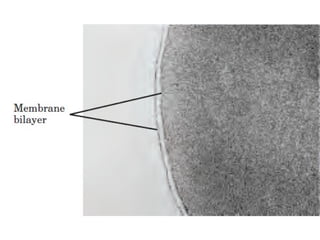
• Boundaries of all the cells are defined byBoundaries of all the cells are defined by
biological membranebiological membrane
• Barrier with selective permeabilityBarrier with selective permeability
COMMON PROPERTIES:COMMON PROPERTIES:
• Sheet like structures
• Contains mainly lipids and proteins
• Membrane lipids are small amphipathic
molecules
• Specific proteins mediate distinctive function
COMMON PROPERTIES:COMMON PROPERTIES:
• Non covalent assemblies
• Asymmetric
• Fluid structures
• Electrically polarized
• FUNCTIONS:FUNCTIONS:
– Maintenance of cell shape
– Cellular movements
– Controls movement of molecules between inside
and outside of the cell
– Cell-cell recognition and communication
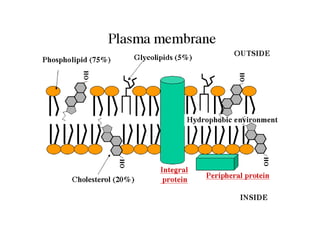
• MAINLY COMPOSED OF :MAINLY COMPOSED OF :
– Lipids
– Proteins
– Carbohydrates
• LIPIDSLIPIDS :
– Phospholipids
– Glycolipids
– Cholesterol
1) PHOSPHOLIPIDS1) PHOSPHOLIPIDS
• Based on the platform:
– Glycerophospholipids( Phosphoglycerides)
– Sphingolipids
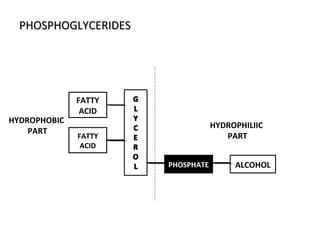
PHOSPHOGLYCERIDESPHOSPHOGLYCERIDES
FATTY
ACID
FATTY
ACID
ALCOHOLPHOSPHATE
HYDROPHOBIC
PART
HYDROPHILIIC
PART
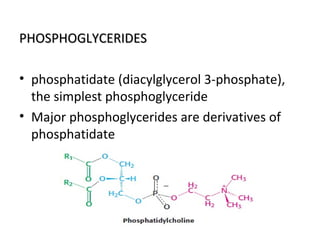
PHOSPHOGLYCERIDESPHOSPHOGLYCERIDES
• phosphatidate (diacylglycerol 3-phosphate),
the simplest phosphoglyceride
• Major phosphoglycerides are derivatives of
phosphatidate
• Phosphtidylinositol:
– Golgi body
– Endosomes
– Plasma membrane
• Cardiolipin:Cardiolipin:
– Inner mitochondrial membrane
• Phosphtidylcholine >
Phosphtidylethanolamine
• Plasmalogens:Plasmalogens:
– Nervous tissue
– Heart
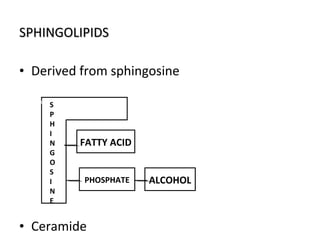
SPHINGOLIPIDSSPHINGOLIPIDS
• Derived from sphingosine
• Ceramide
SS
P
H
I
N
G
O
S
I
N
E
FATTY ACID
ALCOHOLPHOSPHATE
S
P
H
I
N
G
O
S
I
N
E
2)GLYCOLIPIDS:2)GLYCOLIPIDS:
• In animal cells: derived from sphingosine
• Sugar unit is attached to primary -OH group
• Simple glycolipid : cerebroside
– PhrenosinePhrenosine
• Complex glycolipid: Ganglioside
• Galactocerebroside:
– Brain and nervous tissue
• Glucocerebroside:
– Non neural tissue
• Ganglioside:
– 5-8% lipid in brain
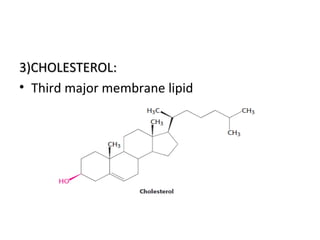
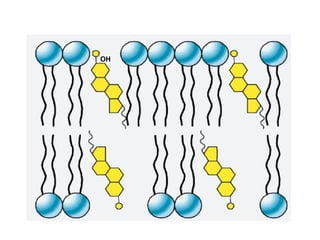
3)CHOLESTEROL:3)CHOLESTEROL:
• Third major membrane lipid
OH
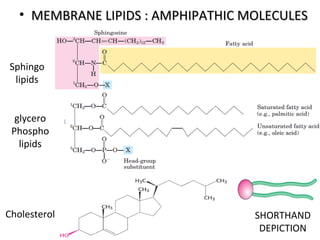
• MEMBRANE LIPIDS : AMPHIPATHIC MOLECULESMEMBRANE LIPIDS : AMPHIPATHIC MOLECULES
Sphingo
lipids
glycero
Phospho
lipids
Cholesterol SHORTHAND
DEPICTION
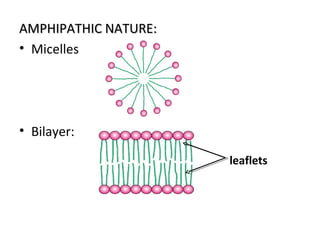
AMPHIPATHIC NATURE:AMPHIPATHIC NATURE:
• Micelles
• Bilayer:
leaflets
PROPERTIES OF LIPID BILAYER:PROPERTIES OF LIPID BILAYER:
• Formation in aqueous environment is rapid and
spontaneous
• Hydrophobic interactions: major driving force
• Other forces:
– Van der waal’s attractive forces
– Electrostatic
– Hydrogen bonds
• Co-operative structures
HYDROPHOBIC INTERACTIONS:HYDROPHOBIC INTERACTIONS:
• Inherent tendency to be extensive
• Tend to close on themselves: forms
compartments
• Self sealing: As hole in lipid bilayer is
energetically unfavorable
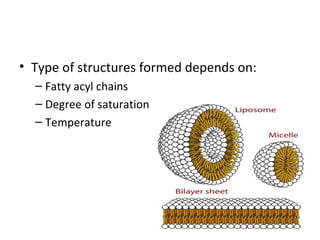
• Type of structures formed depends on:
– Fatty acyl chains
– Degree of saturation
– Temperature
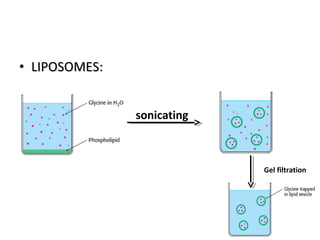
• LIPOSOMES:LIPOSOMES:
sonicating
Gel filtration
Uses
– To study the effect of different fatty acids on
membranes
– Drug delivery
– Concentrate in regions of increased blood flow :
Cell gatingCell gating
– Selective fusion
MEMBRANE PROTEINS:MEMBRANE PROTEINS:
• Integral
• Peripheral
• Amphitropic
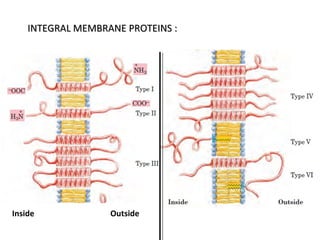
Inside Outside
INTEGRAL MEMBRANE PROTEINS :INTEGRAL MEMBRANE PROTEINS :
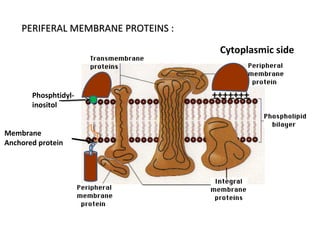
+++++++_ _ _ _ _Phosphtidyl-
inositol
Membrane
Anchored protein
Cytoplasmic side
PERIFERAL MEMBRANE PROTEINS :PERIFERAL MEMBRANE PROTEINS :
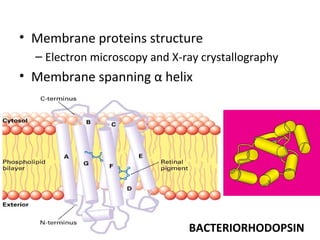
• Membrane proteins structure
– Electron microscopy and X-ray crystallography
• Membrane spanning α helix
BACTERIORHODOPSIN
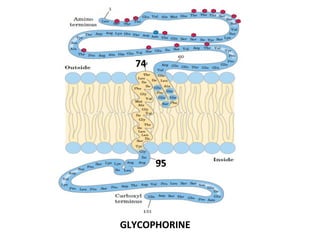
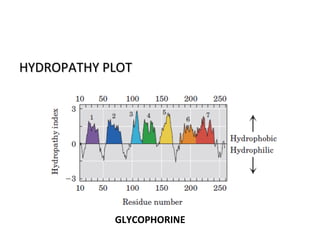
GLYCOPHORIN:GLYCOPHORIN:
• A protein containing single trans-membrane α
helical strand
• Present in plasma membrane of human
erythrocytes
• Amino terminus exterior to cell contains
various oligosaccharide unit including ABO
and MN blood group determinants
GLYCOPHORINE
74
95
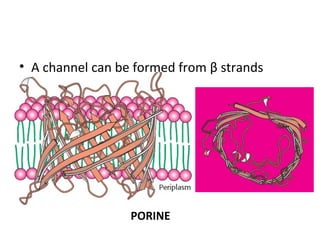
• A channel can be formed from β strands
PORINE
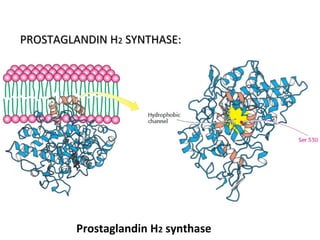
Prostaglandin H2 synthase
PROSTAGLANDIN HPROSTAGLANDIN H22 SYNTHASE:SYNTHASE:
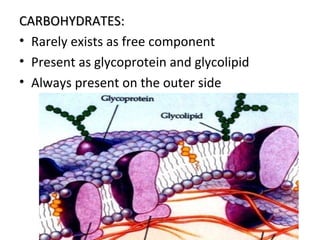
CARBOHYDRATES:CARBOHYDRATES:
• Rarely exists as free component
• Present as glycoprotein and glycolipid
• Always present on the outer side
BIOLOGICAL MEMBRANES DIFFER INBIOLOGICAL MEMBRANES DIFFER IN
COMPOSITION:COMPOSITION:
• Myelin: 18% protein , ↑ glycosphingolipids
• Plasma membrane : 50% protein
• Inner mitochondrial membrane : 75% protein,
↑ cardiolipins
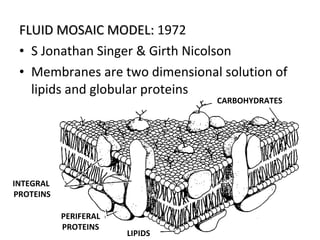
FLUID MOSAIC MODEL:FLUID MOSAIC MODEL: 1972
• S Jonathan Singer & Girth Nicolson
• Membranes are two dimensional solution of
lipids and globular proteins
CARBOHYDRATES
LIPIDS
PERIFERAL
PROTEINS
INTEGRAL
PROTEINS
MEMBRANE DYNAMICSMEMBRANE DYNAMICS
• ↓ physiological temp. : gel phase
• ↑ physiological temp. : liquid-disordered
state
• Intermediate temp. : liquid-ordered state
• Unsaturated fatty acids
• Cholesterol
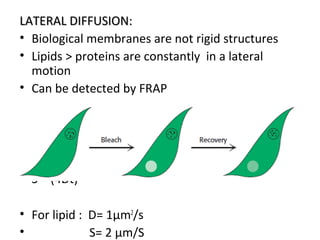
LATERAL DIFFUSION:LATERAL DIFFUSION:
• Biological membranes are not rigid structures
• Lipids > proteins are constantly in a lateral
motion
• Can be detected by FRAP
• S = (4Dt)1/2
• For lipid : D= 1µm2
/s
• S= 2 µm/S
• Proteins differ extremely in mobility
– Rhodopsin : D=0.4 µm/s
– Fibronectin : D = 10-2
µm/s
• fluidity increases with increase in
– No of short chain fatty acids
– Unsaturated fatty acids
– Temperature
• Cholesterol decreases fluidity at high temp
• Increases fluidity at low temp
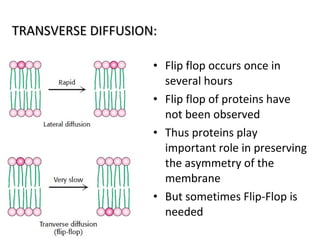
• Flip flop occurs once in
several hours
• Flip flop of proteins have
not been observed
• Thus proteins play
important role in preserving
the asymmetry of the
membrane
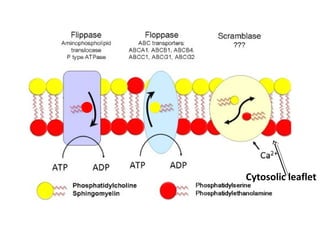
• But sometimes Flip-Flop is
needed
TRANSVERSE DIFFUSION:TRANSVERSE DIFFUSION:
Cytosolic leaflet
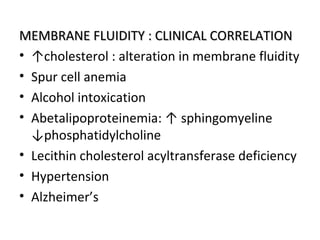
MEMBRANE FLUIDITY : CLINICAL CORRELATIONMEMBRANE FLUIDITY : CLINICAL CORRELATION
• ↑cholesterol : alteration in membrane fluidity
• Spur cell anemia
• Alcohol intoxication
• Abetalipoproteinemia: ↑ sphingomyeline
↓phosphatidylcholine
• Lecithin cholesterol acyltransferase deficiency
• Hypertension
• Alzheimer’s
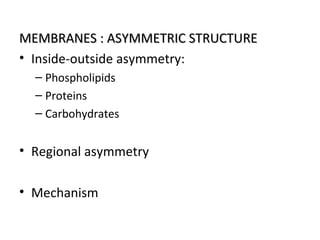
MEMBRANES : ASYMMETRIC STRUCTUREMEMBRANES : ASYMMETRIC STRUCTURE
• Inside-outside asymmetry:
– Phospholipids
– Proteins
– Carbohydrates
• Regional asymmetry
• Mechanism
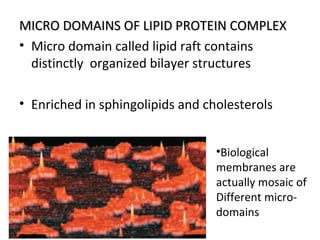
MICRO DOMAINS OF LIPID PROTEIN COMPLEXMICRO DOMAINS OF LIPID PROTEIN COMPLEX
• Micro domain called lipid raft contains
distinctly organized bilayer structures
• Enriched in sphingolipids and cholesterols
•Biological
membranes are
actually mosaic of
Different micro-
domains
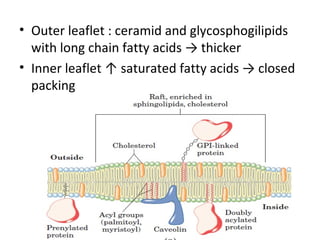
• Outer leaflet : ceramid and glycosphogilipids
with long chain fatty acids → thicker
• Inner leaflet ↑ saturated fatty acids → closed
packing
• Function : to segregate and concentrate
specific protein and to facilitate their activity
• Proteins are activated when
– several rafts fuse together
– Ligands binding which favors fusion of rafts
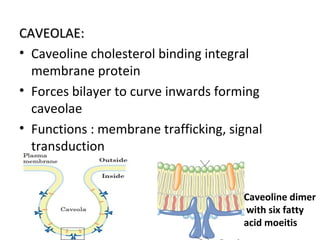
CAVEOLAE:CAVEOLAE:
• Caveoline cholesterol binding integral
membrane protein
• Forces bilayer to curve inwards forming
caveolae
• Functions : membrane trafficking, signal
transduction
Caveoline dimer
with six fatty
acid moeitis
MEMBRANE CURAVATURE :MEMBRANE CURAVATURE :
• Central to ability of membrane to undergo
fusion with other membrane
• Mechanisms
– Intrinsically curved protein binding
– Many subunits of scaffold protein into proteins
assembled into curved supra-molecular
complexes
– May insert one or more hydrophobic helices into
one face of bilayer
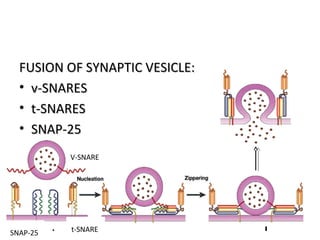
FUSION OF SYNAPTIC VESICLE:FUSION OF SYNAPTIC VESICLE:
• v-SNARESv-SNARES
• t-SNARESt-SNARES
• SNAP-25SNAP-25
• NSFNSF V-SNARE
t-SNARESNAP-25
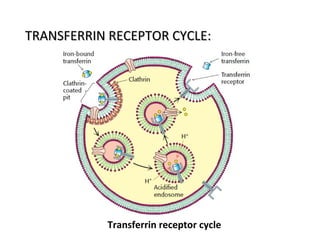
Transferrin receptor cycle
TRANSFERRIN RECEPTOR CYCLE:TRANSFERRIN RECEPTOR CYCLE:
IN A NUTSHELLIN A NUTSHELL
• Biological membranes define cellular
boundaries, divide cells into discrete
compartments, organize complex reaction
sequences, and act in signal reception and
energy transformations.
• The lipid bilayer is the basic structural unit
explained by Fluid-mosaic model.
• Membranes are structarally and functionally
asymmetrical.
• Lipid > proteins are continuously in a state of
motion in the plane of cell membrane called
lateral diffusion
• But transverse diffusion or Flip-flop of lipids is very
slow except when specifically catalyzed by
flippases,floppases and scramblases.
• lipid rafts are rich in sphingolipids and cholesterol
consist of membrane proteins that are GPI-linked
• Specific proteins mediate the fusion of two
membranes, which accompanies processes such
as viral invasion and endocytosis and exocytosis
THANK YOU
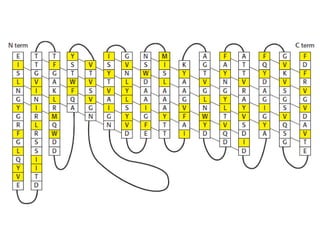
HYDROPATHY PLOTHYDROPATHY PLOT
GLYCOPHORINE
STEPS IN FUSION:STEPS IN FUSION:
• Recognition
• Close opposing
• Local disruption
• Fusion
• Fusion proteins
TIGHT JUNCTION:TIGHT JUNCTION:
• Present between two cells that lies in close a
approximation
• Forms narrow hydrophilic channels
• Prevents the diffusion of macromolecules
• Only three layers of plasma membrane are
present
DESMOSOMES:DESMOSOMES: provide attachment of cells to
the basal tissue
• Mostly seen in epithelial cells

Cell membrane 93 2010

  • 1.
    CELL MEMBRANE :CELLMEMBRANE : CHEMICAL COMPOSITION ,CHEMICAL COMPOSITION , STRUCTURE AND MEMBRANESTRUCTURE AND MEMBRANE DYNAMICSDYNAMICS Presenter: Dr. Dnyanesh Amle Moderator: Dr. Smita Kaushik
  • 2.
    • Boundaries ofall the cells are defined byBoundaries of all the cells are defined by biological membranebiological membrane • Barrier with selective permeabilityBarrier with selective permeability
  • 4.
    COMMON PROPERTIES:COMMON PROPERTIES: •Sheet like structures • Contains mainly lipids and proteins • Membrane lipids are small amphipathic molecules • Specific proteins mediate distinctive function
  • 5.
    COMMON PROPERTIES:COMMON PROPERTIES: •Non covalent assemblies • Asymmetric • Fluid structures • Electrically polarized
  • 6.
    • FUNCTIONS:FUNCTIONS: – Maintenanceof cell shape – Cellular movements – Controls movement of molecules between inside and outside of the cell – Cell-cell recognition and communication
  • 7.
    • MAINLY COMPOSEDOF :MAINLY COMPOSED OF : – Lipids – Proteins – Carbohydrates
  • 8.
    • LIPIDSLIPIDS : –Phospholipids – Glycolipids – Cholesterol
  • 9.
    1) PHOSPHOLIPIDS1) PHOSPHOLIPIDS •Based on the platform: – Glycerophospholipids( Phosphoglycerides) – Sphingolipids
  • 10.
  • 11.
    PHOSPHOGLYCERIDESPHOSPHOGLYCERIDES • phosphatidate (diacylglycerol3-phosphate), the simplest phosphoglyceride • Major phosphoglycerides are derivatives of phosphatidate
  • 12.
    • Phosphtidylinositol: – Golgibody – Endosomes – Plasma membrane • Cardiolipin:Cardiolipin: – Inner mitochondrial membrane • Phosphtidylcholine > Phosphtidylethanolamine • Plasmalogens:Plasmalogens: – Nervous tissue – Heart
  • 13.
    SPHINGOLIPIDSSPHINGOLIPIDS • Derived fromsphingosine • Ceramide SS P H I N G O S I N E FATTY ACID ALCOHOLPHOSPHATE S P H I N G O S I N E
  • 14.
    2)GLYCOLIPIDS:2)GLYCOLIPIDS: • In animalcells: derived from sphingosine • Sugar unit is attached to primary -OH group • Simple glycolipid : cerebroside – PhrenosinePhrenosine • Complex glycolipid: Ganglioside
  • 15.
    • Galactocerebroside: – Brainand nervous tissue • Glucocerebroside: – Non neural tissue • Ganglioside: – 5-8% lipid in brain
  • 16.
  • 17.
  • 18.
    • MEMBRANE LIPIDS: AMPHIPATHIC MOLECULESMEMBRANE LIPIDS : AMPHIPATHIC MOLECULES Sphingo lipids glycero Phospho lipids Cholesterol SHORTHAND DEPICTION
  • 19.
    AMPHIPATHIC NATURE:AMPHIPATHIC NATURE: •Micelles • Bilayer: leaflets
  • 20.
    PROPERTIES OF LIPIDBILAYER:PROPERTIES OF LIPID BILAYER: • Formation in aqueous environment is rapid and spontaneous • Hydrophobic interactions: major driving force • Other forces: – Van der waal’s attractive forces – Electrostatic – Hydrogen bonds • Co-operative structures
  • 21.
    HYDROPHOBIC INTERACTIONS:HYDROPHOBIC INTERACTIONS: •Inherent tendency to be extensive • Tend to close on themselves: forms compartments • Self sealing: As hole in lipid bilayer is energetically unfavorable
  • 22.
    • Type ofstructures formed depends on: – Fatty acyl chains – Degree of saturation – Temperature
  • 23.
  • 24.
    Uses – To studythe effect of different fatty acids on membranes – Drug delivery – Concentrate in regions of increased blood flow : Cell gatingCell gating – Selective fusion
  • 25.
    MEMBRANE PROTEINS:MEMBRANE PROTEINS: •Integral • Peripheral • Amphitropic
  • 26.
    Inside Outside INTEGRAL MEMBRANEPROTEINS :INTEGRAL MEMBRANE PROTEINS :
  • 27.
    +++++++_ _ __ _Phosphtidyl- inositol Membrane Anchored protein Cytoplasmic side PERIFERAL MEMBRANE PROTEINS :PERIFERAL MEMBRANE PROTEINS :
  • 28.
    • Membrane proteinsstructure – Electron microscopy and X-ray crystallography • Membrane spanning α helix BACTERIORHODOPSIN
  • 29.
    GLYCOPHORIN:GLYCOPHORIN: • A proteincontaining single trans-membrane α helical strand • Present in plasma membrane of human erythrocytes • Amino terminus exterior to cell contains various oligosaccharide unit including ABO and MN blood group determinants
  • 30.
  • 31.
    • A channelcan be formed from β strands PORINE
  • 33.
    Prostaglandin H2 synthase PROSTAGLANDINHPROSTAGLANDIN H22 SYNTHASE:SYNTHASE:
  • 34.
    CARBOHYDRATES:CARBOHYDRATES: • Rarely existsas free component • Present as glycoprotein and glycolipid • Always present on the outer side
  • 35.
    BIOLOGICAL MEMBRANES DIFFERINBIOLOGICAL MEMBRANES DIFFER IN COMPOSITION:COMPOSITION: • Myelin: 18% protein , ↑ glycosphingolipids • Plasma membrane : 50% protein • Inner mitochondrial membrane : 75% protein, ↑ cardiolipins
  • 36.
    FLUID MOSAIC MODEL:FLUIDMOSAIC MODEL: 1972 • S Jonathan Singer & Girth Nicolson • Membranes are two dimensional solution of lipids and globular proteins CARBOHYDRATES LIPIDS PERIFERAL PROTEINS INTEGRAL PROTEINS
  • 37.
    MEMBRANE DYNAMICSMEMBRANE DYNAMICS •↓ physiological temp. : gel phase • ↑ physiological temp. : liquid-disordered state • Intermediate temp. : liquid-ordered state • Unsaturated fatty acids • Cholesterol
  • 38.
    LATERAL DIFFUSION:LATERAL DIFFUSION: •Biological membranes are not rigid structures • Lipids > proteins are constantly in a lateral motion • Can be detected by FRAP • S = (4Dt)1/2 • For lipid : D= 1µm2 /s • S= 2 µm/S
  • 39.
    • Proteins differextremely in mobility – Rhodopsin : D=0.4 µm/s – Fibronectin : D = 10-2 µm/s • fluidity increases with increase in – No of short chain fatty acids – Unsaturated fatty acids – Temperature • Cholesterol decreases fluidity at high temp • Increases fluidity at low temp
  • 40.
    • Flip flopoccurs once in several hours • Flip flop of proteins have not been observed • Thus proteins play important role in preserving the asymmetry of the membrane • But sometimes Flip-Flop is needed TRANSVERSE DIFFUSION:TRANSVERSE DIFFUSION:
  • 41.
  • 42.
    MEMBRANE FLUIDITY :CLINICAL CORRELATIONMEMBRANE FLUIDITY : CLINICAL CORRELATION • ↑cholesterol : alteration in membrane fluidity • Spur cell anemia • Alcohol intoxication • Abetalipoproteinemia: ↑ sphingomyeline ↓phosphatidylcholine • Lecithin cholesterol acyltransferase deficiency • Hypertension • Alzheimer’s
  • 43.
    MEMBRANES : ASYMMETRICSTRUCTUREMEMBRANES : ASYMMETRIC STRUCTURE • Inside-outside asymmetry: – Phospholipids – Proteins – Carbohydrates • Regional asymmetry • Mechanism
  • 44.
    MICRO DOMAINS OFLIPID PROTEIN COMPLEXMICRO DOMAINS OF LIPID PROTEIN COMPLEX • Micro domain called lipid raft contains distinctly organized bilayer structures • Enriched in sphingolipids and cholesterols •Biological membranes are actually mosaic of Different micro- domains
  • 45.
    • Outer leaflet: ceramid and glycosphogilipids with long chain fatty acids → thicker • Inner leaflet ↑ saturated fatty acids → closed packing
  • 46.
    • Function :to segregate and concentrate specific protein and to facilitate their activity • Proteins are activated when – several rafts fuse together – Ligands binding which favors fusion of rafts
  • 47.
    CAVEOLAE:CAVEOLAE: • Caveoline cholesterolbinding integral membrane protein • Forces bilayer to curve inwards forming caveolae • Functions : membrane trafficking, signal transduction Caveoline dimer with six fatty acid moeitis
  • 48.
    MEMBRANE CURAVATURE :MEMBRANECURAVATURE : • Central to ability of membrane to undergo fusion with other membrane • Mechanisms – Intrinsically curved protein binding – Many subunits of scaffold protein into proteins assembled into curved supra-molecular complexes – May insert one or more hydrophobic helices into one face of bilayer
  • 49.
    FUSION OF SYNAPTICVESICLE:FUSION OF SYNAPTIC VESICLE: • v-SNARESv-SNARES • t-SNARESt-SNARES • SNAP-25SNAP-25 • NSFNSF V-SNARE t-SNARESNAP-25
  • 50.
    Transferrin receptor cycle TRANSFERRINRECEPTOR CYCLE:TRANSFERRIN RECEPTOR CYCLE:
  • 51.
    IN A NUTSHELLINA NUTSHELL • Biological membranes define cellular boundaries, divide cells into discrete compartments, organize complex reaction sequences, and act in signal reception and energy transformations. • The lipid bilayer is the basic structural unit explained by Fluid-mosaic model. • Membranes are structarally and functionally asymmetrical.
  • 53.
    • Lipid >proteins are continuously in a state of motion in the plane of cell membrane called lateral diffusion • But transverse diffusion or Flip-flop of lipids is very slow except when specifically catalyzed by flippases,floppases and scramblases. • lipid rafts are rich in sphingolipids and cholesterol consist of membrane proteins that are GPI-linked • Specific proteins mediate the fusion of two membranes, which accompanies processes such as viral invasion and endocytosis and exocytosis
  • 54.
  • 55.
  • 56.
    STEPS IN FUSION:STEPSIN FUSION: • Recognition • Close opposing • Local disruption • Fusion • Fusion proteins
  • 57.
    TIGHT JUNCTION:TIGHT JUNCTION: •Present between two cells that lies in close a approximation • Forms narrow hydrophilic channels • Prevents the diffusion of macromolecules • Only three layers of plasma membrane are present DESMOSOMES:DESMOSOMES: provide attachment of cells to the basal tissue • Mostly seen in epithelial cells