Chapter 3  Digital Control System Data Acquisition Conversion Distribution Systems
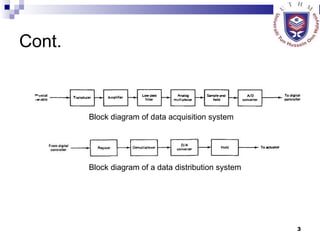
5. Data Acquisition, Conversion and Distribution System Signal conversion in digital control system: Multiplexing and demultiplexing Sample and hold Analog-to-digital conversion (quantizing and encoding) Digital-to-analog conversion (decoding)
Cont. Block diagram of data acquisition system Block diagram of a data distribution system
Physical Variable Defined as an input to the system such as position, velocity, acceleration, temperature, pressure, etc. This parameter is converted to the voltage or current signal by transducer The signal represents the measured value and used in data-acquisition process
Transducer Device that converts input signal (physical variable) into output signal form Eg. Pressure sensor that converts pressure signal into voltage output Classified as: Analog transducer (continuous function of time) Sampled-data transducer (periodic discrete time) Digital transducer (quantized discrete time)
Exercise 1 Name 4 parameters in process control measurement. Level Flow Pressure Temperature
Amplifier Frequently made from operational amplifier Amplify the voltage output of the transducer Convert current signal into voltage signal It also used to buffer the signal
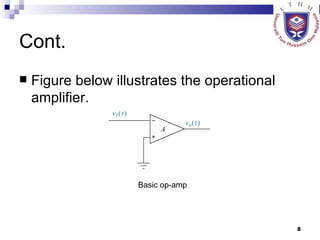
Cont. Figure below illustrates the operational amplifier. Basic op-amp
Low-pass filter Output from amplifier contains noise signal (high-frequency) which may corrupt the data Low-pass filter is used to reduce the noise into an analog signal However, periodic noise such as in power-line are filtered by notch filter
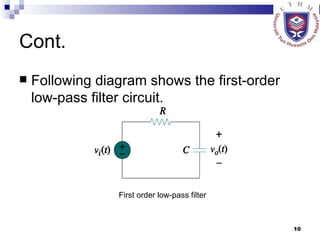
Cont. Following diagram shows the first-order low-pass filter circuit. First order low-pass filter
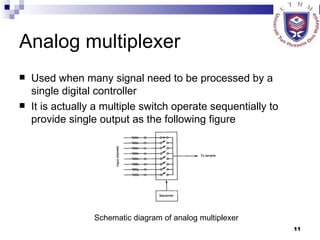
Analog multiplexer Used when many signal need to be processed by a single digital controller It is actually a multiple switch operate sequentially to provide single output as the following figure Schematic diagram of analog multiplexer
Cont. Only one switch is ‘ON’ in a specific  time which allows the input channel connected to the output of multiplexer During this short time, S/H circuit samples the analog signal and holds its value and the same time the A/D converter converts the analog signal to digital signal
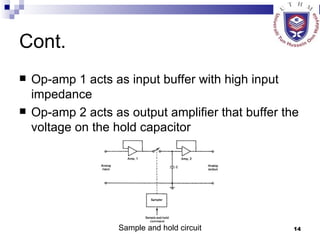
Sample-and-hold S/H It is actually sample-and-hold amplifier The amplifier circuit receives an analog input signal and holds it for a specified time The following figure illustrates the sample-and-hold circuit
Cont. Op-amp 1 acts as input buffer with high input impedance Op-amp 2 acts as output amplifier that buffer the voltage on the hold capacitor Sample and hold circuit
Cont. Tracking mode (switch close) – input signal is connected Hold mode (switch open) – capacitor voltage holds constant for a specified time The operation is dictated by a periodic clock
Analog/digital converter (ADC) Converts analog signal in the form of voltage and current into a digital signal which is numerically coded signal or binary number Comprises a single IC with some supporting components The hardware required some conversion time depends on type of ADC, clock frequency and number of bit
Cont. ADC performs the operations of sample-and-hold, quantizing, and encoding amplitude quantization - a process of representing a continuous or analog signal by a finite number of discrete states “ Quantizing" means transforming a continuous or analog signal into a set of discrete states
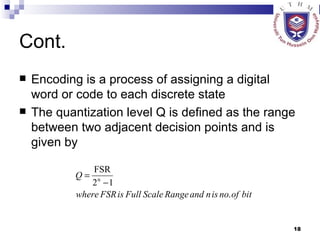
Cont. Encoding is a process of assigning a digital word or code to each discrete state The quantization level Q is defined as the range between two adjacent decision points and is given by
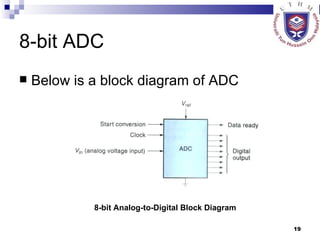
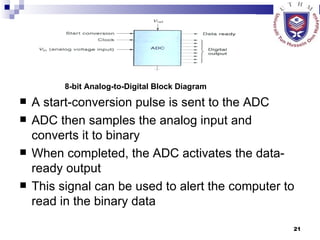
8-bit ADC Below is a block diagram of ADC 8-bit Analog-to-Digital Block Diagram
Cont. V in  can be any voltage between 0 V and V ref When V in  is 0 Vdc, the output is 00000000 When V in  is V ref , the output is 11111111 (255 decimal) For input voltages between 0 and V ref , the output increases linearly with V in
Cont. A start-conversion pulse is sent to the ADC ADC then samples the analog input and converts it to binary When completed, the ADC activates the data-ready output This signal can be used to alert the computer to read in the binary data 8-bit Analog-to-Digital Block Diagram
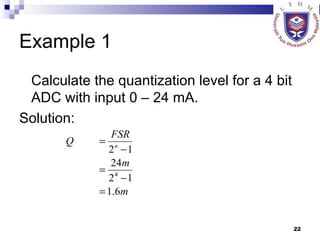
Example 1 Calculate the quantization level for a 4 bit ADC with input 0 – 24 mA. Solution:
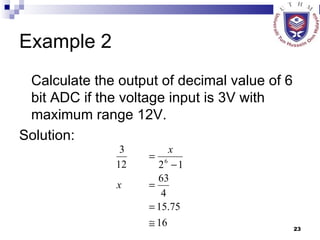
Example 2 Calculate the output of decimal value of 6 bit ADC if the voltage input is 3V with maximum range 12V. Solution:
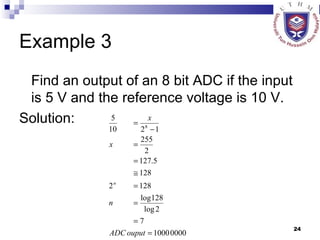
Example 3 Find an output of an 8 bit ADC if the input is 5 V and the reference voltage is 10 V. Solution:
ADC method Among the many ADC circuits available, the following types are used most frequently: Successive-approximation type Integrating type Counter type Parallel type Each type has its own advantages and disadvantages Application, the conversion speed, accuracy, size, and cost are the main factors to be considered in choosing the type of ADC
Counter type ADC Simplest type of ADC Principle: 1. Clock pulses applied to the digital counter 2. This results the output voltage of DAC which is part of feedback loop in ADC stepped up one LSB at a time 3. At each pulse, the output voltage is compared to the analog input voltage 4. The clock pulses stopped when output voltage is equal to the magnitude of the input voltage 5. Therefore, the counter output voltage is the digital output
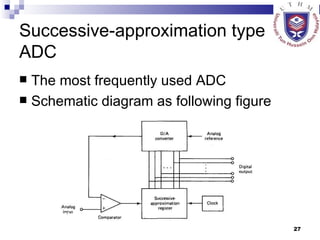
Successive-approximation type ADC The most frequently used ADC Schematic diagram as following figure
Successive-approximation  principle: Successive-approximation register turns MSB and compares it with analog input The comparator will determine to leave the bit on or off by comparing with analog input voltage The MSB is set on if the input voltage is larger

Meeting w9 chapter 3 part 2

  • 1.
    Chapter 3 Digital Control System Data Acquisition Conversion Distribution Systems
  • 2.
    5. Data Acquisition,Conversion and Distribution System Signal conversion in digital control system: Multiplexing and demultiplexing Sample and hold Analog-to-digital conversion (quantizing and encoding) Digital-to-analog conversion (decoding)
  • 3.
    Cont. Block diagramof data acquisition system Block diagram of a data distribution system
  • 4.
    Physical Variable Definedas an input to the system such as position, velocity, acceleration, temperature, pressure, etc. This parameter is converted to the voltage or current signal by transducer The signal represents the measured value and used in data-acquisition process
  • 5.
    Transducer Device thatconverts input signal (physical variable) into output signal form Eg. Pressure sensor that converts pressure signal into voltage output Classified as: Analog transducer (continuous function of time) Sampled-data transducer (periodic discrete time) Digital transducer (quantized discrete time)
  • 6.
    Exercise 1 Name4 parameters in process control measurement. Level Flow Pressure Temperature
  • 7.
    Amplifier Frequently madefrom operational amplifier Amplify the voltage output of the transducer Convert current signal into voltage signal It also used to buffer the signal
  • 8.
    Cont. Figure belowillustrates the operational amplifier. Basic op-amp
  • 9.
    Low-pass filter Outputfrom amplifier contains noise signal (high-frequency) which may corrupt the data Low-pass filter is used to reduce the noise into an analog signal However, periodic noise such as in power-line are filtered by notch filter
  • 10.
    Cont. Following diagramshows the first-order low-pass filter circuit. First order low-pass filter
  • 11.
    Analog multiplexer Usedwhen many signal need to be processed by a single digital controller It is actually a multiple switch operate sequentially to provide single output as the following figure Schematic diagram of analog multiplexer
  • 12.
    Cont. Only oneswitch is ‘ON’ in a specific time which allows the input channel connected to the output of multiplexer During this short time, S/H circuit samples the analog signal and holds its value and the same time the A/D converter converts the analog signal to digital signal
  • 13.
    Sample-and-hold S/H Itis actually sample-and-hold amplifier The amplifier circuit receives an analog input signal and holds it for a specified time The following figure illustrates the sample-and-hold circuit
  • 14.
    Cont. Op-amp 1acts as input buffer with high input impedance Op-amp 2 acts as output amplifier that buffer the voltage on the hold capacitor Sample and hold circuit
  • 15.
    Cont. Tracking mode(switch close) – input signal is connected Hold mode (switch open) – capacitor voltage holds constant for a specified time The operation is dictated by a periodic clock
  • 16.
    Analog/digital converter (ADC)Converts analog signal in the form of voltage and current into a digital signal which is numerically coded signal or binary number Comprises a single IC with some supporting components The hardware required some conversion time depends on type of ADC, clock frequency and number of bit
  • 17.
    Cont. ADC performsthe operations of sample-and-hold, quantizing, and encoding amplitude quantization - a process of representing a continuous or analog signal by a finite number of discrete states “ Quantizing" means transforming a continuous or analog signal into a set of discrete states
  • 18.
    Cont. Encoding isa process of assigning a digital word or code to each discrete state The quantization level Q is defined as the range between two adjacent decision points and is given by
  • 19.
    8-bit ADC Belowis a block diagram of ADC 8-bit Analog-to-Digital Block Diagram
  • 20.
    Cont. V in can be any voltage between 0 V and V ref When V in is 0 Vdc, the output is 00000000 When V in is V ref , the output is 11111111 (255 decimal) For input voltages between 0 and V ref , the output increases linearly with V in
  • 21.
    Cont. A start-conversionpulse is sent to the ADC ADC then samples the analog input and converts it to binary When completed, the ADC activates the data-ready output This signal can be used to alert the computer to read in the binary data 8-bit Analog-to-Digital Block Diagram
  • 22.
    Example 1 Calculatethe quantization level for a 4 bit ADC with input 0 – 24 mA. Solution:
  • 23.
    Example 2 Calculatethe output of decimal value of 6 bit ADC if the voltage input is 3V with maximum range 12V. Solution:
  • 24.
    Example 3 Findan output of an 8 bit ADC if the input is 5 V and the reference voltage is 10 V. Solution:
  • 25.
    ADC method Amongthe many ADC circuits available, the following types are used most frequently: Successive-approximation type Integrating type Counter type Parallel type Each type has its own advantages and disadvantages Application, the conversion speed, accuracy, size, and cost are the main factors to be considered in choosing the type of ADC
  • 26.
    Counter type ADCSimplest type of ADC Principle: 1. Clock pulses applied to the digital counter 2. This results the output voltage of DAC which is part of feedback loop in ADC stepped up one LSB at a time 3. At each pulse, the output voltage is compared to the analog input voltage 4. The clock pulses stopped when output voltage is equal to the magnitude of the input voltage 5. Therefore, the counter output voltage is the digital output
  • 27.
    Successive-approximation type ADCThe most frequently used ADC Schematic diagram as following figure
  • 28.
    Successive-approximation principle:Successive-approximation register turns MSB and compares it with analog input The comparator will determine to leave the bit on or off by comparing with analog input voltage The MSB is set on if the input voltage is larger