CHAPTER 3:
AM RECEIVERS


               1
Topics
•   AM Demodulators
•   Tuned Radio Frequency Receivers
•   Superheterodyne Receivers
•   RF Section and Characteristics
•   Path and Frequency Changing
•   Intermediate Frequency (IF) & IF Amplifier
•   Detector and Automatic Gain Control (AGC)


                                                 2
AM Demodulator


                 3
Demodulator
• Definition:
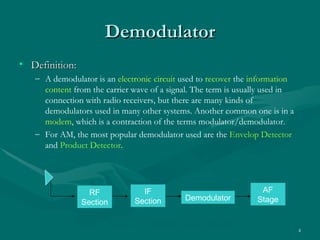
   – A demodulator is an electronic circuit used to recover the information
     content from the carrier wave of a signal. The term is usually used in
     connection with radio receivers, but there are many kinds of
     demodulators used in many other systems. Another common one is in a
     modem, which is a contraction of the terms modulator/demodulator.
   – For AM, the most popular demodulator used are the Envelop Detector
     and Product Detector.


                  RF              IF                             AF
                                Section       Demodulator       Stage
                Section

                          Figure 3.1 Receiver Block Diagram
                                                                              4
AM DEMODULATOR
• Demodulation of DSBFC AM
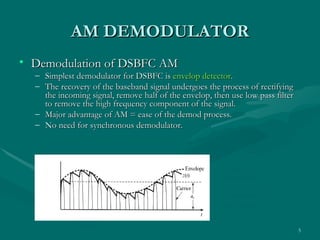
  – Simplest demodulator for DSBFC is envelop detector.
  – The recovery of the baseband signal undergoes the process of rectifying
    the incoming signal, remove half of the envelop, then use low pass filter
    to remove the high frequency component of the signal.
  – Major advantage of AM = ease of the demod process.
  – No need for synchronous demodulator.


                                                        Figure 3.2
                                                        Envelope
                                                        detection of a
                                                        conventional
                                                        AM signal

                                                                                5
AM Demodulation
• Demodulation of SSBSC AM
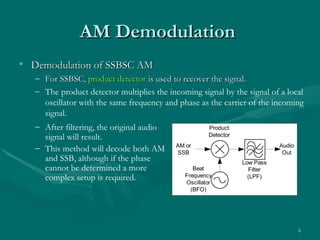
   – For SSBSC, product detector is used to recover the signal.
   – The product detector multiplies the incoming signal by the signal of a local
     oscillator with the same frequency and phase as the carrier of the incoming
     signal.
   – After filtering, the original audio               Product
     signal will result.                              Detector

   – This method will decode both AM AM or SSB
                                                                          Audio
                                                                           Out
     and SSB, although if the phase                            Low Pass
     cannot be determined a more                Beat             Filter
     complex setup is required.              Frequency           (LPF)
                                             Oscillator
                                                (BFO)


                                Figure 3.3 Product Detector for AM and SSB

                                                                               6
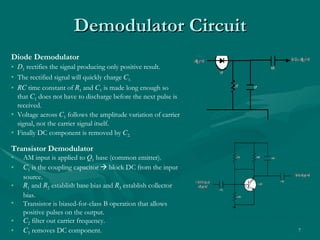
Demodulator Circuit
Diode Demodulator
• D1 rectifies the signal producing only positive result.
• The rectified signal will quickly charge C1.
• RC time constant of R1 and C1 is made long enough so
  that C1 does not have to discharge before the next pulse is
  received.
• Voltage across C1 follows the amplitude variation of carrier
  signal, not the carrier signal itself.
                                                                   Figure 3.4: Diode Demodulator
• Finally DC component is removed by C2.

Transistor Demodulator
•   AM input is applied to Q1 base (common emitter).
•   C1 is the coupling capacitor  block DC from the input
    source.
•   R1 and R2 establish base bias and R3 establish collector
    bias.
•   Transistor is biased-for-class B operation that allows
    positive pulses on the output.
•   C2 filter out carrier frequency.                             Figure 3.5: Transistor Demodulator
•   C3 removes DC component.                                                                  7
AM RECEIVERS


               8
Process in a Receiver
           Antenna


                                                           Speaker

                RF                          Audio
                             Detector
             Amplification                Amplification


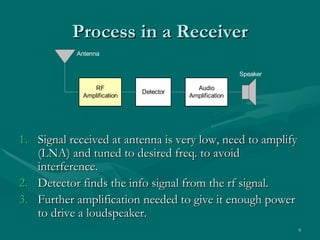
             Fig. 3.6 Simple block diagram of a receiver

1. Signal received at antenna is very low, need to amplify
   (LNA) and tuned to desired freq. to avoid
   interference.
2. Detector finds the info signal from the rf signal.
3. Further amplification needed to give it enough power
   to drive a loudspeaker.
                                                                     9
RECEIVER PARAMETERS
•   Parameters used to evaluate the ability of a receiver to
    successfully demodulate radio signal :-
    –   Selectivity
    –   Sensitivity
    –   Bandwidth Improvement Factor
    –   Dynamic Range
    –   Fidelity
    –   Insertion Loss


                                                           10
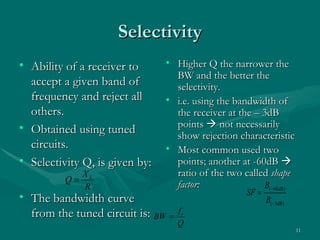
Selectivity
• Ability of a receiver to      • Higher Q the narrower the
                                  BW and the better the
  accept a given band of          selectivity.
  frequency and reject all      • i.e. using the bandwidth of
  others.                         the receiver at the – 3dB
• Obtained using tuned            points  not necessarily
                                  show rejection characteristic
  circuits.                     • Most common used two
• Selectivity Q, is given by:     points; another at -60dB 
               XL                 ratio of the two called shape
          Q=
               R                  factor:               B( − 60 dB )
                                                      SF =
• The bandwidth curve                                        B( − 3dB )
  from the tuned circuit is: BW =   fr
                                    Q
                                                                          11
Example 3.1
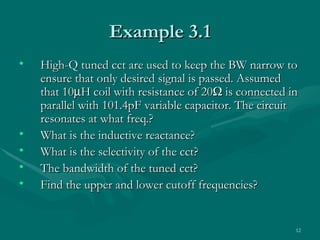
•   High-Q tuned cct are used to keep the BW narrow to
    ensure that only desired signal is passed. Assumed
    that 10µH coil with resistance of 20Ω is connected in
    parallel with 101.4pF variable capacitor. The circuit
    resonates at what freq.?
•   What is the inductive reactance?
•   What is the selectivity of the cct?
•   The bandwidth of the tuned cct?
•   Find the upper and lower cutoff frequencies?


                                                        12
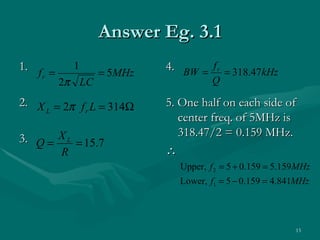
Answer Eg. 3.1
1. f =       1
                 = 5MHz
                          4. BW = f r = 318.47kHz
    r
         2π LC                      Q

2. X = 2π f L = 314Ω      5. One half on each side of
    L      r
                             center freq. of 5MHz is
                             318.47/2 = 0.159 MHz.
3. Q = X L = 15.7
         R                ∴
                            Upper, f 2 = 5 + 0.159 = 5.159 MHz
                            Lower, f1 = 5 − 0.159 = 4.841MHz


                                                          13
Sensitivity
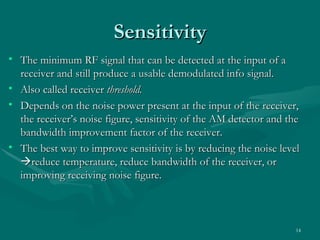
• The minimum RF signal that can be detected at the input of a
  receiver and still produce a usable demodulated info signal.
• Also called receiver threshold.
• Depends on the noise power present at the input of the receiver,
  the receiver’s noise figure, sensitivity of the AM detector and the
  bandwidth improvement factor of the receiver.
• The best way to improve sensitivity is by reducing the noise level
  reduce temperature, reduce bandwidth of the receiver, or
  improving receiving noise figure.


                                                                    14
Bandwidth Improvement Factor
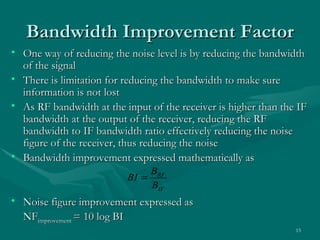
• One way of reducing the noise level is by reducing the bandwidth
  of the signal
• There is limitation for reducing the bandwidth to make sure
  information is not lost
• As RF bandwidth at the input of the receiver is higher than the IF
  bandwidth at the output of the receiver, reducing the RF
  bandwidth to IF bandwidth ratio effectively reducing the noise
  figure of the receiver, thus reducing the noise
• Bandwidth improvement expressed mathematically as
                               BRF
                          BI =
                               BIF
• Noise figure improvement expressed as
  NFimprovement = 10 log BI
                                                                 15
Dynamic Range
• The minimum input level necessary to discern a signal
  and the input that will overdrive the receiver and
  produce distortion.
• Minimum receive level is a function of front-end noise,
  noise figure and the desired signal quality.
• Input that produce distortion is a function of the net
  gain of the receiver.
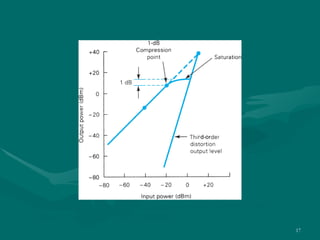
• 1 dB compression point is used for the upper limit for
  usefulness.


                                                        16
FIGURE 3.7 Linear gain, 1-dB compression point, and third-order
intercept distortion for a typical amplifier
                                                                  17
Fidelity
• A measure of the ability of the receiver to
  produce, at the output of the receiver, an exact
  replica of the original source information.
• Any amplitude, frequency or phase variations
  present in the demodulated waveform that are
  not included in the original signal are consider as
  distortion.


                                                    18
Insertion Loss
• Loss occur when a signal enter the input of the
  receiver.
• Parameters associated with the frequencies that
  fall within the passband of a filter.
• Defined as the ratio of the power transferred to
  the load with a filter in the circuit to the power
  transferred to the load without a filter.


                                                       19
Tuned Radio Frequency Receiver
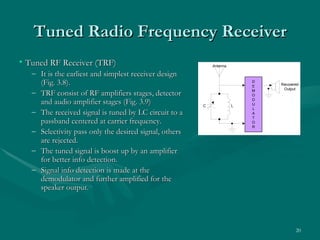
• Tuned RF Receiver (TRF)                                     Antenna

   – It is the earliest and simplest receiver design
     (Fig. 3.8).                                                            D
                                                                            E   Recovered
                                                                                 Output
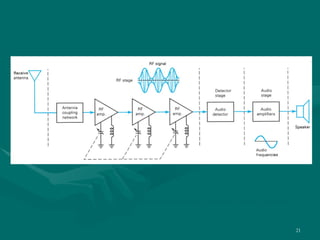
   – TRF consist of RF amplifiers stages, detector                          M
                                                                            O

     and audio amplifier stages (Fig. 3.9)                C             L
                                                                            D
                                                                            U
                                                                            L
   – The received signal is tuned by LC circuit to a                        A
                                                                            T
     passband centered at carrier frequency.                                O
                                                                            R
   – Selectivity pass only the desired signal, others
     are rejected.
                                                        Figure 3.8 Basic TRF receiver
   – The tuned signal is boost up by an amplifier
                                                        block diagram, showing simple
     for better info detection.
                                                        structure.
   – Signal info detection is made at the
     demodulator and further amplified for the
     speaker output.


                                                                                       20
FIGURE 3.9   Noncoherent tuned radio frequency receiver block diagram


                                                                        21
TRF cont…
– TRF has high sensitivity – ability to drive the speaker to an
  acceptable level (to amplify).
– Disadvantages :-
    • BW is inconsistent and varies with center frequency when
      tuned over a wide range of input frequencies  selectivity
      changes, (means the extent to which a rx can differentiate
      between the desired signal and other signal).
    • Instability due to the large number of RF amplifier all tuned to
      the same center frequency  oscillation.
    • Gain is not uniform over a wide range of frequency.


                                                                     22
Superheterodyne Receiver
•       Superhets was designed to overcome the problems in TRF.
•       Complex circuitry compared to TRF but excellent
        performance under many conditions (Fig. 3.10).
•       Heterodyne mean:
    –      to mix 2 frequencies together in a nonlinear device or
    –      to translate one frequency to another using nonlinear device.
•       Superhets concept:
    –      Rx tunes to desired signal and converts the signal to intermediate
           frequency via a signal mixing circuit.
    –      Then IF signal is optimized to fully recovered the modulated info
           signal.


                                                                                23
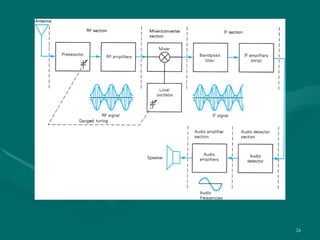
FIGURE 3.10   AM superheterodyne receiver block diagram

                                                          24
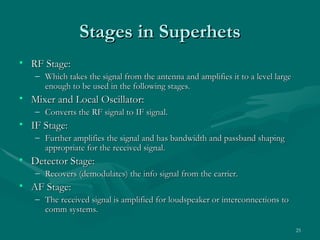
Stages in Superhets
• RF Stage:
   – Which takes the signal from the antenna and amplifies it to a level large
     enough to be used in the following stages.
• Mixer and Local Oscillator:
   – Converts the RF signal to IF signal.
• IF Stage:
   – Further amplifies the signal and has bandwidth and passband shaping
     appropriate for the received signal.
• Detector Stage:
   – Recovers (demodulates) the info signal from the carrier.
• AF Stage:
   – The received signal is amplified for loudspeaker or interconnections to
     comm systems.

                                                                                 25
RF Stage and
Characteristics


                  26
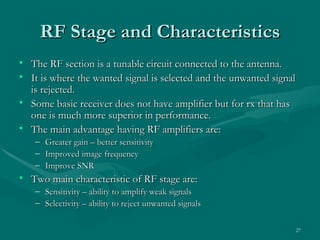
RF Stage and Characteristics
• The RF section is a tunable circuit connected to the antenna.
• It is where the wanted signal is selected and the unwanted signal
  is rejected.
• Some basic receiver does not have amplifier but for rx that has
  one is much more superior in performance.
• The main advantage having RF amplifiers are:
   – Greater gain – better sensitivity
   – Improved image frequency
   – Improve SNR
• Two main characteristic of RF stage are:
   – Sensitivity – ability to amplify weak signals
   – Selectivity – ability to reject unwanted signals


                                                                  27
Path and Frequency
     Changing


                     28
Path & Frequency Changing
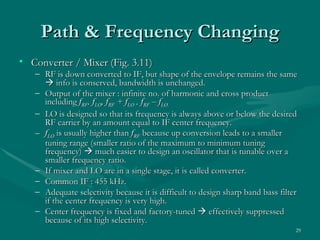
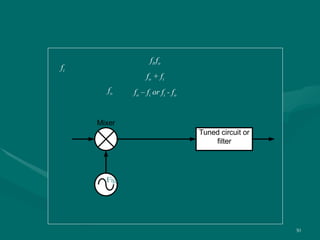
• Converter / Mixer (Fig. 3.11)
   – RF is down converted to IF, but shape of the envelope remains the same
      info is conserved, bandwidth is unchanged.
   – Output of the mixer : infinite no. of harmonic and cross product
     including fRF, fLO, fRF + fLO , fRF – fLO.
   – LO is designed so that its frequency is always above or below the desired
     RF carrier by an amount equal to IF center frequency.
   – fLO is usually higher than fRF because up conversion leads to a smaller
     tuning range (smaller ratio of the maximum to minimum tuning
     frequency)  much easier to design an oscillator that is tunable over a
     smaller frequency ratio.
   – If mixer and LO are in a single stage, it is called converter.
   – Common IF : 455 kHz.
   – Adequate selectivity because it is difficult to design sharp band bass filter
     if the center frequency is very high.
   – Center frequency is fixed and factory-tuned  effectively suppressed
     because of its high selectivity.
                                                                                 29
fi,fo
fi
                    fo + f i
       fo      fo – fi or fi - fo


     Mixer
                                    Tuned circuit or
                                        filter


       Figure 3.11: Mixer input - output


                                                       30
Intermediate Frequency
          &
     IF Amplifiers


                         31
IF & IF Amplifiers
• Intermediate Frequency
   – Sum or difference in the output of a mixer that enters the IF
     stage.
   – A down-converted frequency that carries the information.
• IF amplifiers
   –   One or more stage(s).
   –   Provide most gain and selectivity.
   –   IF is much lower than RF  easier to design and good
       sensitivity is easier to obtain with tuned circuit.


                                                                     32
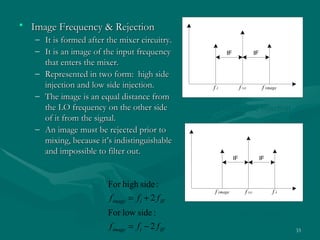
• Image Frequency & Rejection
   – It is formed after the mixer circuitry.
   – It is an image of the input frequency                    IF                  IF
     that enters the mixer.
   – Represented in two form: high side
     injection and low side injection.                  fi              f LO            f image
   – The image is an equal distance from
     the LO frequency on the other side           Fig. 3.12 High-side Injection
     of it from the signal.
   – An image must be rejected prior to
     mixing, because it’s indistinguishable
     and impossible to filter out.
                                                                   IF                  IF


                        For high side :
                                                         f image           f LO              fi
                         f image = f i + 2 f IF
                        For low side :             Fig. 3.13 Low-side Injection
                         f image = f i − 2 f IF                                                   33
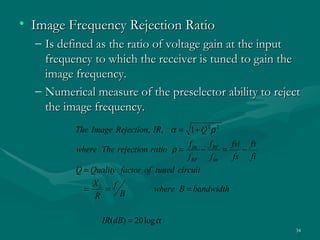
• Image Frequency Rejection Ratio
  – Is defined as the ratio of voltage gain at the input
    frequency to which the receiver is tuned to gain the
    image frequency.
  – Numerical measure of the preselector ability to reject
    the image frequency.
          The Image Rejection, IR, α = 1 + Q 2 ρ 2
                                          f im f RF fsi fs
          where The rejection ratio ρ =       −     =   −
                                          f RF f im   fs fi
          Q = Quality factor of tuned circuit
              X
            = L = f             where B = bandwidth
               R      B


                 IR(dB) = 20 log α
                                                              34
Example 3.2
Determine the image frequency for a standard broadcast band receiver
using 455-kHz IF and tuned to station at 620 kHz.

The first is determine the frequency of the LO
The LO frequency minus the desired station’s frequency of 620 kHz should equal the
IF of 455 KHz
Hence,
    fLO – 620 kHz = 455 kHz
    fLO = 620 KHz + 455 kHz
    fLO = 1075 kHz
Now determine what other frequency, when mixed with 1075 kHz, yields an output
component at 455 kHz
    X – 1075 kHz = 455 kHz
    X = 1075 kHz + 455 kHz
    X = 1530 kHz
Thus, 1530 is the image frequency in this situation. To solve the problem associated
with image frequency, sometimes a technique known as double conversion is
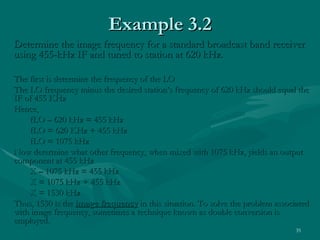
employed.
                                                                                35
Detector And Automatic
    Gain Controller


                         36
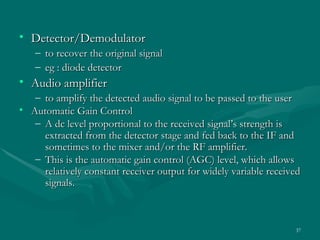
• Detector/Demodulator
   –   to recover the original signal
   –   eg : diode detector
• Audio amplifier
   – to amplify the detected audio signal to be passed to the user
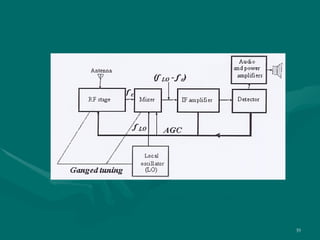
• Automatic Gain Control
   – A dc level proportional to the received signal’s strength is
     extracted from the detector stage and fed back to the IF and
     sometimes to the mixer and/or the RF amplifier.

   – This is the automatic gain control (AGC) level, which allows
     relatively constant receiver output for widely variable received
     signals.


                                                                   37
Cont..
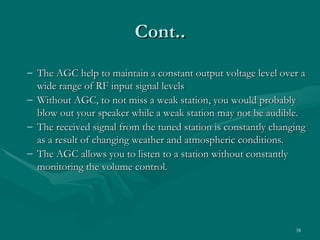
– The AGC help to maintain a constant output voltage level over a
  wide range of RF input signal levels
– Without AGC, to not miss a weak station, you would probably
  blow out your speaker while a weak station may not be audible.
– The received signal from the tuned station is constantly changing
  as a result of changing weather and atmospheric conditions.
– The AGC allows you to listen to a station without constantly
  monitoring the volume control.


                                                                38
Figure 3.14 Automatic Gain Control


                                     39

Chapter 3 am receivers

  • 1.
  • 2.
    Topics • AM Demodulators • Tuned Radio Frequency Receivers • Superheterodyne Receivers • RF Section and Characteristics • Path and Frequency Changing • Intermediate Frequency (IF) & IF Amplifier • Detector and Automatic Gain Control (AGC) 2
  • 3.
  • 4.
    Demodulator • Definition: – A demodulator is an electronic circuit used to recover the information content from the carrier wave of a signal. The term is usually used in connection with radio receivers, but there are many kinds of demodulators used in many other systems. Another common one is in a modem, which is a contraction of the terms modulator/demodulator. – For AM, the most popular demodulator used are the Envelop Detector and Product Detector. RF IF AF Section Demodulator Stage Section Figure 3.1 Receiver Block Diagram 4
  • 5.
    AM DEMODULATOR • Demodulationof DSBFC AM – Simplest demodulator for DSBFC is envelop detector. – The recovery of the baseband signal undergoes the process of rectifying the incoming signal, remove half of the envelop, then use low pass filter to remove the high frequency component of the signal. – Major advantage of AM = ease of the demod process. – No need for synchronous demodulator. Figure 3.2 Envelope detection of a conventional AM signal 5
  • 6.
    AM Demodulation • Demodulationof SSBSC AM – For SSBSC, product detector is used to recover the signal. – The product detector multiplies the incoming signal by the signal of a local oscillator with the same frequency and phase as the carrier of the incoming signal. – After filtering, the original audio Product signal will result. Detector – This method will decode both AM AM or SSB Audio Out and SSB, although if the phase Low Pass cannot be determined a more Beat Filter complex setup is required. Frequency (LPF) Oscillator (BFO) Figure 3.3 Product Detector for AM and SSB 6
  • 7.
    Demodulator Circuit Diode Demodulator •D1 rectifies the signal producing only positive result. • The rectified signal will quickly charge C1. • RC time constant of R1 and C1 is made long enough so that C1 does not have to discharge before the next pulse is received. • Voltage across C1 follows the amplitude variation of carrier signal, not the carrier signal itself. Figure 3.4: Diode Demodulator • Finally DC component is removed by C2. Transistor Demodulator • AM input is applied to Q1 base (common emitter). • C1 is the coupling capacitor  block DC from the input source. • R1 and R2 establish base bias and R3 establish collector bias. • Transistor is biased-for-class B operation that allows positive pulses on the output. • C2 filter out carrier frequency. Figure 3.5: Transistor Demodulator • C3 removes DC component. 7
  • 8.
  • 9.
    Process in aReceiver Antenna Speaker RF Audio Detector Amplification Amplification Fig. 3.6 Simple block diagram of a receiver 1. Signal received at antenna is very low, need to amplify (LNA) and tuned to desired freq. to avoid interference. 2. Detector finds the info signal from the rf signal. 3. Further amplification needed to give it enough power to drive a loudspeaker. 9
  • 10.
    RECEIVER PARAMETERS • Parameters used to evaluate the ability of a receiver to successfully demodulate radio signal :- – Selectivity – Sensitivity – Bandwidth Improvement Factor – Dynamic Range – Fidelity – Insertion Loss 10
  • 11.
    Selectivity • Ability ofa receiver to • Higher Q the narrower the BW and the better the accept a given band of selectivity. frequency and reject all • i.e. using the bandwidth of others. the receiver at the – 3dB • Obtained using tuned points  not necessarily show rejection characteristic circuits. • Most common used two • Selectivity Q, is given by: points; another at -60dB  XL ratio of the two called shape Q= R factor: B( − 60 dB ) SF = • The bandwidth curve B( − 3dB ) from the tuned circuit is: BW = fr Q 11
  • 12.
    Example 3.1 • High-Q tuned cct are used to keep the BW narrow to ensure that only desired signal is passed. Assumed that 10µH coil with resistance of 20Ω is connected in parallel with 101.4pF variable capacitor. The circuit resonates at what freq.? • What is the inductive reactance? • What is the selectivity of the cct? • The bandwidth of the tuned cct? • Find the upper and lower cutoff frequencies? 12
  • 13.
    Answer Eg. 3.1 1.f = 1 = 5MHz 4. BW = f r = 318.47kHz r 2π LC Q 2. X = 2π f L = 314Ω 5. One half on each side of L r center freq. of 5MHz is 318.47/2 = 0.159 MHz. 3. Q = X L = 15.7 R ∴ Upper, f 2 = 5 + 0.159 = 5.159 MHz Lower, f1 = 5 − 0.159 = 4.841MHz 13
  • 14.
    Sensitivity • The minimumRF signal that can be detected at the input of a receiver and still produce a usable demodulated info signal. • Also called receiver threshold. • Depends on the noise power present at the input of the receiver, the receiver’s noise figure, sensitivity of the AM detector and the bandwidth improvement factor of the receiver. • The best way to improve sensitivity is by reducing the noise level reduce temperature, reduce bandwidth of the receiver, or improving receiving noise figure. 14
  • 15.
    Bandwidth Improvement Factor •One way of reducing the noise level is by reducing the bandwidth of the signal • There is limitation for reducing the bandwidth to make sure information is not lost • As RF bandwidth at the input of the receiver is higher than the IF bandwidth at the output of the receiver, reducing the RF bandwidth to IF bandwidth ratio effectively reducing the noise figure of the receiver, thus reducing the noise • Bandwidth improvement expressed mathematically as BRF BI = BIF • Noise figure improvement expressed as NFimprovement = 10 log BI 15
  • 16.
    Dynamic Range • Theminimum input level necessary to discern a signal and the input that will overdrive the receiver and produce distortion. • Minimum receive level is a function of front-end noise, noise figure and the desired signal quality. • Input that produce distortion is a function of the net gain of the receiver. • 1 dB compression point is used for the upper limit for usefulness. 16
  • 17.
    FIGURE 3.7 Lineargain, 1-dB compression point, and third-order intercept distortion for a typical amplifier 17
  • 18.
    Fidelity • A measureof the ability of the receiver to produce, at the output of the receiver, an exact replica of the original source information. • Any amplitude, frequency or phase variations present in the demodulated waveform that are not included in the original signal are consider as distortion. 18
  • 19.
    Insertion Loss • Lossoccur when a signal enter the input of the receiver. • Parameters associated with the frequencies that fall within the passband of a filter. • Defined as the ratio of the power transferred to the load with a filter in the circuit to the power transferred to the load without a filter. 19
  • 20.
    Tuned Radio FrequencyReceiver • Tuned RF Receiver (TRF) Antenna – It is the earliest and simplest receiver design (Fig. 3.8). D E Recovered Output – TRF consist of RF amplifiers stages, detector M O and audio amplifier stages (Fig. 3.9) C L D U L – The received signal is tuned by LC circuit to a A T passband centered at carrier frequency. O R – Selectivity pass only the desired signal, others are rejected. Figure 3.8 Basic TRF receiver – The tuned signal is boost up by an amplifier block diagram, showing simple for better info detection. structure. – Signal info detection is made at the demodulator and further amplified for the speaker output. 20
  • 21.
    FIGURE 3.9 Noncoherent tuned radio frequency receiver block diagram 21
  • 22.
    TRF cont… – TRFhas high sensitivity – ability to drive the speaker to an acceptable level (to amplify). – Disadvantages :- • BW is inconsistent and varies with center frequency when tuned over a wide range of input frequencies  selectivity changes, (means the extent to which a rx can differentiate between the desired signal and other signal). • Instability due to the large number of RF amplifier all tuned to the same center frequency  oscillation. • Gain is not uniform over a wide range of frequency. 22
  • 23.
    Superheterodyne Receiver • Superhets was designed to overcome the problems in TRF. • Complex circuitry compared to TRF but excellent performance under many conditions (Fig. 3.10). • Heterodyne mean: – to mix 2 frequencies together in a nonlinear device or – to translate one frequency to another using nonlinear device. • Superhets concept: – Rx tunes to desired signal and converts the signal to intermediate frequency via a signal mixing circuit. – Then IF signal is optimized to fully recovered the modulated info signal. 23
  • 24.
    FIGURE 3.10 AM superheterodyne receiver block diagram 24
  • 25.
    Stages in Superhets •RF Stage: – Which takes the signal from the antenna and amplifies it to a level large enough to be used in the following stages. • Mixer and Local Oscillator: – Converts the RF signal to IF signal. • IF Stage: – Further amplifies the signal and has bandwidth and passband shaping appropriate for the received signal. • Detector Stage: – Recovers (demodulates) the info signal from the carrier. • AF Stage: – The received signal is amplified for loudspeaker or interconnections to comm systems. 25
  • 26.
  • 27.
    RF Stage andCharacteristics • The RF section is a tunable circuit connected to the antenna. • It is where the wanted signal is selected and the unwanted signal is rejected. • Some basic receiver does not have amplifier but for rx that has one is much more superior in performance. • The main advantage having RF amplifiers are: – Greater gain – better sensitivity – Improved image frequency – Improve SNR • Two main characteristic of RF stage are: – Sensitivity – ability to amplify weak signals – Selectivity – ability to reject unwanted signals 27
  • 28.
  • 29.
    Path & FrequencyChanging • Converter / Mixer (Fig. 3.11) – RF is down converted to IF, but shape of the envelope remains the same  info is conserved, bandwidth is unchanged. – Output of the mixer : infinite no. of harmonic and cross product including fRF, fLO, fRF + fLO , fRF – fLO. – LO is designed so that its frequency is always above or below the desired RF carrier by an amount equal to IF center frequency. – fLO is usually higher than fRF because up conversion leads to a smaller tuning range (smaller ratio of the maximum to minimum tuning frequency)  much easier to design an oscillator that is tunable over a smaller frequency ratio. – If mixer and LO are in a single stage, it is called converter. – Common IF : 455 kHz. – Adequate selectivity because it is difficult to design sharp band bass filter if the center frequency is very high. – Center frequency is fixed and factory-tuned  effectively suppressed because of its high selectivity. 29
  • 30.
    fi,fo fi fo + f i fo fo – fi or fi - fo Mixer Tuned circuit or filter Figure 3.11: Mixer input - output 30
  • 31.
    Intermediate Frequency & IF Amplifiers 31
  • 32.
    IF & IFAmplifiers • Intermediate Frequency – Sum or difference in the output of a mixer that enters the IF stage. – A down-converted frequency that carries the information. • IF amplifiers – One or more stage(s). – Provide most gain and selectivity. – IF is much lower than RF  easier to design and good sensitivity is easier to obtain with tuned circuit. 32
  • 33.
    • Image Frequency& Rejection – It is formed after the mixer circuitry. – It is an image of the input frequency IF IF that enters the mixer. – Represented in two form: high side injection and low side injection. fi f LO f image – The image is an equal distance from the LO frequency on the other side Fig. 3.12 High-side Injection of it from the signal. – An image must be rejected prior to mixing, because it’s indistinguishable and impossible to filter out. IF IF For high side : f image f LO fi f image = f i + 2 f IF For low side : Fig. 3.13 Low-side Injection f image = f i − 2 f IF 33
  • 34.
    • Image FrequencyRejection Ratio – Is defined as the ratio of voltage gain at the input frequency to which the receiver is tuned to gain the image frequency. – Numerical measure of the preselector ability to reject the image frequency. The Image Rejection, IR, α = 1 + Q 2 ρ 2 f im f RF fsi fs where The rejection ratio ρ = − = − f RF f im fs fi Q = Quality factor of tuned circuit X = L = f where B = bandwidth R B IR(dB) = 20 log α 34
  • 35.
    Example 3.2 Determine theimage frequency for a standard broadcast band receiver using 455-kHz IF and tuned to station at 620 kHz. The first is determine the frequency of the LO The LO frequency minus the desired station’s frequency of 620 kHz should equal the IF of 455 KHz Hence, fLO – 620 kHz = 455 kHz fLO = 620 KHz + 455 kHz fLO = 1075 kHz Now determine what other frequency, when mixed with 1075 kHz, yields an output component at 455 kHz X – 1075 kHz = 455 kHz X = 1075 kHz + 455 kHz X = 1530 kHz Thus, 1530 is the image frequency in this situation. To solve the problem associated with image frequency, sometimes a technique known as double conversion is employed. 35
  • 36.
    Detector And Automatic Gain Controller 36
  • 37.
    • Detector/Demodulator – to recover the original signal – eg : diode detector • Audio amplifier – to amplify the detected audio signal to be passed to the user • Automatic Gain Control – A dc level proportional to the received signal’s strength is extracted from the detector stage and fed back to the IF and sometimes to the mixer and/or the RF amplifier. – This is the automatic gain control (AGC) level, which allows relatively constant receiver output for widely variable received signals. 37
  • 38.
    Cont.. – The AGChelp to maintain a constant output voltage level over a wide range of RF input signal levels – Without AGC, to not miss a weak station, you would probably blow out your speaker while a weak station may not be audible. – The received signal from the tuned station is constantly changing as a result of changing weather and atmospheric conditions. – The AGC allows you to listen to a station without constantly monitoring the volume control. 38
  • 39.
    Figure 3.14 AutomaticGain Control 39